








Executive Overview
Danish shipping and logistics operator DFDS has formally launched a group-wide strategic review to redefine its long-term corporate vision, market positioning, and financial priorities. The initiative comes alongside the release of the company’s second-quarter 2026 financial results, which demonstrated a marked operational recovery across both its core maritime and land-based logistics divisions.
Despite achieving double-digit top-line growth and a substantial expansion in operating earnings during the quarter, leadership has issued a clear directive: current returns remain inadequate relative to the company’s structural potential and capital deployed. Chief Executive Officer Michael Hansen noted that while DFDS maintains robust competitive positions across its primary European and regional transport corridors, underlying profitability is "far from where it should be."
+-----------------------------------------------------------------------------------+
|                           Q2 2026 FINANCIAL SNAPSHOT                              |
+----------------------+------------------+-------------------+---------------------+
| Metric               | Q2 2026 Reported | YoY Change / Delta| FY 2026 Outlook     |
+----------------------+------------------+-------------------+---------------------+
| Revenue              | DKK 8.6 Billion  | +10.0%            | 3.0% – 5.0% Growth  |
| EBIT                 | DKK 454 Million  | +DKK 291 Million  | DKK 1.2 – 1.4 Billion|
| Adj. Free Cash Flow  | DKK 728 Million  | Significant Growth| ~DKK 500 Million    |
| Leverage Ratio       | 3.4x NIBD/EBITDA | Sequentially Lower| Continuous Target   |
| CO2e Emission Intensity| Network Wide   | +2.0% Intensity   | Decarbonization TBD |
+----------------------+------------------+-------------------+---------------------+
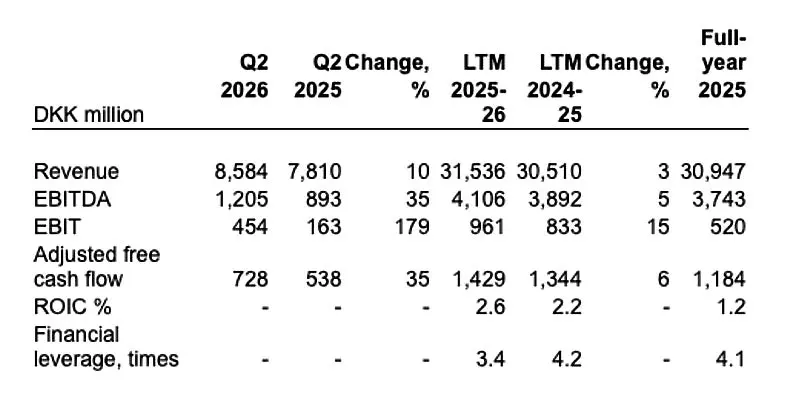
During Q2 2026, DFDS recorded a 10% year-over-year increase in total revenue, reaching DKK 8.6 billion. Earnings before interest and taxes (EBIT) saw an upward swing, expanding by DKK 291 million to stand at DKK 454 million. This rebound was fueled by dual earnings expansion within both the Ferry Division and the Logistics Division, reflecting improved freight volume management, disciplined cost control, and stronger passenger activity compared to the baseline set in Q2 2025.
Concurrently, liquidity and balance sheet fundamentals showed positive momentum. Adjusted free cash flow for the quarter surged to DKK 728 million, facilitating a reduction in corporate indebtedness and easing financial leverage to 3.4x Net Interest-Bearing Debt relative to EBITDA (NIBD/EBITDA). Leveraging these gains, executive management narrowed and upgraded its full-year 2026 guidance, lifting the lower bound of its profit forecast.
However, the quarter’s performance was tempered by ESG metrics: overall CO2e emission intensity across the global network rose by 2.0%. As regulatory scrutiny around maritime carbon footprints intensifies across Europe, addressing operational efficiency alongside emissions intensity will be a core focal point of the newly launched six-month review.
Detailed Chronology
+------------------------------------------------------------------------------------+
|                         CHRONOLOGY OF RECENT DEVELOPMENTS                          |
+------------------------------------------------------------------------------------+
|  Q2 2025             • Cyclical troughs and operational margin compression         |
|                      • Capital expenditure allocation under investor review        |
|                                                                                    |
|  Q1–Q2 2026          • Implementation of operational efficiency programs          |
|                      • Rebound in freight movement and cross-border transport      |
|                                                                                    |
|  Q2 2026 (Reporting) • Revenue hits DKK 8.6bn (+10% YoY); EBIT rebounds to DKK 454m|
|                      • Leverage reduced to 3.4x NIBD/EBITDA                        |
|                      • CEO Michael Hansen announces 6-month Strategic Review       |
|                      • Full-year 2026 EBIT guidance upgraded to DKK 1.2bn–1.4bn    |
|                                                                                    |
|  Late 2026 / Early 2027 • Scheduled conclusion of Strategic Review                 |
|                         • Unveiling of long-term targets, capital, and ESG roadmap |
+------------------------------------------------------------------------------------+
Comparative Performance: Q2 2025 to Q2 2026 Transition
The second quarter of 2025 served as a period of earnings baseline adjustment for DFDS, characterized by persistent operational margin compression, broader European macroeconomic sluggishness, and fluctuating fuel spreads. Over the subsequent four quarters, the corporate focus shifted toward route rationalization, tighter contract pricing in logistics networks, and operational cost management.
By the commencement of the second quarter of 2026, these measures bore tangible fruit. Revenue expanded systematically across regional corridors, driven by sustained customer demand in key North Sea, Mediterranean, and English Channel ferry routes, alongside enhanced contract fulfillment within land-based European logistics.

Operational Developments and Quarter Highlights
Throughout Q2 2026, the company recorded progress across major financial metrics:
- Top-Line Expansion: Revenue reached DKK 8.6 billion, up 10% over Q2 2025, driven by improved yield management and rising cargo unit volumes.
- Operating Profit Growth: Operating profit (EBIT) reached DKK 454 million, representing an absolute increase of DKK 291 million compared to the prior-year period.
- Cash Generation Surge: Free cash flow (adjusted) reached DKK 728 million, supported by improved working capital cycles and timing of operational expenditures.
- Deleveraging Steps: Balance sheet leverage fell to 3.4x NIBD/EBITDA, marking progress in the corporate capital management plan.
Launch of the 2026 Strategic Review
Simultaneously with the Q2 reporting, management announced the immediate initiation of a comprehensive group strategic review. Led by CEO Michael Hansen and supported by executive division heads, the evaluation process is structured to run over a six-month window. The timeline positions the conclusion of the review for late 2026 or early 2027, at which point DFDS intends to present an updated financial frame, revised long-term return targets, and an updated structural growth strategy to equity and debt markets.
Supporting Context & Metrics
Financial Segment Analysis: Ferry vs. Logistics Divisions
The operational rebound in Q2 2026 was broad-based, with both core operational divisions contributing to the bottom-line improvement.
                  +----------------------------------------+
                  |         DFDS Q2 2026 EBIT REBOUND      |
                  +----------------------------------------+
                  |  Ferry Division   | Increased YoY      |
                  |  Logistics Div.   | Increased YoY      |
                  |  Group EBIT       | DKK 454m (+DKK291m)|
                  +----------------------------------------+
The Ferry Division
The Ferry Division—comprising freight shipping (Ro-Ro and Ro-Pax networks) and passenger operations—benefited from stabilized volume growth across northern European and Mediterranean trade routes. Increased capacity utilization on long-haul routes offset localized competitive pressure on short-sea routes. Crucially, freight yields were maintained despite volatile regional trade flows, while passenger travel metrics sustained momentum heading into the peak summer season.
The Logistics Division
The Logistics Division—which covers door-to-door transport, cold chain solutions, and contract logistics—achieved operating margin expansion through network integration and route optimization. Previous strategic investments aimed at building end-to-end supply chain infrastructure paid dividends, enabling the segment to capture cross-selling opportunities across its customer base.
Capital Allocation and Leverage Dynamics
Maintaining financial agility remains central to DFDS’s risk management strategy, particularly given its elevated leverage metrics in recent periods.
- Free Cash Flow Expansion: Generating DKK 728 million in adjusted free cash flow during Q2 provided executive leadership with increased capital allocation flexibility.
- Leverage Improvement: Net Interest-Bearing Debt relative to EBITDA dropped to 3.4x. While this represents progress, leadership maintains that structural leverage must be aligned with overall target levels to shield the balance sheet against prospective cyclical turns in shipping markets.
+-----------------------------------------------------------------------------------+
|                        FINANCIAL INDICATORS & GUIDANCE LIFT                       |
+----------------------------------+-----------------------+------------------------+
| Financial Metric                 | Q2 2026 Result        | FY 2026 Outlook        |
+----------------------------------+-----------------------+------------------------+
| Top-line Growth Rate             | +10.0% YoY            | 3.0% – 5.0%            |
| Group EBIT                       | DKK 454 Million       | DKK 1.2bn – 1.4bn      |
| Adjusted Free Cash Flow          | DKK 728 Million       | ~DKK 500 Million       |
| Net Debt Ratio (NIBD/EBITDA)     | 3.4x                  | Ongoing Deleveraging   |
+----------------------------------+-----------------------+------------------------+
Environmental Performance and Decarbonization Pressures
Amidst financial recovery, DFDS faces operational challenges regarding greenhouse gas abatement. During Q2 2026, the group recorded a 2.0% increase in CO2e emission intensity across its combined network.
   [ Network CO2e Intensity Trend ]
   Q2 2025 Baseline ------> Q2 2026 Result (+2.0% Intensity Increase)
   Factors: Vessel deployment shifts, speed profiles, capacity mix, route integration
This uptick highlights the operational complexities of balancing fleet utilization with environmental goals. Factors contributing to the intensity surge include shifting vessel deployment configurations, altered speed profiles to accommodate supply chain schedules, and route mix changes following network realignments.
Given expanding regulatory mandates—including the European Union’s Emissions Trading System (EU ETS) for maritime transport and FuelEU Maritime standards—reversing this trajectory will form a mandatory workstream within the newly established strategic review.
Official Statements
Addressing the core challenge facing the company, Chief Executive Officer Michael Hansen provided a direct assessment of DFDS’s position, highlighting the gap between market footprint and financial returns.
"We have launched a strategy review to clarify our long-term vision, positioning, and priorities. While DFDS is well positioned across most of its core markets, our underlying financial performance remains far from where it should be. Enhancing profitability and capital efficiency is our imperative."
— Michael Hansen, CEO of DFDS
+-----------------------------------------------------------------------------------+
|                            EXECUTIVE PRIORITIES SUMMARY                           |
+-----------------------------------------------------------------------------------+
|  1. Profitability Realignment : Elevate group margins to reflect market position  |
|  2. Portfolio Optimization    : Re-assess asset allocation and underperforming routes|
|  3. Capital Discipline        : Continuous reduction of debt leverage (3.4x target)  |
|  4. Decarbonization Roadmap   : Neutralize the +2.0% CO2e intensity increase       |
+-----------------------------------------------------------------------------------+
Hansen’s framing underscores a willingness by the executive team to question long-standing operational assumptions. Market analysts view the CEO’s candid evaluation as an explicit signal that the upcoming review will not merely be an incremental plan, but rather an active structural review.
Key operational focus areas highlighted by management include:
- Capital Return Targets: Restructuring business units that consistently fail to cover their cost of capital (ROIC).
- Structural Cost Frameworks: Eliminating redundancies created during recent strategic acquisitions across European logistics markets.
- Fleet Modernization: Balancing upcoming capital expenditures for green vessels against mandatory deleveraging targets.
Future Outlook
Revised Full-Year 2026 Financial Guidance
On the back of its stronger-than-expected Q2 2026 output, DFDS updated its outlook for the full financial year:
- Revenue Growth: Projected to land between 3.0% and 5.0% year-over-year.
- Operating Profit (EBIT): Narrowed upwards to between DKK 1.2 billion and DKK 1.4 billion (previously set across a broader, lower range).
- Adjusted Free Cash Flow: Anticipated to settle at approximately DKK 500 million, reflecting continued investment in fleet maintenance and logistics integration in the second half of the year.
+-----------------------------------------------------------------------------------+
|                         FULL-YEAR 2026 GUIDANCE ANALYSIS                          |
+-----------------------------------------------------------------------------------+
| Revenue Growth Target  : [ 3.0% ========================= 5.0% ]                  |
| Group EBIT Target      : [ DKK 1.2bn ==================== DKK 1.4bn ]             |
| Free Cash Flow Target  : [ ~DKK 500m Expected ]                                   |
+-----------------------------------------------------------------------------------+
Strategic Horizon: The Six-Month Transformation Window
The strategic review launched in Q2 2026 will serve as the guiding strategic framework for DFDS over the coming quarters. Scheduled for completion within six months, the outcome of this assessment will shape the company’s trajectory through the end of the decade.
Key Review Pillars
- Network Rationalization: Evaluating freight and passenger route profitability to streamline vessel assets and optimize scheduling dynamics.
- Logistics Synergies: Deeper structural integration of door-to-door freight acquisitions to generate sustainable operating margins rather than non-integrated top-line volume.
- Balance Sheet Restructuring: Pathways to accelerate net debt reduction, target long-term leverage thresholds below 3.4x NIBD/EBITDA, and preserve credit capacity.
- Decarbonization Alignment: Establishing operational pathways to correct the 2.0% emission intensity increase, aligning vessel transition capital spend with evolving environmental compliance obligations.
By pairing immediate guidance upgrades with a long-term strategic review, DFDS seeks to construct a operational platform capable of converting market presence into sustained shareholder value.
The full Q2 2026 interim report and investor presentation can be accessed via the official corporate investor relations portal:
DFDS Q2 2026 Interim Report