








Executive Overview
For decades, urban planners and traffic engineers focused heavily on vehicle throughput, lane widths, and high-tech signaling systems to manage the complex ecosystem of modern roadways. Yet, amidst these macro-level interventions, a quiet yet profoundly lethal hazard routinely went unaddressed: the curb space immediately adjacent to intersections. For generations, drivers seeking a place to park were permitted to squeeze their vehicles right up to the crosswalk boundary. This practice routinely created opaque visual barriers that obscured both pedestrians waiting to cross and motorists navigating turns.
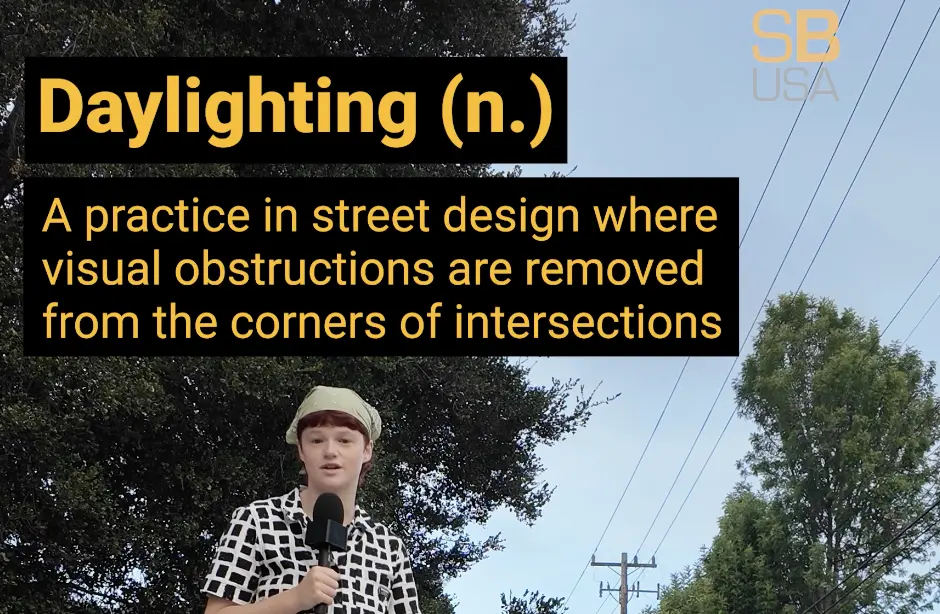
Today, this long-overlooked vulnerability is finally taking center stage in the national discourse on urban mobility. The strategy is known as "daylighting"—the deliberate restriction of motor vehicle parking closest to intersections. By eliminating parked cars from these critical transition zones, cities clear the lines of sight between pedestrians and drivers, fundamentally altering the safety dynamics of urban street corners.
While the concept has historically been an obscure tool in the urban designer’s kit, it received a massive legislative boost when California legalized its statewide enforcement under Assembly Bill 413. This regulatory shift has catalyzed a broader movement across the United States. With approximately one in every four pedestrian fatalities occurring within an intersection—frequently driven by motorists failing to yield while rolling through occupied crosswalks—daylighting is emerging not merely as an aesthetic or parking management choice, but as a critical, life-saving public health intervention. This report examines the mechanics of daylighting, its regulatory evolution, the data underpinning its efficacy, and the future outlook for pedestrian safety across American cities.
Detailed Chronology: From Obscure Design Principle to Statewide Mandate
To understand how daylighting reached the forefront of contemporary transportation policy, it is necessary to trace its journey from a localized, grassroots urban design theory to a codified legal requirement.
Early Roots and the Visibility Crisis
Long before the term "daylighting" became a common fixture in transportation lexicon, traffic safety advocates recognized the inherent danger of "sight-triangle obstructions." In the mid-20th century, as automobile adoption skyrocketed, municipalities prioritized maximum parking capacity to appease commercial districts and motorists. Curbsides were monetized or made freely available right up to the corner radii.
However, as urban planning evolved toward human-centric design in the late 1990s and early 2000s, safety auditors noticed a recurring pattern in intersection-related collisions. Time and again, police reports and collision reconstructions pointed to a fundamental failure of visibility: a driver executing a right or left turn simply could not see a pedestrian—particularly children, wheelchair users, or individuals of shorter stature—because a parked SUV or van blocked their line of sight until it was too late to brake.
The Tactical Urbanism Movement
During the 2010s, frustration with bureaucratic inertia led to the rise of tactical urbanism. Grassroots advocacy groups, frustrated by the slow pace of municipal safety overhauls, began taking matters into their own hands. Utilizing low-cost, temporary materials—such as brightly colored paint, chalk, traffic cones, and flexible delineators—activists surreptitiously or semi-officially "painted the asphalt" to reclaim intersection space from parked cars.
These DIY interventions served a dual purpose. First, they physically forced vehicles away from the crosswalks. Second, they provided municipalities with real-world, before-and-after data demonstrating that clearing the corners did not cause catastrophic parking shortages, but rather led to immediate, measurable reductions in vehicle speeds and near-misses.
Institutional Adoption and the California Watershed
As tactical experiments gained traction, progressive cities began formalizing daylighting into their local engineering guidelines. Hoboken, New Jersey, famously emerged as a national leader by systematically installing physical daylighting (often reinforced with vertical delineators and planters) at intersections across the city, resulting in a staggering multi-year streak of zero traffic fatalities.
Despite these localized successes, widespread adoption remained hamptons-to-hinterlands patchy. Many states maintained antiquated motor vehicle codes that technically prohibited parking "too close" to a crosswalk or fire hydrant, but these laws were rarely enforced uniformly, and drivers routinely ignored them.
The paradigm shifted dramatically when the California State Legislature took up the mantle. Through the passage and signing of Assembly Bill 413 (AB 413), California became a trailblazer by legalizing and mandating the enforcement of daylighting statewide. The law prohibited parking within 20 feet of the vehicle approach side of any crosswalk, whether marked or unmarked, even in the absence of red curbs or signage. This monumental legislative act transformed daylighting from an optional municipal design guideline into an enforceable rule of the road, setting a powerful precedent for other states grappling with rising pedestrian mortality rates.
Supporting Context & Metrics: The Anatomy of Intersection Danger
The urgency behind the daylighting movement is anchored in sobering empirical data regarding pedestrian safety in the United States. Over the past decade, American roadways have grown increasingly perilous for those outside of motor vehicles, even as vehicle safety features for occupants have improved exponentially.
The Grim Statistics of Intersection Fatalities
According to comprehensive data compiled by the Insurance Institute for Highway Safety (IIHS) and federal transportation agencies, approximately one in every four pedestrian fatalities occurs within an intersection. These locations represent the most complex conflict zones in the transportation network, where turning vehicles, crossing pedestrians, cyclists, and through-traffic converge simultaneously.
+-------------------------------------------------------------+
|         Pedestrian Fatalities by Location (Approximate)     |
+-------------------------------------------------------------+
| Intersections      | [████████████████████] ~25%            |
| Mid-Block / Other  | [██████████████████████████████] ~75%  |
+-------------------------------------------------------------+
A significant percentage of these intersection casualties occur because of "rolling turns"—a maneuver where drivers slow down, look exclusively for oncoming vehicular traffic to find a gap, and accelerate through the turn without ever fully scanning the crosswalk for foot traffic. When a parked vehicle is positioned directly adjacent to the crosswalk, it creates a visual screen. A driver executing a turn must pull past the line of the parked car to see down the crosswalk, effectively placing the front of their vehicle into the pedestrian path before they possess an unobstructed line of sight.
How Daylighting Solves the Visual Obstruction Problem
Daylighting attacks this problem at its root by engineering the physical environment to eliminate ambiguity. By removing parking spaces within 15 to 25 feet of an intersection, cities achieve several immediate safety benefits:
- Expanded Sight Lines: Drivers approaching a turn can see pedestrians waiting to cross from a greater distance, allowing adequate reaction and stopping time.
- Pedestrian Visibility: Pedestrians—particularly children and wheelchair users who might otherwise be completely obscured by a large pickup truck or SUV—become visible to turning motorists well before stepping into the roadway.
- Reduced Turning Speeds: The physical widening of the visual corridor, often paired with bulb-outs or curb extensions, naturally signals to drivers that they are entering a pedestrian-dense environment, encouraging slower, more cautious turning speeds.
- Shorter Crossing Distances: When combined with curb extensions (bulb-outs), daylighting physically shortens the total distance a pedestrian must spend exposed to moving traffic within the crosswalk.
Official Statements and Policy Perspectives
The acceleration of daylighting initiatives has sparked robust dialogue among urban planners, elected officials, legislative advocates, and law enforcement agencies.
Proponents of statewide mandates, such as the authors and sponsors of California’s AB 413, argue that uniform rules are essential to eliminate driver confusion. During the legislative debate, advocates emphasized that relying on a patchwork of municipal ordinances creates an environment where drivers from out of town—or even neighboring suburbs—unwittingly violate local parking restrictions or, worse, endanger pedestrians due to unfamiliarity with localized striping.
"For too long, our street design has prioritized the storage of private metal boxes over the basic human right of safe passage," noted one urban mobility advocate during the legislative hearings. "When a child is struck in a crosswalk because a parked SUV blocked the driver’s view, that is not an unavoidable accident; it is a design failure. Daylighting fixes that failure by restoring basic human visibility to our intersections."
Conversely, municipal parking administrators and local business associations have historically expressed nuanced concerns regarding the implementation of daylighting. The primary friction point centers on the loss of curb space. In dense commercial corridors and residential neighborhoods alike, parking is often perceived as a scarce and fiercely contested commodity. Business owners frequently voice anxiety that removing one or two parking spaces per corner will harm customer access and diminish foot traffic to local storefronts.
However, transportation economists and urban researchers have consistently pushed back against these concerns, pointing to empirical studies showing that replacing parking spaces with daylighting zones often improves overall street vitality. By slowing traffic and making the street environment demonstrably safer and more welcoming, pedestrian foot traffic increases, frequently resulting in higher economic activity for local businesses compared to the single parking stall displaced by the safety zone.
Law enforcement agencies have also adjusted their posture toward daylighting. In states like California, where enforcement has been formalized, police and parking enforcement departments are tasked with educating the public during grace periods before issuing citations for vehicles parked illegally within the designated daylighting buffers.
Future Outlook: The Next Frontier in Pedestrian Safety
As cities nationwide look for scalable, cost-effective solutions to address the ongoing crisis in traffic fatalities—often tracked under the banner of "Vision Zero" initiatives—daylighting is poised to transition from a progressive novelty to a standard engineering baseline across the United States.
Integration with Modern Infrastructure Design
Looking ahead, the future of daylighting lies in its integration with holistic street redesigns. While painting curbs red or placing temporary flexible posts is an efficient, low-cost way to jumpstart safety interventions, cities are increasingly moving toward permanent infrastructure enhancements.
Transportation departments are pairing daylighting zones with concrete curb extensions (bulb-outs), rain gardens for stormwater management, and high-visibility continental crosswalk striping. These permanent changes not only enforce the sight-line requirements permanently but also transform the public realm, turning grey, car-dominated asphalt intersections into greener, more inviting civic spaces.
Technological Enablers and Automated Enforcement
As urban areas adopt smart city technologies, the enforcement and monitoring of daylighting zones are also evolving. Cities are exploring the use of automated parking enforcement cameras mounted on municipal buses or street-sweeping vehicles to detect and ticket vehicles illegally parked within daylighting buffers. This reduces the burden on traditional police forces while ensuring high compliance rates.
Furthermore, digital curb management platforms are enabling cities to dynamically manage curb spaces, ensuring that safety buffers remain strictly protected even as delivery vehicles, rideshares, and commercial logistics continue to exert pressure on urban street capacity.
Conclusion
The quiet intervention of intersection daylighting represents a profound shift in how society values human life versus vehicular storage on public rights-of-way. By recognizing that a parked car can be as lethal as a speeding vehicle when placed in the wrong location, cities are reclaiming their street corners and re-centering safety at the heart of urban design. As more states follow California’s lead and normalize daylighting through clear, enforceable mandates, the hazardous blind spots that have plagued American intersections for decades are finally beginning to clear—paving the way for a safer, more connected, and truly walkable urban future.