




Executive Overview
The recreational boating industry has long been tethered to tradition. For decades, stepping aboard a powerboat meant accepting combustion engines’ inherent trade-offs: the roar of heavy machinery, the sting of exhaust fumes, the constant vigilance required to monitor complex analog gauges, and the steep learning curve associated with maneuvering heavy vessels in tight marinas.
Enter ESEA, a forward-thinking electric boat builder that is challenging these decades-old paradigms. Riding the substantial wave of momentum generated by the global debut of their flagship model—the F800—at the prestigious Boot Düsseldorf boat show, ESEA has successfully closed its initial seed funding round.
This financial milestone marks more than just a successful capital injection; it represents a validation of ESEA’s long-term vision. The company is spearheading a new generation of watercraft explicitly engineered to be environmentally responsible, deeply intuitive, and meticulously tailored to the realities of modern, time-poor consumers.
By combining the multidisciplinary expertise of yacht fleet managers, superyacht brokers, and non-naval software engineers, ESEA has systematically stripped away the friction historically associated with boating. The result is a philosophy encapsulated in three words: Easy, Smart, Silent.
With fresh capital secured, the company is turning its sights toward global scalability, modular manufacturing models, and an expanded product lineup—beginning with a forthcoming 6-meter model designed to bring zero-emission luxury to an even broader audience.
Detailed Chronology: From Concept to Düsseldorf Debut
The genesis of ESEA was not born in a traditional naval architecture mill, but rather from a profound observation of a persistent market gap. Co-founder and Director Dee Du, alongside his core team, brought backgrounds rich in superyacht sales, fleet management, and cutting-edge software design. Day in and day out, they witnessed a specific demographic of prospective boaters: busy professionals, successful executives, and families with diverse leisure interests who loved the romance of the water but felt completely alienated by the complexity of traditional boating.
These modern consumers do not have the time to master complex mechanical systems, troubleshoot engine trouble, or perform meticulous end-of-season winterization. They want a turnkey experience—something they can pilot safely, maintain effortlessly, and enjoy without environmental guilt.
Recognizing this, the founding team established their foundational mantra: Easy, Smart, Silent. This philosophy organically birthed the brand name "ESEA" (a phonetic play on "easy").
To translate this philosophy into a seaworthy reality, ESEA bypassed conventional internal combustion design bureaus and partnered with world-class talent. They consulted award-winning superyacht designers before enlisting the renowned UK-based Thorne Yacht Design to handle naval architecture. Thorne was tasked with integrating ESEA’s core pillars into a vessel that could redefine a displacement hull’s capabilities.
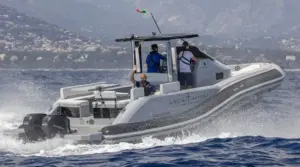
The culmination of this multi-year development cycle was the world premiere of the F800 at Boot Düsseldorf. The boat’s introduction sent ripples through the electric marine sector, proving that zero-emission mobility could coexist seamlessly with high-end luxury, thoughtful ergonomics, and accessible handling. The successful seed funding round, completed immediately following the Düsseldorf launch, provides the financial runway required to transition ESEA from an innovative startup into a globally scalable manufacturer.
Supporting Context & Metrics: Engineering the F800
At the heart of ESEA’s market disruption is the F800 itself—a vessel designed from the ground up to optimize every electron flowing through its architecture.
Hull Design and Hydrodynamic Efficiency
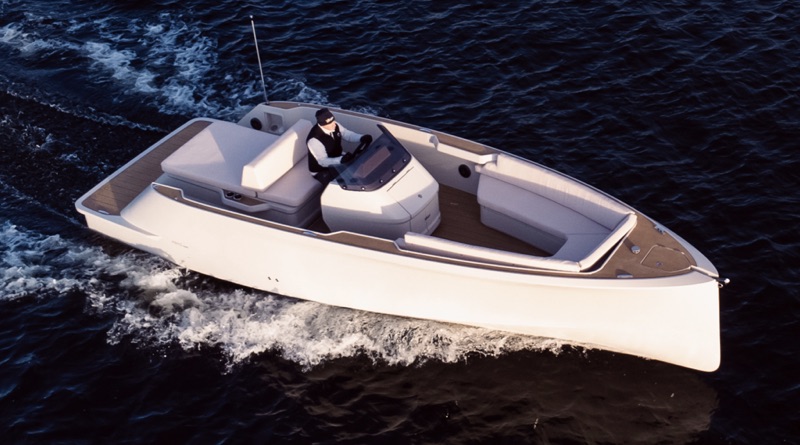
To maximize the range of an electric boat, minimizing hydrodynamic drag is paramount. Traditional planing hulls demand immense energy to lift out of the water, rapidly depleting battery reserves. ESEA chose an optimized displacement hull for the F800, built to excel at comfortable, efficient cruising speeds.

A standout feature of the F800 is its exceptionally sharp, almost knife-like bow entry. Because the entry angle is too severe to be achieved using a standard single-mold manufacturing process, ESEA utilized an advanced split-hull technique. The hull is molded in separate port and starboard sections, which are then structurally bonded together after molding. This manufacturing precision allows the F800 to slice cleanly through chop with minimal energy consumption and zero hull slap.
Propulsion, Performance, and Range
Driven by a quiet 20 kW electric motor (roughly equivalent to a 30-to-35 horsepower combustion engine), the F800 prioritizes range and serenity over breakneck speed.
- Cruising Speed: Operating at its sweet spot of 6 knots (approx. 11 km/h or 7 mph), the 20 kW motor yields an astonishing range of nearly 11 hours of continuous operation.
- Distance Range: This translates to an operational distance of 67 nautical miles (124 km / 77 miles) on a single charge.
- Top Speed: While the vessel is capable of doubling its cruising speed to reach a maximum velocity of 12 knots (22 km/h / 14 mph), the displacement hull’s efficiency peaks at lower speeds.
As Dee Du explained during their showcase in Düsseldorf, excessive speed introduces unnecessary friction, both physically and mentally. High speeds demand hyper-vigilance from the pilot regarding floating debris, wave angles, and wake management, while simultaneously making life uncomfortable for passengers trying to relax or enjoy a meal.
Smart Controls and Intuitive Helm Ergonomics
To ensure anyone can step aboard and feel like an experienced captain, ESEA integrated a suite of smart digital controls:
- Dock Mode & Digital Gearing: To eliminate the sudden, jerky forward or backward surges common when engaging traditional gearboxes, the F800 features a dedicated "dock mode" button. This initiates a digital gear profile that dampens throttle sensitivity, allowing for microscopic adjustments during close-quarters marina maneuvering.
- Steerable Pod Drive: Complemented by a 270-degree rotation arc, the steerable pod drive grants exceptional agility, allowing the F800 to rotate within its own footprint or slide sideways with practice.
- Virtual Anchor: Utilizing GPS integration, the virtual anchor system holds the boat’s exact coordinates automatically at a prime swimming or dining spot. This frees the skipper from the helm, allowing them to join friends and family in the social areas without worrying about drifting off-station.
- Simplified Glass Cockpit: The helm eschews overwhelming analog dials and confusing RPM readouts in favor of a clean, highly intuitive touchscreen monitor. It displays only what the modern boater needs to know at a glance: speed, GPS location, battery state-of-charge, and remaining range.
Onboard Comfort and Luxury
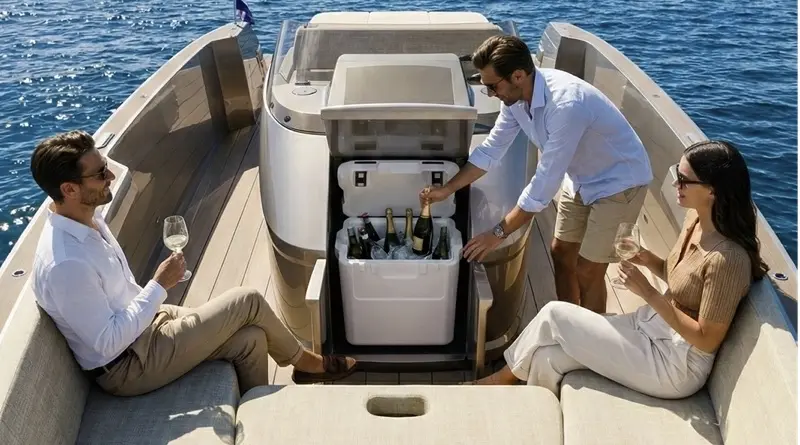
The deck layout reflects ESEA’s user-first ethos. An expansive social seating area dominates the bow ahead of the center console, while a sprawling sun bed and a wide swimming platform occupy the stern.
Subtle luxury touches abound. Deck lighting is engineered to shine exclusively downward, eliminating blinding glare in passengers’ eyes during evening cruises. The integrated cooler box is strategically positioned within arm’s reach of multiple seating zones. Furthermore, the boat features remote locking and geo-fencing capabilities, ensuring peace of mind for owners when the vessel is moored or docked unattended.

ESEA F800 Specifications At-A-Glance
| Specification | Metric Value | Imperial Value |
|---|---|---|
| Length Overall (LOA) | 8.0 meters | 26 feet |
| Beam (Width) | 2.64 meters | 8 feet 7 inches |
| Motor Output | 20 kW | ~30–35 hp equivalent |
| Cruising Range | 124 kilometers | 67 Nautical Miles / 77 miles |
| Cruising Speed | 11 km/h | 6 knots / 7 mph |
| Maximum Speed | 22 km/h | 12 knots / 14 mph |
Official Statements: The Philosophy of Frictionless Boating
The core driving force behind ESEA’s engineering and business model is rooted in human experience. The company’s leadership recognized early on that the marine industry has historically marketed to hardcore enthusiasts, alienating a massive segment of consumers who desire time on the water without the administrative and mechanical overhead.
Reflecting on the founding principles of the brand, Co-Founder and Director Dee Du articulated the company’s ultimate mission:
"We founded ESEA with the belief that boating should feel simple, intuitive, and enjoyable. With the F800, we have taken a fully integrated approach, bringing together propulsion, controls, and onboard systems into a single, cohesive design that creates a more seamless and responsive experience on the water."
Elaborating further on the psychological aspect of the F800 experience during his discussions in Düsseldorf, Du emphasized the absence of sensory and operational stress:
"The goal is for them to have an easy experience, whether they are driving it or as a passenger. No friction, just enjoyment. They can really enjoy the water and natural surroundings without any noise, and their food and drinks without any fumes and smoke. Really, everything is designed for the name of the boat—easy. That’s our philosophy. Make everything easy for the user."
This philosophy directly informs every corporate decision, from the choice of electric propulsion—which inherently eliminates oil changes, winterization hassles, and smoky exhaust—to the software architecture governing the helm.

Future Outlook: Scaling Innovation and the New 6-Meter Model
The successful closing of ESEA’s initial seed funding round is not a finish line; it is the starting pistol for the company’s aggressive expansion strategy.
Management has confirmed that the fresh capital injection will be directly channeled into two primary initiatives:
- Advanced Modular Product Architecture: Developing a flexible, modular design framework that can be easily adapted across a wider portfolio of future hull sizes and configurations.
- Globally Adaptable Manufacturing: Establishing a scalable production model capable of meeting international demand while maintaining rigorous quality control standards.
The first major manifestation of this growth strategy is already underway. ESEA is actively developing a new 6-meter (approximately 20-foot) model. This upcoming watercraft will distill the core design philosophy of the F800—Easy, Smart, Silent—into a more compact, trailerable, and accessible package.
By expanding downward into a broader market segment, ESEA aims to capture the imaginations of everyday water sports enthusiasts, cottage owners, and urban day-boaters. As the recreational marine sector slowly pivots toward a sustainable, zero-emission future, companies like ESEA are proving that environmental stewardship does not require sacrificing luxury, ease of use, or peace of mind. With the F800 establishing a high-water mark for intuitive design, and new models on the horizon, ESEA is well-positioned to steer the future of leisure boating into a cleaner, quieter era.