








Executive Overview
In the boardrooms of the Ras Al Khaimah Tourism Development Authority (RAKTDA), a quiet yet radical transformation is underway. For years, the northernmost emirate of the United Arab Emirates has successfully carved out an identity as an accessible, nature-focused escape—a value-driven alternative to the glitz of Dubai and the cultural gravity of Abu Dhabi. Known for its rugged Hajar mountains, pristine coastline, and sprawling mangrove forests, Ras Al Khaimah (RAK) leaned heavily into its affordability and outdoor adventure offerings to attract regional weekenders and budget-conscious European holidaymakers.
That playbook is now being systematically retired.
RAKTDA has announced an ambitious, high-stakes pivot that will fundamentally redefine the emirate’s tourism DNA. The strategy is stark in its ambition: shift the destination’s entire market positioning from a value proposition to a premier, luxury-dominated ecosystem. At the heart of this strategy is a staggering real estate pipeline that will nearly double the emirate’s hotel room inventory by the end of the decade. More importantly, the composition of that inventory is experiencing a tectonic inversion.

Currently, luxury five-star properties account for a modest 13.3% of the emirate’s total hotel inventory. According to Phillipa Harrison, CEO of RAKTDA, that metric will look entirely different by 2030, when an astonishing 80% of the destination’s keys will fall into the premium and luxury categories.
This is not merely a branding exercise; it is an aggressive, multi-billion-dollar infrastructure and hospitality play backed by some of the most formidable names in global real estate, high-end hospitality, and integrated entertainment. From secluded mountain lodges perched atop the UAE’s highest peaks to ultra-exclusive international hotel brands and the region’s first-ever regulated gaming resort, Ras Al Khaimah is preparing to stake its claim among the world’s elite luxury destinations.
Detailed Chronology of the Hospitality Surge
The evolution of Ras Al Khaimah’s luxury landscape is not a distant, conceptual blueprint—it is unfolding in real-time. The emirate’s meticulous timeline of upcoming openings illustrates a steady, accelerated march toward its 2030 luxury saturation goal, featuring a blend of localized eco-luxury, boutique mountain retreats, and massive, globally recognized integrated resorts.
2024–2025: Laying the Groundwork and Opening Doors
The transition kicks off with foundational additions designed to test and expand the high-end market. Among the immediate flagships is the opening of the 258-key Rotana Ras Al Khaimah – The Mangroves. Strategically positioned to capitalize on the emirate’s unique ecological assets, this property bridges the gap between nature immersion and upper-upscale hospitality, offering guests high-end amenities adjacent to the protected coastal wetlands that have long defined RAK’s scenic appeal.

As the calendar turns, the focus shifts vertically. Slated for a 2025 debut is the 70-key Saij Mountain Lodge by Mantis. Perched dramatically on Jebel Jais—the UAE’s highest peak, towering nearly 1,934 meters above sea level—this boutique luxury lodge represents a masterclass in experiential hospitality. Designed for affluent travelers seeking seclusion, wellness, and high-altitude adventure, Saij Mountain Lodge taps into the growing global demand for hyper-localized, low-impact luxury that coexists harmoniously with raw landscapes.
2026–2027: The Mega-Resorts and Global Powerhouses
While the mountain retreats capture the imagination, the coastal developments are set to radically rewrite the economic and tourism metrics of the emirate. The centerpiece of this era—and indeed, the entire contemporary history of Ras Al Khaimah’s tourism development—is the Wynn Al Marjan Island resort.
Originally slated for a rapid debut in the first quarter of 2027, the timeline for the mega-development has seen a minor calibration, with developers now targeting an opening in September 2027. As the pipeline’s single largest addition, the Wynn property is a monumental undertaking. Spanning a dedicated island development, the 1,530-key resort will feature ultra-luxury accommodations, world-class dining, extensive retail, entertainment arenas, and the UAE’s highly anticipated first regulated gaming facility. The project has already served as a magnetic catalyst, drawing institutional investment, high-net-worth individuals, and secondary developers to the Al Marjan Island master community.
Following hot on the heels of the Wynn resort, a wave of elite international luxury brands will flood the market. The years immediately surrounding and following the Wynn opening will witness the debut of globally revered hospitality names, including:
- Nobu: Bringing its signature minimalist luxury, celebrity-chef culinary prestige, and sleek lifestyle aesthetics to the RAK coastline.
- Janu: Aman’s vibrant sister brand, focusing on social wellness, contemporary design, and dynamic hospitality experiences.
- Fairmont: Introducing its timeless, grand-scale luxury and corporate-leisure appeal.
- W Hotels: Injecting its trademark bold design, energetic nightlife, and youth-oriented luxury into the local beach scene.
- The Unexpected: Offering a disruptive, experiential luxury concept tailored to modern, trend-conscious travelers.
- Four Seasons: Establishing the gold standard of intuitive, personalized service and ultra-luxury hospitality within the destination.
Supporting Context & Metrics: The Numbers Behind the Transformation
To fully grasp the magnitude of Ras Al Khaimah’s pivot, one must examine the cold, hard metrics driving the strategy. Transitioning a destination from "value" to "premium" requires careful capacity management, robust investor confidence, and a granular understanding of shifting global travel demographics.
Inventory Inversion: The 80% Rule
Currently, Ras Al Khaimah operates with approximately 8,700 hotel rooms distributed across various tiers, ranging from mid-scale beach resorts to budget-friendly city hotels, with the luxury five-star segment hovering at a modest 13.3%.
By 2030, RAKTDA’s master plan dictates that the total room inventory will expand to approximately 16,000 keys. Crucially, because the active development pipeline accounts for 8,000 new keys through 2030—nearly all of which are concentrated in the four- and five-star luxury brackets—the math naturally forces the market equilibrium to shift. When the dust settles at the end of the decade, 80% of all available keys in Ras Al Khaimah will be classified as premium or luxury.
| Metric | Current Status (Baseline) | 2030 Target |
|---|---|---|
| Total Hotel Keys | ~8,700 rooms | ~16,000 rooms |
| Luxury 5-Star Share | 13.3% | 80.0% |
| Active Pipeline Keys | N/A | 8,000 rooms (through 2030) |
| Flagship Mega-Projects | Regional resorts | Wynn Al Marjan Island (1,530 keys) |
Economic Ripple Effects
This structural overhaul is designed to capture a higher daily average rate (ADR) and a more resilient class of international traveler. Historically, value destinations struggle with seasonality and lower spend-per-visitor metrics. By aggressively pivoting toward luxury, RAKTDA aims to attract long-haul travelers from key source markets—such as Western Europe, the UK, India, and North America—who demand world-class service, fine dining, and bespoke wellness experiences.
The inclusion of the Wynn Al Marjan Island resort, in particular, fundamentally alters the economic forecast. Integrated resorts of this scale act as economic multipliers, generating thousands of direct and indirect jobs, boosting aviation demand at Ras Al Khaimah International Airport, and catalyzing high-end residential real estate developments across the emirate.
Official Statements and Strategic Vision
The mastermind behind this operational and philosophical pivot is Phillipa Harrison, CEO of the Ras Al Khaimah Tourism Development Authority. In discussions outlining the destination’s trajectory, Harrison has been unflinchingly clear about the necessity of the shift.
"Around 13.3% of the current hotel inventory is in the luxury five-star category. By 2030, 80% of our keys are going to be premium," Harrison stated, encapsulating the sheer scale of the repositioning strategy.
According to RAKTDA leadership, the decision to abandon the value-destination model is a proactive response to changing global travel patterns. Post-pandemic travelers are increasingly segmenting their preferences: while budget travel remains commoditized, the luxury and experiential travel segments have experienced explosive, sustained growth. High-net-worth individuals are actively seeking out "undiscovered" luxury destinations that offer authentic nature, privacy, and lack the overcrowding associated with traditional European or Caribbean hotspots.
Ras Al Khaimah fits this brief perfectly. By pairing its natural geography—the dramatic expanse of the Hajar Mountains, pristine white-sand beaches, and rich archaeological heritage—with ultra-luxury hospitality infrastructure, the emirate is creating a product that is difficult to replicate elsewhere in the region.
Furthermore, RAKTDA has emphasized that this growth will be sustainable and balanced. The development is not merely a concrete sprawl along the coastline; it is intentionally diversified across distinct geographical zones:
- Coastal and Island Zones: Anchored by Al Marjan Island, focusing on high-density luxury resorts, entertainment complexes, and beach clubs.
- Mountain Zones: Centered around Jebel Jais, focusing on low-density eco-lodges, wellness retreats, and adventure-luxury tourism.
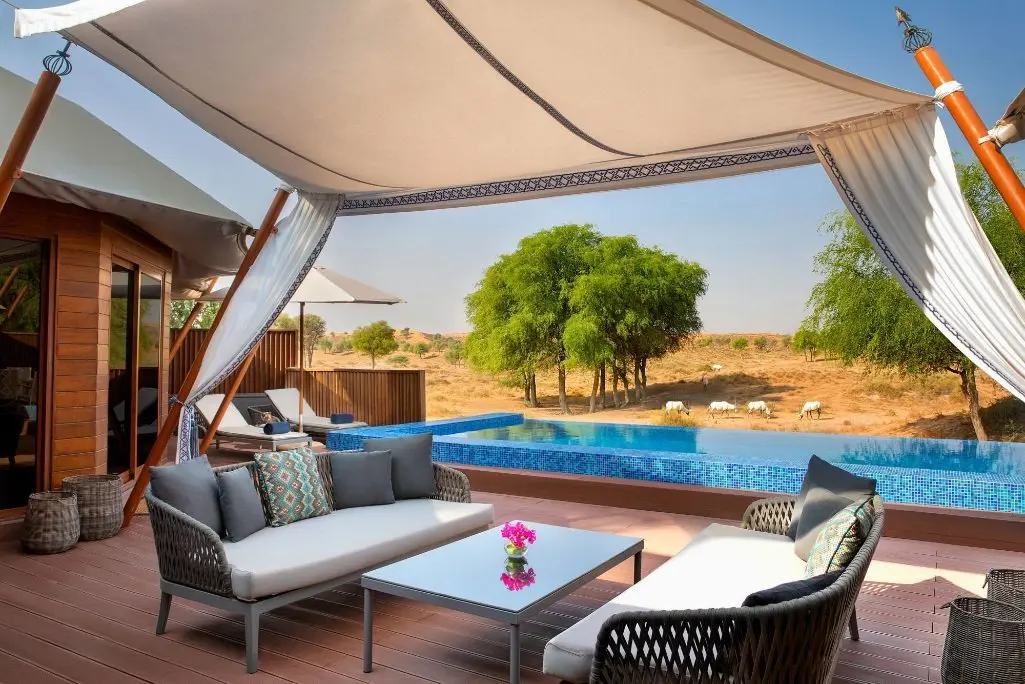
- Inland and Heritage Zones: Emphasizing cultural tourism, desert glamping, and agricultural heritage.
Future Outlook: Challenges and Opportunities on the Road to 2030
As Ras Al Khaimah charges toward its 2030 vision, the destination faces a fascinating matrix of opportunities and strategic hurdles. The coming years will test the agility of local regulators, infrastructure planners, and hospitality operators as they manage a transformation of historic proportions.
Infrastructure and Air Connectivity
Doubling the hotel inventory from 8,700 to 16,000 rooms while simultaneously elevating the demographic profile of visitors places immense pressure on supporting infrastructure. Chief among these is air connectivity. While Ras Al Khaimah International Airport has steadily expanded its routes, many international luxury travelers still arrive via Dubai International Airport (DXB), located roughly an hour’s drive away. Enhancing direct flight options, improving highway transit links, and potentially exploring high-speed rail or luxury transit options will be critical components in ensuring seamless arrivals for high-net-worth clientele.
Labor, Talent, and Service Standards
Moving from a value destination to an ultra-luxury powerhouse requires an extraordinary leap in service culture. Luxury travelers accustomed to the legendary hospitality standards of established hubs like Dubai, Singapore, or London will be unforgiving of inconsistent service. RAKTDA, in partnership with international hotel operators, will need to spearhead massive training and talent acquisition initiatives to ensure that the human infrastructure matches the physical bricks and mortar of the new resorts.
Environmental Preservation as a Luxury Asset
Ironically, the very natural assets that made Ras Al Khaimah attractive in its value days—its untouched mountains, mangroves, and quiet beaches—are its greatest competitive advantage in the luxury space today. Modern luxury is inextricably linked to sustainability and environmental integrity. As the emirate constructs thousands of new keys, maintaining stringent environmental regulations, protecting local ecosystems from over-development, and pioneering green-building standards will determine whether RAK can sustain its premium positioning over the long term.
Conclusion
Ras Al Khaimah’s evolution is a masterclass in strategic destination repositioning. By shedding its skin as a budget-friendly alternative and boldly investing in an 80% luxury key inventory by 2030, the emirate is betting its future on the resilience and spending power of the global elite. With foundational projects like The Mangroves, high-altitude marvels like Saij Mountain Lodge, and game-changing mega-developments like Wynn Al Marjan Island leading the charge, RAK is no longer waiting in the shadow of its illustrious neighbors. It is forging a glittering, high-end identity all its own—one that promises to forever alter the luxury tourism landscape of the Arabian Gulf.