









Executive Overview
To the average consumer, electricity is an invisible utility. We flip a switch, adjust a thermostat, or plug in a smartphone with the quiet expectation of instant gratification. Behind this everyday convenience, however, lies an increasingly complex and strained electrical grid. Across the United States, electricity demand is skyrocketing, driven by a convergence of energy-intensive artificial intelligence data centers, advanced manufacturing facilities, and the punishing reality of extreme summer heatwaves.
Keeping the lights on under these unprecedented pressures requires more than just generating electricity; it requires precision timing. Enter utility-scale energy storage. By capturing surplus power during periods of low demand—such as windy nights or sun-drenched afternoons—and dispatching it seamlessly when the grid is most strained, energy storage acts as the ultimate shock absorber for modern power systems.
The market response has been nothing short of historic. In 2020, the U.S. grid featured a modest 6,000 megawatt-hours (MWh) of installed energy storage capacity. Today, that figure has exploded past 175,000 MWh—enough electricity to power more than 5 million American homes for an entire day on a single charge. Recognizing that traditional generation assets alone cannot keep pace with 21st-century demands, policymakers, utility regulators, and grid operators nationwide are racing to integrate battery storage into their core infrastructure portfolios. While states across the nation are accelerating their clean energy transitions, five jurisdictions—California, Nevada, Illinois, Virginia, and Massachusetts—have emerged as undeniable leaders, setting the standard for grid modernization and reliability.
Detailed Chronology: The Evolution of U.S. Energy Storage Policy
The meteoric rise of American energy storage did not happen overnight. It is the result of more than a decade of deliberate policy design, regulatory evolution, and aggressive procurement targets enacted by forward-thinking state legislatures.
- 2010 — California Sets the Baseline: The modern storage revolution effectively began in the Golden State, which became the first jurisdiction in the nation to adopt an explicit energy storage procurement target. California mandated that its investor-owned utilities procure 1,825 megawatts (MW) of storage by 2024, sparking a wave of innovation and investment.
- 2017 — Bipartisan Consensus in Nevada: Proving that grid reliability transcends partisan politics, Republican Governor Brian Sandoval signed a landmark bipartisan storage standard into law. This established a framework for incremental capacity growth overseen by the state’s Public Utilities Commission.
- 2018 — New England Joins the Vanguard: Massachusetts Governor Charlie Baker signed An Act to Advance Clean Energy, establishing a statutory target of 1,000 MWh of storage capacity by 2025, which laid the groundwork for robust regional market participation.
- 2020–2024 — Scaling Up and Beating Deadlines: California rapidly surpassed its original 2024 procurement goal ahead of schedule, prompting regulators to establish aggressive new targets for long-duration storage. Meanwhile, Massachusetts cleared its 2025 target early, prompting Governor Maura Healey to issue executive orders and sign subsequent legislation in 2024 to double down on long-duration storage deployment.
- 2025–2026 — The New Wave of Legislative Aggression: Faced with data center expansions and surging industrial demand, states like Illinois and Virginia enacted aggressive new policies. Illinois Governor J.B. Pritzker signed the Clean and Reliable Grid Affordability Act, targeting 3,000 MW by 2030, while Virginia Governor Abigail Spanberger and state lawmakers dramatically expanded their state’s storage targets to 16,780 MW of short-duration storage by 2040.
Supporting Context & Metrics: Five States Leading the Charge
A closer examination of the five front-running states reveals distinct regional strategies yielding remarkable grid-stabilizing results.
1. California: The Vanguard of Battery Discharge
California has transformed from a pioneer into a titan of storage deployment, now boasting over 21,000 MW of operational capacity. The state’s massive battery fleet exerts vital downward pressure on peak generation demands.
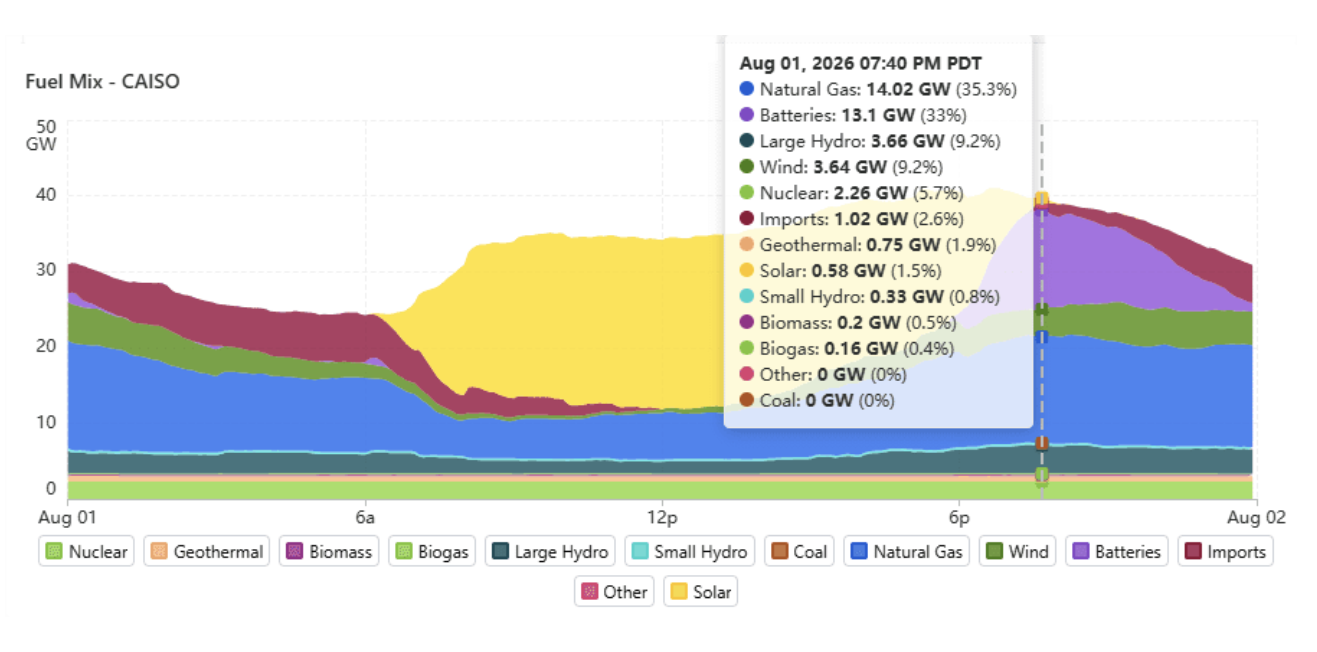
The system’s true capabilities were put on vivid display on the evening of August 1, 2026. During a period of intense grid stress, California’s primary grid operator surpassed 13,000 MW of battery discharge for the first time in history, successfully supplying an astonishing one-third of the state’s total power demand entirely from stored energy.

2. Nevada: Blasting Past Future Goals
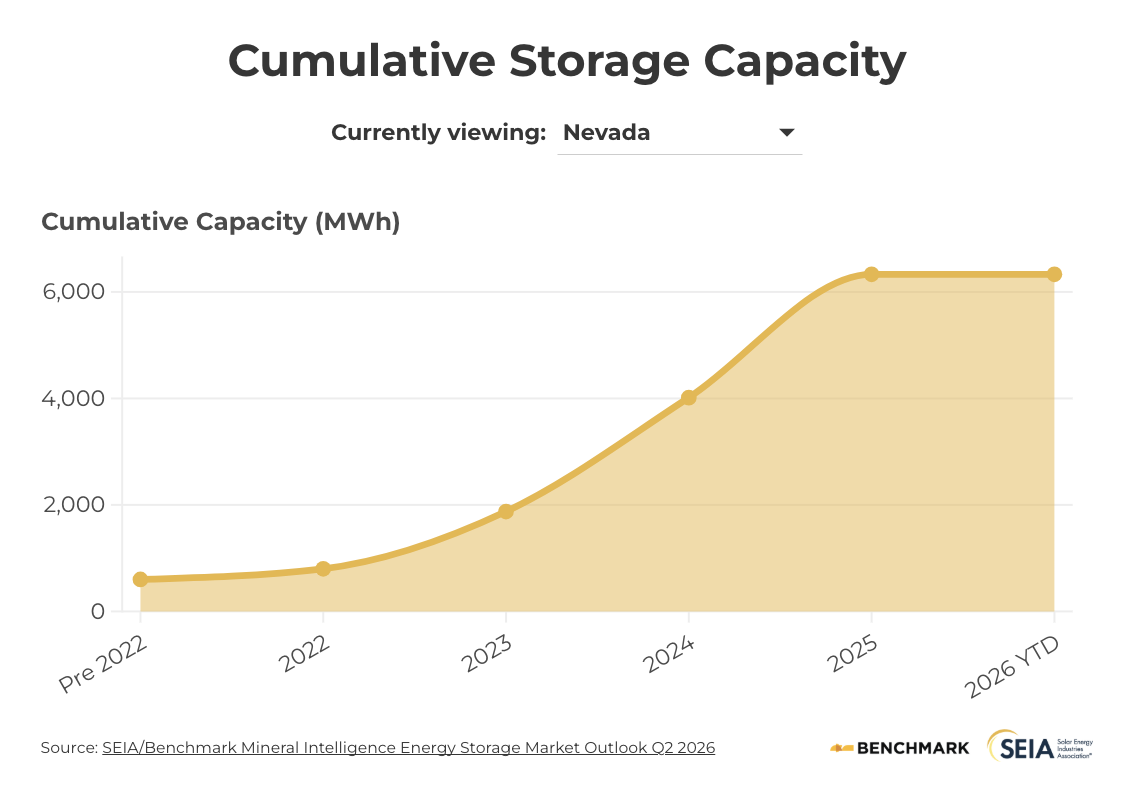
Nevada’s 2017 bipartisan storage standard has proven to be an unmitigated success, forged through rare alignment between state legislators, utility providers, and regulators. Although the Nevada Public Utilities Commission originally mapped out incremental goals to achieve 1,000 MW of capacity by 2030, the Silver State has already blown past that milestone. With approximately 1,700 MW currently online, Nevada comfortably ranks fourth nationwide in total installed energy storage capacity.
3. Illinois: Targeting Affordability and Virtual Power Plants
Illinois is addressing grid reliability through the lens of economic relief for everyday consumers. Under the Clean and Reliable Grid Affordability Act, the Illinois Power Agency is directed to procure 3,000 MW of energy storage by the end of the decade.
Crucially, the legislation incentivizes standalone storage while establishing a robust Virtual Power Plant (VPP) framework. By aggregating distributed energy resources—such as residential solar-plus-storage systems—into a unified, responsive network, Illinois can tap into decentralized power during peak load events. State analysts estimate these comprehensive measures will save Illinois families and businesses a staggering $13.4 billion in electricity bills over the next twenty years.
4. Virginia: Managing the Data Center Boom
Virginia faces a unique grid challenge: the legendary "Data Center Alley" in Northern Virginia is driving some of the fastest electricity demand growth in the United States. Surging power consumption and rising electricity bills became central flashpoints in recent political cycles, forcing leaders to act decisively.
Building upon the foundations of the 2020 Virginia Clean Economy Act, Governor Abigail Spanberger and state lawmakers approved a massive expansion of the state’s storage portfolio. Backed by advocacy groups like the Solar Energy Industries Association (SEIA), Virginia has committed to procuring an additional 16,780 MW of short-duration storage by 2040, alongside 4,520 MW of long-duration storage by 2045.
5. Massachusetts: Building on a Proven Foundation
Having officially surpassed its initial 2018 statutory goal of 1,000 MWh last year—and currently sitting at over 1,500 MWh—Massachusetts is doubling down on its energy transition. Governor Maura Healey has capitalized on the momentum established by her predecessor, utilizing executive orders and legislative packages signed in 2024 to accelerate the buildout of long-duration storage technologies. This ensures the Commonwealth can weather extended periods of low renewable generation without compromising affordability.
Official Statements and Industry Perspectives
The rapid expansion of energy storage is increasingly viewed not merely as an environmental imperative, but as an indispensable economic and engineering strategy.
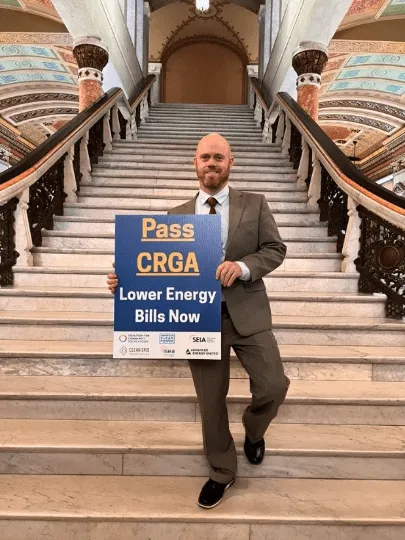
Industry advocates have been vocal about the transformative nature of these policies. During legislative debates at the Illinois State Capitol, SEIA’s Midwest State Affairs Director, Andrew Linhares, emphasized the dual benefits of smart storage deployment: "The Clean and Reliable Grid Affordability Act represents a masterclass in modern energy planning. By integrating large-scale storage and virtual power plants, we are protecting consumers from price volatility while ensuring the grid remains resilient against extreme weather and surging industrial demand."
Similarly, regulatory bodies across the country are echoing the need for flexibility. As energy markets grapple with the retirement of aging fossil fuel plants and the integration of intermittent wind and solar, state utility commissions are finding that batteries provide the instantaneous response times that traditional thermal plants simply cannot match.
Future Outlook: Every State Can Be a Storage State
While California, Nevada, Illinois, Virginia, and Massachusetts currently capture the national spotlight, the energy storage revolution is rapidly expanding beyond their borders. The recognition that batteries are essential tools for economic competitiveness and national security has ignited interest in every corner of the country.
Consider the Southeast: in 2025, the Georgia Public Service Commission unanimously approved an Integrated Resource Plan proposed by Georgia Power that calls for more than 1,500 MW of new energy storage capacity. Meanwhile, Texas—operating within the distinct market dynamics of the ERCOT grid—has aggressively scaled its infrastructure to become the second-largest energy storage market in the United States.
Though regulatory frameworks, market designs, and geographic conditions vary wildly from state to state, the underlying economic and operational advantages remain universal. Energy storage grants grid operators the operational flexibility required to manage modern power loads, insulating consumers from price shocks and fortifying critical infrastructure against disruptions.
As the U.S. electrical grid navigates its most transformative era in a century, the message to policymakers nationwide is clear: the future belongs to the states that invest in storage. Whether driven by the explosive power demands of artificial intelligence, the economic imperative of lowering consumer utility bills, or the absolute necessity of climate resilience, energy storage has officially transitioned from an emerging technology to the absolute bedrock of modern American energy independence.