









Executive Overview
For years, automotive analysts and everyday consumers have echoed a singular, persistent critique regarding the transition to electric mobility: the absolute scarcity of genuinely affordable, full-sized, family-friendly battery-electric vehicles (BEVs). While the market has been flooded with compact crossovers, sleek sedans, and wildly expensive luxury haulers, finding a spacious, three-row electric SUV for under $50,000 has felt nearly impossible.
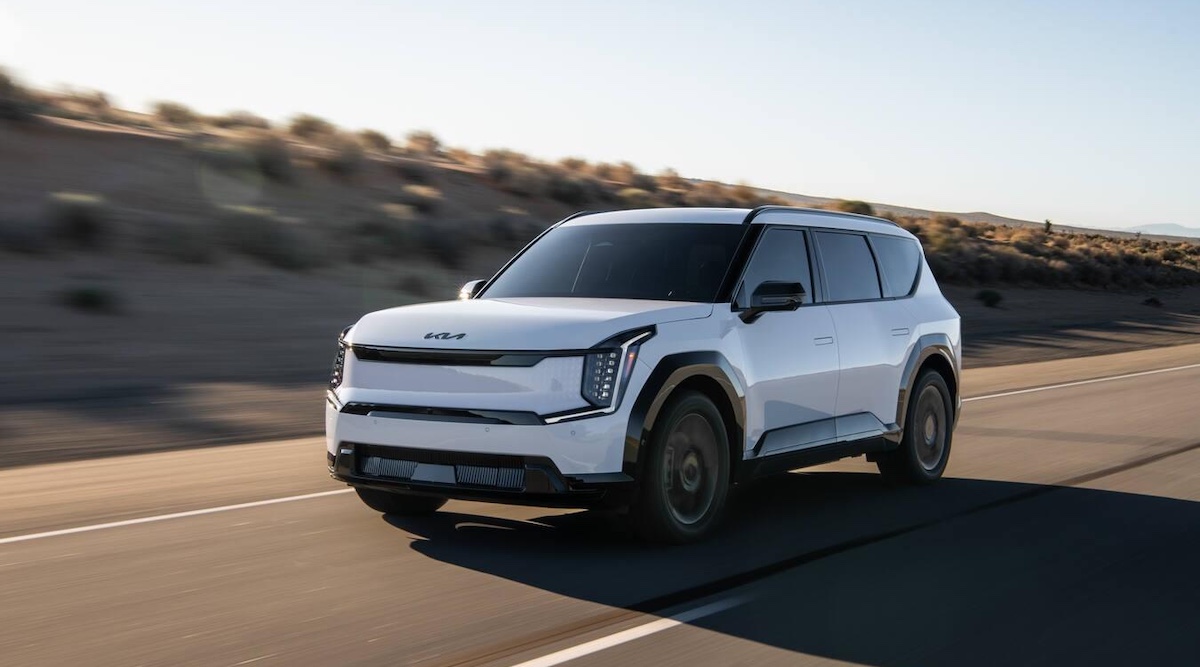
Enter the Kia EV9. As one of the very few dedicated three-row electric SUVs on the market, the EV9 has routinely won praise for its futuristic styling, cavernous interior, and high-tech cabin. Yet, despite its critical acclaim, the vehicle’s initial manufacturer’s suggested retail price (MSRP) kept it just out of reach for budget-conscious suburban families.
That calculus has fundamentally changed. Driven by aggressive dealer incentives, surplus inventory management, and fierce market competition, dealerships across the United States have initiated a wave of staggering discounts. Leading the charge, a Texas dealership recently lopped a monumental $16,041 off the price of a brand-new Kia EV9 Light RWD. This jaw-dropping markdown drops the vehicle’s cost from a baseline MSRP of $54,900 to an astonishing $41,414—effectively positioning a massive, seven-passenger luxury-grade utility vehicle at the exact same price point as entry-level compact EVs like the Tesla Model 3, Tesla Model Y, or the smaller Kia Niro EV.

This deep dive examines the anatomy of these historic price cuts, explores regional market trends, evaluates the real-world value proposition of these discounted variants, and analyzes what this inventory clearance means for the broader trajectory of the electric vehicle market in late 2026.
Detailed Chronology: How the EV9 "Fire Sale" Unfolded
To understand how a flagship electric vehicle commanding nearly $55,000 found itself subjected to clearance-level markdowns, one must look closely at the convergence of manufacturing output, dealership economics, and shifting consumer finance landscapes.
The Launch and Initial Market Positioning (2024–2025)
When Kia originally introduced the EV9 to global markets, it was heralded as a watershed moment for mainstream automakers. Built on the advanced Electric-Global Modular Platform (E-GMP), the EV9 offered ultra-fast 800V charging architecture, ultra-modern interior packaging, and robust towing capabilities. However, early adopters faced standard first-wave EV pricing. Even the entry-level Light RWD trim started at $54,900, while long-range and dual-motor all-wheel-drive (AWD) variants quickly scaled past $60,000 and well into the $70,000 bracket for top-tier GT-Line trims.
While sales were initially brisk among early-adopting tech enthusiasts and large families eager to ditch gasoline, the broader pool of mainstream buyers ran into persistent headwinds: elevated interest rates, lingering inflation, and cautious consumer spending on high-ticket durable goods.
The Mid-2026 Inventory Accumulation
By mid-2026, assembly lines had ramped up significantly, and dealerships found themselves managing healthy volumes of EV9 stock. In an era where competing automakers were adjusting pricing structures downward to maintain sales momentum, dealership groups recognized that passive lot presence would no longer suffice.
The turning point arrived during the late summer of 2026. Dealerships—particularly high-volume operations facing carrying costs and eager to hit quarterly volume bonuses—began leveraging a combination of factory-to-dealer incentives, promotional financing, and direct dealer-margin cuts. What started as modest localized haggling quickly snowballed into unprecedented public listings, highlighted by automotive industry trackers at Carscoops and Autoblog.
The Breaking Point: Record-Breaking Markdowns
The tipping point of this retail evolution materialized in Texas, where a local Kia franchise slashed $16,041 off a fresh EV9 Light RWD. By dropping the sticker price below the $42,000 threshold, the dealership erased the traditional price premium associated with size and seating capacity.
Soon after, corroborating reports emerged from major Midwestern hubs. Liberty Auto Plaza in Illinois surfaced with an identical aggressive strategy, applying a $15,000 markdown to an EV9 Light Short Range—reducing its sticker from $57,480 down to $42,480. Simultaneously, the dealership applied an identical $15,000 price slash to the more practical Light Long Range model, dragging its price from $59,785 down to a remarkably accessible $44,785.
Supporting Context & Metrics: Unpacking the Value Proposition
A discount of this magnitude naturally invites skepticism. Savvy consumers are right to ask: What am I giving up to get a $16,000 discount on a Kia EV9? A close inspection of the entry-level trims reveals that these markdowns do not reflect compromised engineering or defective inventory, but rather the strategic positioning of base models that were already exceptional values.
Range and Battery Dynamics
The focal point of these deep discounts is predominantly the single-motor, rear-wheel-drive (RWD) "Light" variants.
- EV9 Light RWD (Standard/Short Range): Equipped with a smaller battery pack, this variant delivers an EPA-estimated range of roughly 230 miles. While long-distance road warriors often fixate on 300+ mile benchmarks, data consistently demonstrates that 230 miles is more than sufficient for the daily commuting, school drop-offs, and errand-running duties that occupy 95% of a family vehicle’s lifecycle.
- EV9 Light Long Range: For buyers requiring extra peace of mind on weekend getaways, the discounted Long Range variants push capability up to an impressive 304 miles between charges—all while retaining the $15,000 markdown structure at select dealerships.
The Seven-Passenger Reality
Unlike compact crossovers that force passengers into cramped rear quarters, the EV9 is a true, uncompromising, large-scale utility vehicle. It accommodates up to seven adults comfortably across three rows of seating. To acquire a vehicle with this footprint, cargo capacity, and passenger volume at a price point traditionally reserved for compact sedans is a historic anomaly in modern automotive pricing.
Comparative Cost of Ownership
When evaluating these sale prices, the broader financial context stretches far beyond the initial purchase price. Operating an electric vehicle of this size yields massive savings over an equivalent internal combustion engine (ICE) three-row SUV like the Kia Telluride, Ford Explorer, or Chevrolet Traverse.
Consider the arithmetic of fuel versus electricity:
- Gasoline Costs: A typical gas-powered three-row SUV averaging 20 miles per gallon driven 15,000 miles annually requires roughly 750 gallons of fuel. At an average of $3.50 per gallon, the annual fuel bill hovers around $2,625.
- Electricity Costs: Charging an EV at home overnight using average residential electricity rates dramatically undercuts liquid fuel expenses. Over the same 15,000-mile span, operating costs can easily drop by 60% to 70%, saving owners thousands of dollars annually.
When combined with lower routine maintenance requirements—such as the elimination of oil changes, spark plug replacements, and complex exhaust system upkeep—the total cost of ownership for a discounted EV9 becomes remarkably compelling.
Market Performance and Consumer Response
Paradoxically, while individual dealerships are slashing prices to accelerate lot turnover, the overarching demand for the EV9 remains fundamentally robust.

According to year-to-date sales data released for 2026, sales of Kia’s flagship electric model are up an impressive 12% during the first eight months of the year compared to the same January–August window in 2025. This proves that consumer appetite for a well-executed, spacious electric SUV is extraordinarily high; buyers were simply waiting for the financial barrier to entry to align with broader economic realities.
Market analysts note that these aggressive dealership strategies serve a dual purpose:
- Volume Velocity: Moving units quickly allows dealerships to clear physical lot space and secure lucrative manufacturer incentives.
- Market Penetration: By landing these vehicles in driveways where traditional gas SUVs once sat, Kia accelerates brand loyalty and expands the overall footprint of zero-emission transit in suburban neighborhoods.
Future Outlook: What the EV9 Discount Wave Signals for the EV Market
The unprecedented fire sale on the Kia EV9 is much more than a localized quirk of automotive retail—it serves as a crystal ball for the next phase of the electric vehicle transition.
1. The Normalization of EV Pricing Parity
For years, automakers used early-adopter enthusiasm to justify inflated price tags on large EVs. The current situation with the EV9 demonstrates that market forces are reasserting themselves. As manufacturing efficiencies catch up and inventory stabilizes, automakers and their retail networks are realizing that electric vehicles must compete directly—dollar-for-dollar—with their legacy gas-powered counterparts to capture mainstream market share.
2. Pressure on Competitors
Competitors operating in the three-row electric segment—including upcoming models from domestic and international legacy automakers, as well as emerging EV-only brands—will be forced to take notice. When a consumer can walk onto a lot and drive away in a massive, seven-passenger, high-tech Kia EV9 for roughly $41,500, rival brands offering comparable vehicles at $60,000+ will find it increasingly difficult to justify their premiums.
3. A Window of Opportunity for Buyers
Industry insiders suggest that these extreme $15,000+ discounts are likely tethered to specific inventory clearance windows and aggressive quarterly sales targets. While prices may not remain at these rock-bottom levels indefinitely, the trend indicates that discounting is becoming a standard tool for navigating surplus stock in the maturing EV landscape.
Final Verdict
For consumers who have been sitting on the fence, waiting for the elusive combination of family-friendly space, modern technology, long-term operational savings, and sensible pricing, the current market reality for the Kia EV9 represents a rare alignment of the planets. If you have been contemplating making the switch to a large electric vehicle, the window to secure a luxury-grade three-row SUV at compact-car pricing is wide open—at least for now.