




Executive Overview
Boating offers an unmatched sense of freedom, adventure, and connection to nature. Yet, venturing onto the open water inherently demands a profound respect for unpredictable conditions, mechanical failures, and marine emergencies. When a crisis strikes miles from shore, the margin between a safe recovery and a maritime tragedy often relies on a captain’s ability to communicate distress clearly and rapidly. Among the foundational pillars of marine safety equipment, Visual Distress Signals (VDS) stand out as indispensable tools designed to alert nearby vessels, maritime patrols, and search-and-rescue (SAR) teams to a situation requiring immediate intervention.
Federal and state regulations mandate that specific vessels operating on designated waterways carry approved visual distress signals. However, compliance goes far beyond merely stowing a box of flares in a damp locker. Effective emergency signaling requires a comprehensive understanding of daytime versus nighttime requirements, the mechanical operation and expiration parameters of pyrotechnic devices, the rise of Coast Guard-approved electronic alternatives, and the proper integration of modern electronic rescue beacons.
This authoritative guide provides an in-depth examination of marine visual distress signals. By synthesizing current federal regulations, maritime safety protocols, and expert recommendations from on-water assistance leaders like Sea Tow, this article equips boaters with the knowledge necessary to select, store, maintain, and deploy emergency signaling equipment effectively, ensuring that help is never out of sight when lives hang in the balance.
Detailed Chronology & Evolution of Maritime Distress Signaling
The evolution of maritime distress signaling mirrors the advancement of seafaring itself—moving from rudimentary visual cues to highly regulated, technologically sophisticated electronic systems. Understanding this historical trajectory underscores why modern regulations are structured the way they are today.
From Smoke and Fire to International Standards
For centuries, mariners relied on primitive methods to signal distress when in peril. Bonfires lit on coastal cliffs, the firing of muskets, hoisting inverted flags, or generating thick smoke from burning pitch were the standard protocols of early sailing vessels. While these methods occasionally caught the attention of passing ships, they lacked standardization, often leading to confusion, delayed responses, or catastrophic failures to communicate the exact nature of the emergency.
The industrial revolution and the expansion of commercial shipping in the 19th and 20th centuries catalyzed the formalization of maritime safety. The introduction of chemical pyrotechnics brought predictable, high-visibility solutions to the maritime sector. Red flares, rockets, and smoke canisters transformed distress signaling into a science, providing intense luminescence and color-coding that could pierce through fog, darkness, and blinding sunlight.
The Codification of Modern Regulations
As recreational boating surged in popularity following World War II, national and international maritime authorities recognized the urgent need for standardized carriage requirements. The United States Coast Guard (USCG), operating under federal mandate, established rigorous testing and approval protocols for marine visual distress signals.

MAIB Annual Report 2025
Over the decades, these rules evolved from vague suggestions into precise legal requirements codified in the Code of Federal Regulations (CFR). The implementation of specific criteria for daytime signals (such as orange smoke and orange distress flags) versus nighttime signals (such as red pyrotechnic flares and approved electronic lights) ensured that boaters were adequately prepared for any operating window. Furthermore, the late 20th and early 21st centuries saw the integration of satellite-based rescue beacons—such as Emergency Position-Indicating Radio Beacons (EPIRBs) and Personal Locator Beacons (PLBs)—which revolutionized long-range distress alerting, shifting the paradigm from purely visual observation to global satellite tracking complemented by visual confirmation.
Legal Framework, Requirements, and Jurisdictional Scope
Compliance with visual distress signal regulations is not merely a best practice; it is a strict legal requirement enforced by the U.S. Coast Guard and state law enforcement agencies. Navigating these rules requires a clear understanding of where, when, and to whom federal and state mandates apply.
Where Are VDS Required?
Federal regulations regarding visual distress signals apply to coastal waters, the Great Lakes, territorial seas, and those connecting waters directly connected to them, up to a point where the waterway is less than two miles wide. Vessels operating on these designated waters must carry compliant equipment.
Specifically, the requirements generally mandate VDS carriage for:
- Vessels 16 feet (4.8 meters) or more in length operating on federally controlled waters.
- Vessels of any size operating on the high seas.
- Manually propelled boats (such as canoes, kayaks, and rowboats) under specific length thresholds are often exempt during daylight hours, but rules can tighten significantly during hours of darkness.
Vessel Classification and Operating Time Nuances
Requirements are not one-size-fits-all. They vary based on vessel length, construction type, and the specific hours of operation:
- Daytime vs. Nighttime Needs: Boaters operating exclusively during daylight hours (defined as sunrise to sunset) are legally permitted to carry devices approved solely for daytime use (e.g., orange smoke signals or an approved orange distress flag). Conversely, vessels operating at night must carry devices approved for nighttime use. Because many recreational voyages span both daylight and darkness, mariners operating at all hours must carry equipment that satisfies both conditions.
- Combinations and Equivalency: To meet full day-and-night carriage requirements, a boater might carry three pyrotechnic devices that are approved for both day and night (such as multi-use red aerial flares or handheld flares), or a distinct combination of daytime-only signals (like an orange flag or smoke canisters) paired with nighttime-approved devices (such as an approved electronic distress light).
Vessel Safety Checks and Avoiding Penalties
Because maritime laws and equipment approvals are subject to updates, boaters must periodically verify current Coast Guard guidance and local state laws before embarking on a voyage. Partner organizations like the U.S. Coast Guard Auxiliary and America’s Boating Club offer free, voluntary Vessel Safety Checks (VSCs). Certified marine examiners inspect safety equipment—including visual distress signals—to ensure they are present, unexpired, properly stowed, and fully operational, helping mariners avoid costly citations and, more importantly, ensuring readiness in an actual emergency.
Comprehensive Breakdown of Visual Distress Signal Categories
To build an effective safety kit, boaters must understand the distinct mechanics, advantages, and operational limitations of the various types of visual distress signals available on the market.
+---------------------------------------------------------------------------------+
|                      VISUAL DISTRESS SIGNAL CATEGORIES                          |
+--------------------------+---------------------------+--------------------------+
| Pyrotechnic Marine Flares| Electronic Distress Lights| Orange Distress Flags    |
| (Day & Night options)    | (Nighttime requirement)   | (Daytime requirement)    |
+--------------------------+---------------------------+--------------------------+
| - Handheld Red Flares    | - Repeating LED flash     | - International orange   |
| - Aerial Meteors         | - No flame or hot slag    | - Black square & circle  |
| - Orange Smoke Canisters | - Requires battery checks | - Reusable, non-burning  |
+--------------------------+---------------------------+--------------------------+
1. Pyrotechnic Marine Flares
Pyrotechnic signals remain the gold standard for immediate urgency due to their brilliant illumination, smoke generation, and aerial visibility. However, because they contain energetic chemical compositions, they have strict expiration dates and require meticulous handling.
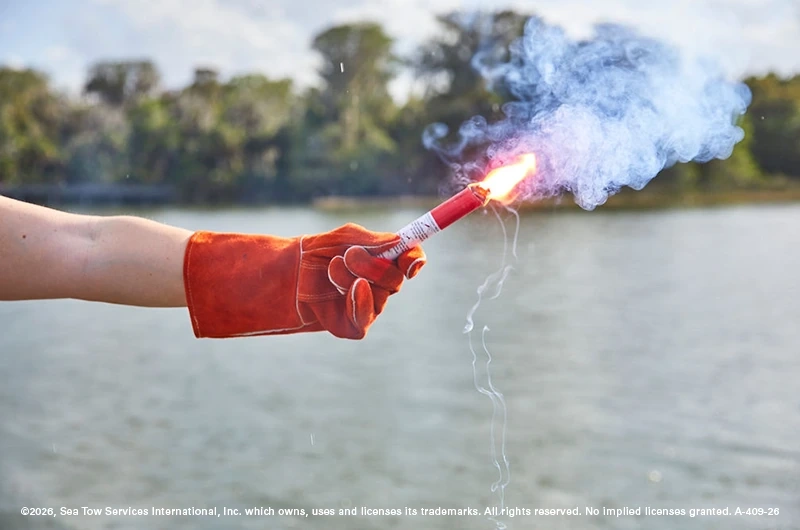
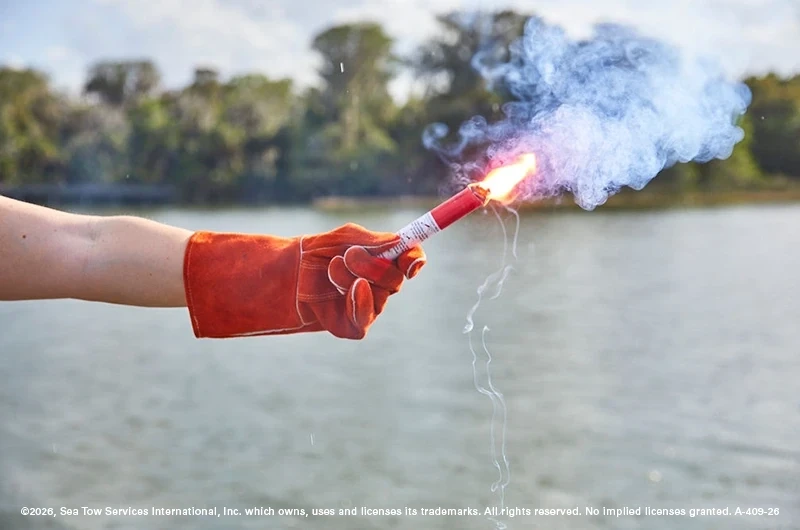
- Handheld Red Flares: Emitting an intensely bright red flame, these devices are designed primarily for nighttime use, though some models offer dual-day/night utility. When deploying a handheld flare, the operator must hold it downwind and over the gunwale (boat rail). This simple physical precaution prevents hot chemical residue, slag, and toxic smoke from dripping onto the vessel, igniting fuel vapors, damaging rigging, or causing severe burns to passengers.
- Aerial Flares and Meteor Signals: These devices project a bright projectile high above the horizon, significantly expanding the line-of-sight visibility radius. Aerial signals must be aimed and fired strictly according to the manufacturer’s instructions—always pointed well away from people, sails, structural components of the boat, overhead aircraft, and flammable materials.
- Orange Smoke Signals: Designed exclusively for daytime use, smoke canisters produce dense clouds of bright orange smoke. This serves a dual purpose: it signals distress to nearby vessels and helps aircraft and rescue boats easily determine the vessel’s exact position and prevailing wind direction. Crucially, smoke is never a substitute for a nighttime signal.
2. Electronic Visual Distress Signal Devices
In recent years, the U.S. Coast Guard has approved advanced electronic visual distress signal devices as valid replacements for traditional pyrotechnic nighttime flares.
- Mechanics and Compliance: These electronic devices emit a distinctive, repeating rescue light pattern (typically SOS) without producing open flames, hot slag, or toxic smoke. They also eliminate the problem of expiration dates. To meet legal carriage requirements, the device must bear an explicit label stating it meets USCG requirements for nighttime use, and it must be paired with an approved daytime signal (such as an orange flag). An ordinary flashlight, strobe, or smartphone screen light does not legally qualify as a substitute.
- Maintenance Protocol: Electronic devices are not maintenance-free. Skippers must regularly inspect the housing, internal switches, lenses, and battery compartments for corrosion or water intrusion. Fresh batteries must be installed seasonally, or rechargeable units maintained precisely per manufacturer specifications.
3. Orange Distress Flags
An approved orange distress flag is a durable, reusable daytime signal. Featuring a black square and black circle on an international orange background, it is instantly recognizable to other mariners and rescue personnel.
- Deployment and Limitations: The flag should be displayed from a mast, boathook, paddle, or any elevated point on the vessel where it maximizes line-of-sight visibility. While flags do not burn out and can be used indefinitely, their effectiveness is entirely dependent on daylight, ambient wind conditions, and unobstructed viewing angles. Because of these limitations, they should be combined with sound signals, mirrors, or radio communications.
4. Supplementary Signaling Tools (Mirrors, Flashlights, and Improvised Aids)
While not universally accepted as primary carriage-requirement substitutes, secondary signaling tools are vital life-saving additions:
- Signal Mirrors: A specialized retro-reflective signal mirror can direct a blindingly bright beam of concentrated sunlight toward a passing aircraft or vessel, catching the eye of rescuers even over long distances.
- Flashlights and Improvised Aids: High-lumen waterproof flashlights can attract attention at night or signal in Morse code patterns. Brightly colored clothing, waving arms, and emergency thermal blankets can drastically improve visual contrast against the water, aiding in search-and-rescue spotting efforts.
Supporting Context: EPIRBs, PLBs, and Rescue Beacons
It is a common misconception among novice boaters that electronic rescue beacons function as visual distress signals. Devices such as Emergency Position-Indicating Radio Beacons (EPIRBs) and Personal Locator Beacons (PLBs) are sophisticated radio-transmitting locating devices rather than visual cues.
When properly registered and manually or automatically activated, an EPIRB or PLB transmits a distress code and precise GPS coordinates via the Cospas-Sarsat satellite system directly to search-and-rescue coordination centers.
These technologies work in tandem with traditional visual signals:
- The Beacon initiates the emergency response, cuts down search radiuses from miles to feet, and guides rescuers to the general area.
- The Visual Signal (flares, electronic lights, flags) confirms the final visual location, allowing rescue crews to pinpoint the exact vessel in heavy seas, fog, or darkness.
Official Statements and Industry Insights
Marine safety authorities emphasize that possessing safety gear is only half the battle; proper integration, passenger education, and operational discipline are vital for survival.
In guidance released regarding on-water safety protocols, Sea Tow Services International emphasizes the holistic nature of marine preparedness:
"A complete distress signaling plan uses communication, location, and visual confirmation. Carry approved day and night devices for your specific route, maintain batteries and pyrotechnics meticulously, and keep everything instantly accessible. Choose the signal most likely to be seen, use it safely, and contact emergency authorities first when people or the vessel are in immediate danger."
Furthermore, maritime rescue coordinators frequently stress the danger of false distress signals. Pyrotechnic flares should never be ignited for practice, celebration, or disposal outside of strict, authorized training environments. Firing a flare unnecessarily triggers a massive, costly, and resource-intensive emergency response by the Coast Guard and local marine police, while needlessly risking fire on board and severe physical injury to the operator.
Best Practices: Storage, Selection, and Common Mistakes
How to Store Visual Distress Signals
- Accessibility is Paramount: Storing flares at the bottom of a deep, locked bilge locker renders them useless in a rapidly developing emergency. Signals must be stored in cool, dry, easily accessible locations where every adult passenger knows their exact location.
- Weatherproofing: Pyrotechnics are highly sensitive to moisture. Store them in waterproof containers or dedicated safety bags to prevent chemical degradation.
When to Use a Distress Signal
Distress signals must be reserved exclusively for genuine emergencies where life, limb, or the vessel is under immediate threat. Valid scenarios include:
- Active sinking, hull breach, or uncontrolled flooding.
- On-board fire or explosion.
- Capsize or vessel inversion.
- Person overboard (MOB) situations in adverse conditions.
- Serious medical emergencies or severe injuries.
- Total loss of steering or propulsion driving the vessel toward navigational hazards (such as rocks, jetties, or heavy surf).
Note: For routine, non-emergency assistance—such as running out of fuel, a dead starting battery, or minor mechanical disablement in calm weather—boaters should contact commercial tow services (like Sea Tow via VHF channel 16 or mobile app) or local friends. Flares communicate grave peril and should never be wasted on routine towing requests.
Common Mistakes to Avoid
- Relying on Expired Flares: Expired pyrotechnics cannot be relied upon to function correctly and generally do not satisfy legal carriage requirements. While some jurisdictions permit keeping expired flares strictly as backup units, they must be clearly segregated from primary, unexpired gear.
- Failing Passenger Briefings: If the captain is incapacitated, passengers must know where safety gear is stored and how to operate it. A pre-departure safety briefing should always cover the location and operation of VDS equipment.
- Confusing Phone Flashlights for Approved Gear: While a smartphone light is useful in everyday settings, it lacks the optical power, battery durability, and regulatory approval required to serve as a maritime visual distress signal.
Future Outlook: Technological Advancements in Marine Safety
As marine electronics and photonics continue to advance, the future of visual distress signaling is shifting toward higher efficiency, greater durability, and seamless digital integration.
- Next-Generation LED and Laser Technology: Regulatory bodies are continuously evaluating advanced high-intensity LED and laser signaling arrays. These emerging technologies offer hyper-bright, multi-spectral signaling capabilities that consume minimal battery power, eliminate pyrotechnic hazards entirely, and provide continuous signaling for hours or even days.
- Integration with Smart Marine Ecosystems: Future safety protocols are moving toward interconnected marine networks. Upcoming emergency devices will likely synchronize automatic distress activation with onboard VHF radios (Digital Selective Calling / DSC), chartplotters, and satellite communicators, transmitting real-time distress telemetry while simultaneously triggering visual and audible local alerts.
- Eco-Friendly and Sustainable Pyrotechnics: With environmental concerns surrounding chemical residues, slag, and plastic waste from traditional flares, manufacturers are researching biodegradable casings and non-toxic chemical formulations to minimize the ecological footprint of marine safety equipment.
Ultimately, while technology will continue to refine the tools at a mariner’s disposal, the foundational rule of boating safety remains unchanged: proactive preparation, rigorous equipment maintenance, and thorough situational awareness are the ultimate safeguards for every voyage on the water.