




Executive Overview
In a landmark decision that promises to reshape urban mobility, downtown circulation, and economic development in the heart of Oklahoma, the Central Oklahoma Transportation and Parking Authority (COTPA) board of trustees has officially adopted a resolution making the OKC Streetcar a permanent zero-fare service. Effective immediately, riders will no longer be required to purchase tickets or validate passes to board the city’s modern streetcar fleet.
This decisive regulatory shift follows the conclusion of a highly successful fare-free pilot program initially launched by EMBARK—the public transit operating arm under COTPA—in January. The pilot was designed as a empirical experiment to test a central hypothesis of modern transit planning: that removing the financial and logistical barriers of fare collection would dramatically accelerate ridership, ease downtown congestion, and seamlessly integrate public transit into the daily rhythms of a rapidly growing metropolitan core.
The data gathered during the experimental period exceeded even the most optimistic projections of transit authorities. A comprehensive ridership analysis tracking performance from January through June revealed an astonishing average month-over-month increase of 71% compared to the same period in the previous year. This massive surge in passenger volume proved that cost was indeed a primary friction point for prospective riders. By eliminating ticket purchases, EMBARK not only democratized access to public transit for lower-income residents and visitors alike, but also engineered operational efficiencies that shaved valuable seconds off route times, keeping the system moving with unprecedented fluidity.
While transit leaders emphasize that the permanent zero-fare policy is currently confined to the streetcar system and will not immediately cascade across the entirety of EMBARK’s fixed-route bus and paratransit networks, the policy represents a watershed moment for urban transit in the American Southwest. As Oklahoma City continues to invest aggressively in downtown infrastructure, prepare for an influx of major national and international events, and cement its status as a major regional hub, the zero-fare streetcar stands out as a visionary model for how modern cities can leverage public transit to drive economic vitality, improve air quality, and enhance the quality of life for all residents.
Detailed Chronology: From Pilot to Permanent Policy
To fully understand how the OKC Streetcar arrived at this historic juncture, it is necessary to examine the deliberate, step-by-step evolution of EMBARK’s strategic planning over recent years. The journey toward a zero-fare system was not an impulsive reaction to shifting political winds, but rather the result of a calculated, data-driven progression aimed at testing the waters before making a permanent structural commitment.
The Genesis of the Experiment: January
The pivotal chapter in this transition opened in January, when EMBARK officials officially rolled out the fare-free pilot program for the OKC Streetcar network. For years, the streetcar had operated under a traditional ticketing model where passengers were required to purchase single-ride passes, day passes, or use regional smart cards. While these fares were modest, transit planners suspected that the mere mechanics of fare payment—figuring out where to buy tickets, downloading apps, carrying exact change, or validating passes—acted as a psychological deterrent for casual users, tourists, and downtown workers who might otherwise choose the streetcar over walking or driving short distances.
By suspending fare collection entirely across the network starting in January, EMBARK created a controlled environment to measure user response. The agency established a strict analytical framework to monitor boarding counts, track passenger demographics, evaluate operational impacts, and gauge public feedback over a multi-month period.
The Six-Month Evaluation Window (January – June)
The pilot operated continuously through the winter and spring, capturing a wide variety of operational conditions, including inclement weather, major downtown conventions, spring festival seasons, and the early onset of summer tourism. Throughout this six-month window, transit analysts closely tracked electronic passenger counters installed on the streetcars, comparing the incoming data against historical benchmarks from the exact same months of the previous year.
By the time the final tallies for June were compiled and analyzed, the results were unequivocal. The system was not experiencing a temporary bump driven by novelty; rather, it was maintaining a sustained, month-over-month ridership surge that averaged 71% higher than pre-pilot levels.
The COTPA Board Action
Armed with these compelling metrics, EMBARK leadership presented their findings to the COTPA board of trustees. The presentation detailed not only the quantitative leap in passenger numbers, but also the qualitative feedback gathered from downtown merchants, regular commuters, and visitors. Recognizing the clear alignment between the zero-fare pilot and the city’s broader strategic goals for downtown revitalization, the COTPA board took swift and decisive action. At its regularly scheduled meeting, the board formally adopted the resolution to sunset the fare structure permanently, transitioning the OKC Streetcar into an enduring zero-fare public asset.
Supporting Context & Metrics: Analyzing the 71% Surge
The decision to eliminate streetcar fares permanently was anchored in hard data rather than theoretical assumptions. The metrics compiled by EMBARK provide a fascinating case study in how removing minor transactional friction can unlock massive latent demand for public transportation.
The Power of Removing Friction
In transit planning, "friction" refers to any obstacle—real or perceived—that discourages a person from using a service. Fare collection is a classic source of transit friction. For a first-time visitor or a downtown worker running late for a lunch meeting, the need to locate a ticket vending machine, navigate a mobile ticketing app, or interact with a farebox introduces hesitation.
When EMBARK suspended fares in January, that friction vanished instantly. Passengers could simply step onto the platform, wait for the next streetcar, and board immediately. This instantaneous boarding process unlocked several cascading benefits:
- Elimination of Dwell Time: Without passengers fumbling for payment methods, holding up lines, or waiting for fare validation, the time each streetcar spent stopped at a station (dwell time) decreased significantly. This directly improved the overall schedule reliability and operational cadence of the route.
- Lowered Barriers for the Unbanked: Traditional digital ticketing systems often disadvantage individuals who do not possess credit cards, smartphones, or bank accounts. A zero-fare system is inherently egalitarian, offering completely barrier-free access to all socio-economic strata.
- Spontaneous Ridership: In a downtown environment, trips are often short and opportunistic. People are far more likely to hop on a streetcar for a two-block ride to escape the heat or avoid a sudden downpour if the service is entirely free, generating a vibrant, highly active urban streetscape.
Anatomy of the OKC Streetcar Network
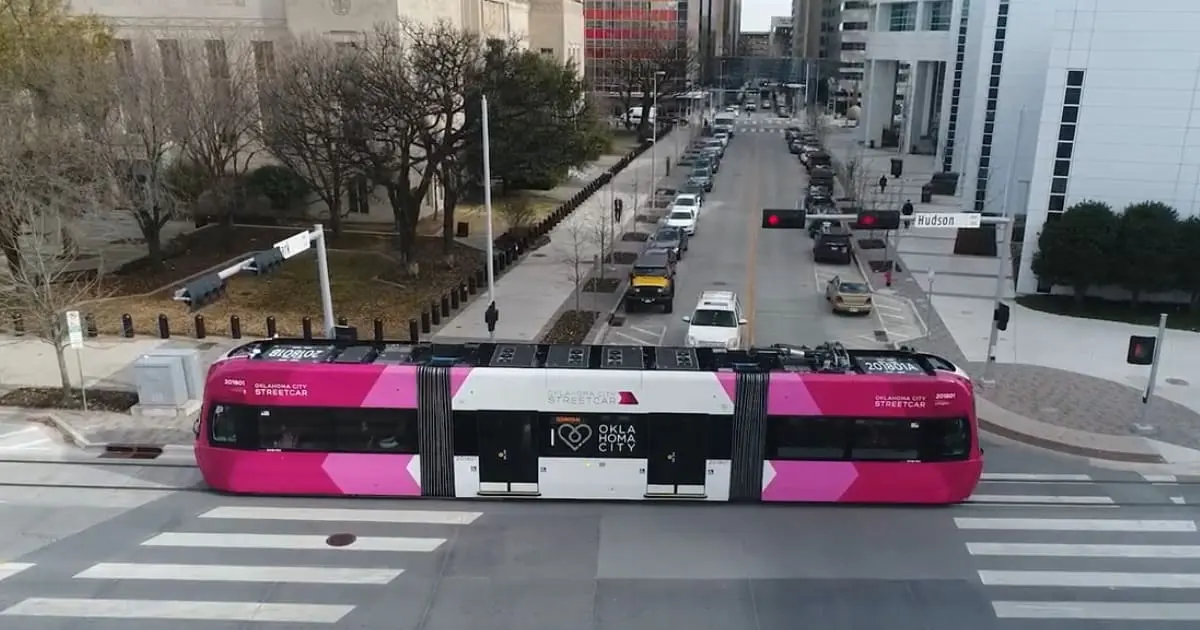
To appreciate the scale of the zero-fare mandate, one must examine the infrastructure of the OKC Streetcar system itself. Operating seven days a week, the network spans two distinct loops—the Downtown Loop and the Bricktown Loop—interconnected to provide comprehensive coverage of Oklahoma City’s most dynamic commercial, residential, and entertainment districts.
The system features:
- 22 Strategically Placed Stops: Connecting major destinations including the Myriad Botanical Gardens, the Chesapeake Energy Arena (Paycom Center), Automobile Alley, Midtown, and the bustling Bricktown entertainment district.
- A Modern Fleet of 7 Streetcars: Sleek, low-floor, contemporary vehicles designed for accessibility, featuring ample room for wheelchairs, bicycles, and strollers.
- High-Frequency Service: Operating continuously throughout the week to ensure that riders never have to wait long for the next vehicle, a frequency that has only been enhanced by the speedier boarding times achieved under the zero-fare model.
Official Statements & Industry Perspectives
The permanent transition to a zero-fare streetcar system has drawn praise from civic leaders, transportation executives, and urban planners across the region. The move is viewed not merely as a transit policy adjustment, but as a core pillar of Oklahoma City’s master plan for urban growth.
Leadership Insights from EMBARK Director Jesse Rush
Jesse Rush, the director of EMBARK, has been a vocal champion of data-driven experimentation and customer-centric transit design. Following the board’s adoption of the resolution, Rush articulated the agency’s enthusiasm and the broader strategic vision guiding the policy.
“We’re pleased to see these positive results from the ridership analysis and to create a Zero Fare OKC Streetcar system for our residents and visitors,” Rush stated. “As our city continues to invest in projects and host major events coming to downtown Oklahoma City, the streetcar can improve downtown circulation, help ease traffic congestion and boost economic activity for downtown businesses.”
Rush further emphasized that the operational benefits observed during the pilot—particularly the reduction in boarding times and the corresponding gains in route efficiency—proved that a fare-free model could enhance the quality of service while simultaneously cutting administrative overhead associated with fare enforcement, ticket machine maintenance, and cash handling.
Building on Proven Precedent
The permanent streetcar decision did not emerge in a vacuum; it builds upon years of incremental innovation by EMBARK to lower barriers to transit entry. As previously reported by METRO, the agency has cultivated a culture of experimentation through periodic promotional events, most notably its popular Third Friday Free initiative.
Now celebrating its fifth year, Third Friday Free offers complimentary rides across EMBARK’s entire multi-modal network, encompassing:
- Fixed-route bus networks
- RAPID NW bus rapid transit (BRT) service
- Zone 1 paratransit services
- The OKC Streetcar
- Oklahoma River Cruises
These recurring promotional days provided EMBARK with invaluable longitudinal data regarding how fare-free structures influence public behavior, paving the way for the more permanent, targeted zero-fare approach now applied to the streetcar.
Future Outlook: Partnerships, Funding, and System-Wide Implications
While the permanent elimination of streetcar fares is a monumental victory for transit advocates and downtown stakeholders, it naturally raises important questions regarding financial sustainability, long-term funding models, and the potential for similar programs to expand across the broader EMBARK network.
Navigating the Financial Realities
Operating a transit system without farebox revenue requires creative fiscal engineering. While fares traditionally cover a minor fraction of overall operating costs for most public transit agencies—often less than 10% to 15%—the loss of that revenue stream must be offset through alternative funding mechanisms, municipal appropriations, or strategic partnerships.
EMBARK has pioneered innovative approaches to bridge this gap. A prime example is the agency’s collaboration with the private sector to support the Third Friday Free program. In 2025, Allegiance Credit Union made history by becoming the agency’s first official private-sector financial partner, injecting corporate sponsorship into public transit support.
Director Jesse Rush and his executive team view such public-private partnerships as a vital blueprint for the future. By aligning with local businesses, corporate campuses, and tourism associations that directly benefit from increased downtown foot traffic, EMBARK can secure sustainable revenue streams to maintain and expand fare-free initiatives without straining public coffers.
The Question of System-Wide Zero-Fare Service
Despite the overwhelming success of the streetcar pilot, transit officials remain pragmatic regarding the scope of zero-fare policies. Earlier this summer, Rush addressed speculation about whether the entire EMBARK network—including buses and paratransit—might eventually go fare-free. He clarified that the agency is not currently considering a system-wide elimination of bus fares, citing the massive capital and operational scale required to support a city-wide zero-fare bus network.
Instead, EMBARK is pursuing a nuanced, targeted strategy. Rather than applying a blanket zero-fare policy across every mode, the agency continues to explore specialized programs designed to maximize affordability where it matters most:
- Employer-Sponsored Pass Programs: EMBARK is actively developing corporate partnerships that would allow downtown businesses and major employers to purchase heavily subsidized or reduced-cost transit passes for their workforces, effectively making transit free at the point of use for thousands of local employees.
- Targeted Demographic Relief: Continuing to refine programs that assist low-income riders, students, seniors, and individuals with disabilities in accessing affordable transportation without placing undue financial burdens on the transit operating budget.
- Strategic Event Partnerships: Collaborating with convention organizers, sports franchises, and city festival planners to sponsor fare-free transit service during major high-attendance events, ensuring seamless mobility when downtown traffic congestion peaks.
A Model for Modern Urban Mobility
As Oklahoma City looks toward the future, the permanent zero-fare OKC Streetcar serves as a shining example of progressive urban planning. By courageously testing the boundaries of traditional transit models, EMBARK has demonstrated that public transportation can be reimagined not merely as a utility of last resort, but as a vibrant, welcoming public amenity that binds a community together.
The 71% surge in ridership is more than just an impressive statistic; it is a resounding endorsement from the people of Oklahoma City. It proves that when you remove the barriers standing between citizens and their city, they will step outside, board the streetcar, and actively participate in the cultural and economic renaissance of their urban core. As other metropolitan areas grapple with declining post-pandemic ridership and mounting traffic congestion, Oklahoma City’s bold experiment offers a clear, actionable roadmap for the future of urban transit.