








Executive Overview
In a deal that signals a strategic shift in the United States naval defense industrial base, Master Boat Builders of Coden, Alabama, has secured its first-ever prime shipbuilding contract with the U.S. Navy. The agreement tasks the veteran Gulf Coast shipbuilder with the construction of three new Landing Craft Utility (LCU) 1700-class vessels, with an integrated option for a fourth hull. While the exact financial valuation of the contract remains undisclosed, the operational timeline extends through 2029, cementing a steady, multi-year pipeline of defense manufacturing at the company’s Coden facility.
For decades, the U.S. Navy has relied on a highly consolidated network of Tier-1 prime shipyards to construct its fleet. However, persistent delays, labor shortages, and capacity bottlenecks across major defense yards have forced a tactical recalculation within the Pentagon. The award to Master Boat Builders represents a tangible execution of the Navy’s "distributed shipbuilding" strategy—an initiative designed to recruit, upskill, and utilize agile, mid-tier commercial shipyards to relieve pressure on larger defense facilities and rapidly expand domestic shipbuilding capacity.
This contract marks a major evolutionary step for Master Boat Builders. Having previously operated as a subcontractor fabricating sub-assemblies and hull modules for larger defense primes, the Alabama-based shipyard will now assume full responsibility as the prime contractor. This transition requires the company to manage the complete lifecycle of the build, from initial steel cutting and propulsion integration to final outfitting, sea trials, and direct delivery to the Navy.
From a geopolitical perspective, the timing of this award is critical. As the Department of Defense pivots toward the Indo-Pacific theatre, military planners are grappling with the realities of "contested logistics." Modern naval doctrine dictates that in a high-intensity conflict, the ability to move heavy armor, troops, fuel, and munitions across vast distances to remote, austere island chains will determine operational success. The LCU 1700 class serves as the literal connective tissue for these amphibious operations, making the acceleration of their production a matter of national security.
Detailed Chronology
+---------------------------------------------------------------------------------------+
|                                  HISTORICAL TIMELINE                                  |
+---------------------------------------------------------------------------------------+
|                                                                                       |
|  1979: Master Boat Builders founded in Coden, Alabama (focus on commercial vessels)   |
|                                                                                       |
|  2010s: Navy identifies critical need to replace aging LCU 1610 fleet                 |
|                                                                                       |
|  2018: Navy initiates LCU 1700 program to modernize amphibious ship-to-shore links    |
|                                                                                       |
|  Sept 2024/25: Master Boat & Austal USA establish strategic distributed partnership   |
|                                                                                       |
|  Early 2024: Fabrication of Navajo-class T-ATS hull modules begins at Coden yard     |
|                                                                                       |
|  Late 2024: Master Boat Builders awarded first U.S. Navy prime contract for 3 LCUs    |
|                                                                                       |
|  2025–2029: Scheduled construction and delivery phase for the LCU 1700 vessels        |
|                                                                                       |
+---------------------------------------------------------------------------------------+
The Commercial Foundation (1979–2020)
Founded in 1979 in the heart of the Gulf Coast’s maritime hub, Master Boat Builders spent its first four decades building a reputation as a highly efficient commercial shipbuilder. Operating out of Bayou La Batre and Coden, Alabama, the yard specialized in workboats, offshore supply vessels (OSVs) for the oil and gas sector, harbor tugs, and commercial fishing vessels. This commercial focus required the shipyard to remain highly adaptable, maintaining lean operations and rapid production cycles to survive the cyclical downturns of the commercial maritime market.
The Subcontractor Transition (2021–2023)
As the U.S. Navy began sounding the alarm over the fragility of the domestic shipbuilding industrial base, defense planners sought to leverage the latent capacity of high-performing commercial yards. Master Boat Builders identified an opportunity to diversify its portfolio.
The company entered the defense sector by aligning with Austal USA, a major defense prime located nearby in Mobile, Alabama. This collaboration focused on the Navy’s Navajo-class Towing, Salvage, and Rescue Ship (T-ATS) program. Under a distributed shipbuilding framework, Master Boat Builders was contracted to fabricate massive structural hull modules for two T-ATS vessels.
The Strategic Alliance (September 2024)
To formalize and scale this cooperative model, Master Boat Builders and Austal USA announced a strategic partnership in September. The alliance was designed to address systemic bottlenecks in the Gulf Coast shipbuilding corridor. By distributing labor-intensive fabrication tasks to Master Boat Builders’ Coden facility, Austal USA could optimize its final assembly lines in Mobile. This arrangement proved to the Navy that a mid-tier commercial yard could successfully execute naval construction to rigorous NAVSEA (Naval Sea Systems Command) quality and tolerance standards.
The Prime Award (Present)
Building upon the successful execution of the T-ATS module fabrications, the Navy bypassed the traditional prime contractors to award the LCU 1700 contract directly to Master Boat Builders. This milestone transforms the yard from a component supplier into a prime defense contractor, establishing a direct contractual and operational relationship with the U.S. Navy.
Supporting Context & Metrics
The LCU 1700 Platform: Technical Specifications
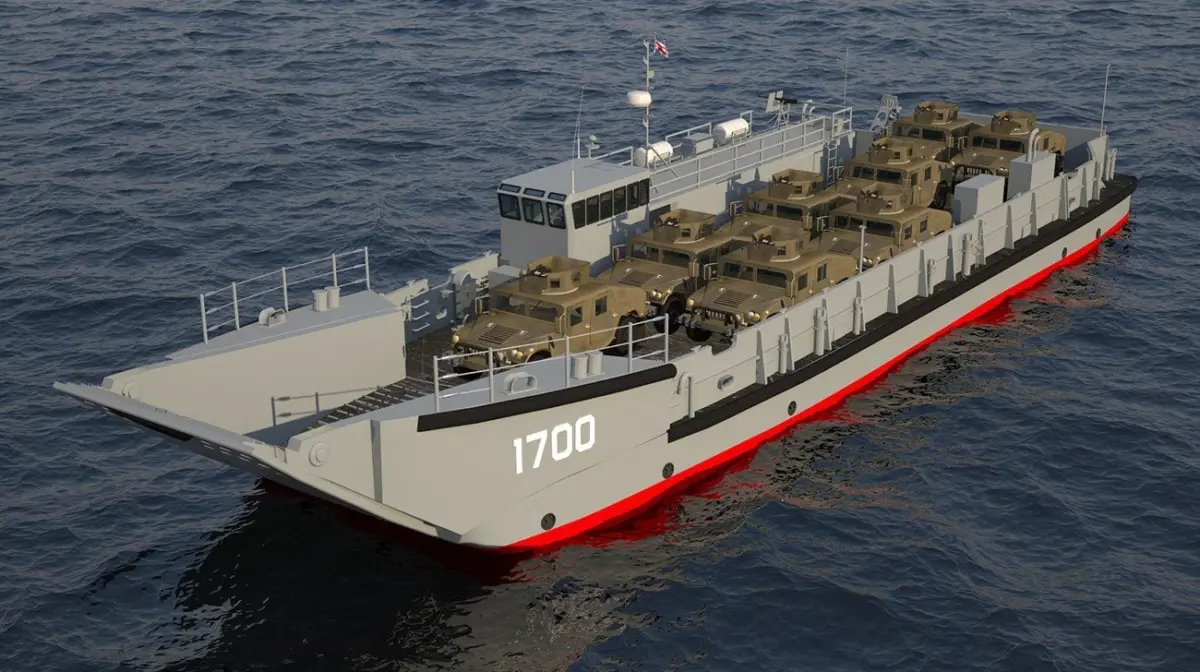
The Landing Craft Utility (LCU) 1700 class is a heavy-lift displacement vessel designed to operate both independently and from the well decks of amphibious warfare ships, such as Landing Helicopter Assault (LHA), Landing Helicopter Dock (LHD), Landing Platform Dock (LPD), and Landing Ship Dock (LSD) platforms.
| Parameter | Specification |
|---|---|
| Length Overall | Approximately 139 feet (42.4 meters) |
| Beam | 31 feet (9.4 meters) |
| Displacement (Loaded) | ~430 long tons |
| Payload Capacity | 170 short tons (152 long tons) |
| Range | 1,200 nautical miles at 8 knots |
| Complement | 14 crew members |
| Propulsion | Twin diesel engines driving conventional shafts |
| Cargo Access | Bow ramp and stern gate for drive-through capability |
Unlike high-speed, maintenance-intensive Air Cushion Vehicles (LCACs), the LCU 1700 is a conventional steel-hulled vessel built for durability, heavy payloads, and long-range transit. Its drive-through configuration (bow ramp and stern gate) allows for rapid loading and unloading of heavy military hardware, including the main battle tanks, armored vehicles, and heavy logistics trucks utilized by the U.S. Marine Corps.
                  LCU 1700 CLASS GENERAL LAYOUT (CONCEPTUAL)

   STERN GATE                                                        BOW RAMP
     |                                                                  |
     v                                                                  v
+----+------------------------------------------------------------------+----+
|    |                                                                  |    |
|    |======= OPEN CARGO DECK (Capacity: 170 Short Tons / Armor) =======|    |
|    |                                                                  |    |
+----+---------+--------------------------------------------------------+----+
     | Engine  |   [Superstructure / Crew Quarters / Bridge]
     | Room    |   (Starboard Side / Offset to maximize deck width)
     +---------+
Replacing an Aging Fleet
The LCU 1700 program was established to replace the Navy’s legacy LCU 1610 class, some of which have been in active service since the late 1950s and 1960s. Operating vessels that are over half a century old has presented severe maintenance, structural, and obsolescence challenges for the Navy. The LCU 1700 class modernizes this capability by introducing:
- Enhanced Survivability: Modern steel hull designs with improved damage control systems.
- Improved Propulsion Efficiency: Updated diesel power plants that reduce fuel consumption and maintenance overhead.
- Operational Compatibility: Full integration with the latest amphibious ship classes and modern military payloads, ensuring that the heavy armor of today and tomorrow can be safely transported from ship to shore.
The Industrial Base Crisis
The decision to award this contract to Master Boat Builders highlights a broader crisis within the U.S. defense industrial base. Decades of consolidation have left the nation with only a handful of shipyards capable of building naval vessels. This lack of competition and capacity has resulted in:
- Labor Bottlenecks: A critical shortage of skilled tradespeople, including certified marine welders, pipefitters, shipfitters, and marine electricians.
- Facility Constraints: Limited drydock and slipway space at major shipyards, where delays on one vessel cascade down to delay multiple other programs.
- Single Points of Failure: Vulnerabilities in the supply chain where a delay at a single subcontractor can halt prime-level production.
By onboarding Master Boat Builders as a prime contractor, the Navy is actively expanding its industrial ecosystem. This strategy utilizes regional, highly efficient yards to build less complex auxiliary and support vessels, thereby freeing up capacity at major yards for complex surface combatants and submarines.
Official Statements
The leadership at Master Boat Builders views this contract as both a validation of their historical performance and a catalyst for future growth.
Garrett Rice, President of Master Boat Builders, emphasized the cultural and operational significance of the award:
"This award represents a major milestone for Master Boat and reflects the dedication of the skilled workforce that has built our reputation over the last 45 years. We are honored by the Navy’s confidence in our team and proud to expand our role in supporting America’s maritime mission. As we deliver these craft, we will continue investing in our people, capabilities, and Gulf Coast operations to provide the quality and performance our warfighters depend on."
This statement highlights several key themes that are critical to the success of the distributed shipbuilding model:
- Workforce Retention and Growth: To meet NAVSEA standards, Master Boat Builders must continuously invest in recruiting and training its local workforce, directly addressing the regional shortage of skilled maritime trades.
- Capital Reinvestment: The transition to a prime contractor status requires upgrades in shipyard infrastructure, quality assurance protocols, and digital enterprise tracking systems.
- Regional Economic Impact: The contract secures stable, high-paying manufacturing jobs in the Alabama Gulf Coast region through the end of the decade, creating a positive economic multiplier effect for local suppliers and sub-tier contractors.
Future Outlook
Geopolitical and Tactical Alignment
As the United States shifts its defense posture toward the Pacific, the tactical utility of landing craft has elevated from utility transport to strategic enablers. Under the U.S. Marine Corps’ Force Design initiative—specifically the concept of Expeditionary Advanced Base Operations (EABO)—forces will operate in small, highly mobile, and dispersed units across island chains.
These units will be tasked with anti-ship missile interdiction, reconnaissance, and forward arming and refueling points (FARPs). To sustain these dispersed networks, the military requires a robust fleet of heavy-lift connectors that can operate independently of major port infrastructures. The LCU 1700 fleet, built by yards like Master Boat Builders, will be the primary mechanism for moving these littoral forces, their launchers, and their logistics tails through contested waters.
                DISTRIBUTED MARITIME LOGISTICS MODEL (EABO)

   +-----------------------+              +-----------------------+
   |  Amphibious Warship   |              |  Amphibious Warship   |
   |   (LPD / LHA / LHD)   |              |   (LPD / LHA / LHD)   |
   +-----------+-----------+              +-----------+-----------+
               |                                      |
               +------------------+-------------------+
                                  |
                                  v  (Ship-to-Shore Transit)
                       +----------------------+
                       |  LCU 1700 Connector  | (Built by Master Boat)
                       +----------+-----------+
                                  |
         +------------------------+------------------------+
         |                        |                        |
         v                        v                        v
+------------------+     +------------------+     +------------------+
| Expeditionary    |     | Forward Arming & |     | Mobile Missile   |
| Advanced Base A  |     | Refueling Point  |     | Battery (NMESIS) |
+------------------+     +------------------+     +------------------+
The Distributed Shipbuilding Blueprint
The performance of Master Boat Builders over the next five years will serve as a test case for the Navy’s wider industrial base strategy. If Master Boat Builders can deliver these three (and potentially four) LCU vessels on schedule and within budget, it will validate the theory that mid-tier commercial shipyards can successfully absorb defense workloads. This success could lead to:
- Increased Competition: Breaking the near-monopoly of traditional defense primes on small-to-medium naval platforms, leading to better cost control and taxpayer savings.
- Replication in Other Regions: The Navy may seek to establish similar distributed shipbuilding hubs along the East Coast, West Coast, and the Great Lakes, utilizing local commercial yards for auxiliary craft, unmanned surface vessels (USVs), and security platforms.
- Expanded Capacity for Unmanned Systems: As the Navy transitions toward a hybrid manned-unmanned fleet, smaller, agile shipyards will be well-positioned to rapidly prototype and mass-produce medium-sized unmanned surface vessels.
Conclusion
The prime contract awarded to Master Boat Builders is more than a single shipyard victory; it is a strategic realignment of domestic shipbuilding priorities. By elevating a proven Gulf Coast commercial yard to a prime defense contractor, the U.S. Navy is addressing its industrial capacity constraints while securing the heavy-lift connectors necessary to project power in contested maritime environments. As construction gets underway in Coden, Alabama, the maritime industry will be watching closely to see if this model can successfully forge a more resilient, distributed, and capable national security industrial base.