




Executive Overview
In the upper echelons of long-range cruising, the name Nordhavn has long stood as a gold standard for transoceanic capability, rugged engineering, and no-compromise self-sufficiency. For decades, the builders at Nordhavn have understood that their clientele are not merely weekend boaters; they are serious mariners, explorers, and voyagers who demand vessels capable of crossing oceans in weather that sends other yachts scurrying for shelter.
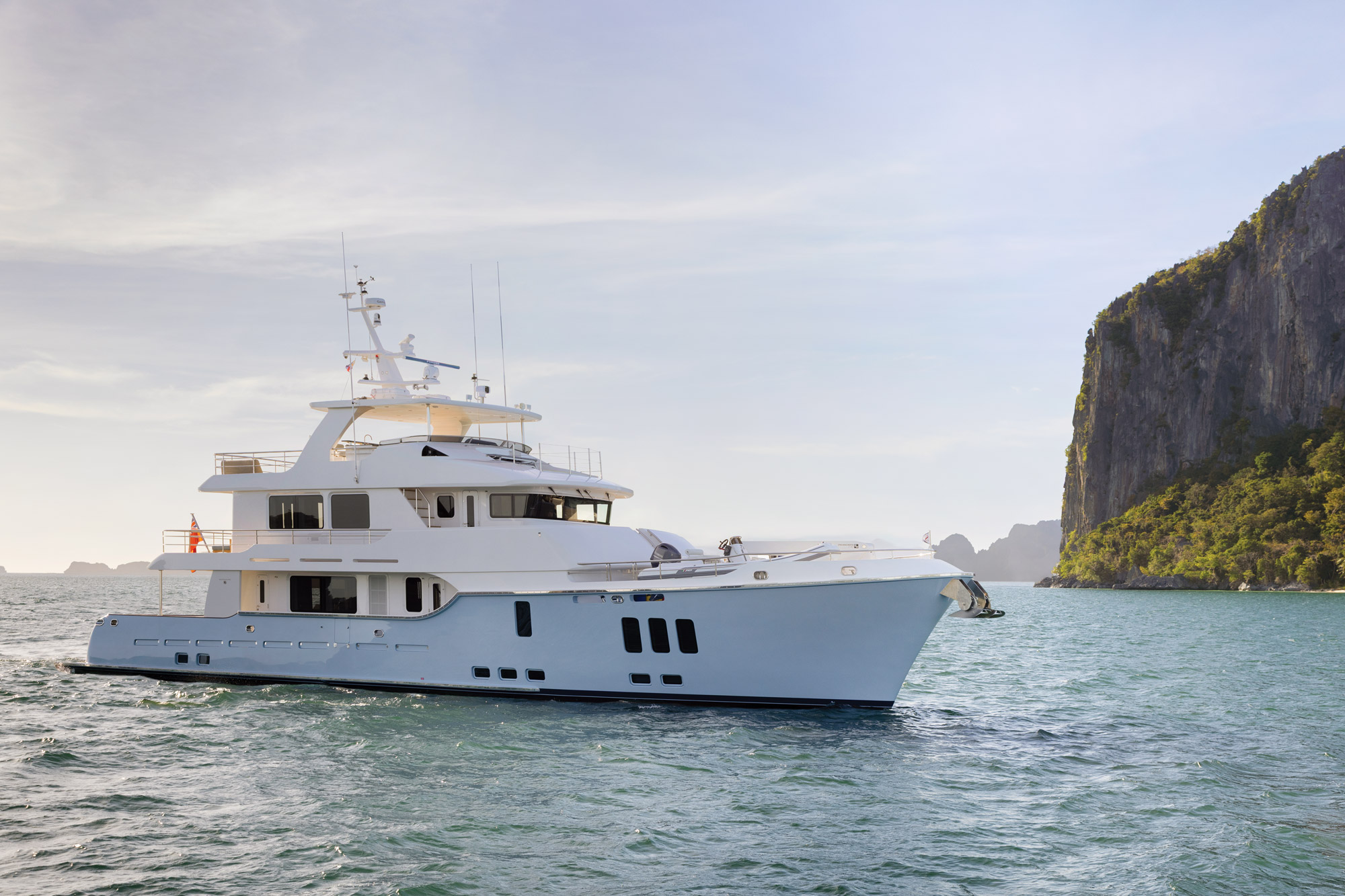
The introduction of the Nordhavn 100 represents a fascinating milestone in the builder’s history. Born not from a sterile drawing board in a corporate office, but from the specific, real-world requests of demanding clients, this 100-foot expedition marvel is an evolutionary leap forward from the highly respected Nordhavn 96. Boasting a formidable 400,000-pound displacement, twin 600-horsepower Caterpillar C18 engines, and a massive 7,000-gallon fuel capacity, the Nordhavn 100 is engineered to go virtually anywhere on the planet—and to do so with supreme comfort, safety, and operational independence.
This comprehensive report examines the design origins, technical specifications, operational capabilities, and future outlook of the Nordhavn 100. By tracing its lineage from a custom one-off modification to a fully realized production model, we explore how this vessel redefines what is possible in contemporary yachting design.
Detailed Chronology: From the N96 Blueprint to the Nordhavn 100
To understand the Nordhavn 100, one must first understand the platform from which it evolved: the Nordhavn 96. The N96 has long been celebrated as a masterpiece of expedition design, offering an exceptional balance of interior volume, seakeeping ability, and transoceanic range. However, as with many custom and semi-custom builds, clients often approach the yard with unique operational visions that push standard boundaries.
The Genesis: The Yachtfish Request
The story of the Nordhavn 100 began not with a master plan for a new hull model, but with a single fishing enthusiast. This client approached Nordhavn with a specific request: they loved the layout and capabilities of the N96, but they needed an extended cockpit to accommodate serious sportfishing activities.
Nordhavn’s engineering and design teams rose to the occasion, modifying the platform to stretch the vessel to an overall length of 100 feet. While the yard successfully delivered this custom yachtfish configuration, the initial expectation within the company was that this would remain a singular, one-off project. Project manager Trever Smith notes that the team did not anticipate a wider market for a 100-foot yachtfish, given that this specialized layout appeals to a relatively niche demographic within the broader superyacht community.
The Evolution: Refining the Pure Motoryacht Configuration
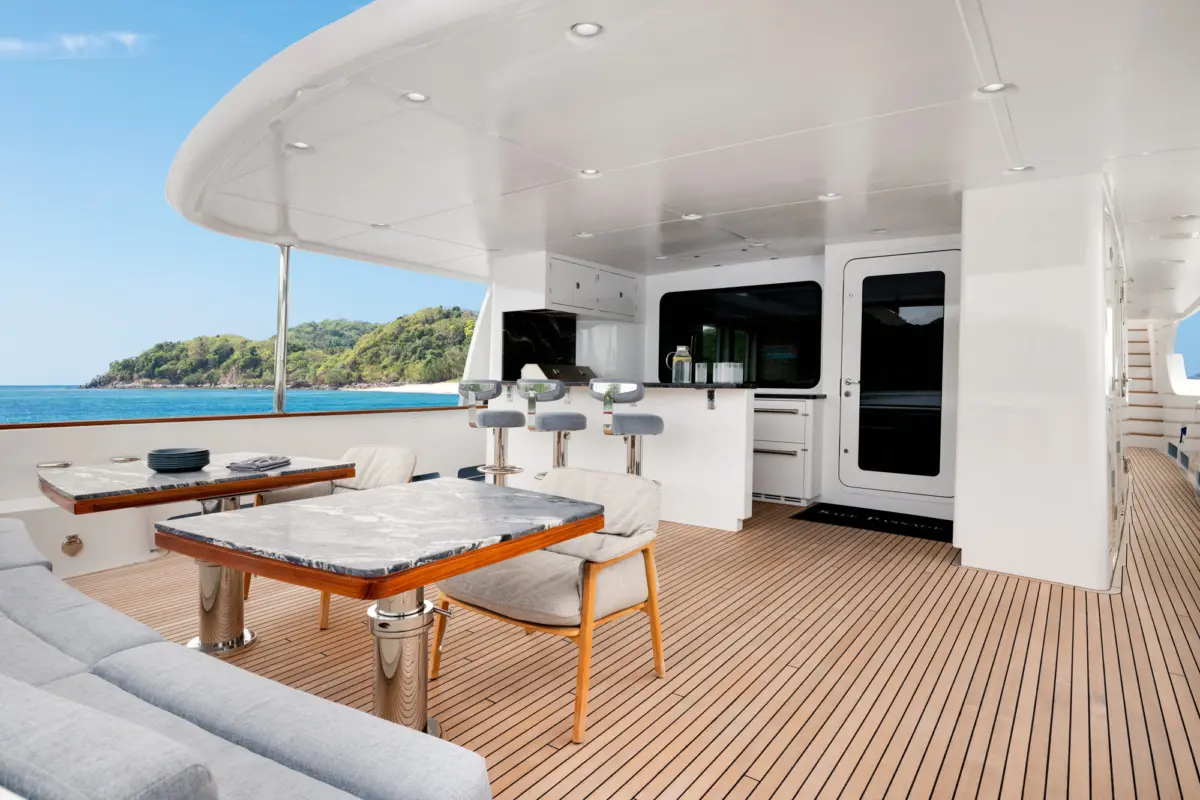
As is often the case in the custom yacht sector, success breeds attention. Soon after the first modified hull was delivered, a second client approached Nordhavn with a different set of priorities. This owner was drawn to the expanded footprint of the 100-foot hull, but their goals did not center on fishing. Instead, they wanted enhanced living spaces: more volume in the lazarette, a larger salon for entertaining, and an expanded main cockpit for alfresco dining and relaxation.
Recognizing that the foundational engineering for a 100-foot hull had already been proven, the design team pivoted. As Smith points out, the yard had already tackled the structural modifications for a stretched platform; now, they could apply those lessons to create a true motoryacht version.
This pivot resulted in the official birth of the Nordhavn 100. Rather than simply stretching the stern for fishing gear, the design team utilized the extra length to systematically reconfigure and optimize multiple zones throughout the vessel. The salon was given significantly more breathing room, the upper aft and flybridge decks were extended to provide superior exterior real estate, and the crew quarters were entirely reimagined to meet the demands of professional crew members operating in remote corners of the globe.
Supporting Context & Metrics: Architecture, Propulsion, and Range
The Nordhavn 100 is an imposing vessel, but its size is entirely functional, driven by the physics of displacement cruising and long-duration voyaging. Every inch of its architecture and every mechanical system has been specified to ensure reliability when thousands of miles away from the nearest service yard.
Hull Numbering and Design Nomenclature
Navigating the hull numbering system of the Nordhavn fleet reveals the organic nature of the company’s manufacturing history. Because hulls are often customized or updated over time, designations reflect both design lineage and overall length milestones.
Earlier models of the Nordhavn 96 that featured custom cockpit extensions were designated as Hull 100#15 to reflect their true length overall (LOA). Consequently, the newly formalized Nordhavn 100 production model has been assigned the hull number 100#20. This numbering underscores that while the vessel is built on a lineage of proven hulls, it represents an entirely distinct generation of interior volume management and deck layout optimization.
Propulsion and Machinery
Powering a 400,000-pound displacement vessel requires a powerplant that prioritizes torque, reliability, and fuel efficiency over high-speed planing performance. The Nordhavn 100 relies on twin Caterpillar C18 engines, each rated at 600 horsepower.
The choice of the C18 platform is deliberate. Caterpillar marine engines are legendary for their durability, global parts availability, and ease of maintenance by local technicians anywhere in the world. Operating at displacement speeds, these engines sip fuel while providing the steady, unwavering thrust needed to push a massive steel or composite-reinforced hull through heavy seas.
Fuel Capacity and Transoceanic Range
Self-sufficiency is the ultimate luxury in modern expedition yachting. The Nordhavn 100 carries an astonishing 7,000 gallons of fuel in its tanks. Combined with the efficient fuel burn of its twin Cat C18s at displacement speeds, this massive bunker capacity translates into transatlantic—and potentially transpacific—range without the need for frequent refueling stops. Owners can set off from major yachting hubs and venture deep into remote island chains, polar regions, or developing coastal areas with absolute peace of mind.
Tender Towing and Exploration Independence
One of the defining operational characteristics of the Nordhavn 100 is its ability to serve as a true mothership for extensive secondary watercraft. With a displacement of 400,000 pounds, the vessel possesses the structural mass, towing bitts, and crane capacity required to pull a sizable tender—specifically, a 35-foot tender—anywhere in the world.
This capability fundamentally changes how owners and their guests experience cruising. As Smith explains, an experienced owner can anchor the mothership in a secure, protected bay and deploy the 35-foot tender, which features its own dedicated cabin. Guests can board the tender for day-long excursions, fishing trips, or diving expeditions into shallow or remote waters. They enjoy complete freedom to explore areas that would be inaccessible to a 100-foot vessel, returning to the climate-controlled comfort, hot showers, and gourmet galley of the Nordhavn 100 by evening.
Official Statements & Insights from the Yard
The philosophy driving the Nordhavn 100 is perhaps best understood through the perspectives of the people who build, manage, and sail her. Project manager Trever Smith offers critical insights into how client interactions shape the yard’s output and how these vessels perform in the wild.
On Market Expectations vs. Reality
When asked about the initial reluctance of the yard to market a 100-foot variant, Smith is candid:
"We weren’t really thinking that model would take off because there’s not a lot of people who want a 100-foot yachtfish."
However, listening closely to client feedback allowed Nordhavn to recognize a latent demand for increased volume. By transforming the concept from a niche fishing platform into a fully fledged, voluminous motoryacht, the yard tapped into a broader segment of the adventure-yachting market.
Reimagining Crew Comfort
In designing superyachts for remote exploration, crew welfare is just as important as guest luxury. On long voyages, a professional crew must be well-rested, comfortable, and equipped with the right spaces to manage shipboard operations. Smith highlights the specific improvements made to the crew quarters on the Nordhavn 100 compared to its predecessor:
"The 96 had a bench with a little table. This is a proper settee with a big table. You can have four crew there with iPads and laptops out working."
This upgrade reflects the modern reality of superyacht operations, where crew members manage complex navigation software, automated systems, and administrative logistics while underway.
Real-World Cruising: The Philippines Expedition
The ultimate test of any expedition yacht is how it performs when taken far outside traditional cruising grounds. At the time of this writing, the owners of Hull No. 1 were putting their Nordhavn 100 through its paces in the Philippines—a cruising ground famous for its staggering biodiversity, complex navigational waters, and scarcity of large-scale superyacht infrastructure.
Smith notes that motoryachts of this caliber are exceedingly rare in those waters:
"It’s mostly sailboat people and smaller yachts. Anywhere you go with something like this where you’re self-contained, it’s amazing. It’s like Jurassic Park. It’s insane."
This quote encapsulates the core appeal of the Nordhavn 100. It is designed precisely for owners who are tired of the crowded marinas of the Mediterranean or the Caribbean, preferring instead to navigate pristine, untouched ecosystems where self-reliance is the price of admission.
Future Outlook: The Expanding Horizon of Expedition Yachting
As the superyacht industry continues to evolve, the definition of luxury is undergoing a profound transformation. While marble countertops, gold-plated fixtures, and high-speed coastal hopping once defined the pinnacle of yacht ownership, a new generation of buyers values autonomy, experiential travel, and geographical freedom above all else.
The Nordhavn 100 sits at the bleeding edge of this cultural shift. By taking the proven, commercial-grade engineering principles of traditional trawlers and packaging them inside an expansive, highly refined 100-foot platform, Nordhavn has created a vessel that bridges two distinct worlds. It offers the interior volume, entertaining spaces, and crew accommodations expected of a modern superyacht, combined with the indestructible build quality and transoceanic range of a mini-ship.
What Lies Ahead for the 100-Foot Platform
With Hull 100#20 now setting a new benchmark for layout and volume, the trajectory for future hulls looks exceptionally bright. As more owners seek out remote cruising grounds in Southeast Asia, the South Pacific, Alaska, and high-latitude northern routes, the demand for self-contained exploration platforms is expected to grow.
Furthermore, the design flexibility demonstrated in the transition from the N96 to the Nordhavn 100 proves that the yard is uniquely positioned to adapt to individual client requirements without compromising the underlying structural integrity of the hull. Whether configured for family world-cruising, extended diving expeditions, or remote wildlife photography, the platform can absorb custom demands while maintaining its core mission: safe, comfortable passage-making across any ocean on Earth.
Conclusion
In the final analysis, the Nordhavn 100 is much more than an exercise in stretching a successful hull design. It is a testament to the power of listening to clients, respecting the laws of marine architecture, and refusing to compromise on seaworthiness. Powered by reliable Caterpillar iron, carrying thousands of gallons of fuel, capable of towing a fully equipped 35-foot tender, and offering living spaces that rival yachts twice its size, the Nordhavn 100 ensures that the horizon is never a barrier—only an invitation.