






Executive Overview
In an era where the maritime sector faces unprecedented pressure to align with global climate targets, localized and operational decarbonization efforts have emerged as critical battlefields in the war against greenhouse gas (GHG) emissions. On August 14, 2026, SAAM Towage, a leading provider of harbor towage services in the Americas, was officially awarded the "Carbon Footprint Reduction" certification (Level 3) by Panama’s Ministry of the Environment (Ministerio de Ambiente – MiAmbiente). This prestigious accolade, conferred under the national "Reduce Your Corporate Carbon Footprint" (Reduce Tu Huella Corporativa – RTH) program, marks a significant milestone in the greening of auxiliary maritime services in one of the world’s most critical logistical transit hubs.
The Level 3 certification recognizes SAAM Towage’s verifiable success in reducing its operational carbon emissions across its Panamanian fleet during the 2024 and 2025 reporting periods. Unlike basic environmental acknowledgments that merely reward intent or reporting, the Level 3 distinction requires rigorous mathematical proof of absolute and relative emissions reductions. It certifies that the company has not only meticulously measured its Scope 1 (direct) and Scope 2 (indirect) emissions but has also designed, financed, and executed highly effective mitigation protocols.
Supported by major international institutions, including the United Nations Development Programme (UNDP) and the Inter-American Development Bank (IDB), Panama’s Reduce Tu Huella initiative serves as a blueprint for public-private collaboration in developing markets. For SAAM Towage, which operates a massive fleet of tugs across North, Central, and South America, this achievement in Panama validates its broader corporate ESG (Environmental, Social, and Governance) strategy. It underscores a growing industry reality: the path to net-zero shipping relies heavily on the decarbonization of harbor craft, which operate continuously within ecologically sensitive coastal zones and bustling urban port environments.
Detailed Chronology: The Path to Level 3 Certification (2024–2026)
The journey to securing the Level 3 Carbon Footprint Reduction award was the culmination of a multi-year, data-driven operational overhaul initiated by SAAM Towage Panama. The timeline below outlines the critical milestones that defined this transition.
[Late 2023] ----------------> [2024] ----------------------> [2025] ----------------------> [Mid-2026]
Baseline Audits &            Implementation of Eco-Draft    Expansion of Alternative Fuel  Independent Auditing &
RTH Program Enrollment       & Digital Optimization         Tests & Real-Time Monitoring   Level 3 Award Conferred
Phase 1: Baseline Audits and RTH Program Enrollment (Late 2023)
Prior to implementing active reduction strategies, SAAM Towage undertook a comprehensive inventory of its energy consumption in Panamanian waters. Working in tandem with local environmental consultants and aligned with the Greenhouse Gas Protocol, the company measured fuel burn, auxiliary engine usage, and port-side electricity consumption across its entire local fleet. By late 2023, these baselines were formally registered with Panama’s Ministry of the Environment, satisfying the requirements for Level 1 (Inventory) and Level 2 (Verification) of the Reduce Tu Huella framework.
Phase 2: Operational Optimization and Eco-Drafting (2024)
Throughout 2024, SAAM Towage introduced targeted operational modifications to reduce fuel consumption—the primary driver of its Scope 1 emissions.
- Optimized Transit Speeds: Tugs frequently transit between berths and incoming vessels at speeds that exceed operational necessity. By implementing strict speed-cap policies during non-revenue transits, the company achieved immediate double-digit fuel savings.
- Hull and Propeller Maintenance: Biofouling on tug hulls dramatically increases hydrodynamic drag. SAAM instituted accelerated hull-cleaning schedules and utilized advanced non-toxic anti-fouling coatings to maintain optimal hydrodynamics.
- Digitalization of Dispatch: By integrating real-time logistical data from port authorities, dispatchers minimized the time tugs spent idling at sea while waiting for incoming container ships.
Phase 3: Technological Upgrades and Alternative Fuel Trials (2025)
Building on the operational adjustments of 2024, the company turned its focus to technological interventions in 2025.
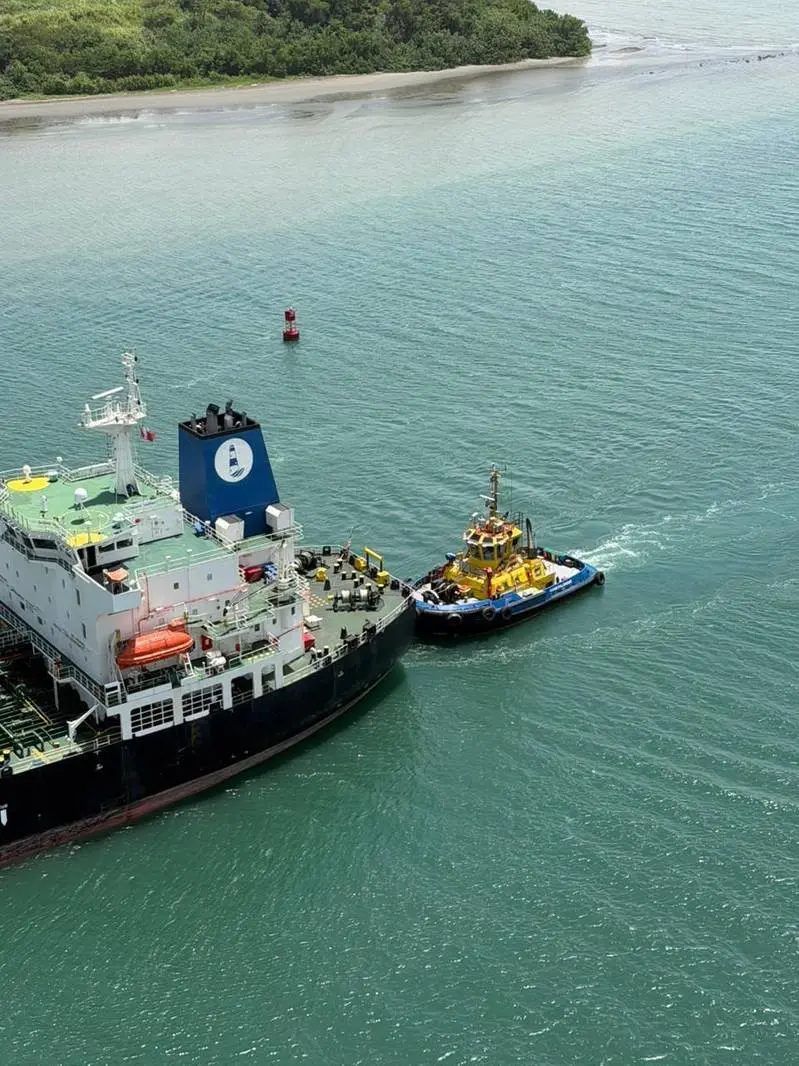
- Auxiliary Engine Management: Tugs require significant power even when stationary to run onboard systems. SAAM optimized the use of smaller, highly efficient auxiliary generators, allowing the massive main propulsion engines to be completely shut down during standby periods.
- Shore-Power Integration: Wherever port infrastructure allowed, SAAM utilized shore-side electrical grids (cold ironing) to power vessels at berth, effectively shifting energy demand from marine diesel to Panama’s increasingly renewable national grid.
- Data-Driven Feedback Loops: Real-time fuel flow meters were installed across key vessels, providing captains with immediate visual feedback on how specific maneuvering decisions impacted fuel burn.
Phase 4: Independent Auditing and Conferral (Mid-2026)
In early 2026, SAAM Towage submitted its consolidated emissions data for the 2024–2025 period to MiAmbiente. The data underwent rigorous third-party auditing to ensure compliance with ISO 14064 standards (greenhouse gas validation and verification). The audits confirmed a measurable, sustained downward trajectory in carbon intensity per maneuver. Consequently, on August 14, 2026, the Ministry officially conferred the Level 3 "Carbon Footprint Reduction" award.
Supporting Context & Metrics: The Mechanics of "Reduce Tu Huella"
To appreciate the significance of SAAM Towage’s achievement, it is necessary to examine the architecture of Panama’s national decarbonization framework and the specific metrics that govern maritime operations.
Understanding the "Reduce Tu Huella Corporativa" Framework
The Reduce Tu Huella program is a cornerstone of Panama’s national strategy to maintain its status as one of the world’s few carbon-negative countries. Developed by MiAmbiente with technical and financial backing from the UNDP and the IDB, the program incentivizes the private sector to systematically manage carbon outputs. The framework is structured into four progressive tiers:
| Level | Classification | Key Requirements | SAAM Towage Status |
|---|---|---|---|
| Level 1 | Quantification | Establish a verified greenhouse gas inventory covering Scopes 1 and 2. | Achieved (2023) |
| Level 2 | Verification | Subject the inventory to independent, accredited third-party auditing. | Achieved (2023) |
| Level 3 | Reduction | Demonstrate absolute or intensity-based GHG reductions over consecutive years. | Achieved (August 2026) |
| Level 4 | Neutralization | Offset all remaining residual emissions using high-integrity, local carbon offsets. | Target (Future Phase) |
The Unique Challenge of Towage Decarbonization
Harbor tugs present a unique engineering challenge for decarbonization. Unlike ocean-going merchant vessels that operate at a steady state for days or weeks, tugs operate in short, violent bursts of extreme power.
Typical Tug Operating Profile:
[ Low-load Standby / Idling ] ===> [ Rapid Transit to Vessel ] ===> [ Peak-load Maneuvering / Pushing ]
          (50-60% of time)                 (20-30% of time)                   (10-20% of time)
A tug must transition from low-load standby idling to peak-load pushing (requiring thousands of horsepower and maximum bollard pull) within minutes. This highly variable duty cycle makes conventional efficiency measures—such as wind-assisted propulsion or waste-heat recovery systems—highly impractical.
Furthermore, because tugs operate within confined port waters, their localized emissions (including particulate matter, sulfur oxides, and nitrogen oxides) directly impact air quality in coastal communities. Therefore, reducing fuel burn through operational optimization not only mitigates global carbon dioxide levels but also yields immediate local environmental and public health benefits.
Technical Challenges and Solutions in Towage Decarbonization
While the Level 3 award celebrates SAAM’s success, achieving these reductions required navigating significant operational and technical hurdles.
1. Managing the Standby Idling Dilemma
Historically, tugs have kept their massive medium-speed diesel engines running during standby hours to ensure instant operational readiness. Shutting down and restarting these engines frequently can cause thermal stress and increase wear on critical components.
- The Solution: SAAM implemented advanced engine pre-heating systems and automated start-stop protocols. By keeping the engine blocks warm using highly efficient auxiliary heaters, captains could safely shut down the main engines during extended standby periods, secure in the knowledge that they could bring the vessel to full power rapidly when dispatched.
2. The Capital Expenditure (CapEx) vs. Operational Expenditure (OpEx) Balance
Retrofitting older vessels with modern emissions-reduction technology is capital-intensive. In a highly competitive towage market where margins are constantly squeezed by fluctuating global trade volumes, justifying green CapEx requires clear long-term financial viability.

- The Solution: SAAM focused on high-yield, low-CapEx solutions first—such as digital optimization and hydrodynamics—before committing to heavy hardware retrofits. The fuel savings realized in the 2024 operating period directly offset the capital required for the advanced telemetry and fuel monitoring systems installed in 2025, creating a self-funding loop of sustainability.
Strategic and Institutional Context: The Role of UNDP, IDB, and the Panama Canal
The broader significance of SAAM Towage’s award lies in its alignment with global trade logistics and international climate finance.
The Geopolitical Engine: The Panama Canal
Panama is not merely a nation; it is the throat of global maritime commerce. With over 12,000 vessels transiting the Panama Canal annually, the country has positioned itself as a champion of "green shipping corridors." The Panama Canal Authority (ACP) has introduced various incentives, such as the Green Connection Award, to reward environmentally friendly vessels.
By greening the harbor tugs that assist these massive container ships, LNG carriers, and bulkers into Panamanian ports and through the Canal’s access channels, SAAM Towage is directly lowering the "Scope 3" emissions of the global shipping lines that utilize the transit zone. A green supply chain is only as strong as its weakest link; greening auxiliary port services ensures that the benefits of low-emission ocean voyages are not compromised during the final mile of port entry.
Global Shipping Line (Low-Emission Ocean Voyage)
                    │
                    ▼
     [ Port Entry / Canal Transit ]  <--- Greened by SAAM Towage (Level 3 Certified)
                    │
                    ▼
       Decarbonized Supply Chain
Institutional Backing: UNDP and IDB
The involvement of the United Nations Development Programme (UNDP) and the Inter-American Development Bank (IDB) in the Reduce Tu Huella program highlights the importance of blended climate finance and structured frameworks in developing markets. These organizations provide the technical expertise, capacity building, and validation methodologies that give international credibility to Panama’s national certifications. For multinational corporations and global investors, a certification backed by the UNDP and IDB carries a level of assurance that mitigates risks associated with "greenwashing."
Official Statements and Institutional Reactions
The conferral of the Level 3 award elicited strong supportive statements from both corporate leaders and government officials, highlighting the collaborative spirit of the initiative.
A spokesperson for the Ministry of the Environment of Panama emphasized the role of the private sector in achieving national climate targets:
"Panama is committed to remaining a global leader in carbon negativity, but government policy alone cannot bridge the gap to absolute sustainability. The active participation of industry leaders like SAAM Towage demonstrates that economic viability and environmental stewardship can coexist. The Level 3 certification under the Reduce Tu Huella program is not a gift; it is a hard-won recognition of measurable, verified progress that sets a standard for maritime operators across the region."
On behalf of SAAM Towage, regional leadership expressed pride in the operational teams that drove the changes:
"Receiving the Level 3 Carbon Footprint Reduction award is a testament to the dedication of our crews, engineers, and shore-side managers in Panama. We recognized early on that decarbonization is not a distant goal for 2050—it is an operational reality that we must address today. By systematically measuring our emissions, optimizing our maneuvers, and investing in efficiency, we have proven that harbor towage can play a leading role in greening the global maritime supply chain. This milestone in Panama will serve as a template for our operations throughout the Americas."
Future Outlook: The Horizon of Zero-Emission Marine Operations
As SAAM Towage celebrates its Level 3 milestone, the company’s strategic focus is already shifting toward the next frontiers of maritime sustainability.
The Path to Level 4: Neutralization and Offsetting
Having successfully reduced its emissions intensity, the immediate next step for SAAM Towage in Panama is achieving Level 4 certification under the Reduce Tu Huella framework. This will require the company to offset its remaining, unavoidable residual emissions. To maintain high environmental integrity, SAAM is exploring partnerships with verified local carbon offset projects, including blue carbon initiatives focused on mangrove restoration along Panama’s extensive coastlines. Mangroves are incredibly efficient carbon sinks, sequestering up to ten times more carbon per acre than terrestrial rainforests, while simultaneously protecting coastal communities from erosion and storm surges.
Fleet Electrification and Alternative Fuels
Looking beyond operational optimization and carbon offsetting, the long-term future of harbor towage lies in absolute zero-emission propulsion technologies.
SAAM Towage Decarbonization Evolution:
[ Operational Optimization ] ──> [ Carbon Offsetting (Blue Carbon) ] ──> [ Full Fleet Electrification ]
     (Current Milestone)                  (Near-Term Goal)                     (Long-Term Vision)
SAAM Towage has already established itself as a pioneer in this space. The company successfully deployed some of the world’s first fully electric tugs—the SAAM Dynamo and SAAM Volt—in Canada’s Port of Vancouver. These vessels, developed in collaboration with Robert Allan Ltd. and Corvus Energy, deliver full operational capabilities with zero tailpipe emissions, leveraging British Columbia’s clean hydroelectric power.
The lessons learned from the Canadian electric tug deployments, combined with the operational efficiency frameworks validated in Panama, lay the groundwork for the eventual introduction of electric or hybrid-propulsion tugs to Latin American ports. While challenges remain—most notably the need for high-capacity megawatt charging infrastructure at Panamanian berths—the rapid evolution of battery technology and international climate funding makes the electrification of the Panamanian fleet a highly anticipated medium-term prospect.
Scalability Across the Americas
SAAM Towage operates in over 14 countries across the Americas, managing a fleet of over 180 tugboats. The successful implementation of the Reduce Tu Huella protocols in Panama serves as an invaluable testing ground. The operational methodologies, data collection systems, and crew training programs refined in Panama are highly scalable. They are already being adapted and deployed across SAAM’s operations in Chile, Brazil, Colombia, Mexico, and Canada, creating a unified corporate sustainability framework that elevates the company’s competitive standing in the global maritime market.
As charterers and port authorities increasingly write strict carbon-efficiency clauses into commercial contracts, SAAM Towage’s proactive approach to verified emissions reduction ensures its long-term resilience. By proving that harbor craft can systematically and measurably lower their environmental impact, the company is helping to steer the global maritime industry toward a cleaner, more sustainable horizon.