










Executive Overview
The global electric vehicle (EV) landscape underwent a fascinating structural realignment in July 2026. Worldwide plugin vehicle registrations posted a modest 7% year-over-year (YoY) increase, closing the month at approximately 1.8 million units. Beneath this headline figure, however, lies a tale of two technologies: pure battery-electric vehicles (BEVs) continue to cement their dominance with strong double-digit growth, while plug-in hybrid electric vehicles (PHEVs) remain trapped in a prolonged downturn.
This divergence has driven BEVs to capture 71% of total plugin sales for the month—pushing their year-to-date (YTD) market share to matching heights not seen since 2022. Excluding the unique regulatory and market adjustments happening concurrently in China and the United States, global EV adoption is expanding at an accelerated pace, jumping an astounding 50% YoY in July alone.
More importantly, July 2026 will likely be remembered as the month the traditional hierarchy began to fracture. Propelled by explosive, high-volume production and aggressive global expansion, Chinese startup Leapmotor breached the global top five original equipment manufacturer (OEM) rankings, temporarily pushing Tesla out of the top tier for the first time in nearly a decade. Meanwhile, legacy giants like Toyota and Volkswagen are locked in a razor-thin battle for supremacy, signaling that mass-market adoption is entering a fierce, highly competitive phase where past pedigree guarantees nothing.

Detailed Chronology & Market Dynamics
To understand the health of the 2026 global EV transition, one must examine the starkly contrasting fortunes of BEVs and PHEVs.
The Great Divide: BEVs vs. PHEVs
In July, BEVs experienced robust 16% YoY growth, demonstrating that pure electric mobility remains resilient despite macroeconomic headwinds, high interest rates, and shifting policy frameworks. Conversely, PHEVs suffered an 11% YoY drop, continuing a negative trend that has defined the category since the beginning of the year.
This sustained "PHEV blues" drag has kept overall 2026 plugin vehicle growth restricted to a modest +4% YoY. Yet, strip away the domestic turbulence of China—where PHEV sales have faced sharp corrections—and the United States, where the abrupt expiration of federal tax credits cooled the market (though Q2 showed stabilization compared to a punishing 40% Q1 drop), and the rest of the world is flying high. Globally, excluding the US and China, EV registrations skyrocketed by 50% YoY in July, with pure BEVs surging by 61%.
On a macro level, July’s performance sustained the global plugin market share at an enviable 24% (17% for BEVs and 7% for PHEVs). Put into historical context, the transformation is staggering: five years ago, global EV share hovered at just 6%, while a decade ago, it stood at a meager 1%.
Model-Level Breakdown: Small EVs Are Hot
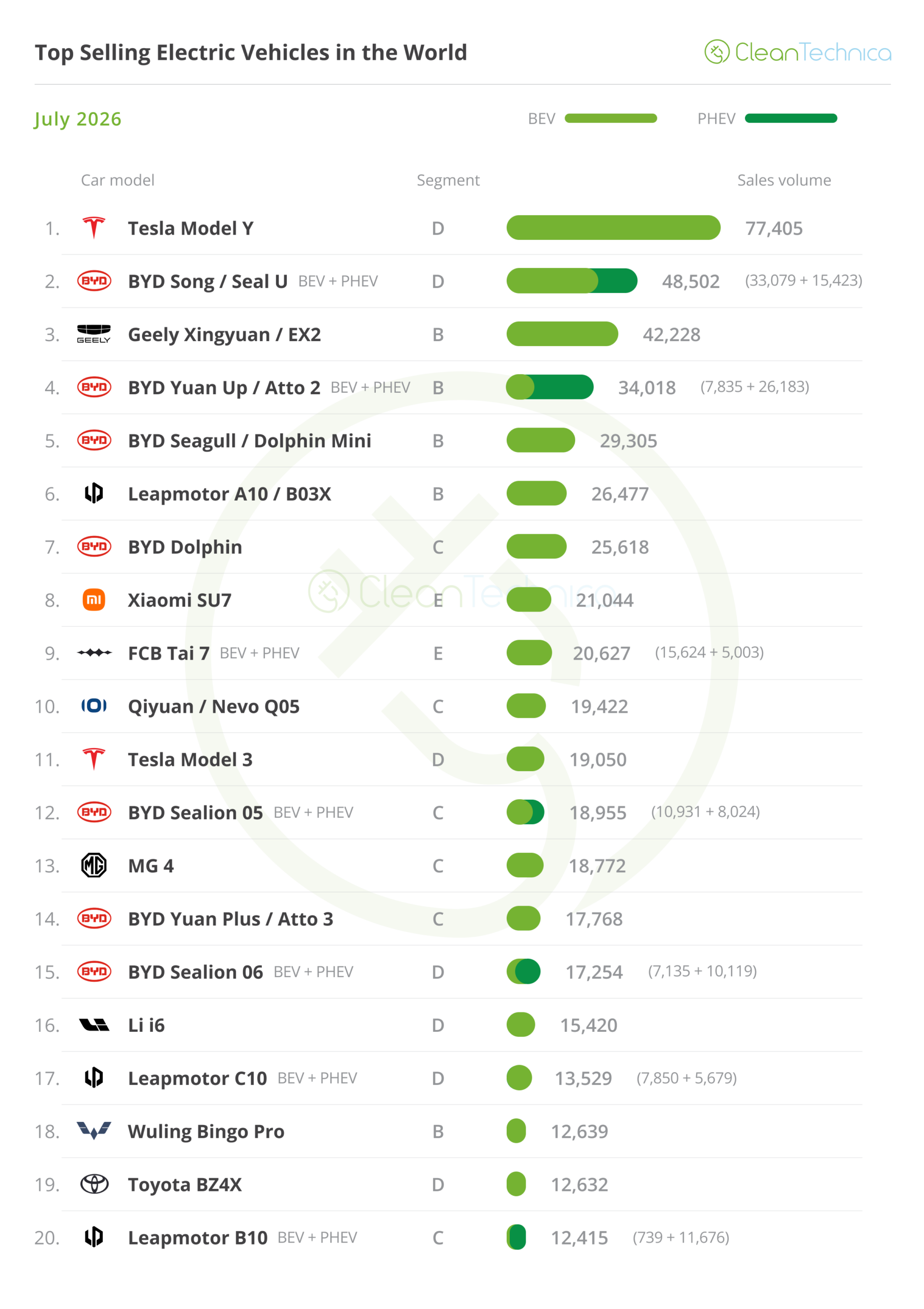
While the Tesla Model Y defended its crown at the top of the global best-sellers list despite a 9% YoY delivery drop, the real story unfolded further down the table.
The Model 3 Slump and the Rise of Compacts
The Tesla Model 3 experienced a severe 44% YoY delivery crash, dropping to 19,000 units and landing in an uncharacteristic 11th place—its lowest standing since January 2018. Even the sporty Xiaomi SU7 outperformed it, securing 8th place with 21,000 units. Analysts attribute Tesla’s temporary slide primarily to production constraints and regional factory retooling rather than structural demand destruction, meaning a rebound is expected by late Q3.
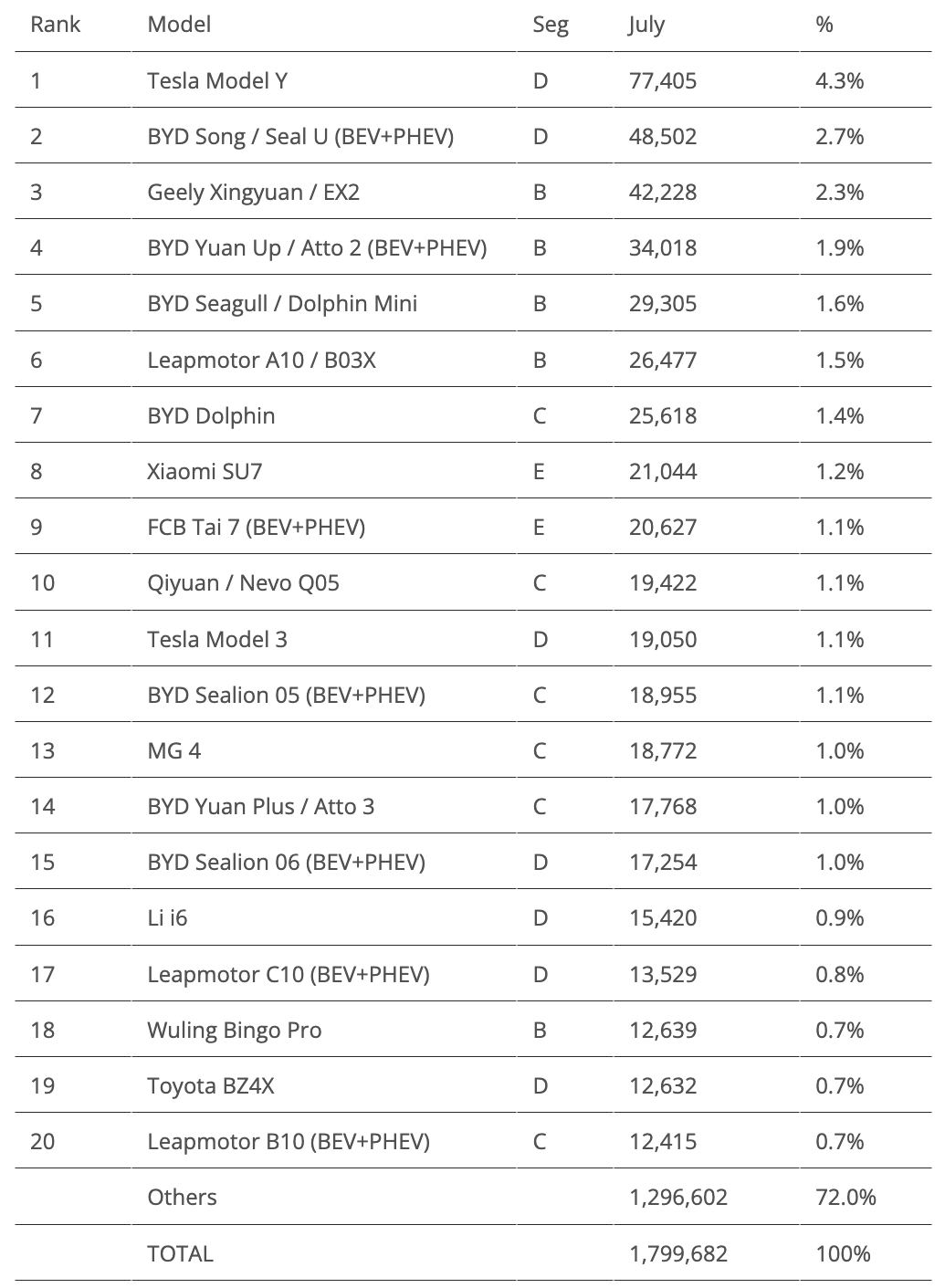
Nevertheless, the Model 3’s temporary absence created a vacuum swiftly filled by an army of small, highly efficient electric vehicles. Positions 3 through 7 were entirely occupied by compact and subcompact offerings:
- #3 Geely Xingyuan
- #4 BYD Yuan Up
- #5 BYD Seagull (marketed locally as the Dolphin Mini, achieving 7,265 registrations in July alone)
- #6 Leapmotor A10 (known internationally as the B03X)
- #7 BYD Dolphin
The dominance of these smaller, accessibly priced vehicles underscores a critical industry milestone: the EV revolution is officially shedding its "elite toy" status and penetrating the mass market.
Export Success Stories
Export markets played a decisive role in July’s model standings. The BYD Dolphin surged to 26,000 registrations—its best performance since last September—bolstered by strong international uptake. South Korea absorbed 1,264 units, while Brazil registered an incredible 6,492 units, fast establishing itself as BYD’s second home turf.
Meanwhile, Leapmotor’s A10 is rapidly turning into an international phenomenon. After securing third place domestically in China, export rollout preparations are underway, positioning the model to challenge for a global top-five spot before the year concludes.
Further up the luxury and crossover spectrum, BYD’s Fang Cheng Bao Tai 7 premium crossover secured 9th place with nearly 21,000 registrations—a new yearly high. As these large off-road-styled plug-in vehicles eye global export markets, legacy brands like Land Rover, Toyota, and Jeep should take immediate notice.
Manufacturer & OEM Showdowns: Leapmotor’s Meteoric Rise
If the model tables showed changing tastes, the manufacturer rankings demonstrated a genuine tectonic shift in global automotive power.
Leapmotor Enters the Big Leagues
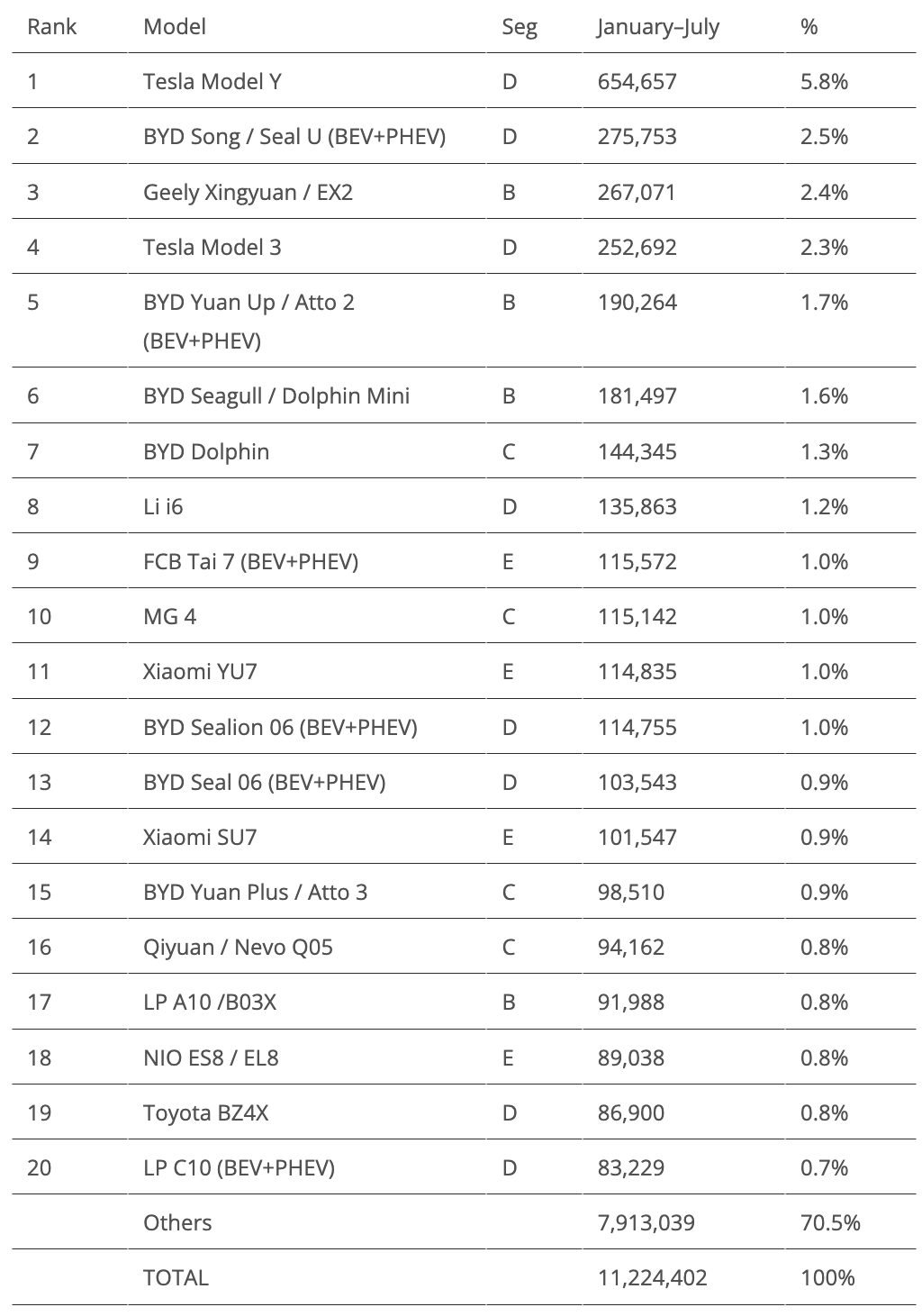
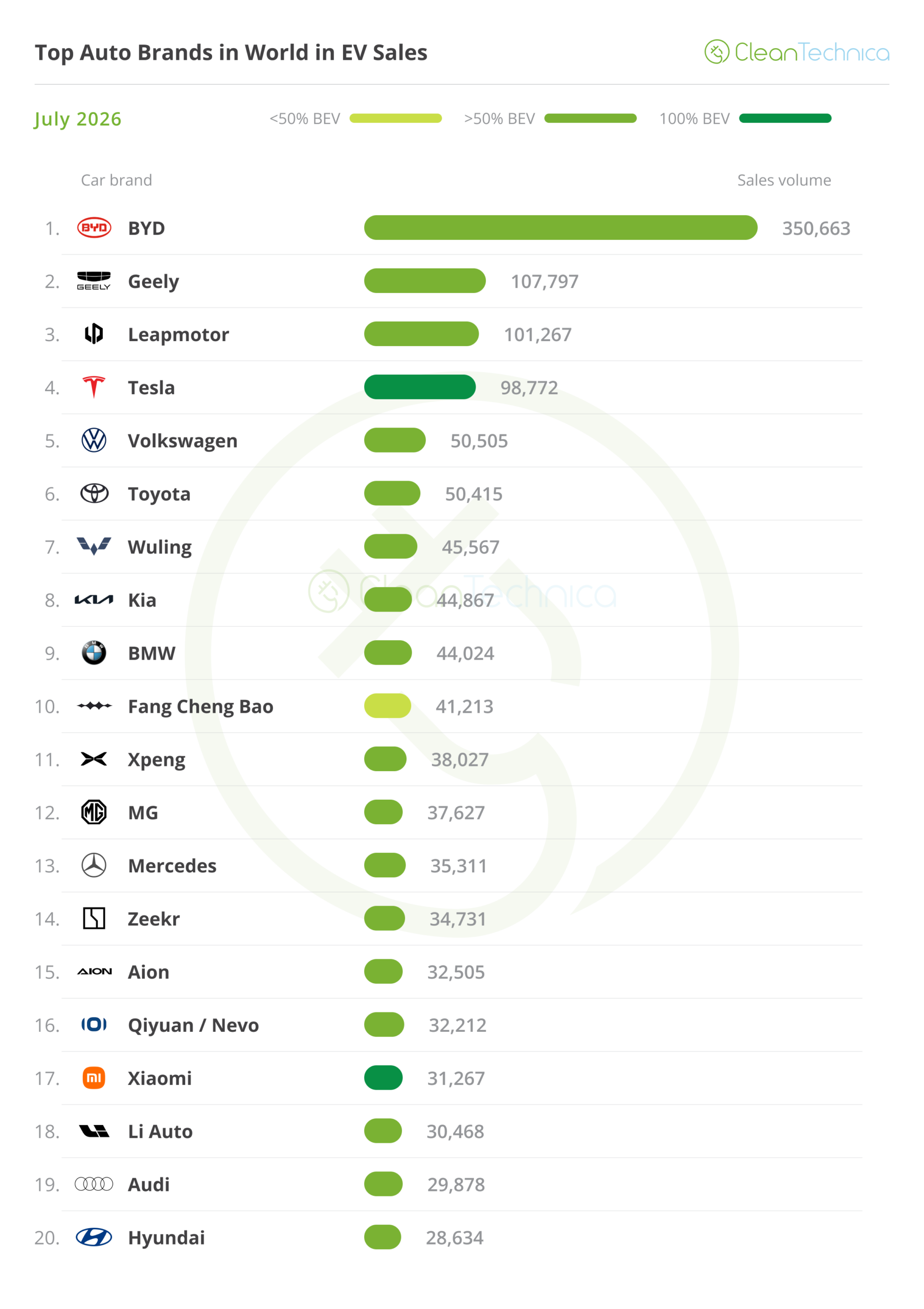
Leapmotor achieved a historic milestone in July, crossing the six-digit monthly delivery threshold for the first time and doubling its output year-over-year (+102%). The startup narrowly missed capturing the global runner-up spot for the month, forcing Geely (which posted 108,000 registrations, its best month since November) into intense competition to protect its turf.
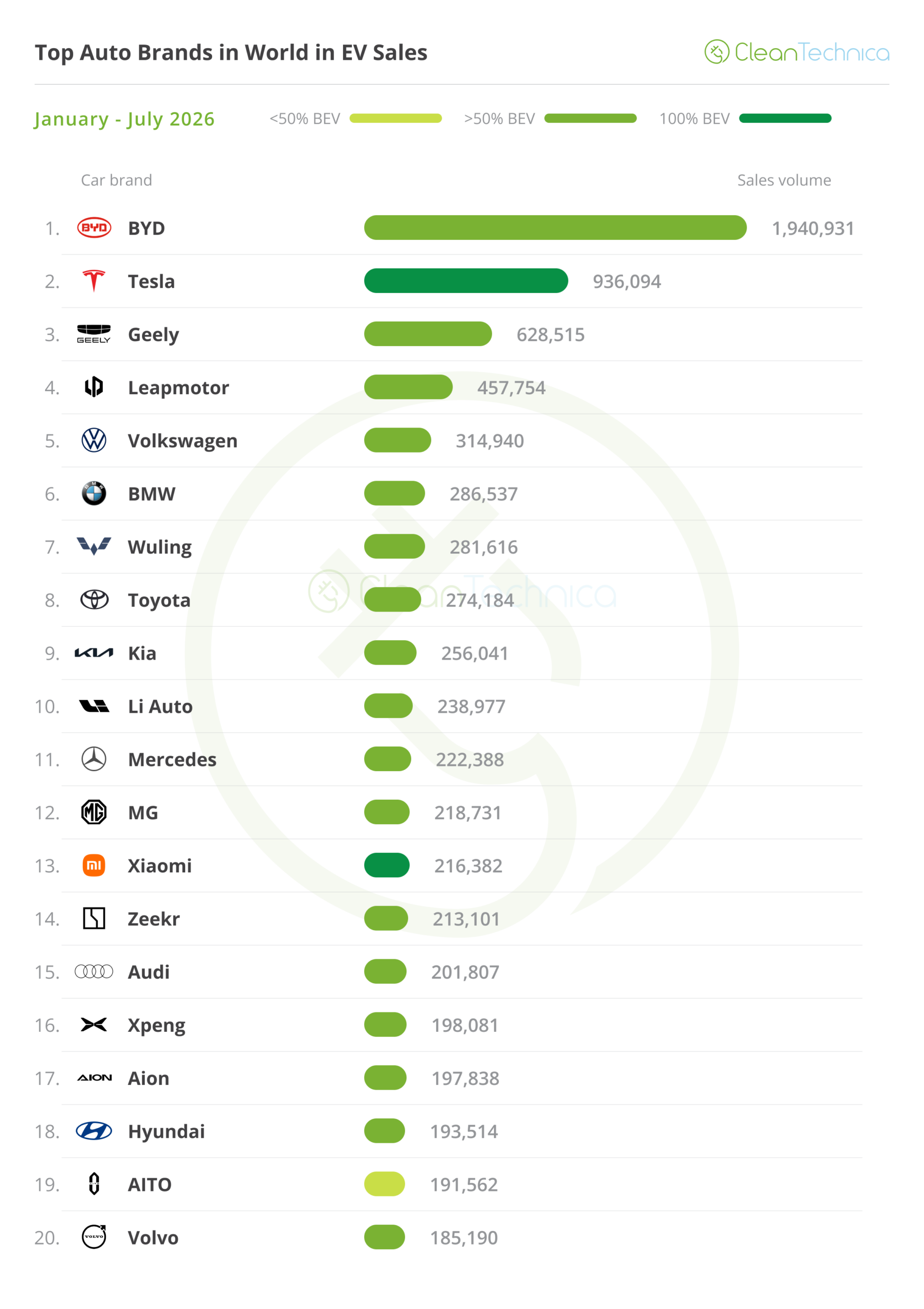
With a relentless pipeline of fresh architecture—including the A10 small crossover, A05 small hatchback, D19 large SUV, and D99 large MPV—Leapmotor is no longer an upstart to be dismissed. In the global OEM plugin rankings, Leapmotor (4.1% market share) officially surpassed Hyundai-Kia to claim the 6th overall spot.
More shockingly, looking strictly at July’s monthly performance, Leapmotor outpaced Tesla, pushing the Texas-based EV pioneer into 6th place for the month—marking the first time in nine years that Tesla has fallen out of the global top five during a regular reporting period. While Tesla’s 19% delivery drop is expected to be temporary, the episode lays bare the vulnerabilities of an aging, highly concentrated product lineup.
The Sleeping Giant Awakens: Toyota vs. Volkswagen
Another compelling battle is unfolding among legacy automotive giants. Toyota notched a record 50,415 registrations in July, putting immense pressure on the Volkswagen Group. VW maintained its 4th-place standing by a margin of fewer than 100 units. Toyota’s aggressive push into dedicated BEVs (such as the 19th-place bZ4X) alongside massive hybrid and PHEV volumes (like the record-breaking RAV4 PHEV at 12,236 units) proves that the world’s largest traditional automaker has fully awakened to the electric era.
Supporting Context & Metrics
A granular review of the 2026 data highlights several underlying structural trends:
- BEV Concentration: Year-to-date BEV registrations have reached approximately 7.9 million units, accounting for 71% of total plugin sales. While reaching 75% by year-end remains a stretch, it would represent the highest pure-electric ratio since 2012.
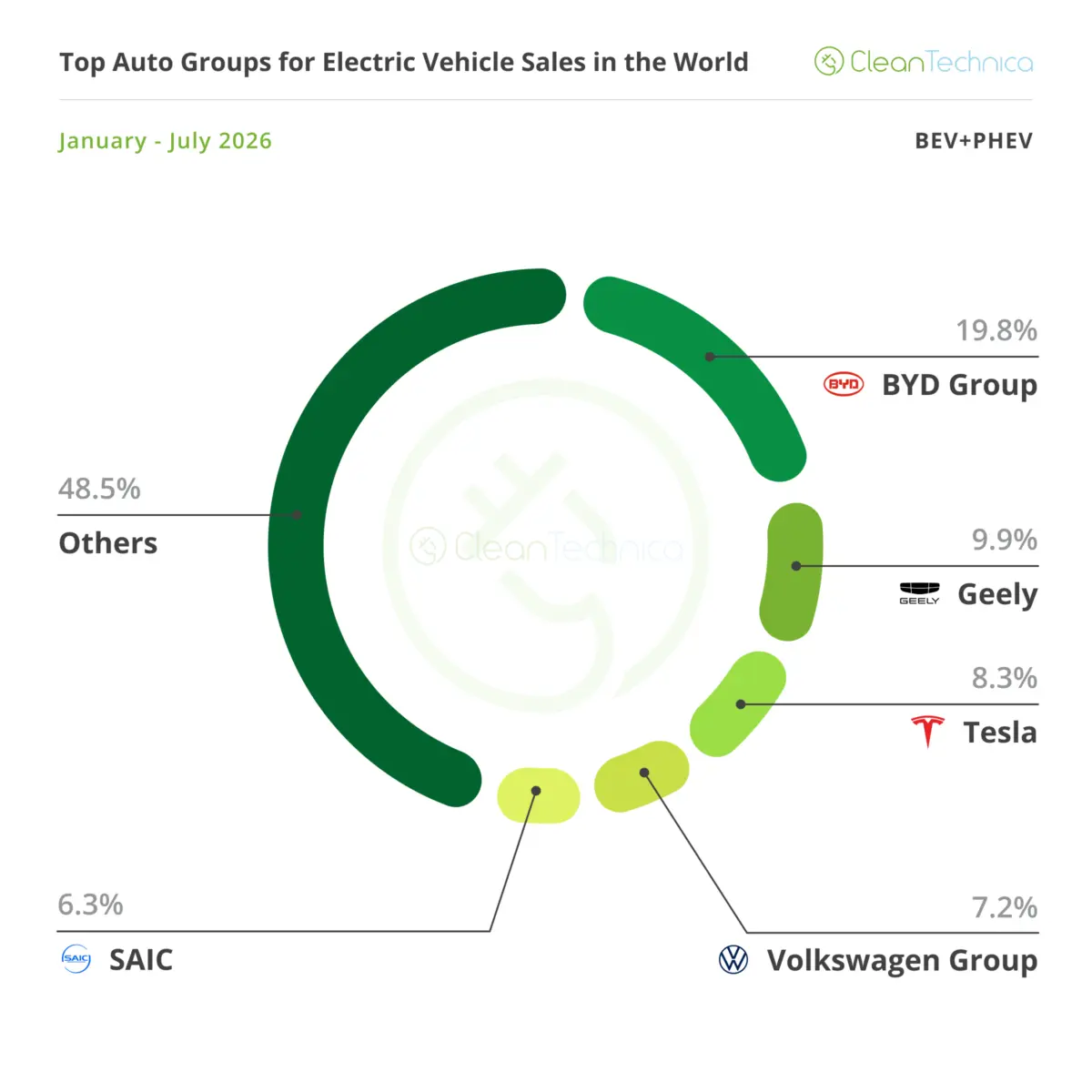
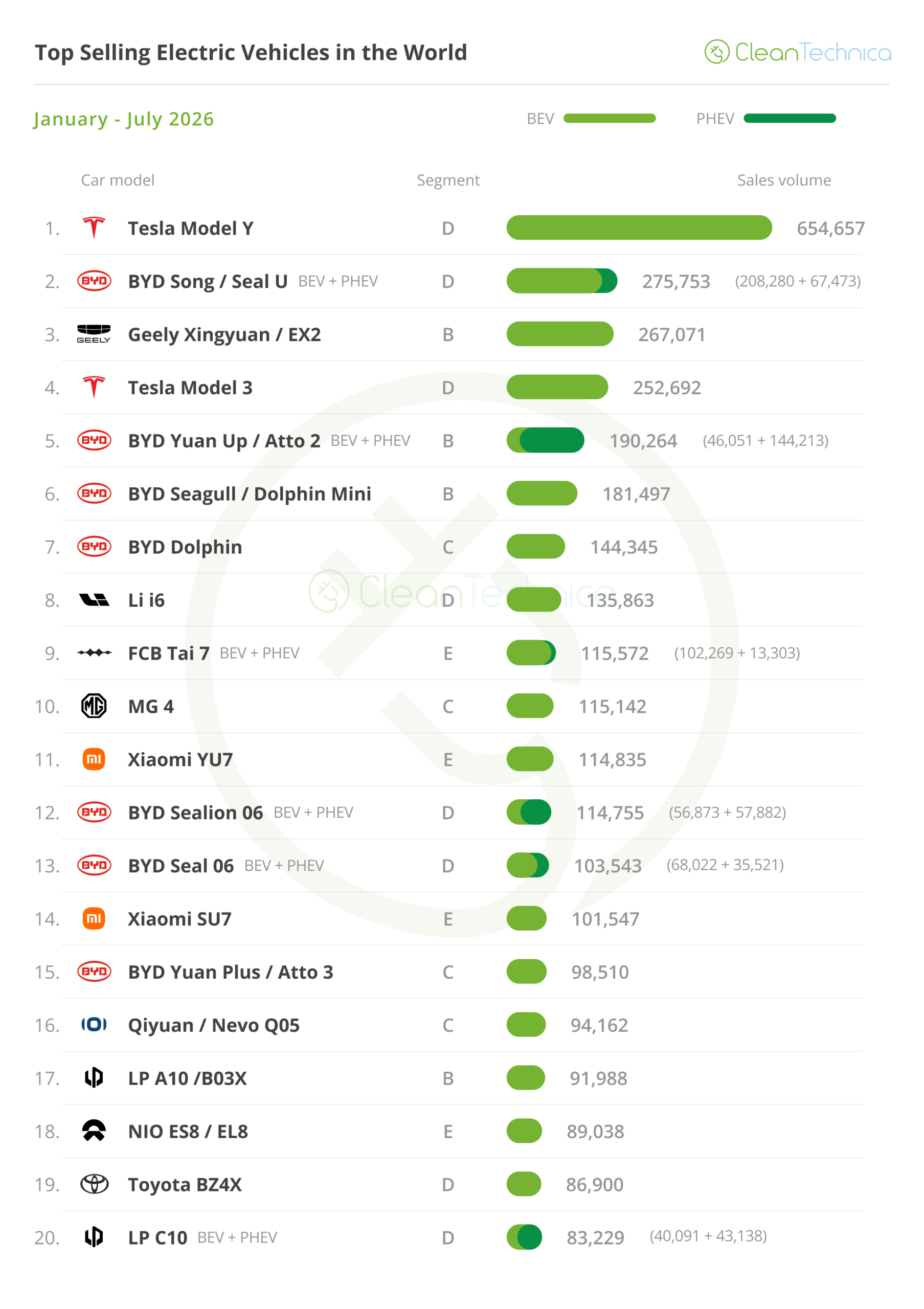
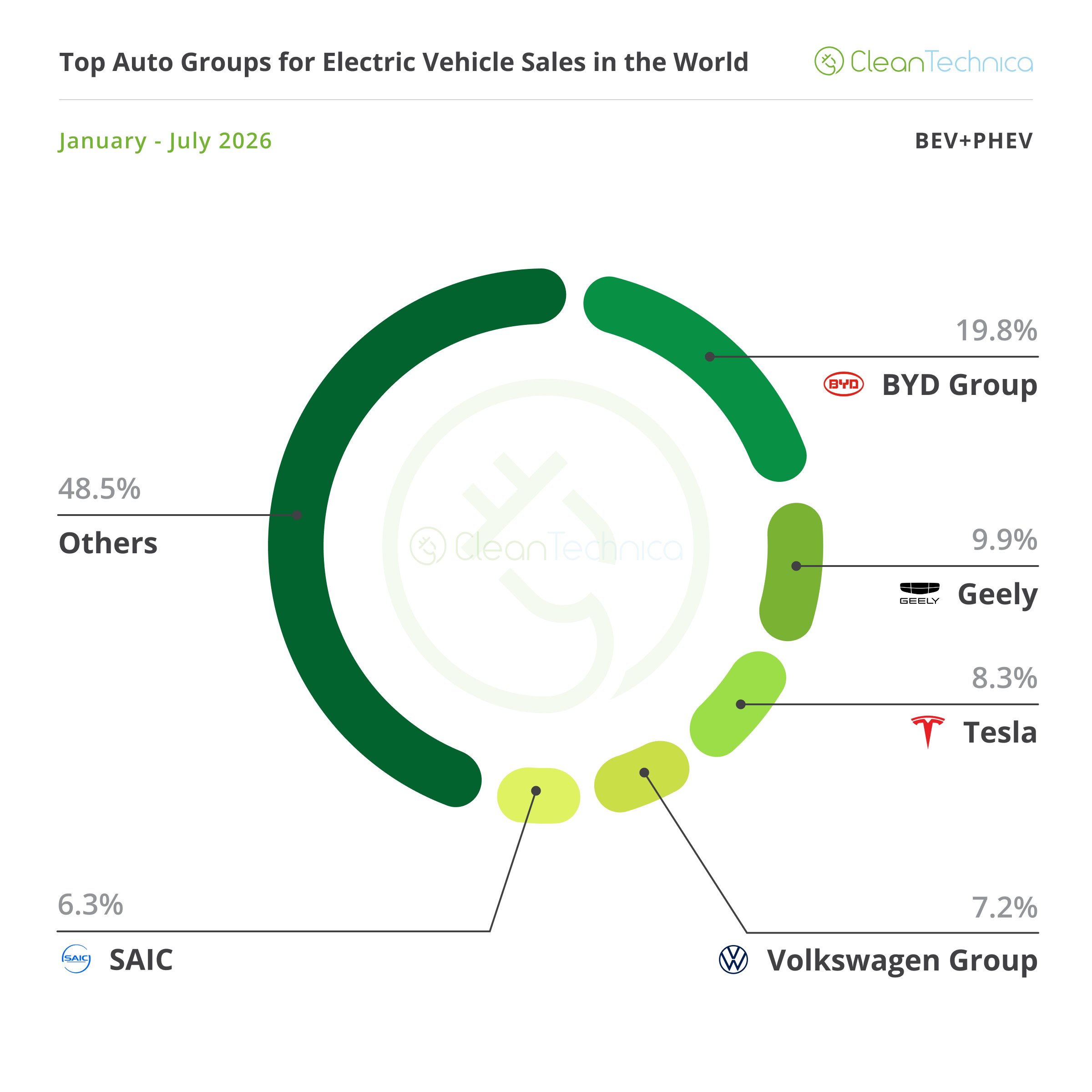
- OEM Dominance (YTD): BYD remains firmly in the driver’s seat with a commanding 19.8% global plugin market share, followed by Geely (9.9%) and Tesla (8.3%). Volkswagen Group holds 4th with 7.2%, and SAIC rounds out the top five with 6.3%.
- The Brand-Level Battleground: The gap between the #20 Leapmotor B10 and the #24 Volkswagen ID.4 was less than 400 units in July, illustrating the hyper-competitive pressure at the bottom of the top-20 threshold. Brands like Xpeng, Changan, and Chery (with its surging Jaecoo 5 crossover) are applying relentless pressure on legacy mainstays.
Official Statements & Industry Perspectives
Industry analysts tracking the 2026 trajectory emphasize that the market has transitioned from early-adopter enthusiasm to pragmatic, utility-driven consumer behavior.
Market observers note that the success of budget-friendly platforms—such as Geely’s Xingyuan and Leapmotor’s expanding stable—proves that long-term survival in the EV space depends on scalable cost-efficiency rather than purely premium positioning.
Furthermore, commentary surrounding legacy manufacturers highlights a stark strategic divide. Brands like Kia, which committed early to a dedicated, modular BEV architecture (encompassing the EV2 through EV9), are reaping robust profits and customer loyalty. Conversely, legacy players that split capital investments too thinly across hydrogen fuel cells, legacy internal combustion engines, and improvised multi-powertrain platforms—such as Hyundai’s mixed-bag approach—risk losing critical ground in high-volume regions.
Future Outlook
As the industry enters the final quarters of 2026, several key storylines will dictate the global trajectory of electric mobility:
- The Bronze Medal Race: While the Tesla Model Y and BYD Song maintain an unassailable lead at the top of the YTD model table, the battle for 3rd place between the Geely Xingyuan and a rebounding Tesla Model 3 will go down to the wire in Q4.
- Leapmotor’s Next Strategic Play: With its multi-segment lineup fully operational, industry analysts are already speculating on Leapmotor’s expansion strategies. Rumors of potential joint ventures or brand acquisitions within Europe—potentially leveraging storied heritage names for premium positioning while retaining Chinese manufacturing scale—could fundamentally reshape the European automotive landscape.
- Legacy Counter-Offensives: With Toyota breathing down Volkswagen’s neck and legacy OEMs slowly scaling dedicated EV platforms, the traditional auto industry is no longer playing catch-up; it is actively fighting for market defense.
The data from July 2026 delivers an unambiguous message: the electric vehicle transition is no longer an emerging trend or an environmental experiment. It is the dominant reality of global transportation, defined by fierce competition, falling cost curves, and the rapid rise of agile new market leaders.