






Executive Overview
The waters off the coast of Monaco have long served as a proving ground for maritime innovation. Dating back to the world’s inaugural international powerboat race in 1904, the principality’s shores demand excellence, durability, and raw speed. During the 13th annual Monaco Energy Boat Challenge (MEBC), hosted by the prestigious Yacht Club de Monaco (YCM) from July 8 to 11, that historic course bore witness to a paradigm-shifting milestone for zero-emission marine mobility.
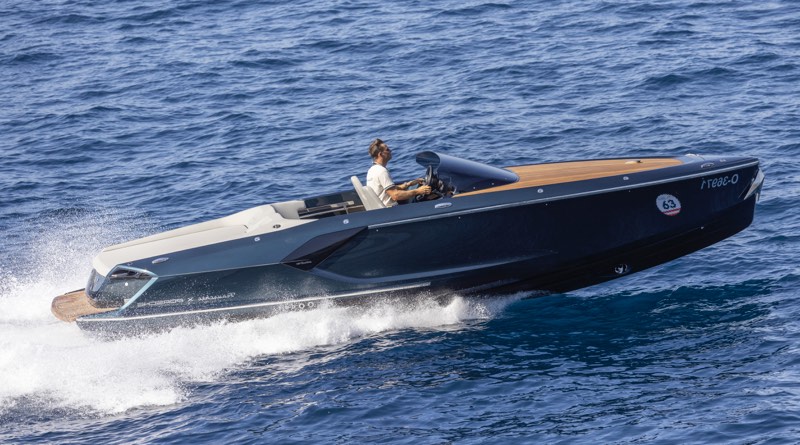
The Frauscher X Porsche partnership shattered the psychological and technical glass ceiling of electric marine propulsion, officially clocking a blistering speed of 51.05 knots (94.54 km/h / 58.75 mph) in the YCM Speed Record competition. Piloted by Bastien Bonnet, the newly unveiled Frauscher X Porsche 797 Spectre not only defended the crown won the previous year by its predecessor—the 850 Fantom Air—but decisively breached the elusive 50-knot barrier.
This monumental achievement marks a watershed moment in the transition from internal combustion engines (ICE) to clean, battery-electric powertrains in the luxury leisure marine sector. By combining the century-old boatbuilding mastery of Austria’s Frauscher Bootswerft with the cutting-edge electric vehicle (EV) automotive architecture of Germany’s Porsche, the 797 Spectre proves that zero-emission electric watercraft can match, and even surpass, the adrenaline-fueled performance of traditional fossil-fueled speedboats without sacrificing luxury, design integrity, or operational range.
Detailed Chronology: From Concept to Record-Breaking Triumph
The genesis of the record-breaking 797 Spectre is a tale of cross-industry collaboration, fortuitous timing, and a relentless pursuit of engineering perfection.
The Heritage of Speed and Innovation
Founded in 1927 by Engelbert Frauscher, Frauscher Bootswerft began its journey crafting wooden sailboats on the lakes of Austria. Over the decades, the family-run shipyard evolved, transitioning into gasoline-powered motorboats before forward-thinking leadership introduced their first electric boat in 1955. Today, Frauscher stands as Europe’s largest and most prolific electric boat builder.
Parallel to this maritime legacy is Porsche, founded in 1931 by Ferdinand Porsche. Operating as one of the world’s most successful luxury sports car manufacturers, Porsche shares an uncanny corporate DNA with Frauscher: both are family-driven enterprises deeply rooted in engineering excellence, minimalist yet evocative design, and uncompromising quality standards.
The paths of these two titans first crossed tangentially in 2016 during a collaborative fossil-fueled project dubbed the Demon. However, the modern electric partnership was born out of a casual conversation in 2022.
The 2022 Catalyst and the 850 Fantom Air
During executive-level discussions regarding prospective ventures, Porsche leadership revealed details of their upcoming all-electric vehicle platform—specifically the powertrain slated for the Macan SUV. The conversation quickly pivoted to a visionary question: What would happen if we integrated an automotive EV powertrain into a high-performance Frauscher marine hull?
The response from the Austrian boatyard was immediate and enthusiastic. Frauscher rapidly developed a working prototype, secured the backing of Porsche’s executive board, and officially unveiled the Frauscher X Porsche 850 Fantom Air in 2024.
The Fantom Air made immediate waves across the marine industry. In 2025, a closed foredeck model captured numerous international accolades—including the prestigious Gussies International Electric Boat Awards—and set the benchmark at the Monaco Energy Boat Challenge by hitting an impressive 49.84 knots (92.3 km/h / 57.35 mph), falling just a fraction of a knot short of the 50-knot milestone.

The Debut of the 797 Spectre
Determined to cross that final threshold, the engineering teams went back to the drawing board. Rather than adapting an existing internal-combustion hull (as was necessary with the Fantom), they designed an entirely new vessel from a clean sheet of paper.
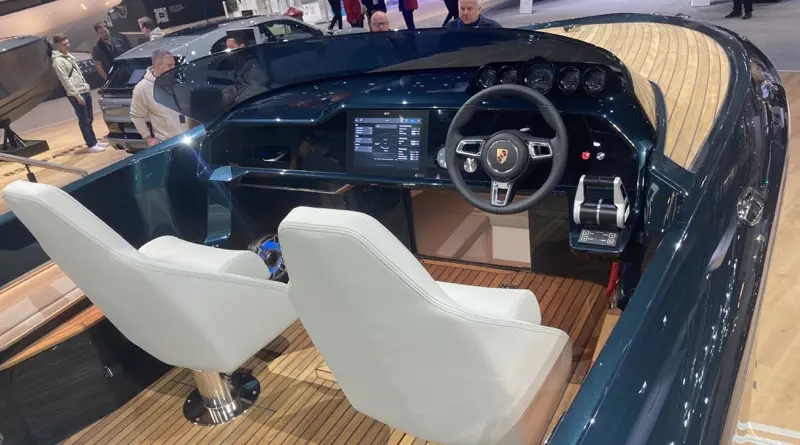
The result—the Frauscher X Porsche 797 Spectre—was officially revealed to the global public in January 2026 at the Boot Düsseldorf boat show. Just months later, transported to the waters of Monaco for the MEBC, the Spectre realized its ultimate design mandate. Piloted with surgical precision by Bastien Bonnet across the grueling 500-meter out-and-back course, the Spectre averaged a breathtaking 38.2 seconds across timed legs, cementing its place in history books with an official top speed of 51.05 knots.
Supporting Context & Metrics: Anatomy of a Record-Breaker
To fully appreciate the engineering feat achieved by the 797 Spectre, one must examine the rigorous structure of the Monaco Energy Boat Challenge and the distinct philosophy behind clean-sheet electric naval architecture.
The Monaco Energy Boat Challenge Classes
The MEBC serves as an international incubator for sustainable marine tech, dividing participants into four distinct classes:
- Energy Class: University students design and build eco-propulsion systems atop standard catamaran hulls supplied by the YCM.
- AI Class: Focuses on autonomous navigation and artificial intelligence applications in maritime environments.
- SeaLab Class: A collaborative testing ground open to both academic researchers and commercial enterprises pushing the envelope of alternative propulsion.
- Open Sea Class: Dedicated to market-ready, zero-emission production electric boats.
The YCM Speed Record pits the high-performance contenders of the SeaLab and Open Sea classes against one another. Starting just outside the Monaco breakwaters, competitors sprint toward a marker 500 meters down the coastline—replicating the historic racecourse of 1904. The winner is determined by calculating the average speed across two high-stakes legs (out and back).

Clean-Sheet Design vs. Retrofit Engineering
The critical distinction between the 2025 record-setting 850 Fantom and the 2026 record-shattering 797 Spectre lies in the design philosophy.
While the Fantom required structural modifications and internal stringer adjustments to distribute the immense weight of the Porsche Macan battery pack and electric motor within a pre-existing gas-powered hull, the Spectre was conceived from day one around electrons and battery cells.
This monumental task was spearheaded by two legendary figures in their respective fields:
- Harry Miesbauer: Renowned nautical engineer and yacht designer whose impressive resume includes high-performance sailboats like the Amer Sport One for the Volvo Ocean Race.
- Stefan Iverwin: Industrial designer with roots in the Porsche Design Studio, who has spent the last decade shaping the visual and tactile identity of Frauscher’s fleet.
Miesbauer notes that designing for electric propulsion fundamentally alters the traditional rules of naval architecture. "The main thing with hull design is to know the weight of all of the parts, and then address the most important aspect—the centre of gravity," Miesbauer explains. "That is what makes the boat ride properly and with optimum efficiency. With the Spectre, we had a blank sheet. We could address everything and have it as we wanted from the first sketches."
Official Statements and Industry Insights
The convergence of automotive DNA and marine engineering has yielded profound reactions from the masterminds behind the project.

Stefan Frauscher, Managing Director of Frauscher Bootswerft, could not hide his pride following the record-breaking run in Monaco:
"Breaking the record we set only last year is an exceptional achievement by the entire team. The 797 Spectre impressively demonstrates the potential created by the consistent joint development of the boat, hull, and electric powertrain."
For designer Stefan Iverwin, the goal was to craft a vessel that elicits an immediate visceral and emotional response from the moment a prospective buyer lays eyes on it.
"For me, the best thing that can happen is if someone sees the boat and just has a gut reaction of ‘I love this boat, I want this boat,’" Iverwin shares. "They also find reasons why it makes sense to decide for the boat, but I want that emotion, that feeling, saying ‘I love how it looks, I love how it feels when I drive it, I love how it performs.’"
The design language of the 797 Spectre aggressively merges automotive aggression with sleek maritime elegance. Noticeable styling cues include striking lateral air intakes and outtakes. While functionally mandatory for cooling the high-capacity lithium-ion battery banks, Iverwin elevated these vents into central aesthetic statements. A crisp character line extends from the side intakes around the stern, imbuing the wider rear profile with a sense of forward-moving dynamism reminiscent of a Porsche 911 or Taycan.

Future Outlook: The Horizon of Zero-Emission Marine Mobility
The successful run at the Monaco Energy Boat Challenge is far more than a PR victory or a fleeting trophy for Frauscher and Porsche; it serves as a harbinger for the future of the entire leisure marine industry.
For decades, skeptics of electric boating pointed to legitimate limitations: restricted top-end speeds, sluggish acceleration curves, prohibitive weight penalties, and anemic operational ranges. The 797 Spectre systematically dismantles every single one of these archaic assumptions. By utilizing automotive-grade high-voltage battery architecture, advanced thermal management systems, and hydrodynamically optimized hulls crafted specifically for electric torque delivery, the barrier between internal combustion performance and electric propulsion has officially evaporated.
As stricter environmental regulations take effect across European lakes, coastal nature reserves, and urban waterways worldwide, high-end boatbuilders are facing mounting pressure to clean up their acts. Traditional marine propulsion manufacturers (such as Torqeedo, Molabo, and Evoy) have long championed this shift, but the entry of automotive giants like Porsche into the marine sphere signals a seismic shift in market validation.
Looking ahead, the technologies pioneered in the collaborative hull of the 797 Spectre will inevitably trickle down into smaller production day-cruisers, commercial water taxis, and broader consumer-grade electric watercraft. As energy density continues to improve and charging infrastructure expands across Mediterranean ports and North American lakes, the day when zero-emission vessels dominate recreational harbors is no longer a distant environmentalist dream—it is an undeniable reality.
With a definitive speed of 51.05 knots recorded under the Mediterranean sun, the Frauscher X Porsche 797 Spectre has thrown down the gauntlet. The future of high-performance boating is electric, and it is moving faster than ever before.