









Executive Overview
In a dramatic and highly calculated escalation of the ongoing maritime conflict in the Middle East, United States military forces launched targeted airstrikes on Saturday, disabling and destroying three Iranian crude oil tankers. This decisive military action came in direct response to an Iranian ballistic missile attack directed at two U.S. Navy warships operating in regional waters. The exchange marks a significant shift in U.S. military engagement in the region, transitioning from localized defensive maneuvers to direct economic warfare targeting the financial lifeblood of the Islamic Revolutionary Guard Corps (IRGC).
According to statements released by U.S. Central Command (CENTCOM), the targeted tankers were key components of a multibillion-dollar "shadow network" utilized by the IRGC to bypass international sanctions, export crude oil, and finance its regional proxy networks—including the Houthis in Yemen, Hezbollah in Lebanon, and various militia groups in Iraq and Syria. By striking these vessels, the U.S. has signaled a new doctrine of proportional economic retaliation, threatening the total destruction of Iran’s commercial maritime infrastructure if attacks on American military assets continue.
The high-seas confrontation has sent shockwaves through global energy markets and maritime security circles. It underscores the growing volatility of the vital shipping lanes of the Persian Gulf and the Gulf of Oman, raising fears of a wider regional war that could disrupt global energy supplies.
Detailed Chronology of the Escalation
The weekend’s hostilities unfolded in a rapid sequence of events, characterized by advanced missile technology, defensive naval maneuvers, and coordinated retaliatory airstrikes.
The Catalyst: Ballistic Missile Attacks on U.S. Warships
The confrontation began early Saturday when the IRGC’s aerospace and naval forces launched multiple anti-ship ballistic missiles from coastal bases inside Iran. The targets were two high-value U.S. Navy assets operating in the region:
- An unidentified U.S. aircraft carrier (operating as part of a carrier strike group).
- An accompanying guided-missile destroyer equipped with the Aegis Combat System.
According to CENTCOM, the Iranian missiles were successfully detected and tracked. Utilizing advanced onboard electronic countermeasures, decoy systems, and interceptor missiles, both warships successfully evaded the strikes. No U.S. personnel were injured, and neither vessel sustained damage. Pentagon officials praised the rapid response of the ships’ crews and the efficacy of American integrated air and missile defense systems in high-threat environments.
The Retaliation: Operation Against the Shadow Fleet
With authorization from the White House and the Department of Defense, CENTCOM quickly initiated a coordinated response. Rather than targeting the land-based missile launchers—which are often mobile and heavily fortified—the U.S. chose to strike the IRGC’s economic infrastructure, focusing on three crude oil tankers identified as part of Iran’s illicit export network.
                  [IRGC Ballistic Missile Attack]
                                │
             ┌──────────────────┴──────────────────┐
             ▼                                     ▼
[U.S. Aircraft Carrier]               [Guided-Missile Destroyer]
     (Evaded / Safe)                       (Evaded / Safe)
             │                                     │
             └──────────────────┬──────────────────┘
                                ▼
                   [U.S. Retaliatory Strikes]
                                │
         ┌──────────────────────┼──────────────────────┐
         ▼                      ▼                      ▼
   [M/T Downy]            [M/T Stark 1]           [M/T Kylo]
(Off Kharg Island)        (Near Jask)         (Gulf of Oman)
Status: Disabled       Status: Disabled     Status: Destroyed
1. The Strike on M/T Downy (Kharg Island)
The first target, the M/T Downy, was located off the coast of Kharg Island—Iran’s premier crude oil export terminal in the northeastern Persian Gulf, which handles over 90% of the country’s oil exports. U.S. forces struck the vessel with precision-guided munitions, causing severe structural damage. CENTCOM later confirmed that the M/T Downy was "permanently disabled," effectively rendering it useless for future transport operations.
2. The Strike on M/T Stark 1 (Jask)
Simultaneously, U.S. assets engaged the M/T Stark 1 near Jask, a strategically important port city along Iran’s Gulf of Oman coast. Jask has been heavily promoted by Tehran as an alternative export hub designed to bypass the vulnerable Strait of Hormuz. The strike on the M/T Stark 1 mirrored the precision of the first attack, leaving the vessel "permanently disabled" and listing in the water.
3. The Destruction of M/T Kylo / Noxen (Gulf of Oman)
The third vessel, the M/T Kylo (also operating under the alias Noxen), was intercepted further out in the Gulf of Oman. Because the vessel was unladen (carrying no cargo), U.S. forces executed a highly structured strike profile designed to minimize loss of life and environmental damage:
- Evacuation Order: U.S. forces contacted the vessel’s crew, directing them to abandon ship immediately.
- Precision Bombardment: Once the crew had safely evacuated, U.S. aircraft and naval assets struck the tanker in multiple critical locations.
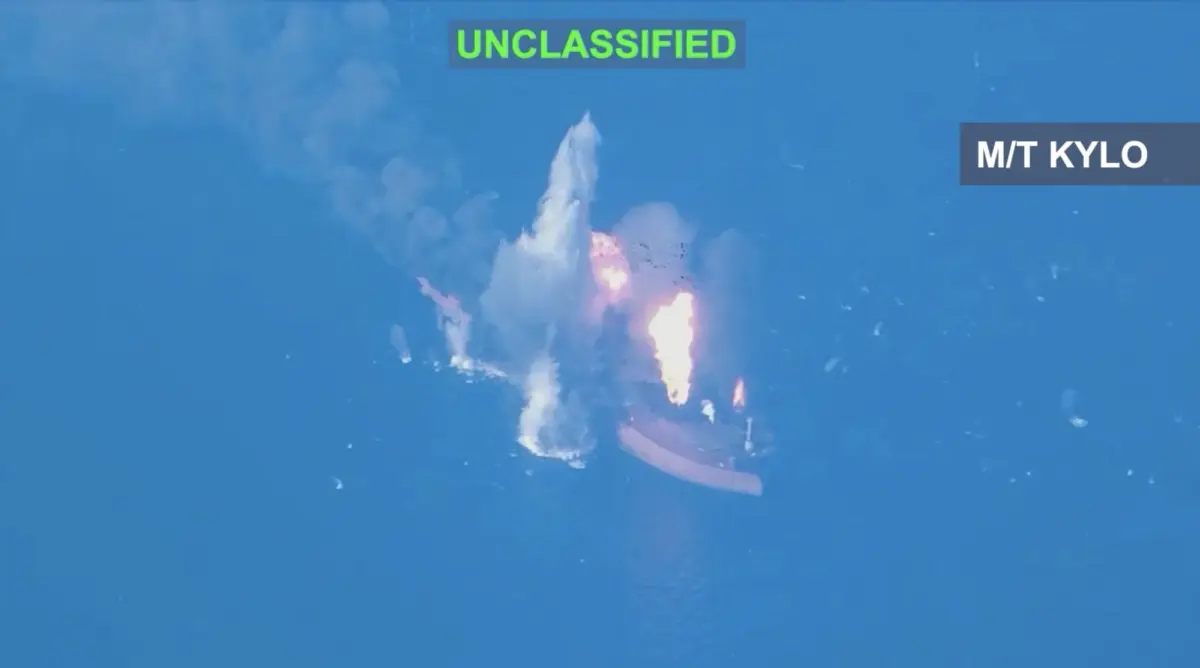
- Result: The M/T Kylo suffered catastrophic hull breaches and secondary explosions. Video footage released by CENTCOM showed massive fireballs consuming the vessel before it sank, completely destroyed.
Supporting Context & Metrics
To understand the gravity of Saturday’s strikes, they must be viewed through the lens of Iran’s economic dependency on its "shadow fleet" and the preceding military actions taken by the United States earlier in the week.
The Mechanics of the IRGC Shadow Fleet
Faced with stringent international sanctions designed to curb its nuclear ambitions and regional influence, Iran has long relied on a sophisticated, clandestine maritime network. This "shadow fleet" consists of older, poorly maintained tankers that operate under flags of convenience (such as Panama, Liberia, or Gabon). These vessels routinely engage in illicit practices, including:
- AIS Spoofing: Turning off or manipulating Automatic Identification System (AIS) transponders to hide their true locations.
- Ship-to-Ship (STS) Transfers: Transferring crude oil to other tankers in deep waters to obscure the oil’s Iranian origin.
- Corporate Shell Games: Utilizing layers of front companies based in offshore tax havens to process payments and hide ownership.
The revenue generated from these clandestine oil sales directly funds the IRGC’s Quds Force, which in turn arms, trains, and finances regional proxy forces. By targeting these specific vessels, the U.S. is striking at the financial foundation of Iran’s regional power projection.
| Vessel Name | Location of Strike | Operational Status Post-Strike | Strategic Significance |
|---|---|---|---|
| M/T Downy | Off Kharg Island, Persian Gulf | Permanently Disabled | Located at Iran’s primary oil export hub; high-visibility economic target. |
| M/T Stark 1 | Near Jask, Gulf of Oman | Permanently Disabled | Struck near Iran’s alternative bypass port, signaling vulnerability of new infrastructure. |
| M/T Kylo (Noxen) | Gulf of Oman | Destroyed (Sunk) | Unladen vessel destroyed after crew evacuation; served as a demonstration of kinetic capability. |
The September 1 Precursor Strikes
The maritime strikes on September 5 did not occur in a vacuum. Just days prior, on September 1, 2026, CENTCOM executed a comprehensive series of preemptive and retaliatory strikes inside Iranian territory. Those strikes targeted critical military infrastructure, including:
- IRGC Air-Defense Sites & Radar Systems: Neutralizing Iran’s ability to track incoming U.S. aircraft and missiles.
- Naval Assets & Facilities: Targeting fast-attack craft and command centers.
- Mine-Laying Capabilities: Disabling Iran’s capacity to choke the Strait of Hormuz using naval mines.
- Military Communications Sites: Disrupting the command-and-control loop of the IRGC.
These September 1 strikes effectively cleared the path for Saturday’s operation. By degrading Iran’s radar and air defenses beforehand, U.S. forces were able to operate with relative impunity when striking the tankers off Kharg Island and Jask.
Official Statements and Rhetorical Escalation
The rhetoric coming out of Washington in the aftermath of the strikes indicates a major policy shift. U.S. officials are no longer speaking in terms of containment; instead, they are openly discussing the systematic destruction of Iran’s maritime commerce if hostilities persist.
Admiral Brad Cooper’s Warning
In a statement published on social media alongside video footage of the strikes, Admiral Brad Cooper, commander of U.S. Central Command, issued a blunt mathematical warning to Tehran:
"Let the message to the IRGC be clear: If you shoot at two of our ships, we will impose an even higher economic cost—taking out three of yours. We will not hesitate to defend American forces, and if necessary, destroy Iran’s limited and exposed oil fleet."
This "three-for-two" formulation establishes a clear, escalatory tariff for future Iranian attacks, indicating that the U.S. will respond asymmetricially to deter aggression.
Secretary Pete Hegseth’s Ultimatum
Defense Secretary Pete Hegseth went even further, stripping away diplomatic ambiguity and outlining a total-war scenario for Iran’s commercial shipping.
"Iran’s oil tanker fleet is defenseless. U.S. aircraft, ships, and submarines can strike these vessels across the region. If Tehran continues to attack American warships, we will destroy and sink their entire tanker fleet."
Hegseth’s comments highlight the severe vulnerability of Iran’s maritime assets. Unlike U.S. Navy warships, which are protected by state-of-the-art air defense umbrellas, commercial oil tankers have no defensive capabilities, making them easy targets for U.S. precision strikes.
Future Outlook & Geopolitical Implications
The transition from proxy skirmishes to direct state-on-state kinetic actions at sea marks a dangerous new chapter in Middle Eastern geopolitics. Several critical factors will shape the trajectory of this conflict in the coming weeks.
1. The Risk of Chokepoint Closure
The Strait of Hormuz, a narrow waterway between Iran and Oman, is the world’s most important oil transit chokepoint, with daily oil flows averaging over 20 million barrels—roughly 20% of global petroleum consumption. Iran has repeatedly threatened to close the strait in the event of an all-out war. While the U.S. strikes on September 1 degraded Iran’s mine-laying capabilities, the IRGC still possesses hundreds of coastal defense cruise missiles, drone swarms, and midget submarines that could make transit through the strait highly perilous for commercial shipping.
2. Escalating Insurance and Shipping Costs
Following the strikes, maritime insurance underwriters are expected to raise war-risk premiums for vessels operating in the Persian Gulf and Gulf of Oman. This will inevitably lead to higher shipping costs, which could be passed on to global consumers in the form of increased energy prices. Major shipping conglomerates may choose to reroute tankers around the Cape of Good Hope, adding weeks to transit times and straining global supply chains.
3. Iran’s Asymmetric Dilemma
Faced with the overwhelming conventional superiority of the U.S. Navy, Iran is unlikely to engage in a direct naval battle. Instead, Tehran is expected to rely on asymmetric tactics:
- Proxy Retaliation: Directing the Houthis to increase drone and missile attacks on commercial shipping in the Red Sea.
- Cyber Warfare: Launching cyberattacks against U.S. infrastructure or financial institutions.
- Covert Sabotage: Utilizing limpet mines or special forces to covertly damage Western-linked tankers in regional ports, allowing for plausible deniability.
4. The Diplomatic Fallout
The destruction of Iranian oil tankers will likely draw sharp criticism from major buyers of Iranian crude, most notably China. Beijing has relied heavily on discounted Iranian oil imported through the shadow network to fuel its economy. Direct U.S. military disruption of these supply lines could strain Washington-Beijing relations and lead to diplomatic maneuvers within the United Nations Security Council.
Conclusion
The disablement of the M/T Downy, M/T Stark 1, and M/T Kylo has established a tense and volatile new status quo. By targeting the economic engines of the IRGC, the United States has demonstrated that it is willing to bypass traditional military targets to hit Tehran where it hurts most. Whether this new doctrine of economic deterrence will force the IRGC to back down—or push the region into an uncontrolled escalatory spiral—remains the critical question for global security in the days ahead.