






Executive Overview
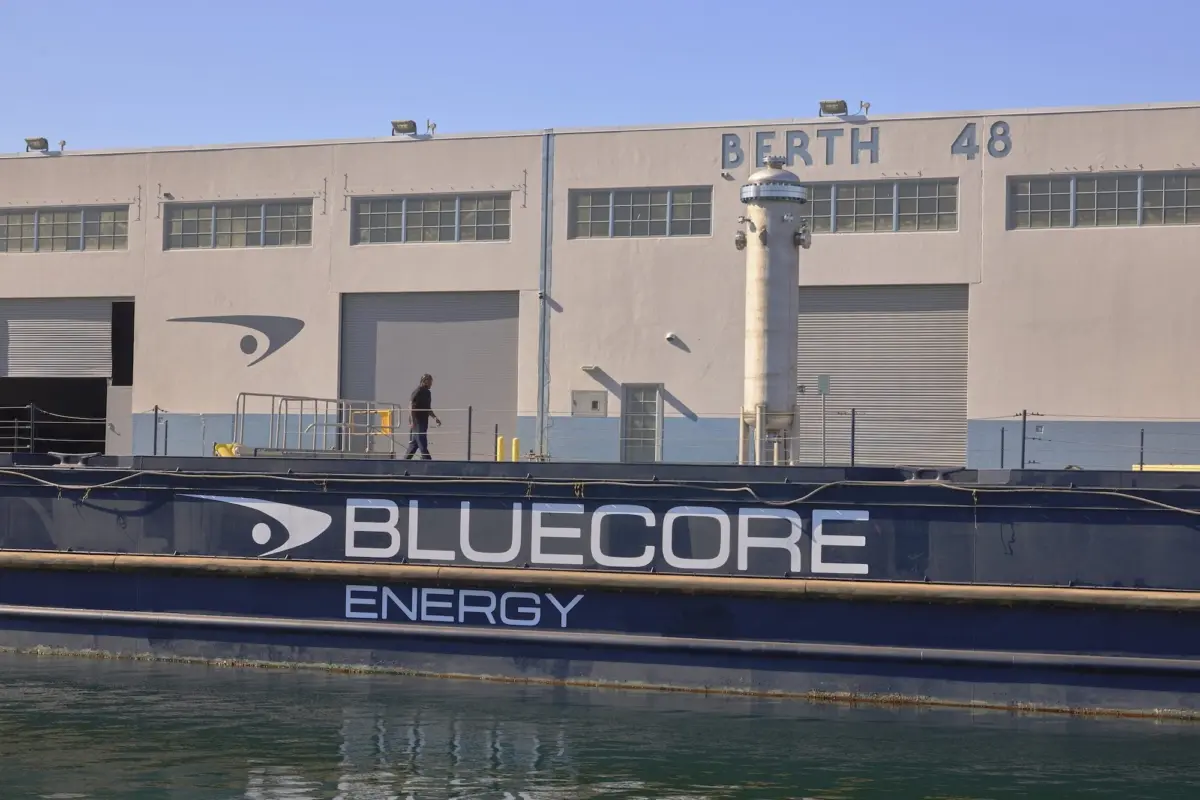
The global race to decarbonize heavy industry, maritime logistics, and coastal infrastructure is intersecting with a modern nuclear renaissance. At the vanguard of this transition is Bluecore Energy, a Long Beach-based nuclear startup that is rapidly transitioning from a stealth-stage concept to a physical engineering reality. In a series of coordinated milestones, the company has secured its first marine barge, initiated formal regulatory discussions with federal oversight bodies, and closed a major $50 million seed financing round led by Silverton Partners.
Bluecore’s core proposition centers on a mobile, floating nuclear power plant designed from the keel up for maritime deployment. Rather than adapting land-based small modular reactors (SMRs) to marine hulls, the company is engineering a bespoke 10-megawatt (MW) water-cooled reactor system integrated directly into a floating platform. This technology aims to bypass the protracted real estate acquisition, local zoning, and seismic engineering bottlenecks that have historically plagued terrestrial nuclear developments.
By positioning clean, high-density power generation on the water, Bluecore seeks to deliver immediate, scalable energy to power-starved ports, coastal data centers, and critical maritime infrastructure. This move comes at a critical juncture. Coastal grids are facing unprecedented strain from electrification demands, and the shipping industry is under intense pressure to decarbonize shoreside operations and vessel propulsion systems.
Detailed Chronology
The trajectory of Bluecore Energy over the past year highlights a rapid transition from theoretical design to hardware validation and regulatory integration.
[July] Emerges from stealth with $10M pre-seed round; Port of Long Beach & MARAD sign cooperation pact.
  │
  ▼
[Late Summer] Initiates development of non-fueled prototype at Port of Long Beach.
  │
  ▼
[Autumn] Formally enters joint regulatory review with U.S. NRC and U.S. Coast Guard.
  │
  ▼
[Current Milestone] Secures first barge, raises $50M seed round led by Silverton Partners.
July: Stealth Emergence and Initial Capitalization
Bluecore Energy emerged from stealth mode in July, backed by an initial $10 million pre-seed funding round. The capitalization allowed the company to establish its headquarters and primary engineering facilities within the Port of Long Beach—one of the world’s busiest container port complexes and a prime testing ground for industrial electrification.
Simultaneously, a broader institutional framework was established. The Port of Long Beach and the U.S. Maritime Administration (MARAD) signed a first-of-its-kind cooperative agreement. This partnership was specifically designed to explore maritime energy systems, including small modular reactors, resilient port microgrids, shoreside power (cold ironing), and advanced vessel propulsion technologies.
Late Summer: Prototype Development and Hardware Assembly
Following its public launch, Bluecore focused on physical engineering, establishing a development facility inside the Port of Long Beach. Engineers began assembling a non-fueled reactor module prototype. This physical testbed does not contain radioactive material; instead, it is utilized to develop, test, and validate the advanced sensor arrays, automated control systems, and remote monitoring software required to operate a maritime nuclear system safely and autonomously.
Autumn: Dual-Agency Regulatory Activation
As the hardware design matured, Bluecore initiated formal engagement with federal regulators. Recognizing that floating nuclear systems fall under overlapping jurisdictions, the company began working directly with both the U.S. Nuclear Regulatory Commission (NRC) and the U.S. Coast Guard (USCG). This joint engagement leverages an existing Memorandum of Understanding (MOU) between the two agencies, designed to streamline the oversight, licensing, and safety analysis of civilian floating nuclear plants.
Current Milestone: Vessel Acquisition and $50 Million Seed Funding
In its latest operational leap, Bluecore secured its first physical marine barge, which will serve as the structural foundation for its subsequent phases of testing and integration. To fund this capital-intensive expansion, the company closed a $50 million seed financing round led by Austin-based Silverton Partners. This brings the company’s total funding to $60 million, providing the financial runway required to scale its engineering team, expand its physical footprint, and advance through complex federal licensing pathways.
Supporting Context & Metrics
To appreciate the commercial logic behind Bluecore’s floating nuclear architecture, one must examine the specific technical, economic, and regulatory variables shaping the modern energy landscape.
The Engineering of Floating Power
Bluecore’s initial system is designed around a water-cooled nuclear reactor capable of generating approximately 10 MW of continuous, emissions-free electricity.
| Metric / Feature | Specification |
|---|---|
| Power Output | ~10 Megawatts (MW) electrical equivalent |
| Reactor Type | Advanced water-cooled nuclear system |
| Platform | Purpose-built floating marine barge |
| Refueling Cycle | Multi-year operation between refueling intervals |
| Primary Use Cases | Ports, shoreside cold ironing, coastal data centers, microgrids |
| Regulatory Jurisdiction | Joint oversight by U.S. NRC and U.S. Coast Guard |
Unlike terrestrial reactors, which require massive civil engineering works, dedicated cooling towers, and extensive environmental footprint mitigation, a floating reactor utilizes the surrounding water body for ultimate heat sink capabilities (subject to strict environmental controls). By building the reactor directly into a standardized maritime hull, the entire system can be manufactured in a controlled shipyard environment, towed to the destination, and plugged into the local grid, reducing capital expenditure and construction timelines.
+-------------------------------------------------------------+
|                     SHIPYARD FABRICATION                    |
|  - Controlled environment manufacturing                     |
|  - Standardized reactor integration into barge hull         |
+------------------------------+------------------------------+
                               |
                               v
+-------------------------------------------------------------+
|                     MARITIME TRANSIT                        |
|  - Towed via established shipping channels                  |
|  - Minimal site-specific civil engineering required         |
+------------------------------+------------------------------+
                               |
                               v
+-------------------------------------------------------------+
|                     COASTAL DEPLOYMENT                      |
|  - Rapid connection to port microgrid or industrial site    |
|  - Marine heat sink utilization for cooling efficiency      |
+-------------------------------------------------------------+
The Port Electrification Crisis
Global supply chains are undergoing a massive transition toward electrification. Ports are replacing diesel-powered gantry cranes, yard tractors, and material handling equipment with electric alternatives. Concurrently, international maritime regulations are forcing ships to shut down their auxiliary diesel generators while at berth and plug into shoreside electrical grids—a process known as cold ironing or alternative maritime power (AMP).
This transition requires immense amounts of electricity. The Port of Long Beach, for instance, has projected that its transition to zero-emission operations will eventually require hundreds of megawatts of additional capacity. Traditional municipal grids, already constrained by transmission bottlenecks, rising consumer demand, and the intermittent nature of regional solar and wind assets, are ill-equipped to deliver this concentrated, high-reliability baseload power directly to the water’s edge. A 10-MW floating nuclear barge can act as a localized, high-density microgrid asset, providing dedicated power directly to terminal operators without placing additional strain on municipal transmission lines.
The Regulatory Dual-Lock
The primary hurdle for any novel nuclear technology is not engineering, but licensing. Historically, the NRC’s regulatory framework was designed for large, land-based light-water reactors. Applying these rules to a mobile, marine-based platform requires a highly coordinated regulatory approach.
The coordination between the NRC and the USCG is governed by a Memorandum of Understanding (MOU) that delineates responsibilities:
- The Nuclear Regulatory Commission (NRC) maintains primary jurisdiction over radiological safety, reactor design, fuel security, and nuclear licensing.
- The U.S. Coast Guard (USCG) retains jurisdiction over marine safety, hull integrity, navigation, security, and marine engineering systems.
By engaging both agencies simultaneously during the prototyping phase, Bluecore hopes to establish a clear, predictable licensing pathway, minimizing the risk of regulatory delays during later stages of commercial deployment.
Official Statements
The leadership team at Bluecore, along with key institutional partners, views the convergence of maritime logistics and advanced nuclear engineering as an inevitable and necessary evolution.
Megan Moyette, Bluecore’s licensing and safety lead, brings direct operational experience to this regulatory challenge. A former U.S. Navy nuclear submarine officer, Moyette has spent years operating complex nuclear reactors in demanding marine environments.
"The regulatory landscape for commercial nuclear maritime is coming together at exactly the right time," Moyette stated. "The NRC and Coast Guard have both participated in our discussions from the beginning, giving Bluecore confidence that a clearer licensing pathway is beginning to emerge."
This structured approach is echoed by the executive leadership at the ports themselves, where the realities of the clean energy transition are most acutely felt. Noel Hacegaba, Chief Operating Officer of the Port of Long Beach, highlighted the scale of the energy challenge facing modern harbor facilities.
"Meeting that future will require new technologies and approaches to energy sources," Hacegaba noted, emphasizing that traditional grid connections alone will not suffice to power the zero-emission port of tomorrow.
Reflecting on the company’s transition from a conceptual startup to a well-capitalized hardware developer, Kofi Asante, founder and CEO of Bluecore Energy, underscored the operational momentum generated by their recent funding and hardware acquisitions.
"Six months ago, we were building the foundation," Asante said. "Today, we have the capital, the team, the hardware, and some of the most important institutions in nuclear and maritime working alongside us."
Future Outlook
While commercial deployment of a fully fueled, operational floating nuclear reactor remains several years away, Bluecore’s progress reflects a broader structural shift. The maritime sector is transitioning from theoretical feasibility studies to concrete hardware validation, regulatory filing, and physical prototyping.
The immediate focus for Bluecore will be the expansion of its engineering facility at the Port of Long Beach and the continuation of tests on its non-fueled prototype. The newly acquired barge will serve as a physical integration platform, allowing engineers to test how the reactor systems interact with marine motion, salinity, and typical harbor conditions.
Furthermore, federal interest in this technology is expanding. MARAD’s maritime nuclear initiative has grown beyond its initial partners. The Port of Corpus Christi—a major energy export hub in Texas—has joined the initiative alongside the Port of Long Beach. Additionally, MARAD has partnered with CORE POWER, a UK-based maritime nuclear technology company, to examine the regulatory, safety, and commercial frameworks required to operate nuclear-powered, U.S.-flagged commercial vessels.
As Bluecore advances its water-cooled floating reactor design, it is positioning itself to address some of the most lucrative and energy-intensive markets in the world. Beyond port electrification, floating reactors could provide dedicated, reliable power to offshore oil and gas platforms, coastal desalination plants, island communities, and hyperscale data centers located near coastal cities. By decoupling nuclear power from traditional land-based constraints, Bluecore Energy is helping to pioneer a flexible, scalable, and resilient approach to clean energy generation for a rapidly electrifying global economy.