









Executive Overview
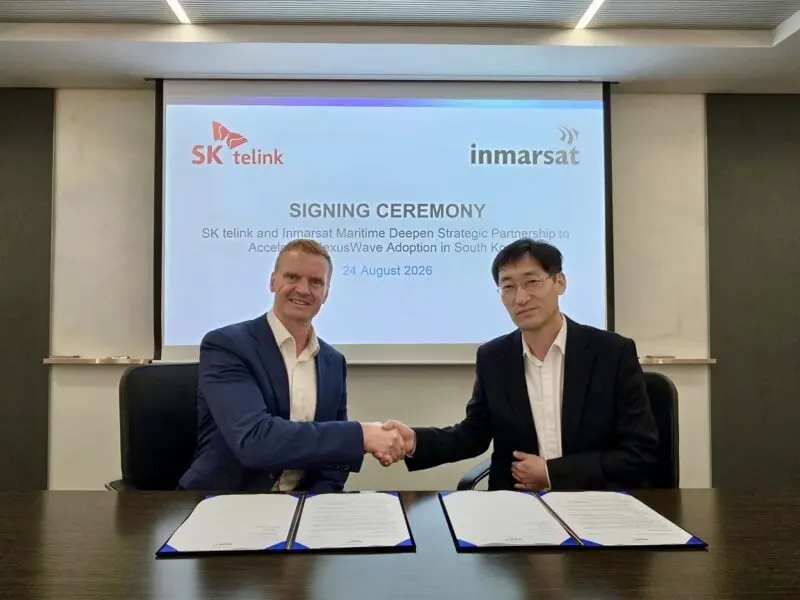
The global maritime sector is undergoing a profound digital transformation, driven by the dual pressures of stringent international environmental regulations and an urgent need to optimize operational efficiency. At the center of this transformation is the demand for uninterrupted, high-capacity, and highly secure connectivity. In a landmark development for the East Asian maritime sector, Inmarsat Maritime (a Viasat company) and SK telink, a leading South Korean telecommunications service provider, have officially signed a strategic agreement to accelerate digitalization across South Korea’s shipping industry.
This partnership is designed to deploy NexusWave, Inmarsat’s next-generation, fully managed connectivity service, across South Korea’s commercial fleet. The agreement targets key domestic and international operators—including industry giants such as HMM and SINOKOR—and spans multiple vessel classes, from car carriers and ultra-large container ships to Very Large Crude Carriers (VLCCs). By combining Inmarsat’s global satellite infrastructure with SK telink’s deep local market penetration and integration capabilities, the alliance aims to provide South Korean shipowners with a robust, resilient digital foundation. This foundation is essential for navigating the complex geopolitical, regulatory, and technological challenges of modern merchant shipping.
+-----------------------------------------------------------------+
|                    NexusWave Hybrid Architecture                |
+-----------------------------------------------------------------+
|                                                                 |
|   [ High-Capacity Ka-Band ]   [ Resilient L-Band (ELERA) ]      |
|         (Global Xpress)             (Safety & Backup)           |
|                                           /                    |
|                                          /                     |
|                  v                       v                      |
|             +---------------------------------+                 |
|             |   NexusWave Bonded Smart Core   |<-- LTE/5G / LEO |
|             +---------------------------------+     Underlays   |
|                              |                                  |
|                              v                                  |
|              [ Secure Vessel LAN / IoT Sensors ]                |
|                                                                 |
+-----------------------------------------------------------------+
Detailed Chronology of the Inmarsat-SK Telink Relationship
The collaboration between Inmarsat Maritime and SK telink is not a sudden development; rather, it represents the culmination of a strategic relationship spanning nearly two decades.
2007: Initial Partnership Established (Inmarsat L-band services introduced to South Korea)
  |
2016: Fleet Xpress Launch (Transition to high-throughput Ka-band hybrid connectivity)
  |
2023: Viasat Acquires Inmarsat (Merger creates a multi-orbit, high-capacity global network)
  |
2024: NexusWave Agreement Signed (Deployment of next-gen bonded service across SK fleets)
2007–2015: The Foundations of Maritime Satellite Communications
In 2007, SK telink and Inmarsat signed their first cooperative agreements, focusing primarily on introducing Inmarsat’s legacy L-band services, such as FleetBroadband, to the South Korean market. During this era, satellite communications were used primarily for basic operational messaging, safety services (GMDSS), and limited crew communications. SK telink established itself as a reliable local partner, handling the complex regulatory, installation, and support requirements of South Korea’s rapidly growing shipbuilding and shipping sectors.
2016–2023: The Fleet Xpress Era and the Viasat Merger
With the launch of Inmarsat’s Fleet Xpress in 2016, the partnership evolved to support high-throughput Ka-band connectivity backed by resilient L-band backup. This hybrid model became the industry standard, allowing South Korean operators to begin utilizing real-time data monitoring and cloud-based fleet management tools.
In May 2023, Viasat completed its $7.3 billion acquisition of Inmarsat, bringing together Viasat’s high-capacity geostationary (GEO) assets and terrestrial technologies with Inmarsat’s established global mobility network. This acquisition set the stage for the development of NexusWave, a service designed to merge these diverse network assets into a single, seamless user experience.
2024: The NexusWave Deployment Agreement
The newly signed agreement marks the official commercial launch of NexusWave in South Korea. This phase moves beyond standard satellite bandwidth provisioning to offer a fully managed, bonded multi-dimensional network. Over the coming months, SK telink and Inmarsat will begin installing NexusWave terminals on target vessels, integrating them with existing shipboard IT infrastructure, and establishing local support protocols to ensure continuous service across global shipping lanes.
Technical Deep Dive: The Architecture of NexusWave
NexusWave is designed to address a common pain point in maritime communications: the fragmentation of connection types. Traditionally, vessels have had to switch manually or semi-automatically between different satellite networks (Ka-band, Ku-band, L-band) and terrestrial cellular networks (LTE/5G) as they moved from ports to the open ocean. This process often resulted in dropped connections, configuration errors, and unpredictable latency.
+------------------+-------------------------------------------------------------------+
| Feature          | Technical Specification / Detail                                  |
+------------------+-------------------------------------------------------------------+
| Core Satellites  | Global Xpress Ka-band constellation, supported by ELERA L-band    |
| Integration      | Planned integration of high-capacity ViaSat-3 GEO constellation    |
| Network Bond     | Dynamic, software-defined bonding of Ka, L, and terrestrial LTE   |
| Cyber Security   | Integrated Unified Threat Management (UTM) and end-to-end firewalls|
| Service Level    | Guaranteed Committed Information Rates (CIR) with global SLAs     |
+------------------+-------------------------------------------------------------------+
NexusWave solves this through a proprietary, software-defined network architecture that features:
- Multi-Dimensional Bandwidth Bonding: NexusWave dynamically bonds multiple network underlays—including high-speed Ka-band, highly reliable L-band (for safety and backup), and terrestrial mobile networks (LTE/5G) when near coastlines—into a single, secure managed service. This ensures that the transition between different frequency bands is completely invisible to shipboard users and applications.
- Intelligent Local Network Management: When trading in regions with complex regulatory requirements, such as the East China Sea or Southeast Asian waters, NexusWave can manage individual network underlays locally. This allows operators to disable or modify specific frequencies in territorial waters to comply with local telecommunications laws, while keeping the primary bonded connection online.
- Enhanced Capacity via ViaSat-3: The service is designed to integrate Viasat’s third-generation satellite constellation (ViaSat-3). Once fully operational, ViaSat-3 is expected to deliver massive capacity upgrades—upwards of 1 Terabit per second per satellite—greatly improving performance on high-traffic shipping corridors across Asia, the Pacific, and the Middle East.
Supporting Context & Industry Metrics
The deployment of NexusWave comes at a critical time for the maritime industry, which is facing several convergent challenges.
             Global Maritime Connectivity Drivers

  +-----------------------+     +-----------------------+
  |  Regulatory Pressure  |     |   Operational Cost    |
  |  - IMO CII Ratings    |     |  - High Fuel Costs    |
  |  - Decarbonization    |     |  - Port Congestion    |
  +-----------+-----------+     +-----------+-----------+
              |                             |
              +--------------+--------------+
                             |
                             v
              +-----------------------------+
              | Real-Time Data Requirements |
              |  - High-Bandwidth SatCom    |
              |  - Predictive Maintenance   |
              |  - Dynamic Route Planning   |
              +--------------+--------------+
                             |
                             v
              +-----------------------------+
              |      NexusWave Solution     |
              +-----------------------------+
1. The Maritime Data Explosion
The shipping industry is no longer purely mechanical; it is increasingly data-driven. According to industry analyses, maritime data consumption has grown by more than 200% over the last four years. This surge is driven by several key applications:
- Predictive Maintenance: Engine manufacturers and ship operators use real-time sensor data transmission to predict machinery failures before they occur, reducing costly unplanned port stays.
- Route Optimization: High-frequency weather and sea-state data feed into AI-driven routing algorithms, helping vessels minimize fuel consumption and meet International Maritime Organization (IMO) decarbonization targets.
- Carbon Intensity Indicator (CII) Compliance: Starting in 2023, the IMO began grading vessels on their carbon efficiency. Continuous, high-volume data transmission is required to report, analyze, and optimize these metrics in real time.
2. The Battle for Crew Retention
The maritime sector is facing a severe shortage of qualified officers and crew. In this environment, onboard connectivity has transitioned from a luxury to a critical recruitment and retention tool. Seafarers expect high-speed internet access to stay in touch with families, stream media, and access online training. By offering robust bandwidth with guaranteed Quality of Service (QoS), NexusWave allows shipowners to segregate operational traffic from crew welfare networks, ensuring that high-volume crew data does not interfere with critical navigational and operational systems.
3. Geopolitical and Regulatory Friction in Asian Waters
The East Asian maritime corridor—stretching from the Sea of Japan through the Taiwan Strait and into the South China Sea—is one of the busiest and most geopolitically complex shipping environments in the world. Different nations enforce strict, and often conflicting, regulations regarding satellite transmissions within their territorial waters (typically within 12 nautical miles of the coast). NexusWave’s ability to manage individual network underlays according to local requirements helps operators avoid regulatory penalties while maintaining secure, continuous data links with shore-side offices.
Official Statements & Strategic Analysis
SK Telink: Embracing the Digital Fleet
Commenting on the agreement, Mr. Shin-Yong Lee, Head of the Satellite Business Division at SK telink, emphasized the shifting paradigm of modern fleet operations:
"Connectivity has become fundamental to the safe, efficient, and competitive operation of a modern fleet. Shipping companies need a resilient digital platform that can support operational applications, cybersecurity requirements, and the expectations of today’s seafarers. NexusWave is designed to support these needs, and we are excited to bring its advanced capabilities to more South Korean operators, helping them unlock greater value from connected, data-driven operations."
Strategic Analysis: Lee’s statement highlights SK telink’s positioning as more than just a bandwidth reseller; the company aims to be an end-to-end digital partner for South Korean shipowners. By addressing cybersecurity and operational applications in tandem, SK telink is acknowledging that modern shipping lines require integrated solutions that protect fleet data from growing cyber threats.
Inmarsat Maritime: Fostering Innovation in East Asia
Justin Yi, Regional Director APAC for Inmarsat Maritime, focused on South Korea’s leadership role in global maritime technology:
"South Korea continues to set the pace for innovation in global shipping, with operators embracing technologies that enhance performance, resilience, and competitiveness. This agreement reflects both the strength of our long-standing relationship with SK telink and growing momentum behind the digitalization of maritime operations. Together, we are helping create the connectivity foundations that will enable South Korean shipowners to realize the full benefits of a connected and increasingly data-driven future."
Strategic Analysis: Yi’s perspective reflects Inmarsat’s broader commercial strategy to secure long-term market share in East Asia. South Korea is not only a major ship-owning nation but also home to the world’s most advanced shipyards (such as HD Hyundai, Samsung Heavy Industries, and Hanwha Ocean). By embedding NexusWave within the South Korean maritime ecosystem, Inmarsat positions its technology to be integrated directly into newbuild vessels at the shipyard stage, establishing a strong barrier to entry for competitors.
Future Outlook: The Next Wave of Maritime Connectivity
The partnership between Inmarsat Maritime and SK telink arrives amid an intensifying battle for dominance in the maritime satellite communications market. The rapid expansion of Low Earth Orbit (LEO) satellite constellations, such as SpaceX’s Starlink and Eutelsat OneWeb, has introduced high-speed, low-latency connectivity to the maritime sector, challenging the historical dominance of Geostationary (GEO) providers.
However, the future of maritime connectivity is widely expected to be hybrid. While LEO networks offer excellent speed and latency, they currently lack the robust Service Level Agreements (SLAs), guaranteed Committed Information Rates (CIR), and safety-certified backup capabilities (such as GMDSS) that GEO networks like Inmarsat’s ELERA and Global Xpress have provided for decades.
+-----------------------------------------------------------------------+
|                 The Hybrid Future of Maritime SatCom                  |
+-----------------------------------------------------------------------+
|                                                                       |
|   [ LEO Constellations ]                  [ GEO Constellations ]      |
|   - Low Latency                           - Global Coverage           |
|   - High Speed                            - Guaranteed CIR/SLA        |
|   - Consumer-Grade                        - Safety-Certified (GMDSS)  |
|                                                /                     |
|                                               /                      |
|            +-->  [ NexusWave Managed Service ] <                      |
|                               |                                       |
|                               v                                       |
|               Uninterrupted, Enterprise-Grade                         |
|                    Maritime Connectivity                              |
|                                                                       |
+-----------------------------------------------------------------------+
The Strategic Value of NexusWave’s Hybrid Approach
NexusWave’s hybrid model positions it well for this landscape. Rather than forcing shipowners to choose between LEO and GEO, NexusWave is built to integrate both. By acting as an intelligent network aggregator, NexusWave can route non-critical, high-bandwidth traffic (such as crew video streaming) over high-capacity channels, while routing mission-critical navigational data and engine telemetry over secure, guaranteed GEO channels.
Supporting South Korea’s Autonomous Shipping Ambitions
Looking further ahead, this robust connectivity infrastructure will be crucial for South Korea’s ambitions in autonomous shipping. The South Korean government and major domestic shipbuilders are investing heavily in autonomous vessel technologies, aiming to capture a significant share of the future autonomous ship market. These vessels rely on continuous, real-time sensor data transmission, high-definition video feeds, and remote-control capabilities—all of which require the high reliability, low latency, and deep redundancy that the NexusWave-SK telink partnership is designed to deliver.
By securing this digital foundation today, Inmarsat and SK telink are not only optimizing the current fleet of container ships, car carriers, and VLCCs; they are also laying the groundwork for the next generation of autonomous, zero-emission merchant vessels that will define the future of global trade.