










Executive Overview
For decades, automotive and environmental debates have been anchored by a seemingly unassailable piece of folk wisdom: “The greenest car is the one already built.” This intuitive philosophy argues that keeping an operational internal combustion engine (ICE) vehicle on the road avoids the upfront manufacturing carbon footprint of a brand-new machine. It treats every legacy vehicle as an asset of environmental preservation simply because its initial production emissions have already been paid to the atmosphere.
However, this traditional framing relies on a critical analytical blind spot—it treats the ongoing tailpipe emissions of a gasoline car as if they were environmentally free.
A groundbreaking study published in Science, authored by J. Elliott Campbell of the University of California, Santa Cruz, and Roland Geyer of the University of California, Santa Barbara, challenges this long-held dogma. By evaluating the comprehensive lifecycles of vehicles under various real-world conditions, Campbell and Geyer demonstrate that prematurely retiring a functional gas vehicle and replacing it with a battery-electric vehicle (BEV) can yield massive net carbon reductions. Rather than dragging down climate goals, early scrappage programs—when strategically designed—can erase their manufacturing carbon "debt" in just a few short years, avoiding decades of cumulative fossil fuel combustion.

Yet, this is not a blank-check endorsement of sweeping vehicle destruction. The researchers’ findings reveal that the carbon payoff hinges entirely on specific operational metrics: the vehicle’s original fuel efficiency, its annual mileage, and the regional carbon intensity of the electrical grid. Furthermore, transitioning to a smarter vehicle-retirement framework must contend with the realities of the American used-car market. For millions of low- and middle-income households, cheap used cars are not a luxury, but an absolute necessity.
This article explores the mechanics of Campbell and Geyer’s study, analyzes the granular metrics driving the data, explores the socioeconomic perils of disrupting the used-vehicle ecosystem, and outlines a modernized policy blueprint for the future of fleet turnover.
Detailed Chronology: From "Cash for Clunkers" to Rigorous Life-Cycle Science
The Legacy of Flat-Rate Scrappage
To understand the current paradigm shift, one must look back at historical policy efforts. In 2009, the United States enacted the Car Allowance Rebate System—popularly known as "Cash for Clunkers." Designed primarily as an economic stimulus during the Great Recession, the program offered financial incentives to consumers who traded in older, less-efficient vehicles for newer, more fuel-efficient models. While it successfully injected liquidity into a stalled automotive sector and removed some high-polluting vehicles from circulation, critics noted that its design was economically blunt. It treated a lightly driven suburban sedan the same way it treated a heavily utilized commercial pickup, paying little heed to the nuanced calculus of life-cycle emissions.
Years later, in 2024, environmental policy commentators began revisiting the concept of vehicle scrappage, arguing for a modernized version of the program tailored specifically to the electric vehicle era: paying citizens to permanently retire internal combustion vehicles early if they are replaced directly by BEVs.

The immediate pushback was predictable and fierce. Critics asked: Does manufacturing a brand-new battery electric vehicle—with its resource-intensive mining, refining, and assembly processes—truly generate fewer emissions than simply driving an existing, functional gasoline car until its engine dies?
Filling the Scientific Void
Until recently, this question remained largely a matter of ideological debate rather than rigorous empirical analysis. While life-cycle assessments (LCAs) frequently compared the cradle-to-grave emissions of a new ICE vehicle versus a new BEV, they rarely modeled the systemic impacts of terminating a working gas car’s operational life midway through its lifespan to introduce a replacement EV.
To resolve this ambiguity, Campbell and Geyer undertook an exhaustive life-cycle modeling effort, the results of which were published in Science. Rather than relying on static assumptions or cherry-picking scenarios most favorable to electrification, the researchers constructed a dynamic framework. They varied vehicle efficiency classes, annual mileage accumulations, battery manufacturing emissions footprints, battery capacities, and regional grid carbon intensities.
Their conclusions upend the conventional wisdom. Far from being an environmental luxury or a carbon-neutral dead-end, the early retirement of targeted internal combustion vehicles emerges as one of the most potent, immediate climate interventions available.
Supporting Context & Metrics: What the Data Actually Shows
The findings of the Campbell-Geyer study offer a granular look at how vehicle retirement plays out over time across varying operational realities.

The SUV Case Study and the Three-Year Payback
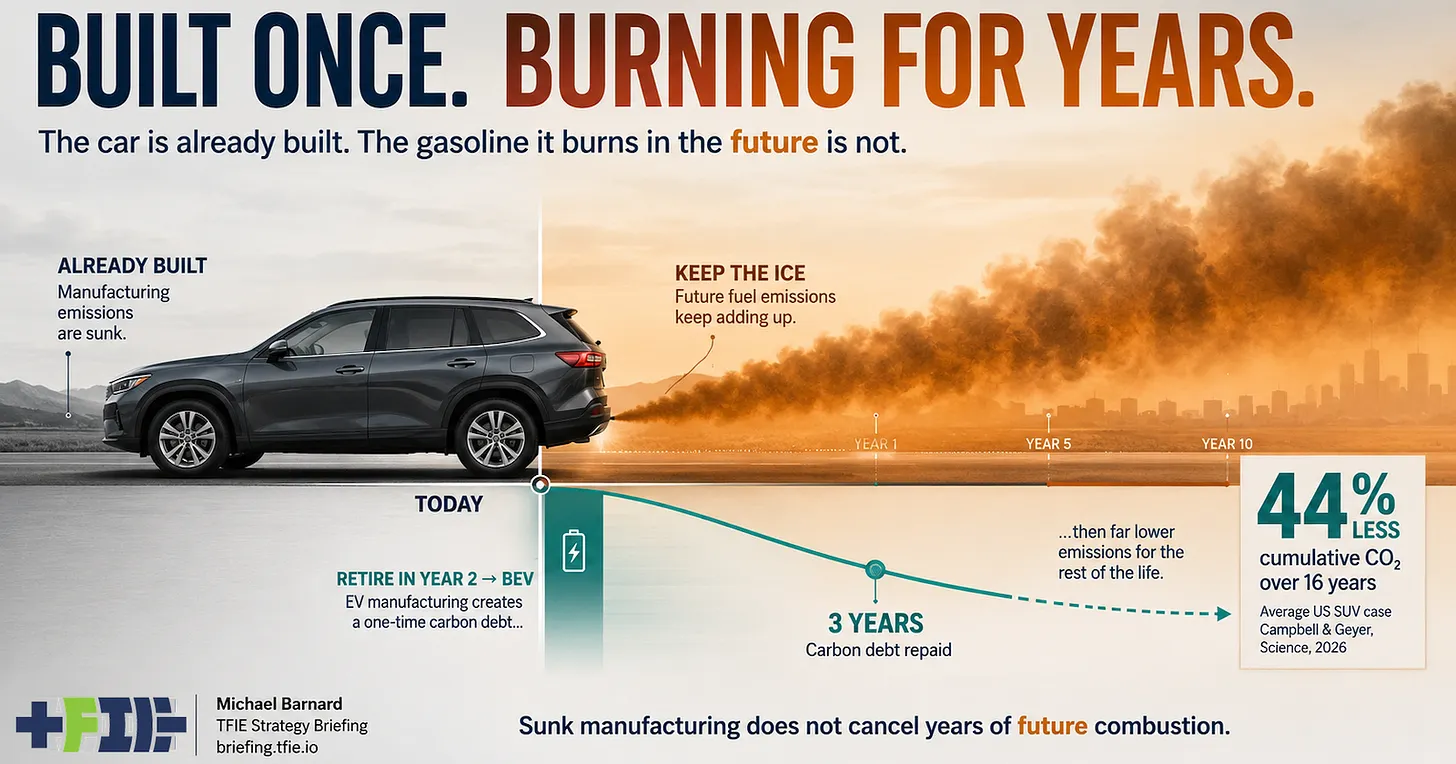
Consider a representative production-weighted SUV operating on the average United States electricity grid. If a consumer retires this combustion vehicle in its second year of life and replaces it with a battery-electric vehicle, the cumulative emissions over a standard 16-year study period drop by an astonishing 44%.
Manufacturing the replacement EV does indeed create an upfront carbon "bump"—the manufacturing debt that critics of early replacement so frequently highlight. However, the significantly lower operating emissions of the electric powertrain completely repay that manufacturing deficit in roughly three years. Because the vehicle is retired early, over a decade of continuous gasoline combustion is permanently wiped from the ledger, yielding massive long-term climate dividends.
Broad Sensitivity Analysis: The 92% Rule
Looking beyond a single SUV example, the broader sensitivity analysis provides profound insight into fleet dynamics. Across the vast array of operational combinations tested by the researchers:
- 92% of modeled scenarios produced net-lower greenhouse gas emissions as a result of early combustion vehicle retirement.
- Fleet-average assumptions yielded a 58% total emissions benefit.
- The absolute range spanned from an 82% reduction in emissions to a 77% increase in deliberately extreme edge cases.
This variance underscores a vital point: early retirement is not a universal panacea. Avoiding a second manufacturing event matters, but it is vastly outweighed by the sheer volume of fuel burned by inefficient legacy vehicles over their remaining lifespans.
Sunk Costs vs. Future Emissions
The core accounting principle driving these results is straightforward: the emissions generated during the original manufacturing of the legacy gasoline car are already trapped in the atmosphere. Consequently, Campbell and Geyer classify them as sunk costs.
The relevant policy and environmental comparison starts today. It asks a simple question: How much future gasoline will the old vehicle burn, and how does that compare to the combined manufacturing and charging emissions of the replacement EV? Keeping a legacy car on the road avoids one new manufacturing cycle, but it locks in a recurring, decades-long commitment to tailpipe pollution.
Where the Strategy Fails: The Danger Zones
Crucially, the study identifies clear boundaries where the climate advantage of early retirement evaporates entirely. For example, there are annual mileage thresholds below which the EV’s manufacturing emissions cannot be recovered:
- Passenger Cars: ~7,054 kilometers (approx. 4,383 miles) per year.
- SUVs: ~6,837 kilometers (approx. 4,248 miles) per year.
- Trucks: ~10,794 kilometers (approx. 6,707 miles) per year.
While these thresholds sit well below the researchers’ baseline average of roughly 20,000 kilometers per year, very lightly driven vehicles exist in significant numbers. For a secondary vehicle that only drives to the grocery store once a week, keeping it alive until its wheels fall off truly is greener than building an EV to replace it.
Furthermore, efficient hybrids and certain plug-in hybrid electric vehicles (PHEVs)—as well as inefficient EVs charged via particularly carbon-heavy regional electricity grids—are poor candidates for scrappage. In the continuous analysis, the climate advantage vanishes when EV electricity consumption exceeds approximately 30 kWh per 100 kilometers and grid emissions surpass 500 kilograms of CO₂ per megawatt-hour (MWh). A blunt policy that rewards the destruction of any running combustion vehicle would miss these vital distinctions.
The Socioeconomic Dilemma: Protecting the Used-Car Ladder
While the environmental math favoring the retirement of high-mileage, inefficient gas vehicles is robust, it collides directly with an acute social challenge: the structural car-dependence of American society and the fragility of the used-car market.
Uniquely American Car Dependence
Data from urban mobility researchers like Prieto-Curiel and Ospina (The ABC of mobility) illustrate the profound structural hurdle facing the United States. Their research indicates that 91.9% of urban trips in their US and Canadian sample were conducted by automobile, compared to 44.9% in Europe and a mere 18.8% in East Asia. Crucially, US car dependence barely budged even as metropolitan areas grew denser.
For the vast majority of Americans, owning a private automobile is not a lifestyle preference; it is an inescapable functional prerequisite for employment, grocery shopping, childcare, healthcare, and civic participation.

The Used-Car Ecosystem
This reality ties directly into how vehicles flow through the economy. New vehicles purchased or leased by affluent households, corporate fleets, rental agencies, and government bodies eventually age into six-, ten-, and fifteen-year-old assets, cascading down through progressively affordable tiers of the marketplace.
Federal Reserve survey data underscores this economic pipeline: roughly two-thirds of lower-income individuals who recently acquired a vehicle purchased it used, and 78% of privately purchased used vehicles cost less than $10,000.
Destroying a working internal combustion vehicle prematurely can inadvertently remove a critical rung from the used-car ladder. While the carbon benefit of removing that gas car might be real on paper, the societal cost is equally tangible if a lower-income family is subsequently priced out of reliable, affordable transportation.
[New Vehicle Market (Affluent Buyers, Fleets)]
                    │
                    ▼ (Depreciation over time)
[Mid-Tier Used Market (5-10 year old vehicles)]
                    │
                    ▼ (Further aging)
[Bottom-Tier Used Market (<$10,000 / Lower-Income Buyers)]
Intervention warning: Unchecked scrappage programs risk collapsing the bottom rungs of this supply chain.
Future Outlook: Designing a Smarter Vehicle-Retirement Policy
Solving the dual crises of climate change and transportation equity requires moving far beyond the simplistic mechanics of 2009’s "Cash for Clunkers." Policymakers must engineer a nuanced, data-driven framework that balances rapid fleet decarbonization with economic justice.
1. Tailored Scrappage Incentives
Future vehicle-retirement programs must abandon flat-rate bounties. Instead, financial incentives should be dynamically calculated based on:
- Fuel Economy & Efficiency: Prioritizing gas guzzlers, full-size pickups, and inefficient SUVs over hybrids and fuel-efficient commuters.
- Recent Mileage: Targeting vehicles with high annual mileage accumulations where immediate carbon savings are maximized.
- Remaining Expected Life: Evaluating vehicle health to ensure cars with years of reliable, low-mileage utility are not needlessly destroyed.
- Local Electricity Mix: Adjusting subsidies based on the cleanliness of regional power grids.
2. Strengthening the Affordable EV Supply Chain
To prevent the collapse of the sub-$10,000 used car market, policymakers must flood the pipeline with affordable secondhand electric vehicles. Governments, corporate fleets, and delivery services rack up miles rapidly; electrifying these commercial and institutional fleets immediately yields massive upfront carbon reductions while feeding 3-to-5-year-old EVs into the secondhand market at scale.
Pairing this influx with battery-health certifications, accessible financing options, and robust charging infrastructure will ensure these vehicles are genuinely useful to budget-conscious buyers. Furthermore, if regional data shows supplies of sub-$15,000 cars tightening sharply, government scrappage subsidies can be temporarily dialed back to protect market equilibrium.
3. Preserving Lightly Driven Assets
As Campbell and Geyer’s data proves, not every gas car belongs in the crusher. Vehicles operating well below annual mileage thresholds—such as an efficiently maintained Prius traveling 5,000 kilometers a year—are often better served through repair and continued operation than premature replacement.
Conclusion
The old environmental adage—“The greenest car is the one already built”—no longer serves as an absolute truth in the age of climate crisis. Campbell and Geyer’s landmark study in Science proves that keeping a high-mileage, fuel-thirsty internal combustion engine on the road carries an environmental toll that dwarfs the upfront manufacturing carbon debt of a replacement electric vehicle.
Yet, crafting a successful decarbonization strategy requires more than paying citizens to crush old cars. It demands an intelligent, empathetic policy approach that targets the worst polluters while protecting the used-car ladder upon which millions of working families rely. By marrying rigorous life-cycle accounting with a commitment to equitable mobility, policymakers can ensure that the transition to an electrified transport system accelerates climate progress without leaving vulnerable drivers behind.