





Executive Overview
The global energy landscape is undergoing a profound structural realignment, driven by the dual imperatives of decarbonization and national energy security. In a landmark development that solidifies the growing economic and industrial alliance between Europe and the Middle East, a tripartite Memorandum of Understanding (MoU) has been signed between Abu Dhabi National Oil Company (ADNOC), XRG, and Securing Energy for Europe (SEFE).
This strategic agreement establishes a comprehensive framework to explore deep cooperation across the natural gas and liquefied natural gas (LNG) value chains. Designed to fortify the energy security of Germany and the broader European market, the partnership encompasses gas supply, infrastructure development, and shipping optimization.
The alliance leverages the unique, complementary strengths of its signatories:
- ADNOC’s world-class upstream production capabilities and vast hydrocarbon reserves in the United Arab Emirates (UAE).
- XRG’s international supply network, investment portfolio, and strategic capital allocation.
- SEFE’s extensive European midstream infrastructure, trading expertise, and established industrial customer base.
Concurrently, the agreement underscores a massive financial commitment to the German economy. XRG and ADNOC have already deployed €19 billion in German investments, with the UAE announcing a long-term intention to invest an additional €40 billion across the country’s industrial and energy sectors.
Signed during an official state visit by UAE President Sheikh Mohamed bin Zayed Al Nahyan to Germany, this MoU represents more than a commercial agreement; it is a geopolitical anchor securing Germany’s industrial future in a post-pipeline energy era.
                  ┌──────────────────────────────────────────┐
                  │          UAE STATE DELEGATION            │
                  │  President Sheikh Mohamed bin Zayed      │
                  └────────────────────┬─────────────────────┘
                                       │ (State Visit)
                                       ▼
    ┌──────────────────────────────────────────────────────────────────────┐
    │                     TRIPARTITE ALLIANCE MoU                          │
    └──────────┬───────────────────────┬───────────────────────┬───────────┘
               │                       │                       │
               ▼                       ▼                       ▼
    ┌────────────────────┐  ┌────────────────────┐  ┌────────────────────┐
    │       ADNOC        │  │        XRG         │  │    SEFE (Germany)  │
    │  • UAE LNG Supply  │  │  • Global Sourcing │  │  • EU Distribution │
    │  • Upstream Assets │  │  • €19B+ Capital   │  │  • Gas Grid Access │
    │  • Ruwais Export   │  │  • Covestro Stake  │  │  • Trading Hubs    │
    └──────────┬─────────┘  └──────────┬─────────┘  └──────────┬─────────┘
               │                       │                       │
               └───────────────────────┼───────────────────────┘
                                       ▼
                  ┌──────────────────────────────────────────┐
                  │          FOUR PILLARS OF COOPERATION     │
                  │  1. Security of Supply                   │
                  │  2. Market Development & Growth          │
                  │  3. Supply Chain Resilience              │
                  │  4. Portfolio & Shipping Optimization    │
                  └──────────────────────────────────────────┘
Detailed Chronology
The signing of this MoU is the culmination of a multi-year diplomatic and commercial campaign initiated in the wake of the 2022 European energy crisis. To understand the significance of this tripartite alliance, one must trace the rapid evolution of Germany’s energy policies and the UAE’s targeted European investment strategy.
2022: The Catalyst of Crisis and the Birth of SEFE
Following the geopolitical rupture of 2022, Germany faced an unprecedented supply shock as Russian pipeline gas deliveries dwindled to zero. In response, the German federal government took the historic step of nationalizing Gazprom Germania, rebranding the entity as SEFE (Securing Energy for Europe).
Tasked with a sovereign mandate to stabilize the German gas market, SEFE transitioned from a subsidiary of a hostile foreign state monopoly into the cornerstone of Germany’s emergency energy procurement strategy. The company rapidly expanded its trading desk, secured storage capacities, and began seeking long-term supply partners outside of Russia.
Early 2023: The First UAE-to-Germany LNG Cargo
In early 2023, the diplomatic groundwork laid by Berlin and Abu Dhabi bore fruit. ADNOC delivered its first-ever Middle Eastern LNG cargo to Germany, unloading at the newly commissioned Elbehafen floating storage and regasification unit (FSRU) terminal in Brunsbüttel.
This delivery served as a proof-of-concept, demonstrating that Middle Eastern LNG could reliably substitute for Siberian pipeline gas. This milestone was quickly followed by the negotiation of multi-year supply contracts and agreements to transport piped gas through the Southern Gas Corridor, establishing a multi-channel supply route into Central Europe.
Mid-2024: The Industrial Integration of XRG
Parallel to ADNOC’s commodity supply deals, the UAE-backed investment platform XRG ramped up its industrial footprint in Germany. Chaired by Dr. Sultan Ahmed Al Jaber (who also serves as the Managing Director and Group CEO of ADNOC), XRG targeted high-value, energy-intensive German industrial assets.
Most notably, XRG spearheaded strategic investments in German materials giant Covestro, linking downstream chemical manufacturing with upstream energy and feedstock security. This move signaled that the UAE’s interest in Germany extended far beyond simple commodity sales, aiming instead for deep vertical integration within the German industrial complex.
September 2024: The State Visit and the Tripartite MoU
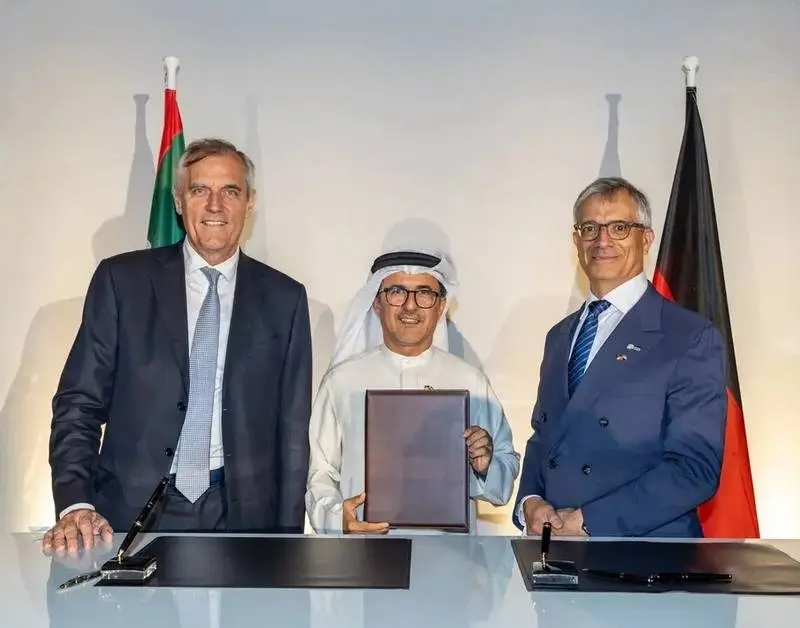
The relationship reached its highest diplomatic expression during the official state visit of UAE President Sheikh Mohamed bin Zayed Al Nahyan to Germany. Against the backdrop of high-level bilateral talks in Berlin, Dr. Sultan Ahmed Al Jaber and SEFE CEO Egbert Laege signed the tripartite MoU.
This agreement formally integrated XRG’s investment capabilities, ADNOC’s upstream muscle, and SEFE’s downstream European network into a single, coordinated energy-security engine.
Supporting Context & Metrics
The partnership between ADNOC, XRG, and SEFE is anchored by substantial capital commitments and structural synergies. The collaboration is organized around four key pillars designed to optimize the gas and LNG value chain.
The Four Pillars of Cooperation
| Pillar | Strategic Objective | Operational Focus |
|---|---|---|
| 1. Security of Supply | Guaranteeing baseload energy volumes for German industrial hubs. | Diversifying import points across northern and southern European entry gates. |
| 2. Market Development | Enhancing infrastructure to support natural gas and future transition fuels. | Investing in pipeline interconnectors, storage facilities, and inland distribution networks. |
| 3. Supply Chain Resilience | Mitigating geopolitical and maritime bottlenecks. | Developing redundant supply routes and securing long-term charter agreements for LNG vessels. |
| 4. Portfolio Optimization | Maximizing arbitrage and cost efficiencies. | Co-managing cargo movements, swapping swap-delivery locations, and integrating trading desk operations. |
                       ┌─────────────────────────┐
                       │   GERMAN ENERGY SECTOR  │
                       │   INVESTMENT LANDSCAPE  │
                       └────────────┬────────────┘
                                    │
                  ┌─────────────────┴─────────────────┐
                  ▼                                   ▼
       ┌─────────────────────┐             ┌─────────────────────┐
       │  EXISTING CAPITAL   │             │   PLANNED CAPITAL   │
       │     DEPLOYED        │             │     COMMITMENT      │
       │   €19 Billion       │             │   €40 Billion       │
       └──────────┬──────────┘             └──────────┬──────────┘
                  │                                   │
                  ▼                                   ▼
       ┌─────────────────────┐             ┌─────────────────────┐
       │ • Covestro Acq.     │             │ • Ruwais LNG Hub    │
       │ • LNG Terminals     │             │ • Hydrogen Infra    │
       │ • Piped Gas Routes  │             │ • Grid Upgrades     │
       └─────────────────────┘             └─────────────────────┘
The €59 Billion Investment Corridor
The financial scale of the UAE-Germany partnership reflects a deep commitment to the country’s industrial survival.
- €19 Billion Existing Investment: This capital pool, deployed by ADNOC and XRG, has been directed toward securing critical stakes in German chemical and materials manufacturing (such as Covestro), alongside early-stage investments in German clean energy technology and LNG import infrastructure.
- €40 Billion Future Commitment: Announced by the UAE during the state visit, this capital is earmarked for long-term deployment across Germany’s infrastructure, energy transition projects, and decarbonization technologies. A significant portion is expected to support the transformation of natural gas grids to handle hydrogen and synthetic methane.
Strategic Asset Integration
By combining the assets of the three signatories, the alliance creates a highly integrated value chain:
- ADNOC’s Supply Capabilities: ADNOC is rapidly expanding its LNG export capacity, centered on the world-class Ruwais LNG project. This facility, designed to run on clean nuclear and solar power, will nearly double ADNOC’s export capacity, providing Germany with some of the lowest-carbon-intensity LNG available globally.
- XRG’s Portfolio Flexibility: XRG brings global sourcing capabilities, allowing the alliance to draw from international LNG pools outside the UAE, thereby mitigating regional supply risks in the Middle East.
- SEFE’s European Footprint: SEFE holds extensive gas transport capacity, direct access to key European trading hubs (such as Title Transfer Facility – TTF and Trading Hub Europe – THE), and a large portfolio of industrial end-users. This ensures that imported LNG is efficiently regasified and delivered directly to Germany’s manufacturing heartlands in North Rhine-Westphalia, Bavaria, and Baden-Württemberg.
Official Statements
The leadership of the participating institutions emphasized the strategic, long-term nature of the alliance, framing it as a vital pillar of both economic growth and energy security.
Dr. Sultan Ahmed Al Jaber, ADNOC Managing Director, Group CEO, and Executive Chairman of XRG, highlighted the enduring nature of the bilateral relationship:
"XRG and ADNOC are committed to Germany for the long term. We have already invested €19 billion, and this week the UAE more widely announced the long-term intention to invest a further €40 billion in the country.
This agreement with SEFE combines our capabilities and opens new opportunities across the gas and LNG value chain, strengthening energy security and supporting the competitiveness and growth of German industry."
Dr. Al Jaber’s statement underscores the dual-track strategy of the UAE: providing the immediate fossil-fuel resources required to keep German factories running, while simultaneously investing the capital necessary to lead the next generation of industrial technology.
Egbert Laege, Chief Executive Officer of SEFE, focused on the operational necessity of value-chain integration in a volatile global market:
"We are thrilled to deepen our collaboration with such trusted partners as ADNOC and XRG. In today’s energy landscape, closer cooperation across the value chain is critical.
By bringing together ADNOC and XRG’s global supply capabilities with SEFE’s market presence, trading expertise, customer relationships and infrastructure access, we aim to enhance the resilience of Germany’s and Europe’s energy systems."
Laege’s remarks reflect the realities of the modern European energy market, where simple bilateral purchase contracts are no longer sufficient to guarantee security of supply. Instead, active participation in shipping, infrastructure investment, and global portfolio trading is required to insulate European consumers from price spikes and supply disruptions.
Future Outlook
The tripartite MoU between ADNOC, XRG, and SEFE establishes a foundation for a multi-decade energy partnership. As the alliance matures, its impact is expected to extend far beyond traditional LNG supply contracts, shaping the future of Europe’s clean energy transition.
The LNG-to-Hydrogen Bridge
A key strategic element of the partnership is the future-proofing of imported energy infrastructure. The new LNG import terminals and pipeline connections being developed under this agreement are designed to be "hydrogen-ready."
As Germany progresses toward its net-zero goals, the natural gas value chains established by ADNOC, XRG, and SEFE are expected to transition to carrying blue and green ammonia, as well as liquid hydrogen. ADNOC is already developing world-scale hydrogen and ammonia production facilities in Ruwais, positioning itself to remain Germany’s primary energy exporter long after the fossil fuel era draws to a close.
       [ Phase 1: Near-Term ]          [ Phase 2: Mid-Term ]         [ Phase 3: Long-Term ]

        ┌───────────────────┐          ┌───────────────────┐          ┌───────────────────┐
        │  LNG & Piped Gas  │  ─────►  │  Low-Carbon Gas   │  ─────►  │   Clean Hydrogen  │
        │  • Baseload LNG   │          │  • Carbon Capture │          │   • Green Ammonia │
        │  • Southern Canal │          │  • Certified Gas  │          │   • H2 Pipeline   │
        └───────────────────┘          └───────────────────┘          └───────────────────┘
Geopolitical Realignment of European Energy
The formalization of this alliance cements a broader shift in Europe’s energy dependency. Having decoupled from Russian state-controlled suppliers, Germany is establishing a diversified import portfolio led by Norway, the United States, and the Arabian Gulf.
The heavy involvement of UAE state-backed entities provides Germany with a reliable counterweight to its reliance on US spot-market LNG, which remains vulnerable to domestic political shifts and regulatory changes.
Industrial Competitiveness
For Germany’s energy-intensive industries—including chemicals, steel, and automotive manufacturing—the long-term supply guarantees provided by this agreement offer critical cost predictability. By integrating upstream supply with downstream industrial players like Covestro, the alliance helps insulate Germany’s industrial core from the extreme energy price volatility that has threatened the nation’s competitive edge since 2022.
Ultimately, the tripartite agreement between ADNOC, XRG, and SEFE represents a sophisticated template for modern energy diplomacy. By combining sovereign capital, world-class upstream assets, and dominant midstream market access, the partners have built an energy corridor designed to weather both geopolitical turbulence and the complex demands of the global energy transition.