









Executive Overview
In a development that has sent tremors through the transatlantic energy markets, state-owned oil giant Saudi Aramco has informed at least two major European refining customers that their contracted crude oil allocations for October 2026 will be completely suspended. The sudden halt in supply follows a sophisticated drone attack targeting Saudi Arabia’s critical East-West pipeline, a vital artery designed to transport crude from the kingdom’s eastern fields to the Red Sea port of Yanbu.
European refiners, which heavily rely on predictable term contracts with Saudi Aramco to secure their baseline feedstock, are now scrambling to find alternative barrels in an already tight physical market. The disruption has forced prominent regional operators, including Poland’s state-controlled refiner PKN Orlen, to pivot to North Sea grades to cover the supply deficit.
While Saudi Aramco is aggressively working to execute a phased recovery plan—aiming to partially restore the pipeline within days and achieve full capacity within six weeks—the incident underscores the persistent vulnerability of Middle Eastern energy infrastructure to asymmetric aerial threats. To mitigate the immediate export shortfall from the Red Sea, Aramco has initiated emergency ship-to-ship (STS) transfers off the coast of Sohar, Oman, shifting its logistics focus back toward the Persian Gulf.

Detailed Chronology
The unfolding supply crisis is the direct result of a highly coordinated security breach that targeted Saudi Arabia’s midstream infrastructure, exposing the vulnerabilities of bypass corridors.
[Drone Attack Targets Pumping Stations]
                 │
                 ▼
[Automatic Emergency Shutdown of East-West Pipeline]
                 │
                 ▼
[Halt of Crude Deliveries to Yanbu Port (Red Sea)]
                 │
                 ▼
[Saudi Aramco Issues October Cancellation Notices to European Refiners]
                 │
                 ▼
[Emergency Mitigation: STS Transfers at Sohar & North Sea Spot Buying]
The Attack and Immediate Operational Shutdown
In mid-September 2026, a fleet of explosive-laden drones bypassed regional air defenses to strike three critical pumping stations along the 1,200-kilometer (745-mile) East-West pipeline. The pipeline, which has a nominal capacity of approximately 5 million barrels per day (bpd), serves as the kingdom’s primary alternative to the Strait of Hormuz, allowing crude to be piped directly to the Yanbu terminal on the Red Sea for onward shipment to Europe and North America.
The strikes caused significant structural damage to the pumping stations, which maintain the pressure required to push heavy crude across the Arabian Peninsula’s vast desert terrain. To prevent catastrophic oil spills and assess the integrity of the line, automated safety systems triggered an immediate, full-scale shutdown of the pipeline.
The Logistics Bottleneck at Yanbu
With the flow of crude severed at the source, loading operations at the Red Sea port of Yanbu ground to a near-total halt. Tankers scheduled to load Saudi Arab Light and Saudi Arab Medium grades at Yanbu were either delayed or forced to idle in the Red Sea. Recognizing that the infrastructure damage would prevent them from honoring near-term delivery schedules, Saudi Aramco’s marketing department began notifying European term buyers that their scheduled October allocations could not be fulfilled.
Rapid Mitigation and Tactical Pivots
In the days following the attack, Saudi Aramco deployed engineering teams to initiate emergency repairs. Sources close to the matter indicate that the state oil giant expects to partially restart the pipeline at reduced capacity within days. However, restoring the system to its pre-attack throughput of several million barrels per day is anticipated to take up to six weeks.
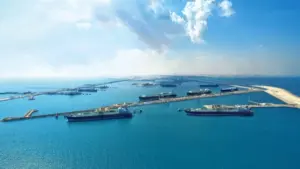
Simultaneously, Aramco’s trading and logistics arms activated contingency plans. To bypass the paralyzed Yanbu terminal, the company began routing additional crude volumes through the Persian Gulf and establishing ship-to-ship (STS) transfer operations off Sohar, Oman. This maneuver allows Aramco to consolidate cargoes onto Very Large Crude Carriers (VLCCs) outside the Strait of Hormuz, though it adds significant transit time and freight costs for cargoes bound for Western markets.
Supporting Context & Metrics
The suspension of October crude deliveries has profound implications for European refining economics and global maritime logistics. Understanding these impacts requires analyzing the strategic role of the East-West pipeline, the chemistry of refinery configurations, and the shifting dynamics of the physical crude market.
The Strategic Value of the East-West Pipeline
The East-West pipeline (often referred to as the Petroline) is more than just commercial infrastructure; it is a geopolitical insurance policy. By transporting crude from the massive Ghawar and Khurais fields in the east to Yanbu in the west, Saudi Arabia can bypass the chokepoint of the Strait of Hormuz, which is frequently subject to geopolitical tensions.
| Metric | Details |
|---|---|
| Total Length | ~1,200 Kilometers (745 miles) |
| Nominal Capacity | 5.0 Million Barrels per Day (bpd) |
| Target Infrastructure | Pumping Stations 6, 7, and 8 |
| Estimated Recovery Window | 6 Weeks to Full Capacity |
| Primary Export Terminal | Yanbu Port, Red Sea |
The disruption of this pipeline effectively forces Saudi Arabia to redirect its export logistics back through the Persian Gulf, increasing the volume of oil that must traverse the Strait of Hormuz and exposing a larger share of global supply to localized maritime risks.
Refinery Chemistry: The Cost of Substituting Saudi Crude
European refineries are highly complex chemical plants optimized to run on specific "crude slates." Saudi Aramco’s primary exports to Europe—such as Saudi Arab Light (approx. 34° API gravity, 1.8% sulfur) and Saudi Arab Medium (approx. 31° API gravity, 2.5% sulfur)—are medium-sour grades.
When these supplies are cut, refiners cannot simply substitute any available crude. The sudden pivot by Poland’s PKN Orlen to North Sea grades highlights this operational challenge:

- North Sea Grades (e.g., Brent, Forties): These are typically light-sweet crudes (lower sulfur, higher API gravity).
- Refining Yield Implications: While lighter, sweeter crudes produce higher yields of high-value transport fuels like gasoline and diesel, they produce less vacuum gasoil and bitumen. Refiners optimized for medium-sour crude must adjust their distillation columns, hydrotreaters, and fluid catalytic crackers (FCCs), which can lead to suboptimal run rates and compressed refining margins.
- Economic Penalty: North Sea grades often trade at a premium to Middle Eastern grades on a delivered basis. The sudden rush to buy North Sea spot cargoes has pushed physical differentials higher, driving up feedstock costs for European refiners precisely when regional fuel demand is fluctuating.
[Saudi Arab Medium (Medium Sour)] ──► Optimized Refinery Yield ──► Maximum Margin
                                                                        │
                                                         (Supply Disrupted by Attack)
                                                                        │
                                                                        ▼
[North Sea Brent (Light Sweet)]   ──► Adjusted Refinery Run   ──► Higher Feedstock Cost & Lower Yield
Emergency Maritime Logistics: The Sohar STS Hub
To counter the Yanbu shutdown, Aramco’s utilization of ship-to-ship (STS) transfers off Sohar, Oman, represents a massive logistical undertaking. Sohar’s deep-water anchorage lies just outside the Persian Gulf, making it an ideal location for consolidating smaller Suezmax or Aframax tankers into supertankers (VLCCs). This emergency measure helps maintain export volumes to long-haul Asian markets, but it does little to ease the immediate supply crunch in the Mediterranean and Northwest Europe, where shipping distances from the Persian Gulf are significantly longer than from the Red Sea.
Official Statements
Despite the widespread market disruption, official communications from the primary entities involved have remained highly guarded, reflecting the sensitive geopolitical nature of energy security.
Saudi Aramco
Saudi Aramco has maintained a strict policy of non-disclosure regarding the specifics of the supply suspensions. When contacted for official comment outside of standard Middle Eastern business hours, a spokesperson for the company declined to comment on the record. Historically, Aramco addresses such disruptions through direct communication with its contracted customers rather than public press releases, aiming to project an image of operational resilience to global markets.
European Refining Sector
Spokespersons for European refining entities have been similarly circumspect, acknowledging the need to adapt supply chains without directly pointing blame or detailing the exact volume of lost barrels.
An industry source close to Poland’s PKN Orlen, speaking on the condition of anonymity, noted:
"Our supply chain security is robust enough to withstand temporary geopolitical disruptions. While the suspension of October allocations from the Red Sea requires us to actively engage the spot market for North Sea and West African alternatives, we do not anticipate any operational shutdowns or regional fuel shortages."
Geopolitical Observers and Security Analysts
Energy security analysts have been more vocal about the broader implications of the drone strikes. Speaking on the vulnerability of the kingdom’s infrastructure, an energy security analyst commented:
"This incident demonstrates that bypassing physical chokepoints like the Strait of Hormuz does not eliminate geopolitical risk; it merely relocates it. The East-West pipeline is a highly visible, static target. As drone technology becomes cheaper and more accessible, securing thousands of miles of overland pipelines against asymmetric threats is becoming an almost impossible task for midstream operators."
Future Outlook
The suspension of Aramco’s October deliveries will have cascading effects on the global oil market over the final quarter of 2026.
Short-Term Market Tightness and Pricing Volatility
As European refiners compete for alternative sweet and sour grades to replace the missing Saudi barrels, physical crude differentials in the North Sea, Mediterranean, and West African markets are expected to strengthen. This localized tightness will likely widen the spread between Brent (the European benchmark) and Dubai crude, making European refined products more expensive relative to Asian products.
The Six-Week Recovery Litmus Test
The primary focus of the market will be Saudi Aramco’s ability to meet its self-imposed six-week timeline for restoring the East-West pipeline to full capacity. If engineering teams encounter delays due to specialized parts shortages or secondary damage discovered during pressure testing, the suspension of deliveries could easily extend into November and December, compounding the winter supply squeeze for European heating oil and diesel markets.
Structural Changes in Infrastructure Defense
In the long term, this attack will likely force Saudi Arabia and its regional allies to drastically increase capital expenditure on automated defense systems, including anti-drone jamming technology, satellite surveillance, and rapid-response repair depots along critical pipeline corridors.
Additionally, European refiners are likely to accelerate their efforts to diversify their crude import portfolios. While Saudi Arabia will remain a cornerstone supplier, the vulnerability of the Red Sea route may prompt European buyers to secure more permanent supply agreements with North American, West African, and non-Middle Eastern producers, permanently altering the flows of global crude.