








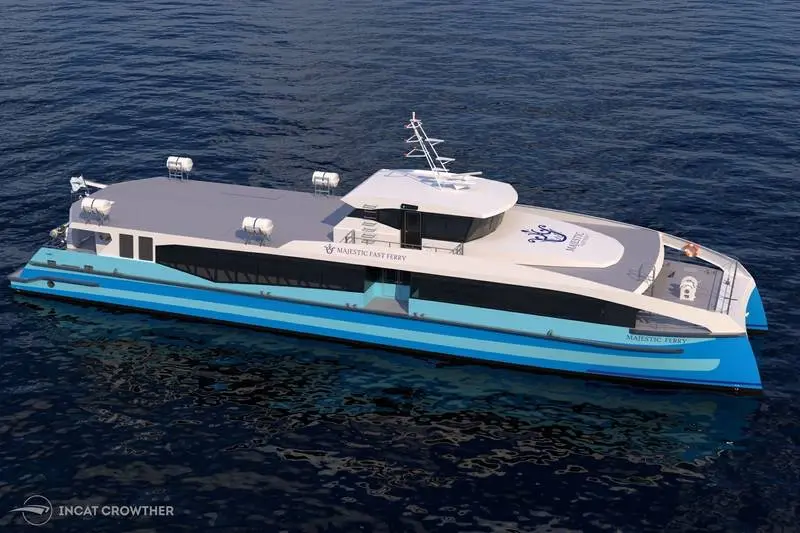
SINGAPORE — In a move set to redefine high-speed passenger transit in Southeast Asia, construction has officially commenced on a next-generation fleet of 39-meter passenger ferries. Designed by the renowned digital shipbuilding pioneer Incat Crowther for Singapore’s premier operator, Majestic Fast Ferry, this ambitious shipbuilding program represents a major leap forward in regional maritime transport.
The vessels, which are being constructed by the prominent Indonesian shipyard PT Cahaya Samudra, are the culmination of years of iterative design, operational feedback, and cutting-edge naval architecture. This project marks the debut of Majestic Fast Ferry’s third-generation 39-meter platform, building upon the highly successful first- and second-generation vessels that have long served as the backbone of the operator’s fleet.
With plans to construct up to 20 of these state-of-the-art vessels, this initiative represents one of the most significant multi-vessel orders in the modern high-speed ferry sector. The first vessel of this new class is scheduled for completion and delivery by 2027, signaling a long-term commitment to fleet modernization, fuel efficiency, and elevated passenger comfort.
Executive Overview
The international maritime boundary separating Singapore and the Riau Islands of Indonesia is home to some of the busiest passenger ferry routes in the world. Thousands of commuters, business travelers, and tourists cross these waters daily, demanding transit solutions that are fast, reliable, comfortable, and environmentally conscious.
To meet these evolving market demands, Majestic Fast Ferry has once again partnered with global naval architecture firm Incat Crowther and Batam-based shipbuilder PT Cahaya Samudra. The partnership’s latest venture—the third-generation 39-meter catamaran—is not merely an incremental update but a comprehensive redesign aimed at optimizing operational economics and passenger experience.
Key Project Highlights:
- Vessel Class: Third-generation 39-meter high-speed passenger catamaran.
- Designer: Incat Crowther.
- Shipbuilder: PT Cahaya Samudra (Batam, Indonesia).
- Project Scale: Up to 20 vessels planned under the construction program.
- First Delivery: Anticipated in 2027.
- Passenger Capacity: 312 passengers, featuring a dedicated VIP cabin.
- Maximum Speed: 32.5 knots, representing a significant performance increase over previous iterations.
- Key Innovations: Optimized raked bow form, extensive use of lightweight extruded aluminum, simplified structural design, and enhanced universal accessibility.
Detailed Chronology of Fleet Evolution
The journey toward this third-generation platform is rooted in a highly collaborative, decade-long partnership between operator, designer, and shipbuilder. By analyzing the chronological development of Majestic Fast Ferry’s fleet, one can observe a clear trajectory toward optimization and standardization.
[Early Fleet Deployment]
   │  (Introduction of 29-meter & 33-meter Incat Crowther catamarans)
   ▼
[Mid-Generation Scaling]
   │  (Launch of 1st & 2nd Gen 39-meter and 42-meter vessels to increase capacity)
   ▼
[Operational Data Collection]
   │  (Years of real-world transit data analyzed from the Singapore Strait)
   ▼
[3rd Generation Conception]
   │  (Raked bow design, structural weight reduction, and speed optimization)
   ▼
[Construction Commenced (Sept 2026)]
   │  (Keel-laying and fabrication underway at PT Cahaya Samudra)
   ▼
[First Vessel Delivery (2027)]
      (Launch of the first of up to 20 next-generation catamarans)
The Early Generations (29m and 33m Platforms)
Incat Crowther’s initial designs for Majestic Fast Ferry focused on establishing a reliable foothold in the competitive Singapore Strait. These early 29-meter and 33-meter vessels prioritized maneuverability, rapid boarding capabilities, and robust mechanical systems capable of withstanding high-cycle daily operations.
The Scaling Phase (39m and 42m Platforms)
As passenger volumes grew between Singapore’s HarbourFront and Tanah Merah terminals and Indonesia’s Batam Center, Sekupang, and Bandar Bentan Telani terminals, the operator required larger vessels. This led to the introduction of the first- and second-generation 39-meter and 42-meter catamarans. These vessels proved to be highly successful, proving that larger passenger capacities could be achieved without sacrificing the speed and agility required to navigate busy shipping lanes.
The Third-Generation Leap (2026 and Beyond)
By late 2026, with years of operational telemetry and passenger feedback in hand, the three partners embarked on their most ambitious project to date. The third-generation 39-meter platform was conceived not just to carry more passengers, but to carry them more efficiently. By focusing on hydrodynamic refinements, weight reduction, and simplified manufacturing techniques, the new design aims to lower the total cost of ownership while raising performance standards.
Supporting Context & Technical Metrics
The engineering philosophy behind the new 39-meter vessel revolves around two primary, interconnected goals: optimizing performance and reducing structural weight. In high-speed catamaran design, even minor weight reductions yield exponential benefits in fuel economy, speed, and engine longevity.
Hydrodynamic Innovation: The Raked Bow
A defining visual and functional feature of the third-generation vessel is its newly designed, aggressively raked bow form. This hull modification serves several critical purposes:
- Reduced Wave-Making Resistance: The bow cuts through coastal chops more cleanly, minimizing the drag that typically slows down wide-beam catamarans.
- Improved Sea-Keeping: The hull form reduces pitching motions, ensuring a smoother ride for passengers in rough seasonal waters.
- Spray Deflection: The geometry is designed to keep green water off the superstructure, preserving visibility and reducing salt-water wear on cabin windows and deck equipment.
Metallurgy and Structural Simplification
To achieve the weight targets set by Majestic Fast Ferry, Incat Crowther’s engineering team turned to advanced material science and structural optimization.
The primary mechanism for weight reduction in this build is the expanded use of custom extruded aluminum sections. Traditional shipbuilding relies heavily on welding flat aluminum plates to separate stiffeners—a process that is both labor-intensive and adds unnecessary weight due to weld fillets and overlapping structures. By utilizing advanced extruded profiles, the designers have integrated the plate and the stiffener into single, continuous aluminum components.
This technique yields several distinct advantages:

- Weight Savings: Eliminates excess weld metal and allows for thinner, high-strength structural profiles where heavy plates are not required.
- Streamlined Fabrication: Reduces the total number of individual parts that must be aligned and welded by the shipyard, significantly accelerating construction timelines.
- Enhanced Structural Integrity: Continuous extrusions eliminate many of the stress concentrations associated with traditional welded joints, reducing the likelihood of fatigue cracking over the vessel’s operational lifespan.
| Parameter | Second-Generation 39m Platform | Third-Generation 39m Platform | Net Operational Benefit |
|---|---|---|---|
| Passenger Capacity | 300 – 312 | 312 (Optimized Layout) | Increased yield per transit |
| Maximum Speed | ~30 Knots | 32.5 Knots | Faster turnaround, reduced transit times |
| Hull Construction | Traditional Marine Aluminum | Advanced Extruded Aluminum | Lower structural weight, faster build time |
| Bow Design | Standard Plumb/Spoon Bow | Optimized Raked Bow | Superior sea-keeping and reduced drag |
| Accessibility | Standard | Universal (Wheelchair Compliant) | Broader market appeal, regulatory compliance |
Passenger Experience and Interior Layout
While technical efficiency dominates the engine room and hull design, passenger comfort is the defining feature of the main and upper decks. High-speed commuting can be fatiguing; therefore, the interior layout of the new vessel has been designed to maximize space, light, and accessibility.
       [UPPER DECK] ── Wheelhouse / Crew Quarters / Exterior Deck
            │
            ▼
       [MAIN DECK]  ── VIP Cabin (Exclusive Seating)
            │       ── Main Passenger Cabin (312 Seats Total)
            │       ── Kiosk & Refreshment Center
            │       ── Five Restrooms (1 Wheelchair Accessible)
            │       ── High-Capacity Luggage Storage Zones
Main Deck Architecture
The main deck cabin is designed to accommodate up to 312 passengers in a spacious, ergonomic seating configuration. High ceilings, large panoramic windows, and advanced noise-vibration-harshness (NVH) insulation materials create a quiet, bright, and relaxing cabin environment.
VIP Cabin and Amenities
Recognizing the growing demand for premium travel options among business executives and luxury tourists heading to Bintan’s high-end resorts, the vessel includes a dedicated VIP seating area. This exclusive zone features wider, reclining seats, increased legroom, and enhanced privacy.
For general passenger convenience, the main deck also features:
- Central Kiosk: A modern refreshment station designed for rapid service during short-distance transits.
- Optimized Luggage Storage: Large, secure luggage racks located near the boarding entryways to facilitate quick embarkation and disembarkation, reducing port turnaround times.
- Sanitary Facilities: Five spacious restrooms, including one fully compliant with universal accessibility standards to accommodate wheelchair-bound passengers.
Strategic Context: The Singapore-Indonesia Maritime Corridor
To understand the scale of this project—potentially encompassing up to 20 vessels—one must examine the unique economic geography of the Singapore Strait.
The Riau Islands of Indonesia, particularly Batam and Bintan, operate as vital economic satellites to Singapore. Batam serves as a major manufacturing, shipbuilding, and logistics hub, while Bintan is a premier leisure and tourism destination. Consequently, the maritime corridor between these islands and Singapore is characterized by high-frequency, high-volume passenger traffic.
┌─────────────────┐             Singapore Strait              ┌─────────────────┐
│    SINGAPORE    │ <───────────────────────────────────────> │    INDONESIA    │
│  (HarbourFront) │       High-Frequency commuter and         │ (Batam / Bintan │
│ (Tanah Merah)   │         tourist transit corridor          │  Ferry Ports)   │
└─────────────────┘                                           └─────────────────┘
The Role of PT Cahaya Samudra
The selection of PT Cahaya Samudra in Batam as the builder for this massive fleet project is a strategic decision. Over the past decade, the shipyard has established itself as a premier center of excellence for aluminum catamaran construction. Its close geographical proximity to Singapore allows Majestic Fast Ferry’s technical superintendents to conduct frequent, real-time quality inspections and sea trials, ensuring that each vessel is delivered in strict accordance with classification society rules and local regulatory frameworks, such as those mandated by the Maritime and Port Authority of Singapore (MPA).
Furthermore, building the vessels in Batam provides significant cost efficiencies in terms of skilled labor and localized supply chains, while maintaining direct access to Singapore’s advanced maritime logistics, financial services, and engineering networks.
Future Outlook and Decarbonization Pressures
As the maritime industry faces intensifying pressure to reduce its carbon footprint, the launch of a major new fleet of diesel-powered high-speed catamarans might initially seem counter to global decarbonization trends. However, a deeper analysis reveals that this project represents a highly pragmatic, transitional approach to sustainable maritime transport.
High-speed catamarans require immense power to maintain speeds above 30 knots. Currently, alternative propulsion technologies—such as pure battery-electric or hydrogen fuel cells—are hindered by weight and energy-density limitations that make them unfeasible for the range and speed profiles required on the Singapore-Batam route.
In this context, dematerialization and hydrodynamic optimization are the most effective tools available to reduce emissions today. By reducing the vessel’s empty weight through extruded aluminum and lowering drag via the raked bow, the third-generation 39-meter ferry requires significantly less horsepower per passenger-mile than its predecessors. This directly translates to lower fuel consumption and reduced greenhouse gas emissions per transit.
Furthermore, the simplified structural design and modular layout of these Incat Crowther catamarans ensure they are "future-ready." Should low-carbon drop-in biofuels, hybrid propulsion packages, or lightweight hydrogen systems become commercially viable in the coming decade, these vessels are well-positioned to undergo retrofits, extending their operational relevance far into the mid-21st century.
Conclusion: A Blueprint for Collaborative Success
The commencement of construction on this next-generation fleet is a testament to the power of long-term commercial relationships. By aligning the operational expertise of Majestic Fast Ferry, the design ingenuity of Incat Crowther, and the construction capabilities of PT Cahaya Samudra, this project sets a new benchmark for high-speed coastal transit. As the first vessel prepares to splash in 2027, the maritime world will be watching closely, recognizing that the future of regional connectivity is being forged in the shipyards of Batam today.