







Executive Overview
California continues to cement its status as an undisputed global powerhouse in the clean energy transition. Driven by aggressive state mandates, widespread consumer adoption of rooftop solar, and massive utility-scale clean energy deployments, the Golden State is steadily redefining what is possible for a major economy. Stanford University Professor Mark Z. Jacobson, Director of the Atmosphere/Energy Program within the Department of Civil and Environmental Engineering, has long championed the "WWS" framework—focusing strictly on Wind, Water, and Solar technologies as the bedrock of a decarbonized energy grid.
By closely monitoring California’s daily energy metrics, infrastructure build-outs, and generation records, analysts and academics are catching a glimpse of a fully electrified future. Recent data highlighted by Jacobson underscores a series of unprecedented milestones for the state’s renewable energy industry. While these achievements represent monumental leaps forward for climate mitigation and energy independence, they are quickly eclipsed by the relentless momentum of an industry that treats today’s records as tomorrow’s baseline. This report provides an in-depth look at California’s renewable trajectory, the framework driving its success, and what these developments mean for the broader global energy landscape.
Detailed Chronology of a Clean Energy Transformation
The journey to California’s current renewable energy dominance was not built overnight. It is the result of decades of proactive policy-making, technological innovation, and localized community investment.
The Foundation: Early Mandates and Grid Evolution
Decades ago, California recognized that its heavy reliance on fossil fuels posed severe environmental and economic risks. The establishment of the Renewable Portfolio Standard (RPS) in 2002 set the initial framework, requiring investor-owned utilities to procure a specific percentage of their electricity from eligible renewable sources. Over the years, these targets have become progressively stringent, culminating in landmark legislation requiring 100% zero-carbon electricity by 2045.
As utility-scale solar farms began to sprawl across the Mojave Desert and wind turbines populated passes like Altamont and Tehachapi, the state’s energy profile shifted dramatically. Concurrently, state incentives and net-metering policies ignited a rooftop solar boom. Millions of residential and commercial property owners transformed from passive consumers into active "prosumers," generating clean power on-site and feeding excess energy back into the grid.
The Modern Era: Reaching New Milestones
In recent years, the convergence of plummeting photovoltaic (PV) hardware costs, advanced lithium-ion energy storage systems, and sophisticated grid management software has allowed California to routinely break its own clean energy records.
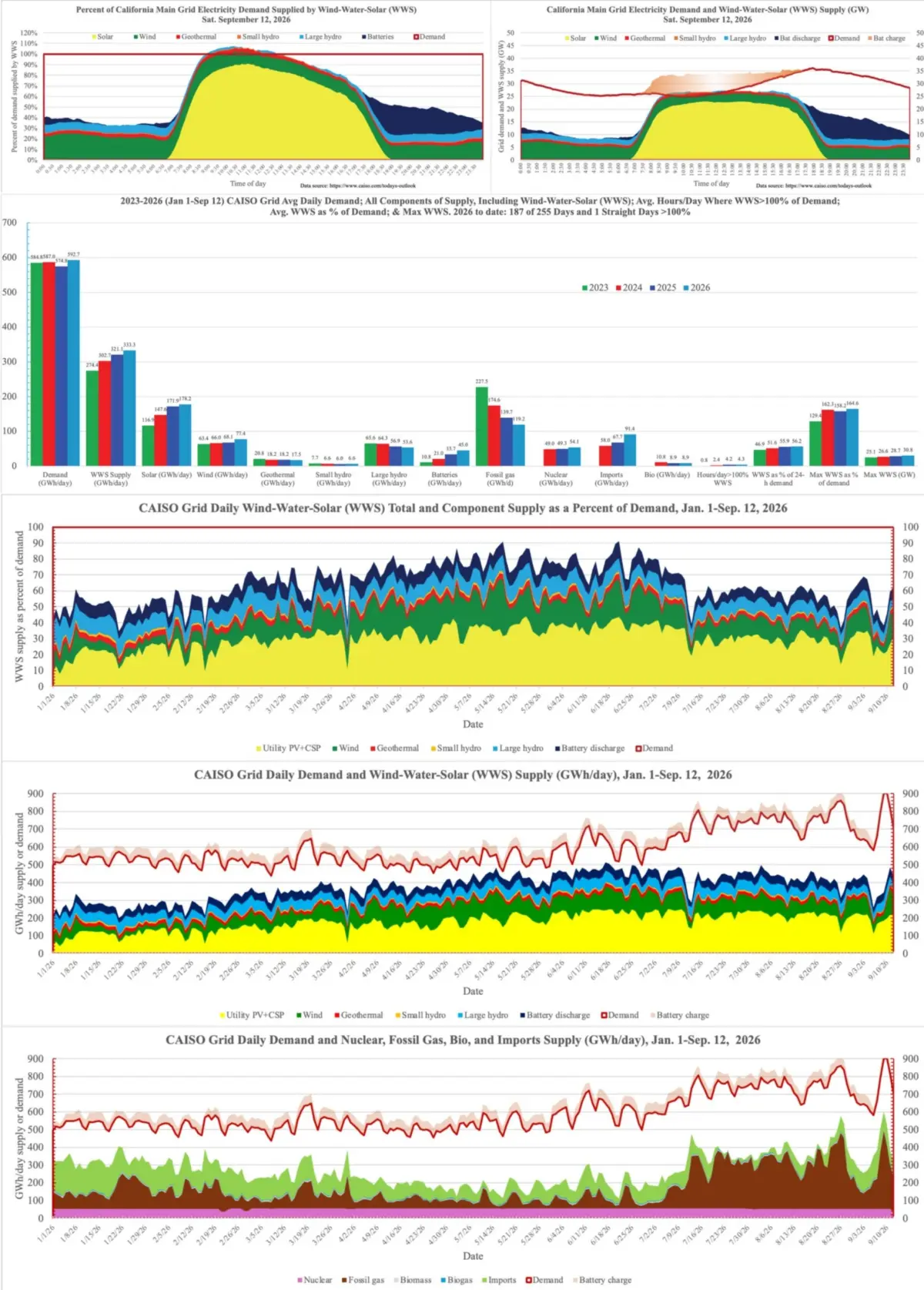
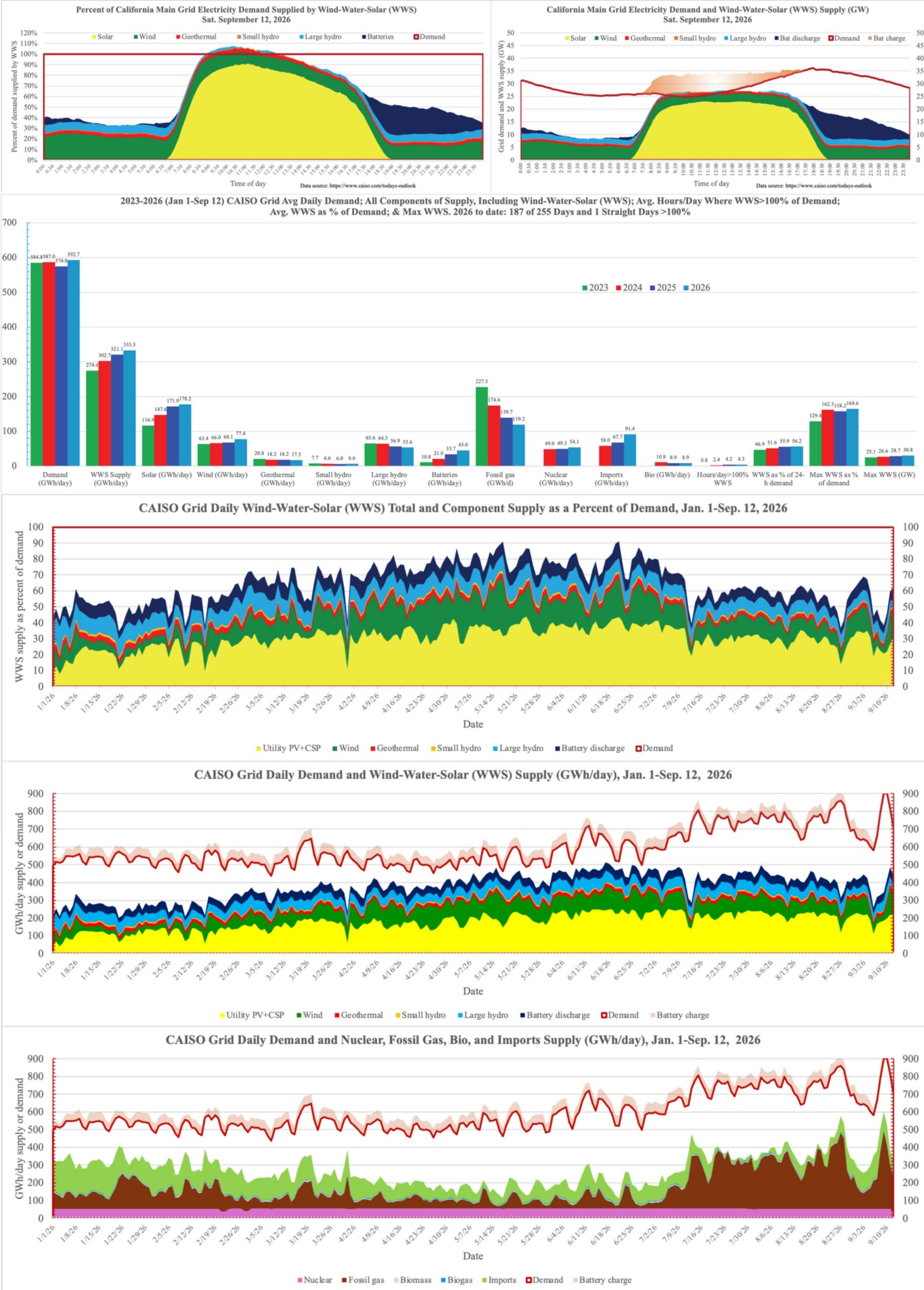
Yesterday’s data releases, spotlighted by academic leaders like Professor Jacobson, emphasize that the integration of WWS infrastructure is accelerating faster than many traditional forecasters anticipated. Milestones that were once projected for the late 2020s—such as sustained periods where renewable generation meets or exceeds 100% of instantaneous demand—are now regular occurrences during peak spring and autumn afternoons. The rapid deployment of utility-scale battery storage has proven especially transformative, capturing midday solar overproduction and discharging it seamlessly during the evening ramp when demand spikes and solar generation wanes.

Supporting Context & Metrics: The WWS Framework
To understand California’s success, one must examine the methodology used to measure it. Professor Mark Z. Jacobson’s WWS framework isolates the three pillars necessary for a sustainable, zero-emission energy economy: Wind, Water (hydroelectric and wave/tidal), and Solar.
The Power of Rooftop and Utility-Scale Solar
Solar energy remains the undisputed workhorse of California’s renewable expansion. The state boasts some of the highest solar irradiance levels in the country. By combining massive photovoltaic plants—capable of generating hundreds of megawatts per installation—with millions of distributed rooftop systems, California has created a decentralized generation matrix that enhances grid resilience.
Recent metrics indicate that utility-scale solar farms provide the bulk of the heavy lifting during peak daylight hours, while distributed rooftop solar reduces the localized load on neighborhood substations. This dual-track approach minimizes transmission losses and empowers local communities to take direct control of their energy consumption and carbon footprint.
Wind Energy: Onshore and Offshore Horizons
While solar dominates daytime generation, wind power plays a vital complementary role, often ramping up during late afternoons, evenings, and winter months when solar output drops. Onshore wind farms in California’s premier wind resource areas continue to generate substantial gigawatt-hours of clean electricity.
Looking forward, the focus is shifting toward offshore wind development. The Pacific coastline offers immense wind resource potential, particularly off the northern and central coasts of California. Floating offshore wind turbine technology is opening up deep-water areas previously deemed unviable for traditional fixed-bottom turbines, promising a massive new frontier for the state’s WWS portfolio.
Water and Storage: Balancing the Grid
Hydroelectric power has historically provided crucial baseload and peaking capacity in California. However, due to variable precipitation patterns and climate-induced droughts, reliance on traditional hydro has fluctuated. To compensate, the state has aggressively integrated utility-scale battery energy storage systems (BESS).
In just a few short years, California has transformed from a grid vulnerable to solar curtailment into a global leader in battery storage deployment. Megawatt-hour and gigawatt-hour storage capacities have scaled exponentially, allowing the grid to absorb excess midday renewable generation and dispatch it reliably after sundown. This technological leap has effectively dismantled the primary argument historically used by fossil fuel advocates: that renewable energy is too intermittent to maintain grid stability.
Official Statements and Academic Insights
The rapid evolution of California’s energy landscape has drawn praise and analysis from leading scientists, economists, and policy-makers worldwide.
Professor Mark Z. Jacobson, a prominent voice in energy policy and grid modeling, frequently utilizes his platform to highlight the tangible progress being made in his home state. By tracking real-time generation data, Jacobson demonstrates that a transition to 100% WWS is not merely a theoretical exercise outlined in academic papers, but a practical, unfolding reality.

"The milestones we are witnessing in California prove that the transition away from fossil fuels is technically feasible and economically viable," academic observers note. "When you combine aggressive policy frameworks with private sector innovation and academic rigor, you create an environment where records are meant to be broken daily."
State regulators and energy agencies, including the California Energy Commission (CEC) and the California Independent System Operator (CAISO), have echoed these sentiments. While acknowledging the immense logistical and engineering challenges of managing a rapidly modernizing grid, officials emphasize that continued investment in transmission infrastructure, demand-response programs, and storage capacity will ensure the state remains safely on track to meet its long-term climate commitments.
Future Outlook: The Road Ahead for California Clean Energy
As impressive as California’s current renewable energy milestones are, industry experts agree that the state cannot afford to rest on its laurels. The upcoming decade will present a new set of challenges and opportunities as the state pushes closer to its ultimate decarbonization goals.
Electrification of Transportation and Heating
Generating 100% clean electricity is only half the battle; the rest of the economy must also be electrified. California is leading the nation in electric vehicle (EV) adoption, driven by strict mandates on zero-emission vehicle sales. Furthermore, building electrification codes are increasingly phasing out natural gas appliances in new constructions in favor of high-efficiency heat pumps.

This massive shift toward electrification will significantly increase total electricity demand. Consequently, the renewable energy sector must expand at an even faster pace to supply clean power not just to homes and businesses, but to millions of electric cars, trucks, buses, and industrial heating systems.
Grid Modernization and Transmission Expansion
To support this surge in clean generation and electrified demand, California must continue upgrading its transmission infrastructure. Moving power efficiently from remote solar and wind resource areas to dense urban centers requires high-voltage transmission lines and regional energy markets that allow for seamless power-sharing across state lines.
Conclusion: A Blueprint for the World
California’s ongoing renewable energy revolution serves as a real-time laboratory for the rest of the United States and the global community. By systematically scaling Wind, Water, and Solar technologies, overcoming intermittency through advanced energy storage, and maintaining rigorous academic and regulatory oversight, the state has proven that a clean energy future is entirely within reach.
The achievements highlighted today will indeed be old news tomorrow as new records are set and surpassed. But for now, California deserves immense credit for lighting the path forward, demonstrating that aggressive climate action and economic vitality can go hand in hand.