






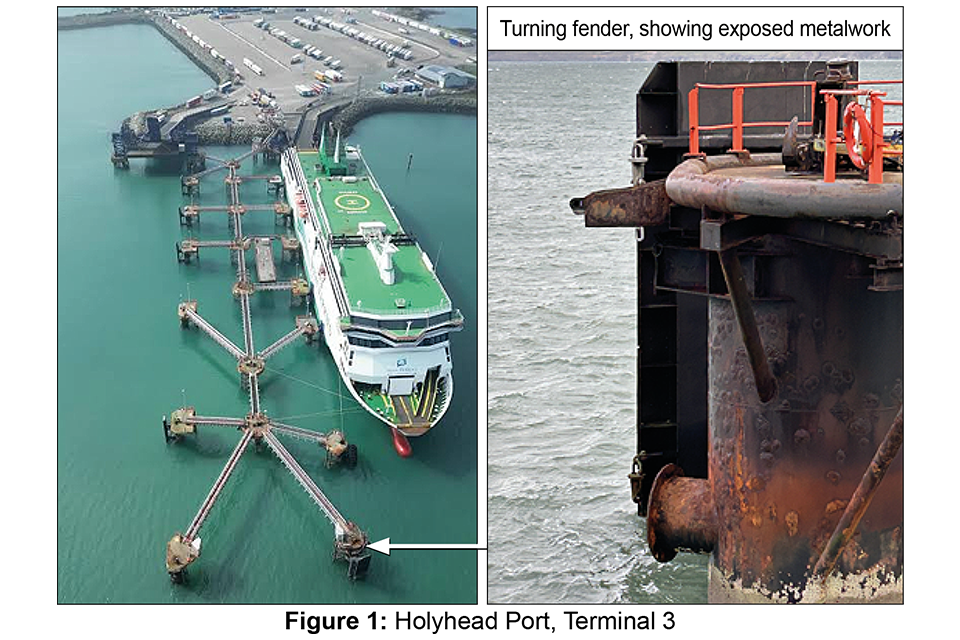
On the morning of 7 January 2026, the international maritime community narrowly avoided a catastrophic disaster in the Irish Sea. At approximately 0750 UTC, the Stena Estrid—a state-of-the-art roll-on/roll-off passenger (RoPax) ferry operated by Stena Line—suffered a serious marine casualty while berthing at Holyhead Port in Wales. Operating its regular cross-channel route from Dublin, Ireland, the 214.5-meter vessel made heavy contact with an unprotected turning fender at the northern extent of Terminal 3.
The impact tore through the vessel’s steel framework, holing the hull both above the waterline on the cargo deck and dangerously below the waterline in the starboard engine room. The breach triggered an immediate influx of approximately 500 tonnes of seawater into the engine room, alongside an unquantified volume leaking into an adjacent void space. Thanks to swift, disciplined damage control measures by the ship’s 66-member crew, a potentially fatal stability crisis was averted. By shoring up compromised bulkheads, pumping out flooded compartments, and intentionally shifting ballast to create a controlled port list, the crew successfully raised the damaged hull sections above the waterline.
Despite the severity of the structural breach and the immediate emergency response required, no injuries or fatalities were reported among the 91 passengers and 66 crew members on board. Remarkably, once the vessel’s internal stability was secured, the Stena Estrid safely completed its berthing maneuver, allowing passengers to disembark and vehicles to be unloaded without significant delay.
Following the incident, the Marine Accident Investigation Branch (MAIB) launched a formal inquiry, culminating in Preliminary Assessment (PA) summary 3/2026. However, due to proactive corrective actions implemented swiftly by both Stena Line Limited and Stena Line Ports Limited—alongside planned infrastructure improvements at Holyhead Port—the MAIB investigation has since been formally closed. This comprehensive report explores the chronology of the collision, the vessel and voyage metrics, the technical realities of the emergency response, and the broader implications for ferry operations in the Irish Sea.
Detailed Chronology of the Incident
To understand how a routine international ferry transit escalated into a serious marine casualty, it is necessary to examine the sequence of events on the morning of 7 January 2026.
The Approach and Maneuvering Phase
The Stena Estrid departed Dublin earlier that morning carrying 91 passengers, 95 vehicles, and a total of 66 crew members. Weather conditions in the Irish Sea and at Holyhead Port were notably challenging, characterized by a brisk westerly wind blowing at Force 6 to 7. Navigating a large RoPax ferry in strong crosswinds requires exceptional precision, particularly when entering the confined spaces of a busy commercial port.
As the vessel approached Holyhead Port, it prepared to dock at Terminal 3. Standard protocol for the berth required the ship to execute a turning maneuver to position itself for backing into the slip. To assist with this maneuver under the prevailing strong westerly winds, a harbour tug was made fast on the ferry’s port aft quarter.
The Collision
At approximately 0750 UTC, while executing the port turn north of the jetty prior to backing in, the control dynamics or external environmental forces caused the Stena Estrid to drift or swing outside its intended trajectory. The starboard side of the vessel made forceful contact with an unprotected turning fender situated at the northern extent of Terminal 3.
The kinetic energy of the 41,671-gross-tonne vessel concentrated heavily upon impact, breaching the steel plating. The collision resulted in a dual-location breach: a puncture above the waterline on the cargo deck and, more critically, a severe hull breach below the waterline directly opening into the starboard engine room.

Immediate Emergency Response and Damage Control
Sea water immediately began rushing into the ship. Within minutes, approximately 500 tonnes of water flooded the starboard engine room, accompanied by unknown volumes entering an adjacent void space. In maritime operations, rapid flooding of a machinery space poses an immediate threat to electrical distribution, propulsion stability, and overall vessel buoyancy.
The ship’s crew executed their emergency routines with exemplary precision. Recognizing the urgency of the situation, engineering and deck personnel mobilized immediately. They initiated emergency pumping systems to expel incoming water while simultaneously undertaking physical shoring operations to reinforce the compromised bulkheads below the waterline.
Recognizing that continued even keel stability was threatened by the asymmetric weight of the floodwater, the master and crew executed a calculated ballast transfer. By shifting ballast water across the vessel’s tanks, they induced a deliberate port list. This strategic tilt effectively elevated the starboard hull breach above the external waterline, dramatically slowing and ultimately halting the unmanaged ingress of sea water.
Berthing, Disembarkation, and Port Operations
With the vessel’s internal situation stabilized and the flooding neutralized, the bridge team resumed control of the berthing process. The Stena Estrid successfully docked at Terminal 3, enabling the safe and orderly disembarkation of all 91 passengers and the unloading of their 95 vehicles.
Holyhead Port authorities acted swiftly to manage the safety of the wider maritime infrastructure. The port was temporarily closed to all ferry traffic while the emergency response unfolded. Later that evening, once the Stena Estrid was safely shifted to an alternative berth, marine engineers conducted a thorough structural assessment of the Terminal 3 jetty. Finding no significant structural damage to the jetty itself, port authorities cleared the terminal for a return to normal service later that night.
Departure for Permanent Repairs
Temporary structural repairs were executed at Holyhead to ensure the vessel’s watertight integrity for an open-water transit. Under its own power, the Stena Estrid departed Wales and navigated across the Irish Sea to a specialized dry dock in Liverpool, England, where permanent repairs to the starboard hull and engine room spaces were carried out.
Supporting Context & Metrics
An analysis of the Stena Estrid’s structural profile, operational parameters, and the specifics of the voyage provides vital context for understanding how the vessel withstood the casualty and how the crew managed the emergency.
Ship Particulars
The Stena Estrid is a modern, high-capacity RoPax ferry built to exacting international standards.
- Vessel’s Name: Stena Estrid
- Flag: Cyprus
- Classification Society: DNV GL
- IMO Number: 9807293
- Vessel Type: Roll-on/Roll-off Passenger (RoPax) Ferry
- Registered Owner: LS-CYP1 Co Ltd
- Manager: Stena Line Limited
- Operator: Stena Line Irish Sea Ferries Limited
- Builder: China Merchants Jinling Shipbuilding Co. Ltd. (China)
- Year of Build: 2019
- Length Overall: 214.5 meters
- Gross Tonnage: 41,671
- Minimum Safe Manning: 19 crew members
- Authorised Cargo: Commercial and passenger vehicles, alongside foot and vehicle passengers.
Voyage Particulars
- Port of Departure: Dublin, Ireland
- Port of Arrival: Holyhead, Wales
- Type of Voyage: International short-sea transit
- Cargo on Board: 95 vehicles (mix of cars and freight) and 91 passengers
- Actual Manning: 66 crew members (well above the minimum safe manning threshold, ensuring robust operational and emergency response capability)
Marine Casualty Information
- Date and Time: 7 January 2026 at 0750 UTC
- Classification: Serious Marine Casualty
- Location: Terminal 3, Holyhead Port, Wales
- Specific Area on Board: Starboard engine room and adjacent void space
- Casualties: Zero injuries, zero fatalities
- Environmental Impact: Hull puncture with localized internal flooding; no reported pollution or fuel spill
- Voyage Segment: Berthing maneuver
- Environmental Conditions: Westerly wind, Force 6 to 7 (strong breeze to near gale)
- Total Persons on Board: 157 (91 passengers + 66 crew)
Official Statements and Regulatory Actions
Following the incident, the Marine Accident Investigation Branch (MAIB) initiated a preliminary assessment to determine the root causes of the collision and evaluate the adequacy of the emergency response. Under the provisions of the MAIB’s investigative framework, preliminary assessments allow maritime authorities to gauge whether a full, protracted investigation is necessary, or if prompt, voluntary remedial actions by operators render further statutory investigation redundant.
In the case of Stena Estrid (PA Summary 3/2026), the investigation was closed following the rapid implementation of comprehensive corrective measures by both the vessel management and port operators.
Actions Taken by Stena Line Limited (Ship Management)
Stena Line Limited initiated internal safety reviews focusing on bridge resource management, tug-assisted berthing protocols in high winds, and damage control preparedness. While specific procedural adjustments were not detailed in the public summary, the company cooperated fully with the MAIB and verified that all onboard damage control equipment functioned as designed during the crisis.
Actions Taken by Stena Line Ports Limited (Port Operators)
Recognizing that the unprotected turning fender at the northern extent of Terminal 3 played a direct role in the severity of the damage, Stena Line Ports Limited committed to infrastructure enhancements. Plans were established to upgrade the fender systems at Holyhead Port to prevent similar contact incidents during adverse weather conditions, thereby safeguarding future port users.
Because these swift administrative, operational, and infrastructural safeguards directly addressed the systemic vulnerabilities highlighted by the casualty, the MAIB concluded that publishing a prolonged formal report was unnecessary, leading to the formal closure of the file.
Future Outlook
The incident involving the Stena Estrid serves as a textbook study in modern maritime risk management, highlighting both the inherent hazards of port navigation in severe weather and the vital importance of professional crew training.
Cross-channel ferry operations between Ireland and the United Kingdom represent a vital economic lifeline, moving thousands of passengers and vast quantities of freight daily across waters notoriously affected by Atlantic depressions and high winds. That the Stena Estrid sustained a 500-tonne water ingress into a vital machinery space yet suffered neither loss of life, severe environmental contamination, nor prolonged passenger disruption is a testament to the resilience of modern ship design and the exceptional competence of its crew.
Nevertheless, the collision underscores ongoing challenges regarding port infrastructure compatibility with modern mega-ferries. As RoPax vessels continue to grow in gross tonnage and windage profile, ports must continually evaluate fender layouts, turning basin dimensions, and tug deployment strategies. The infrastructure upgrades planned by Stena Line Ports Limited at Holyhead represent a proactive step toward closing the gap between modern vessel size and legacy port architecture.
Ultimately, the Stena Estrid casualty reinforces a fundamental maxim of the maritime industry: while accidents can never be entirely eliminated in the face of challenging environmental conditions, proper vessel subdivision, rigorous damage control training, and immediate infrastructural accountability can transform a potential maritime disaster into a masterclass in crisis management.