







By the Global Business & Hospitality Desk
Published: April 2026
Executive Overview
For decades, the hospitality sector has treated natural disasters as predictable irregularities—unfortunate seasonal disruptions factored into broad risk disclosures, bundled neatly into general capital expenditure (capex) budgets, and largely smoothed over by robust property insurance. Hurricanes, floods, and wildfires have long been reduced to boilerplate paragraphs buried deep within annual 10-K filings, viewed by Wall Street as momentary operational hiccups rather than structural threats to asset valuation.
That era of casual risk accounting is officially drawing to a close.
A revealing late-2025 regulatory filing from Host Hotels & Resorts—the largest lodging real estate investment trust (REIT) in the United States—has shattered the industry-wide habit of masking climate repair costs. The filing places an unvarnished, eye-watering price tag on the devastation wrought by Hurricanes Helene and Milton, which battered the Gulf Coast of Florida in the autumn of 2024. The storm damage inflicted upon a single crown jewel in Host’s portfolio, the historic Don CeSar in St. Pete Beach, has been quantified at an estimated $105 million.
Crucially, this figure pulls back the curtain on the true financial architecture of disaster recovery: roughly 30% of that staggering total was swallowed entirely by immediate remediation efforts, while the remainder accounted for comprehensive physical reconstruction.
The cascading financial impacts of the 2024 hurricane season rippled aggressively through Host’s balance sheets well into the subsequent fiscal year. In 2025 alone, the REIT poured $75 million—representing approximately 11.6% of its total annual capital expenditures—into hurricane recovery and broader asset restoration work. While insurance payouts totaling $73 million managed to offset a significant portion of the immediate blow (encompassing both physical damage and business interruption losses), the sheer volume of capital diverted away from growth initiatives and toward basic climate defense signals a profound structural shift.
Furthermore, Host’s disclosures reveal a long-term capital allocation strategy that mirrors a broader macroeconomic reality: over the six-year period concluding in December 2025, the company was forced to dedicate roughly 8% of its entire capex portfolio exclusively to climate resilience and hardening projects.

This in-depth investigative report examines the timeline of the Don CeSar disaster, analyzes the shifting economics of hospitality real estate in an era of intensifying climate volatility, explores the fine print of insurance recoveries, and outlines what this watershed filing means for the future of luxury resort investments worldwide.
Detailed Chronology: From Landfall to Reopening
To understand the immense financial and operational toll extracted by the 2024 Atlantic hurricane season, one must trace the timeline of destruction, triage, and painstaking reconstruction that transformed the iconic Don CeSar—affectionately known as the "Pink Palace"—from a bustling Gulf Coast sanctuary into an active construction zone.
Fall 2024: The Double Blow of Helene and Milton
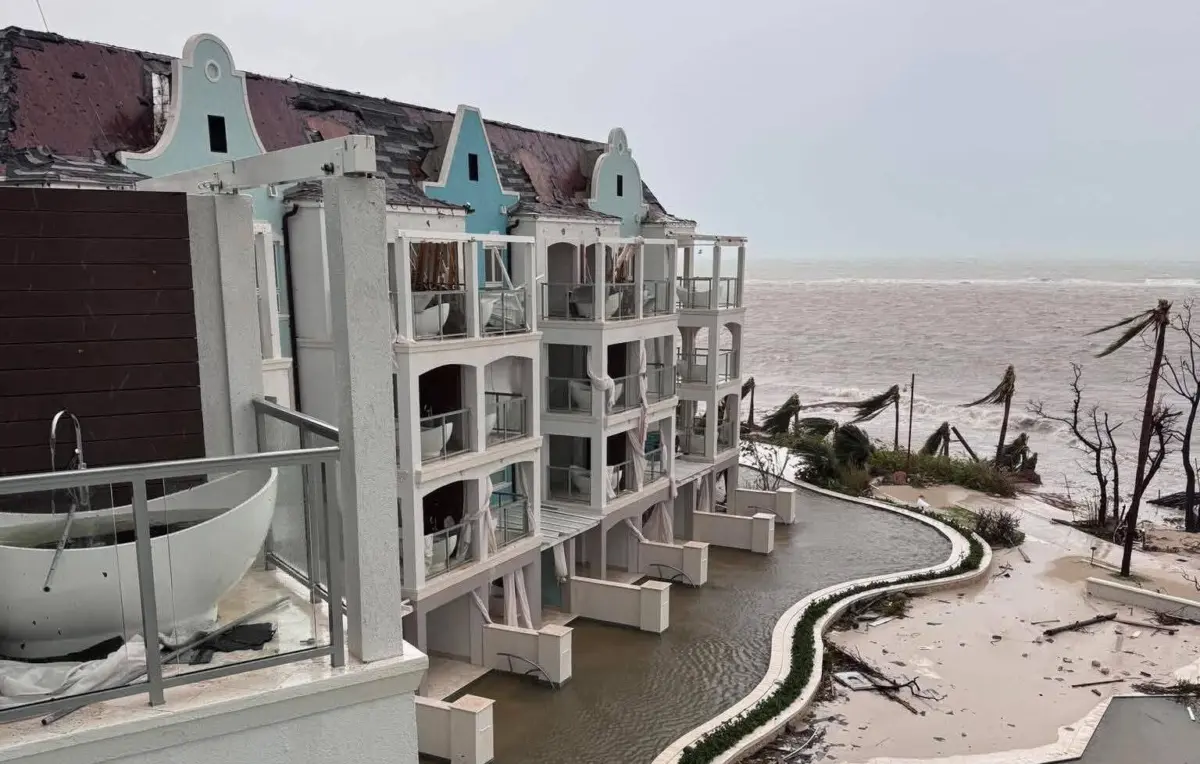
The vulnerability of Florida’s barrier islands was exposed with brutal efficiency in the autumn of 2024. In late September, Hurricane Helene roared ashore as a massive Category 4 storm, sending historic storm surge waters rushing across St. Pete Beach. While the Don CeSar’s historic pink facade withstood the wind speeds, its ground-floor infrastructure, mechanical rooms, landscaping, and lower-level amenities were inundated with corrosive saltwater.
Before remediation teams could even fully assess the scope of the saltwater and wind damage, Hurricane Milton struck the Florida Gulf Coast in October as another ferocious system, compounding structural vulnerabilities and re-flooding areas that had just begun the drying-out process.
The cumulative impact on the 277-room luxury resort was catastrophic. Vital electrical systems, commercial kitchens, subterranean utility conduits, and foundational elements suffered severe, multi-system failures. For Host Hotels & Resorts, the immediate priority shifted from guest hospitality to emergency stabilization.
The Long Closure and Phased Rebirth (Late 2024 – Late 2025)
Following the storms, the Don CeSar was forced to enact an indefinite closure, displacing hundreds of hospitality workers, canceling lucrative fall and winter wedding bookings, and halting tourism revenue at one of Pinellas County’s most vital economic engines.
- Phase 1: Triage and Remediation (Late 2024): Immediately following the storms, Host deployed specialized disaster-response remediation teams. Out of the total $105 million estimated damage bill for the property, approximately $31.5 million (30%) was dedicated strictly to emergency drying, mold prevention, debris removal, structural stabilization, and the gutting of compromised ground-level spaces.
- Phase 2: Partial Reopening (Late March 2025): Through relentless construction schedules and aggressive capital deployment, Host managed to reopen the hotel doors to guests in late March 2025, restoring core room inventory just in time for the lucrative spring break tourism window. However, the property was far from operating at full capacity.
- Phase 3: Full Amenity Restoration (Q3 2025): The journey toward total recovery extended deep into the summer of 2025. It wasn’t until the third quarter of that year that all signature amenities—including the sprawling pool decks, beachside food and beverage operations, high-end spa facilities, and specialized function spaces—were fully restored and operating at pre-storm standards.
The closure of the Don CeSar for nearly half a year highlighted a terrifying metric for hotel investors: asset downtime translates directly into exponential revenue decay, forcing ownership groups to lean heavily on business interruption insurance to bridge massive cash flow chasms.
Supporting Context & Metrics: The Anatomy of a $105 Million Loss
The financial footprint of the Don CeSar disaster extends far beyond local repair bills. It serves as a microscopic case study for macro-level vulnerabilities facing commercial real estate asset owners globally.
Decoding Host’s 2025 Capital Expenditure (Capex)
Host Hotels & Resorts’ end-of-year 2025 filing provides rare transparency into how extreme weather disrupts corporate financial planning.
$$beginarrayc
hline
textbfMetric & textbfValue / Share
hline
textTotal Estimated Damage (Don CeSar) & $105text Million
hline
textRemediation Share (approx. 30%) & $31.5text Million
hline
textTotal 2025 Hurricane/Restoration Spend & $75text Million
hline
textPercentage of Overall 2025 Capex & 11.6%
hline
textInsurance Recoveries Received (at filing) & $73text Million
hline
text6-Year Climate Resilience Spend (2020–2025) & sim 8% text of Total Capex
hline
endarray$$
As the data illustrates, $75 million—or 11.6% of Host’s aggregate capex budget for 2025—was siphoned away from value-add room renovations, technological upgrades, and portfolio expansions to pay for hurricane restoration work. When a double-digit percentage of a major REIT’s capital allocation is held hostage by weather remediation, corporate growth strategies are inevitably throttled.
The Insurance Mirage: Payouts vs. Premiums
At first glance, recovering $73 million in insurance proceeds—as Host had logged by the time of its filing—appears to be a successful mitigation strategy. However, risk analysts caution that relying on traditional property and casualty (P&C) insurance is becoming an increasingly unsustainable business model for coastal real estate.
Property insurance markets across hurricane-prone geographies like Florida, the Gulf Coast, and the Eastern Seaboard are hardening dramatically. Deductibles are rising, coverage limits are shrinking, and annual premium renewals are skyrocketing by double-digit percentages.
While Host successfully recouped a major share of its losses for the Don CeSar, the broader industry faces a looming crisis: insurance companies are either pulling out of high-risk coastal zones altogether or pricing coverage so aggressively that owning waterfront assets becomes financially prohibitive. The $73 million payout underscores the reality that while insurance covers the cost of repair, it rarely compensates for lost market share, brand equity erosion, or the administrative exhaustion of managing multi-year construction recovery projects.
Official Statements & Industry Perspectives
The unprecedented nature of Host’s financial disclosure has sent shockwaves through the hospitality investment community, prompting frank commentary from asset managers, climate economists, and real estate analysts.
The Shift from Discretionary to Mandatory Climate Hardening
Industry experts point out that Host’s allocation of roughly 8% of its capex over a six-year period toward climate resilience is no longer an outlier—it is the new baseline for survival.
"For years, hotel ownership groups viewed storm shutters, elevated electrical grids, and flood barriers as ‘nice-to-have’ engineering enhancements or discretionary ESG investments," notes Sarah Linwood, senior director of hospitality asset valuation at a global real estate consultancy. "Host’s disclosure on the Don CeSar proves that climate resilience is now core infrastructure. If you own coastal real estate and you aren’t spending 5% to 10% of your capital budget on hardening properties against extreme weather, you are derelict in your fiduciary duty."
Executive Pragmatism Amid Rising Volatility
In statements accompanying their financial disclosures, Host executives have emphasized the necessity of agility in the face of escalating weather volatility. While the REIT maintains a geographically diversified portfolio that cushions the blow of localized disasters, the sheer frequency of billion-dollar weather events requires a permanent pivot in risk management.
Corporate leadership has signaled that future acquisitions in coastal or flood-prone regions will be subjected to hyper-rigorous climate-risk modeling. Asset valuations must now bake in projected sea-level rise, intensified storm surge vectors, and escalating long-term insurance overhead over a 20- to 30-year holding period.
Future Outlook: The New Economics of Coastal Hospitality
As the hospitality industry looks toward the latter half of the decade and beyond, the revelations surrounding the Don CeSar’s $105 million hurricane bill serve as both a warning siren and a blueprint for adaptation. The traditional paradigm of real estate development—build on the water, ensure the asset, and repair when broken—is financially obsolete.
1. Architectural and Engineering Transformations
Future luxury resorts situated along vulnerable coastlines will look fundamentally different from their mid-20th-century predecessors. Architects are shifting toward radical defensive engineering:
- Elevated Primary Infrastructure: Moving emergency generators, electrical switchgear, and mechanical systems from sub-grade basements or ground floors to elevated upper levels.
- Resilient Materials: Utilizing marine-grade stainless steel, impact-resistant structural glass, salt-tolerant concrete mixes, and waterproof architectural coatings that withstand prolonged saltwater immersion.
- Modular Landscaping: Designing natural and engineered buffer zones—such as restored dunes, living shorelines, and permeable hardscapes—that absorb storm surge energy before it reaches hotel structures.
2. The Evolution of Underwriting and Valuation
Wall Street is beginning to penalize hospitality portfolios that display high geographic concentration in climate-vulnerable zones without adequate mitigation strategies. Institutional investors are demanding granular, asset-level climate risk audits before releasing capital. Consequently, real estate valuations will increasingly reflect a "climate discount" for properties that fail to demonstrate proactive climate-hardening measures.
3. Portfolio Diversification as a Defense Mechanism
REITs like Host Hotels & Resorts possess a distinct structural advantage over independent hotel owners: portfolio diversification. By spreading assets across urban centers, desert resorts, and mountain retreats alongside coastal properties, diversified portfolios can absorb regional climate shocks without threatening corporate insolvency. Smaller, single-asset coastal operators, by contrast, face an existential threat from a single major hurricane season.
Conclusion
The financial autopsy of Hurricanes Helene and Milton at the Don CeSar is more than a localized corporate accounting note; it is a watershed moment for the global hospitality industry.
When a single storm-battered resort racks up $105 million in damages, demands 30% of its repair budget just for emergency remediation, and consumes over 11% of a major REIT’s annual capex, the hidden costs of climate change are laid bare. Host Hotels & Resorts’ transparent disclosure has ripped away the comforting veil of boilerplate risk language, forcing hotel owners, investors, and operators to confront the stark economic reality of our changing planet.
In the modern hospitality landscape, paradise is no longer just measured by ocean views and luxury amenities. It is measured by resilience, structural hardening, and the capacity to weather the gathering storms of a warming world.