










Executive Overview
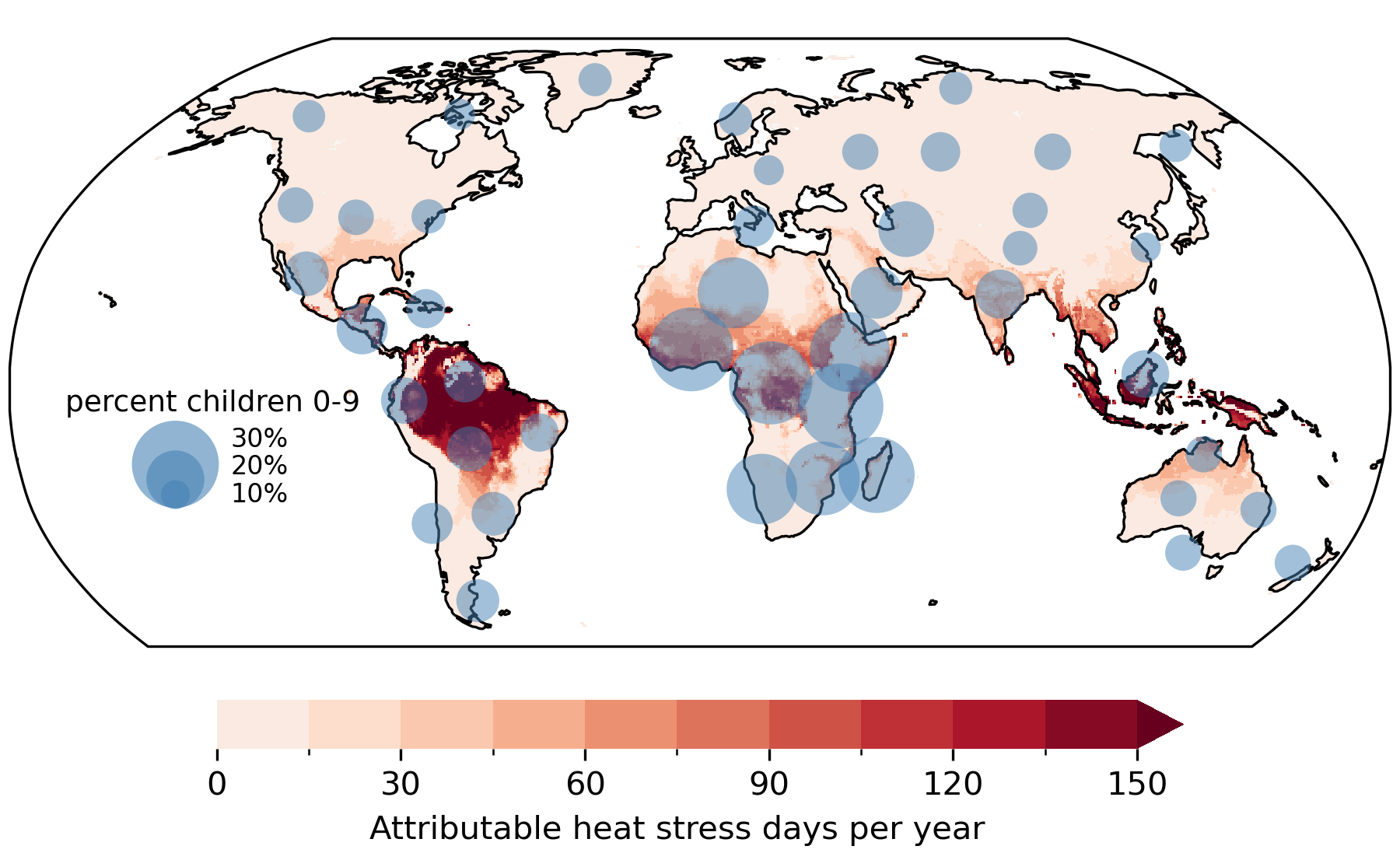
Human-caused climate change is no longer a distant, abstract threat projected for the end of the century; it is an active, reshaping force carving profound inequalities into the daily lives of the world’s youngest generations. According to a landmark attribution study published in Science Advances, more than 40% of children under the age of 10 globally—amounting to roughly 583 million young lives—are already enduring at least 20 additional "heat-stress days" every year compared to a pre-industrial climate.
The research, led by scientists at the Vrije Universiteit Brussel and detailed by author Rosa Pietroiusti alongside colleagues, merges state-of-the-art climate models with high-resolution demographic data. The findings reveal a stark and uncomfortable truth: children are currently bearing the heaviest burden of anthropogenic warming. Because developing nations in south Asia, southeast Asia, and sub-Saharan Africa boast rapidly growing populations with high proportions of young children, they are recording the greatest exposure to dangerous levels of humid heat. Yet, these same populations have historically contributed the least to global greenhouse gas emissions.
This article explores the mechanics of humid heat, the staggering statistics surrounding generational exposure, the structural inequalities highlighted by the study, and what lies ahead as the planet hurtles toward 1.5°C and 2°C warming thresholds.

Detailed Chronology and Methodological Framework
To understand how researchers arrived at these startling figures, it is essential to trace the progression of scientific inquiry into climate extremes over the past half-decade.
The Evolution of Extreme Weather Attribution
The scientific community has spent years sharpening its ability to link specific weather phenomena directly to human activity. In 2021, a high-profile study warned that children born in the 21st century would face unprecedented lifetimes of extreme weather compared to their parents and grandparents. Four years later, a follow-up study by the same research group projected that more than half of all children born in 2020—approximately 62 million individuals—would experience unprecedented lifetime exposure to severe heatwaves, even if global warming is aggressively capped at 1.5°C.
Building upon this foundation, the 2026 Science Advances study pivots from general heatwave frequency to a granular, demographic-specific metric: humid heat stress.
Decoding Wet-Bulb Globe Temperature
High temperatures alone do not tell the whole story of human physiological risk. When ambient air is hot, the human body relies on perspiration; as sweat evaporates from the skin, heat is carried away. However, as relative humidity climbs, the air becomes saturated with moisture, rendering sweat evaporation far less effective.

To capture this physiological bottleneck, the research team utilized the indoor wet-bulb globe temperature (WBGT), a standardized index that accounts for ambient temperature, humidity, wind speed, and solar radiation. The study defines a "heat-stress day" as any 24-hour period where the WBGT exceeds 28°C—the universally recognized threshold for "moderate heat stress."
Simulating the Counterfactual Climate
To determine how much of this heat stress is directly attributable to anthropogenic climate change, the researchers employed advanced climate models:
- Present-Day Baseline: The authors established the "present-day" climate using data from 2023, representing a world warmed by approximately 1.3°C above pre-industrial levels due to human activity.
- Pre-Industrial Counterfactual: They simulated a parallel, counterfactual climate stripped of human-caused greenhouse gas emissions.
- Attribution Mapping: By subtracting the number of pre-industrial heat-stress days from present-day totals, the team isolated the "extra" or "attributable" heat-stress days driven entirely by climate change.
Supporting Context & Metrics: The Anatomy of Generational Inequality
The intersection of shifting climate dynamics and global demographics creates a volatile recipe for generational inequality. The research demonstrates that exposure to excessive heat is dictated not just by geography, but heavily by age structure.
Why Children are Uniquely Vulnerable
Biologically, children are ill-equipped to handle extreme heat stress. Their bodies have a higher surface-area-to-mass ratio than adults, they produce more metabolic heat relative to their size, and their thermoregulatory systems are still developing. Furthermore, children depend entirely on adults to regulate their environments, provide hydration, and limit outdoor exposure during peak heat hours.
Demographically, the numbers are sobering:
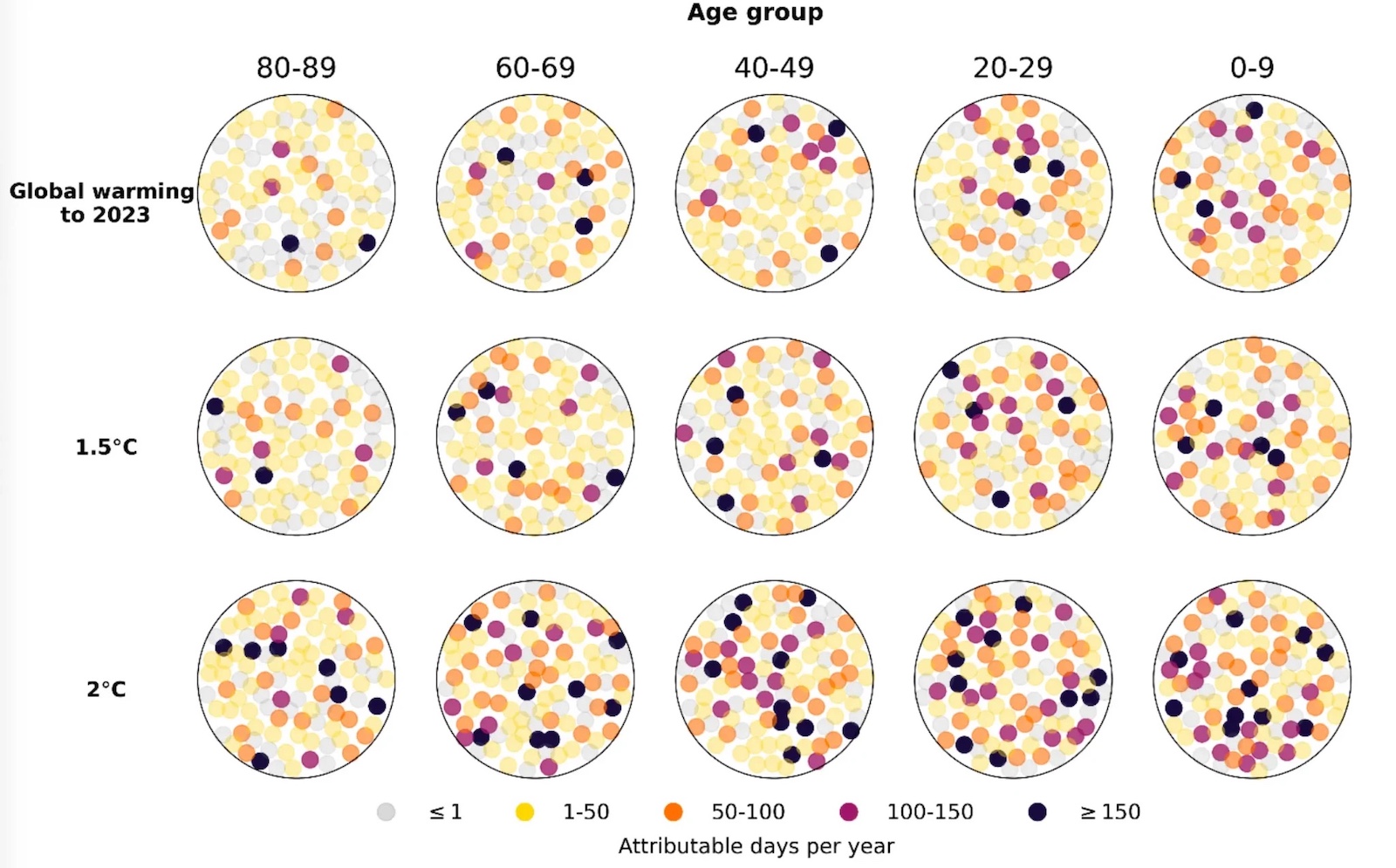
- Global Under-10s: There are approximately 1.3 billion children under the age of 10 globally. Of these, 583 million (44%) live through at least 20 attributable heat-stress days every year.
- Older Age Cohorts: By contrast, only 190 million people aged 60 to 69 (about 30% of that demographic cohort) face a comparable frequency of attributable heat days.
- Extreme Exposure: In today’s 1.3°C warmer world, roughly 11% of all children under 10 experience 100 or more extra heat-stress days annually due to climate change.
The Geography of the Heat Divide
The study highlights a profound disconnect between where emissions are generated and where the impacts are felt. Low-latitude, tropical nations bear the brunt of the crisis.
For instance, residents of Côte d’Ivoire currently endure an astonishing 112 heat-stress days every single year, roughly half of which are directly attributable to human-induced climate change. Meanwhile, countries like Germany experience a baseline of approximately 0.1 heat-stress days per year under current conditions.
Lead author Rosa Pietroiusti noted that while European figures may seem surprisingly low, the study explicitly focuses on humid heat thresholds that are relatively rare in temperate northern latitudes. Furthermore, limitations in climate model resolution mean the study does not capture local phenomena like the urban heat island effect, which frequently exacerbates urban microclimates far beyond regional averages.
Official Statements and Expert Perspectives
The publication of the Science Advances study has triggered widespread discussion among climate scientists, health researchers, and policy analysts regarding equity and methodology.

The Call for Interdisciplinary Health Metrics
While praising the methodology as robust, lead author Rosa Pietroiusti emphasized that the wet-bulb globe temperature metric was not originally designed with pediatrics in mind.
"A really important step forward in the research community would be to link up climate science and health science experts to do research on what metrics are really most representative of, for example, health impacts and educational impacts that children will be suffering," Pietroiusti explained.
Balancing the Intergenerational and Regional Burden
Dr. Qinqin Kong, a postdoctoral researcher in medicine and health policy at Stanford University who was not involved in the study, offered critical praise for the paper. He noted that the research provides "timely quantitative evidence for discussions of climate justice, children’s rights, and intergenerational equity."
However, Dr. Kong cautioned that the study might inadvertently understate the relative vulnerability of older adults:
"The elderly may also be more vulnerable due to their social circumstances. Children often benefit from parental supervision and caregiving, whereas many older adults live alone, have limited mobility, and face barriers to accessing cooling or emergency assistance during heat events."
Dr. Kong also pointed out that mid-latitude societies in Europe and North America possess populations that are less physiologically acclimatized to heat, coupled with lower air-conditioning penetration and urban designs that hinder heat dissipation.
Offering a counter-perspective on human adaptability, Dr. Daniel Vecellio of the University of Nebraska noted that children are surprisingly resilient behavioral adapters. While children represent an understudied cohort, Dr. Vecellio suggested that individuals chronically exposed to extreme heat from an early age may develop better physiological acclimatization over time.
Nevertheless, Pietroiusti underscored the overarching theme of global environmental injustice:

"Studies like this, which start from the climate data, can start to fill some of these gaps [in disaster reporting]. Children in developing countries have contributed the least to historical greenhouse gas emissions, yet they are the ones paying the highest price."
Future Outlook: A 1.5°C and 2°C World
Looking forward, the research team mapped out future exposure trajectories using the Shared Socioeconomic Pathway (SSP2) demographic scenario, which projects the global population peaking above nine billion in the latter half of the 21st century, with rapid growth concentrated in sub-Saharan Africa and low-latitude regions.
The projections under progressive warming scenarios paint a grim picture for coming generations:
- At 1.5°C of Warming: The proportion of children under 10 experiencing 100 or more extra heat-stress days annually rises from 11% to 13%. For adults aged 60–69, the figure rises from 6% to 9%.
- At 2.0°C of Warming: The crisis accelerates dramatically. The share of young children enduring 100+ annual extra heat-stress days more than doubles from present levels to 23%. For older adults, the figure jumps to 17%.
Implications for Policy, Adaptation, and Global Equity
These projections signal an urgent need to pivot global climate adaptation frameworks. Infrastructure investments cannot remain focused solely on carbon mitigation; they must actively incorporate heat-resilient urban planning, school cooling mandates, and robust public health safety nets designed specifically for vulnerable youth in developing regions.
Furthermore, the data provides undeniable quantitative leverage for climate justice litigation and loss-and-damage financing negotiations at international forums such as the UNFCCC COP summits. As vulnerable nations demand accountability from major historical emitters, the image of hundreds of millions of children facing a lifetime of manufactured heat stress serves as a moral and empirical anchor for climate action.
Ultimately, the findings of Pietroiusti et al. serve as a sobering alarm bell. Without aggressive, immediate emissions reductions and targeted adaptation finance, the youngest members of the global population will inherit a world where extreme, life-altering heat is not an anomaly, but the baseline of daily existence.