





Executive Overview
On the evening of August 14, 2025, the waters of Portsmouth Harbour—one of the United Kingdom’s most historically significant and heavily regulated maritime hubs—became the site of a devastating high-speed marine accident. The rigid inflatable boat (RIB) Peaky Blinder, operating under private ownership, violently allided with navigation beacon 81. The impact was catastrophic, instantly throwing all three occupants—the boat’s owner, who was at the helm, and two passengers—into the dark, fast-flowing tidal waters.
The immediate aftermath triggered a multi-agency search and rescue operation involving lifeboats, police marine units, and coastguard helicopters. Despite the rapid response, the human toll of the disaster was immense. One passenger was pulled from the water unresponsive and could not be revived, later being pronounced dead. The search for the boat’s owner extended across five agonizing days before recovery teams located his body. Miraculously, the second passenger survived the ordeal, escaping with minor physical injuries, though carrying the profound psychological trauma of the event.
In response to the tragedy, marine safety authorities launched a comprehensive investigation, culminating in Accident Investigation Report 15/2026. This document serves not only as a forensic breakdown of the final moments of the Peaky Blinder but also as a critical wake-up call for the recreational boating community. The incident has cast a harsh spotlight on the inherent risks associated with high-speed leisure craft operating in congested, commercially vital, and heavily marked waterways.

As the maritime sector processes the findings of Report 15/2026, regulators, port authorities, and safety advocates are forced to confront uncomfortable questions regarding vessel operation standards, situational awareness at night, and the regulatory oversight of fast leisure craft. This article provides an in-depth examination of the disaster, analyzing the sequence of events, the broader context of UK recreational boating safety, official responses, and the vital recommendations aimed at preventing such a tragedy from recurring.
Detailed Chronology
The Setting and the Voyage
Portsmouth Harbour is a complex navigational environment. Balancing a dense mix of Royal Navy warships, commercial cross-channel ferries, container vessels, fishing boats, and an enormous volume of recreational craft, the harbour demands high levels of vigilance from all mariners. Navigation beacons, such as number 81, are strategically placed to delineate safe channels and warn vessels of shallow water or fixed hazards. Under normal daylight conditions, these structures are easily identifiable; however, navigating them at speed during the evening hours requires precise local knowledge, operational discipline, and unwavering attention.
On August 14, 2025, twilight gave way to night as the Peaky Blinder traversed the harbour waters. RIBs like the Peaky Blinder are exceptionally popular in the UK leisure sector due to their power, maneuverability, and speed capabilities. However, these same characteristics make them unforgiving when handled improperly or when unexpected obstacles present themselves in low-visibility conditions.
The Impact at Navigation Beacon 81
At some point during the evening transit, the Peaky Blinder veered off its intended path, hurtling toward navigation beacon 81. Because RIBs are lightweight and designed to plane at high velocities, an allision (the term used in maritime law when a moving vessel strikes a stationary object) with a fixed steel or concrete structure like a navigational mark translates into an instantaneous, violent deceleration.
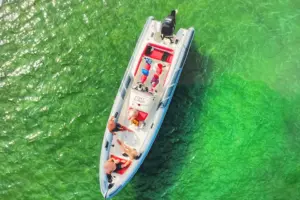
When the bow of the Peaky Blinder struck beacon 81, the forward momentum of the vessel was abruptly halted, converting the kinetic energy of the boat into a destructive shockwave. According to the foundational findings of Accident Investigation Report 15/2026, the sheer force of the sudden stop hurled all three occupants forward and out of their seating positions. They were violently ejected from the vessel, plunging directly into Portsmouth Harbour.
The Immediate Aftermath and Rescue Efforts
The ejection left the Peaky Blinder either momentarily driverless or circling, while the three individuals found themselves struggling for survival in the water. The physical impact of the crash, combined with the shock of immersion in the tidal current, created an immediate, life-threatening crisis.
Emergency services were alerted swiftly, prompting a coordinated search and rescue mobilization. Lifeboats from the Royal National Lifeboat Institution (RNLI), Hampshire Constabulary marine units, and HM Coastguard assets converged on the coordinates near navigation beacon 81.
Search teams located one of the passengers in the water. The individual was unresponsive, and despite immediate administration of emergency first aid and subsequent transport ashore for advanced medical care, life was pronounced extinct. The second passenger, having managed to stay afloat or make contact with rescue assets, was rescued with minor injuries.
The boat’s owner, however, was unaccounted for. This triggered a grueling, multi-day search operation covering vast areas of the Solent and Portsmouth Harbour, utilizing sonar, divers, and aerial surveillance. Five days after the collision, the search concluded with the grim discovery of the owner’s body, bringing closure to the search but deepening the mourning of families and the local community.
Supporting Context & Metrics
The Rise of High-Speed RIBs in Recreational Boating
To fully understand the context of the Peaky Blinder tragedy, one must examine the evolution of the UK’s recreational boating fleet over the past two decades. Rigid Inflatable Boats have transitioned from being exclusively utilized by professional mariners, military units, and rescue organizations to becoming a dominant fixture in the leisure market.
Modern leisure RIBs are capable of astonishing speeds, often powered by high-output outboard engines that can propel a lightweight hull well in excess of 30 or 40 knots. This accessibility to high-performance maritime machinery has democratized speed on the water, but it has also created a dangerous training and competency gap. Unlike driving a motor vehicle, which requires a formal licensing process, mandatory practical testing, and regular certification in the UK, operating a private pleasure vessel of this nature currently operates under a patchwork of voluntary guidelines rather than strict, universal statutory licensing.
The Hazards of Night Navigation
Navigating at night introduces profound sensory challenges. Depth perception is severely restricted, horizon lines blur, and the myriad background lights of a coastal city like Portsmouth (known as "light clutter") can easily swallow or obscure navigation marks, vessel running lights, and hazard markers.

Beacon 81, while standard in its design, presents a formidable physical hazard to any vessel colliding with it at speed. In maritime safety statistics compiled by the Marine Accident Investigation Branch (MAIB), collisions and allisions involving fixed stationary objects remain a persistent category of preventable accidents. Factors frequently contributing to these incidents include:
- Inadequate Lookout: Failure to maintain a continuous, effective visual and auditory watch.
- Speed Inconsistency: Operating at velocities that preclude stopping or altering course within a safe distance based on prevailing visibility and environmental conditions.
- Fatigue and Distraction: The cumulative effect of long days on the water coupled with reduced night vision.
- Over-reliance on Electronics: Trusting chartplotters and GPS systems without cross-referencing visual cues, leading to spatial disorientation.
Regulatory Landscape and Accountability
The tragedy of the Peaky Blinder brings structural questions about UK maritime law back to the forefront. Port authorities, such as the King’s Harbour Master (KHM) in Portsmouth, possess local powers to enforce bylaws regarding speed limits, navigation rules, and safe operation within their designated jurisdictions. However, enforcing compliance across thousands of private recreational vessels entering and leaving a busy port daily is an monumental logistical challenge.
Furthermore, national legislation governing the competence of leisure boat operators has long been a subject of intense debate among maritime safety professionals. While commercial skippers must undergo rigorous certification (such as the RYA Yachtmaster or commercial endorsement schemes), a private individual can purchase a high-powered RIB, launch it into busy waters, and operate it without possessing a single formal qualification. Incidents like the Peaky Blinder allision provide stark empirical evidence of the tragic consequences that can arise when high-performance capability outstrips operator training and awareness.
Official Statements
Statement from the Chief Inspector of Marine Accidents
In conjunction with the publication of Accident Investigation Report 15/2026, the Chief Inspector of Marine Accidents issued a formal statement addressing the findings and the broader implications for maritime safety. While specific statutory details from the report reflect the gravity of the investigation, the overarching message emphasized accountability, vigilance, and respect for the water.
The Chief Inspector underscored that the sea is an unforgiving environment that offers no margin for error when speed and immovable objects intersect. The statement called upon the entire recreational boating community to reflect on their own operational practices, emphasizing that pre-voyage planning, strict adherence to local speed limits, maintaining a sharp lookout, and understanding the limitations of night navigation are not optional recommendations—they are essential survival skills.
The MAIB reiterated its core mission: not to apportion blame or liability, but to determine the causes and circumstances of marine accidents with the sole objective of preventing future loss of life. The comprehensive analysis of the Peaky Blinder incident is designed to serve as a vital educational tool for clubs, training centers, and individual boat owners across the United Kingdom.
Local Authority and Government Response
The King’s Harbour Master Portsmouth, alongside the Department for Transport, received targeted recommendations within the investigative framework of Report 15/2026. These recommendations highlight the continuous need for port authorities to evaluate safety signage, radar reflectors, lighting on navigational hazards, and the enforcement of local bylaws regarding safe speeds.
Government transport officials are continually tasked with balancing the promotion of a vibrant maritime leisure economy against the imperative of public safety. Tragedies like this prompt renewed calls from safety advocacy groups for Parliament to revisit the legislative framework surrounding recreational vessel licensing and mandatory competency standards. While past reviews have often cited the administrative complexity of policing millions of leisure boaters, events involving fatalities continue to test the status quo.
Future Outlook
Lessons Learned and Industry Adaptation
The publication of Accident Investigation Report 15/2026 marks the beginning of the healing and educational phase following the Portsmouth Harbour disaster. For the maritime industry, the key lies in translating the cold, hard data of the report into actionable behavioral changes among boaters.
Training organizations, such as the Royal Yachting Association (RYA), are expected to incorporate the findings of the Peaky Blinder accident into their powerboat training syllabi. Emphasizing night navigation hazards, the physics of high-speed allusions, and the critical importance of wearing appropriate personal flotation devices (PFDs) and kill cords are central tenets of modern maritime education.
Technological Interventions and Harbour Safety
As technology advances, port authorities and vessel manufacturers are looking toward innovative solutions to mitigate the risks of night and high-speed navigation. Developments in marine radar, thermal imaging cameras, and advanced collision-avoidance systems—once restricted to large commercial ships and military craft—are increasingly finding their way into the high-end recreational market. Improved night-vision aids can radically enhance a skipper’s ability to detect unlit or poorly lit navigation marks like beacon 81 long before an allision becomes inevitable.
Additionally, port infrastructure is subject to ongoing review. Ensuring that critical navigation marks are maximally visible—through high-intensity reflective tape, improved solar-powered lighting arrays, and radar-conspicuous designs—reduces the likelihood of navigational error during periods of darkness or restricted visibility.
A Lasting Legacy of Safety
The loss of life resulting from the Peaky Blinder allision is a sobering reminder of the hazards lurking beneath the surface of leisure pursuits. Behind the bureaucratic terminology of "Accident Investigation Report 15/2026" lie families shattered by grief, a community in mourning, and a survivor grappling with the memory of a catastrophic night in Portsmouth Harbour.
The most fitting tribute to those who lost their lives on August 14, 2025, is a renewed, uncompromising commitment to maritime safety. By fostering a culture of continuous learning, rigorous training, and profound respect for the marine environment, the UK boating community can honor their memory and strive toward a future where such preventable tragedies become a relic of the past.