





SEVILLE, SPAIN — In an aggressive push to safeguard the region’s economic lifelines, the Port Authority of Seville (Autoridad Portuaria de Sevilla) has officially commenced comprehensive maintenance dredging operations along the Eurovía del Guadalquivir. This vital inland maritime access channel connects the historic Port of Seville directly to the Atlantic Ocean, serving as a critical artery for international trade, industrial logistics, and regional economic prosperity in Andalusia.
The campaign, which officially kicked off today, comes in direct response to an unprecedented accumulation of sediment triggered by a punishing sequence of Atlantic storms that lashed southern Spain between November 2025 and February 2026. Armed with cutting-edge dredging technology and an environmentally conscious execution strategy, maritime authorities are racing against time to restore optimal navigational depths across seven critical sections of the navigation channel.
Executive Overview
The initiation of the Eurovía del Guadalquivir maintenance program marks one of the most critical maritime infrastructure interventions in southwestern Europe for 2026. The Guadalquivir River is not merely a geographic landmark; it is a complex, highly regulated estuarine navigation channel that handles substantial commercial shipping, bulk cargo, and passenger vessels traveling dozens of kilometers inland to reach the Port of Seville.
However, the physical geography of the river makes it acutely vulnerable to dynamic sedimentary processes. The severe hydrological events of the 2025–2026 winter season—characterized by torrential rainfall, swollen tributaries, and high-energy coastal storms—funneled staggering volumes of silt, sand, and clay down the river basin. This massive influx severely compromised draft depths across multiple sectors, threatening to bottleneck maritime traffic and force commercial carriers to lighten loads or divert to alternative ports.
To counter this, the Port Authority of Seville has mobilized specialized contractors and state-of-the-art vessels. The operation relies on a dual-pronged engineering approach: combining traditional trailing suction hopper dredging (TSHD) with innovative water injection dredging (WID). Furthermore, the project strictly adheres to circular economy principles, utilizing dredged clean sediment for ecological beach replenishment along the sensitive coastlines of the Doñana Natural Area.
This report provides an in-depth analysis of the campaign, examining the chronology of the weather events that precipitated the crisis, the technological framework driving the operations, the environmental protocols safeguarding the Doñana ecosystem, and the long-term economic outlook for the Port of Seville.
Detailed Chronology: From Winter Storms to Operational Deployment
The Catalyst: The 2025–2026 Winter Storm Surge
To understand the urgency of the current dredging campaign, one must examine the meteorological anomalies that battered Andalusia late last year and early into the new year. Beginning in November 2025, a persistent series of low-pressure atmospheric systems swept in from the Atlantic, stalling over the Iberian Peninsula. These systems unleashed torrential downpours across the Guadalquivir river basin, causing widespread flash flooding and drastically accelerating soil erosion upstream.
As millions of tons of topsoil and riverbed materials were scoured from the countryside, they were carried downstream by raging currents. When these sediment-laden waters reached the lower stretches and the estuarine transition zones of the Eurovía del Guadalquivir, the sudden decrease in current velocity caused massive particulate fallout. By the time the storm front finally dissipated in February 2026, hydrographic surveys conducted by the Port Authority revealed an alarming spike in sedimentation volumes, particularly concentrated across seven distinct bottleneck sections of the 90-kilometer navigation channel.
[November 2025 - February 2026]
  └── Series of severe Atlantic storms batter Andalusia
        └── Heavy rainfall causes extreme upstream soil erosion
              └── Massive sediment load carried downstream to Guadalquivir estuary

[March - July 2026]
  └── Emergency hydrographic surveys map out critical shoaling
        └── Engineering teams design dual-method dredging and environmental strategy
              └── Contract awarded; mobilization of maritime assets

[August 26, 2026]
  └── OFFICIAL LAUNCH: Dredging operations commence on the Eurovía del Guadalquivir
Pre-Operational Surveying and Engineering Design
Throughout the spring and early summer of 2026, port engineers worked tirelessly to map the extent of the shoaling. Utilizing multibeam echosounders and advanced sub-bottom profiling equipment, the Port Authority’s hydrography division pinpointed the exact tonnage and composition of the deposited material.
The data confirmed that standard maintenance cycles would be wholly insufficient to handle the anomaly. The localized volume spikes required a complete redesign of the deployment schedule. Engineers had to balance the necessity of rapid draft recovery with strict regulatory frameworks governing estuarine dredging, ensuring that operations would not interfere with local fisheries, seasonal bird migrations, or the fragile habitats flanking the riverbanks.
By mid-August, all logistical hurdles were cleared, environmental permits were finalized, and operational clearance was granted, setting the stage for today’s deployment.
Supporting Context & Technology: Dual-Method Dredging and the Costa Atlántica
The Workhorse: Dravo’s Costa Atlántica
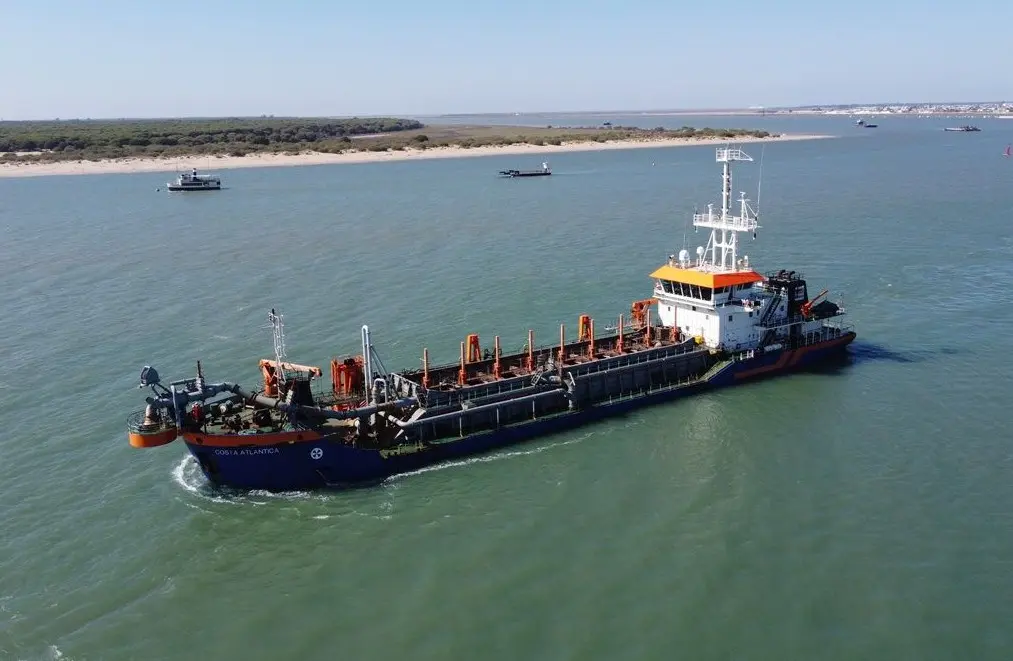
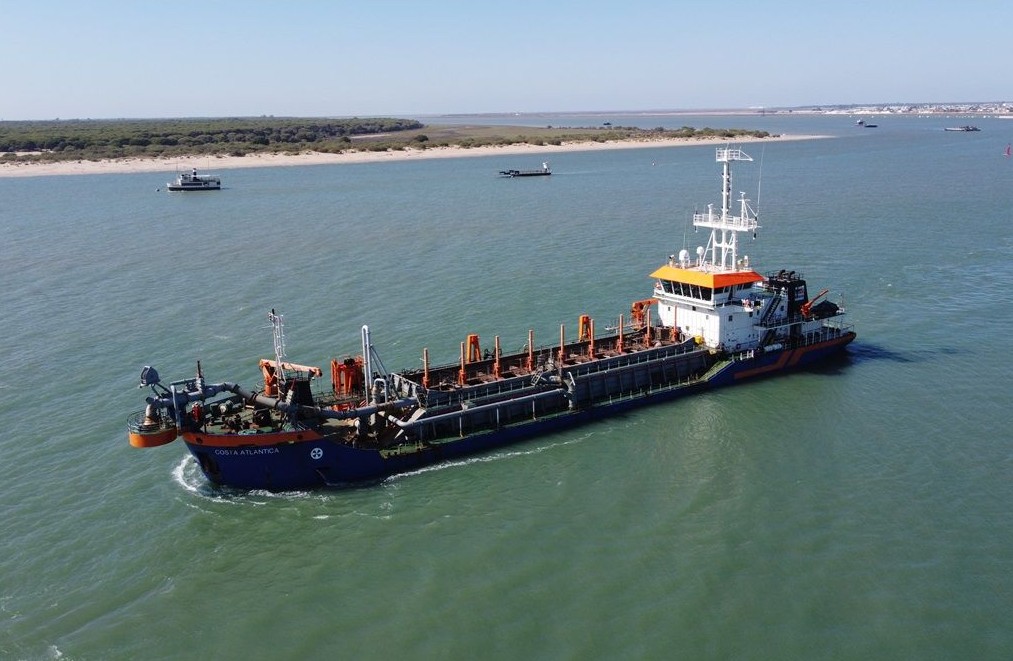
The primary mechanical muscle behind the Eurovía del Guadalquivir cleanup is the trailing suction hopper dredger (TSHD) Costa Atlántica, operated by renowned marine contractor Dravo. The Costa Atlántica is a highly sophisticated vessel equipped with powerful dredge pumps, dragarms, and trailing suction heads designed to vacuum up consolidated and unconsolidated sediments from the riverbed efficiently.
As the Costa Atlántica moves slowly along the designated sections of the channel, its dragarms scrape the bottom while high-capacity pumps suck up a mixture of water and sediment—known as slurry—storing it in the vessel’s large hopper bay. Once loaded to capacity, the vessel can either transport the material to designated offshore placement sites or, in this specific project, deliver clean sand to coastal restoration zones.
Hybrid Efficiency: Water Injection Dredging (WID)
While the Costa Atlántica handles heavy-duty mechanical extraction, the Port Authority is also deploying Water Injection Dredging (WID) for targeted sections of the channel. WID is an advanced, highly efficient technique designed to manipulate sediments naturally without scooping them into a hopper.
Traditional TSHD Process:
[Seabed Sediment] ──(Suction/Vacuum)──> [Vessel Hopper] ──(Transport)──> [Offshore/Beach Placement]

Water Injection Dredging (WID) Process:
[Compacted Sediment] ──(Low-Pressure Water Jets)──> [Fluidized Sediment Gravity Flow] ──(Natural Currents)──> [Deep Estuarine Sinks]
During WID operations, a specialized vessel injects large volumes of water at low pressure directly into the sediment layer via a horizontal jet pipe positioned close to the riverbed. This process fluidizes the compacted sediment, creating a high-density, gravity-driven current (density current). Because the Guadalquivir estuary experiences natural tidal flows and density gradients, this fluidized sediment naturally flows downward along the channel bed into deeper estuarine areas or areas where it can be safely assimilated without impeding navigation.
The integration of WID drastically reduces fuel consumption, lowers operational costs, and minimizes physical disruption to the water column compared to conventional mechanical dredging alone.
Environmental Stewardship & Sustainable Sediment Management
Operating within and adjacent to world-renowned ecological reserves requires an uncompromising commitment to environmental protection. The Eurovía del Guadalquivir runs adjacent to some of Europe’s most sensitive natural landscapes, most notably the Doñana National and Natural Park—a UNESCO World Heritage Site and a vital sanctuary for millions of migratory birds and endangered species like the Iberian lynx.
Circular Economy on the Coastline
Rather than treating dredged sediment as waste, the Port Authority of Seville has integrated a sustainable sediment management protocol that benefits the surrounding coastal geography. Under this framework, clean, high-grade sand extracted from the navigation channel is systematically repurposed for beach replenishment along the Doñana Natural Area coastline.
Coastal erosion is an ongoing existential threat to southwestern Spain’s beaches. By recycling clean marine sand dredged from the river channel and depositing it onto eroding shorelines, the project achieves a dual objective:
- Navigational Safety: Restoring the required draft for commercial shipping in the Guadalquivir.
- Coastal Defense: Strengthening natural dune buffers and widening recreational and ecological beaches along the Atlantic coast, thereby mitigating the impacts of rising sea levels and winter storm surges.
Environmental Monitoring Protocols
To ensure zero negative impact on local flora and fauna, the dredging operations are subjected to rigorous, real-time environmental monitoring. Independent marine biologists and environmental consultants are deployed to track turbidity levels, water quality parameters, and acoustic signatures. Strict threshold limits are established; if turbidity sensors detect suspended particulate spikes that could threaten local aquatic life or sensitive benthic habitats, operations are immediately paused or modified. Furthermore, dredging schedules are coordinated to respect the breeding and nesting seasons of local avifauna within the Doñana biosphere.
Official Statements & Industry Perspectives
The launch of the dredging campaign has drawn commentary from key figures across Spain’s maritime, economic, and logistical sectors, highlighting the strategic importance of the Guadalquivir navigation channel.
In an official briefing released this morning, representatives for the Port Authority of Seville emphasized the resilience of the port infrastructure and the necessity of proactive maintenance:
"The severe meteorological conditions witnessed between late 2025 and early 2026 put our infrastructure to an extraordinary test. The accumulation of sediment across these seven critical sections threatened the fluid connectivity that drives our regional economy. By deploying a balanced mix of traditional trailing suction hopper dredging and innovative water injection techniques, we are ensuring that the Eurovía del Guadalquivir remains open, safe, and efficient for international commerce, while simultaneously investing in the ecological health of our coastline through strategic beach nourishment."
Maritime logistics experts have equally praised the timing and execution of the project. Eldin Ganic, writing for Dredging Today, noted that the integration of Dravo’s Costa Atlántica signals a high level of preparedness within the Spanish dredging sector. Industry analysts point out that maintaining a reliable 90-kilometer inland maritime route requires constant vigilance, especially in an era marked by climate-induced weather volatility and increasingly intense precipitation cycles.
Future Outlook: Securing Seville’s Maritime Future
As the Costa Atlántica commences its first sweeps today, the broader outlook for the Port of Seville and the Eurovía del Guadalquivir remains robust. The completion of this current maintenance campaign—expected to take several weeks depending on weather windows and tidal conditions—will fully restore the channel’s design depths, allowing fully laden panamax and handysize vessels to navigate safely upriver without draft restrictions.
Looking ahead, the Port Authority of Seville is already exploring next-generation predictive hydrography tools. By integrating artificial intelligence and machine learning models with real-time river flow sensors, port engineers hope to anticipate sediment deposition patterns months in advance. This predictive capability will allow for even more targeted, efficient dredging campaigns, minimizing downtime and reducing operational expenditure.
Furthermore, the success of the current sediment-recycling initiative sets a benchmark for sustainable port management across Mediterranean and Atlantic European ports. By treating dredging not merely as a maintenance chore, but as an active component of regional coastal management—balancing economic trade routes with environmental restoration—Seville is proving that inland shipping can coexist harmoniously with fragile natural ecosystems.
As maritime trade continues to evolve in the face of environmental challenges, the ongoing operations on the Eurovía del Guadalquivir stand as a testament to engineering excellence, environmental responsibility, and unwavering economic foresight.