






Executive Overview
In a milestone achievement for sustainable maritime engineering, Indian solar-boat pioneer Navalt has officially delivered one of its flagship luxury tour boats to the shores of Nova Scotia, Canada. Shipped over 12,700 kilometers (nearly 7,900 miles) from its production facility in Kerala, India, the state-of-the-art Limo catamaran is set to join the fleet of Halifax Harbour Tours. This transcontinental voyage represents far more than a simple boat delivery; it is a profound validation of modular, clean-energy shipbuilding.
Transporting a 10-meter vessel across the globe is an immense logistical challenge. Rather than chartering a massive, specialized heavy-lift cargo ship for a fully assembled catamaran, Navalt engineered the Limo as a precision "knock-down kit." Divided strategically into modules designed to fit snugly inside standard forty-foot equivalent (FEU) shipping containers, the craft travelled in five separate boxes. Upon arrival in Halifax, under the stewardship of Halifax Harbour Tours founder Colin Smith, the modules are being systematically reassembled, bridging tropical marine innovation with the bracing, often brutal realities of Atlantic Canadian weather.
This cross-pollination of marine technology highlights a growing global appetite for fossil-fuel-free water transport. For Navalt, founded in 2009 by visionary naval architect Sandith Thandassery, the Halifax delivery marks its historic debut in the North American market. For Halifax Harbour Tours, it provides a crucial weather-resistant, zero-emission platform to expand a boutique eco-tourism enterprise that began seven years ago with a repurposed London Thames barge. As cities worldwide scramble to decarbonize their urban waterfronts, the partnership between an Indian solar-ferry trailblazer and a Canadian harbor tour operator offers a compelling blueprint for the future of green marine mobility.
Detailed Chronology: From Kerala’s Backwaters to the Port of Halifax
To understand the magnitude of Navalt’s North American debut, one must trace the parallel journeys of two maritime visionaries operating on opposite sides of the globe: Sandith Thandassery in India and Colin Smith in Canada.
The Rise of Navalt: A Decade of Solar Innovation
In 2009, naval architect Sandith Thandassery established Navalt with a singular, uncompromising mission: to “electrify the oceans.” From its inception, the company pushed the boundaries of what solar-electric propulsion could achieve. Navalt’s maiden vessel, the Sunrider, quickly established its pedigree by setting a Limca Book of Records benchmark as the fastest solar boat ever built in India.

The defining moment for the company, however, arrived in 2017 with the launch of the Aditya, India’s first solar-electric ferry. Operating in the tranquil, picturesque backwaters of Kerala, the Aditya proved that commercial electric passenger transport was not only viable but exceptionally reliable. To date, the vessel has carried over four million passengers—averaging roughly half a million annually—while displacing an estimated 225,000 liters of diesel fuel and preventing more than 500,000 kilograms of carbon dioxide emissions. The global maritime community took notice: the Aditya captured a prestigious Gustave Trouvé Electric Boat Award in 2020, an accolade Navalt secured once again in 2024 for its Srav solar-electric workboat.
Over the last decade and a half, Navalt has evolved into India’s premier builder of solar-electric ferries, amassing a portfolio of over 80 operational vessels spanning 18 distinct models—including workboats, leisure cruisers, defense craft, water taxis, and public ferries. None of these vessels have burned a single drop of fossil fuel, nor will they ever.

Halifax Harbour Tours: From Thames Barge to E-Tide
Roughly concurrent with the launch of the Aditya in India, Colin Smith was carving out a sustainable niche on the Atlantic coast of Canada. Having previously worked as a captain on conventional diesel-powered tour boats in Halifax Harbour, Smith grew weary of the toxic fumes, ear-splitting engine noise, and environmental degradation associated with traditional marine tourism. Craving a cleaner, more intimate experience for his passengers, he sought a vessel with an ultra-efficient hull design.
Smith’s search led him to a remarkable artifact: a former British Thames River tow barge with a storied past. Originally built for service on the Thames in London, the barge was eventually acquired by a Puerto Rican tour operator who installed a 40-horsepower diesel motor. It subsequently ferried sightseers through the Florida Everglades before airboats dominated the landscape, languished in Lake Erie as a tourist craft, and was ultimately rescued by Smith from a nearby barn.
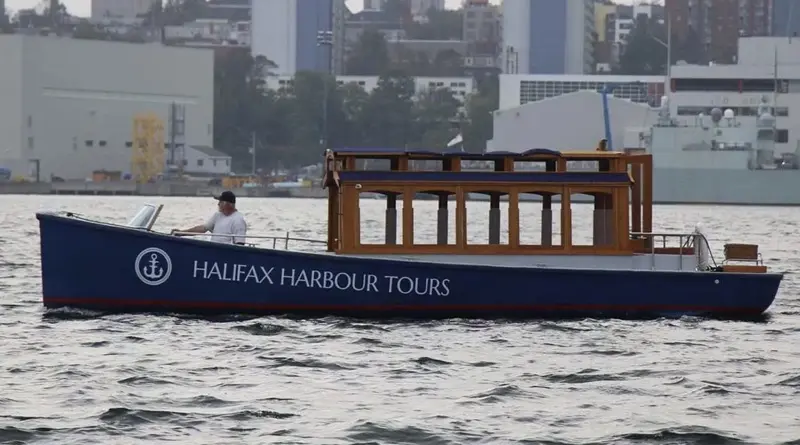
Recognizing the innate efficiency of the barge’s hull, Smith stripped out the polluting diesel mechanics and retrofitted the craft with an 8kW Lynch axial flux motor powered by a 7kWh battery bank. He integrated a custom solar roof and meticulously restored the boat—christened the Violet Mac—to its historical grandeur. In 2018, Halifax Harbour Tours officially launched, offering a uniquely quiet, personalized perspective on the historic Nova Scotia port.

The Catalyst for Collaboration
While the Violet Mac proved immensely popular—earning glowing reviews for its intimate eight-passenger capacity and serene atmosphere—Halifax’s notoriously unpredictable weather presented a persistent operational hurdle. Smith needed a vessel capable of navigating rougher conditions and offering comprehensive shelter against Atlantic "liquid sunshine," all without sacrificing eco-friendly credentials.
While researching cutting-edge marine electrification online through industry outlets like Plugboats, Smith discovered Navalt. Struck by the craftsmanship, efficiency, and total enclosure of Navalt’s passenger designs, Smith reached out to Thandassery. After reviewing various options, the two collaborators selected the Limo—a sleek, fully covered solar-electric catamaran tailor-made for high-end leisure cruising.
Supporting Context & Metrics: Re-Engineering for the North American Climate
Shipping a boat across hemispheres is a logistical feat, but re-engineering a vessel designed for tropical backwaters to survive a punishing North American winter requires extraordinary technical adaptation.
The Knock-Down Logistics
A standard 10-meter catamaran cannot fit inside a conventional shipping container. To solve this, Navalt’s engineering team conceived a radical "knock-down" construction method. The Limo was systematically deconstructed into modular components engineered specifically to fit inside five standard Forty-Foot Equivalent Unit (FEU) shipping containers.
This modular approach drastically reduced long-haul logistics costs while laying the groundwork for international technology transfer. As Thandassery noted in his personal reflections on the project, moving the boat’s "anatomy" rather than the completed structure itself represents a scalable paradigm for global clean-tech export.

Cold-Climate Thermal Management
Operating in Halifax means confronting sub-zero temperatures, freezing salt spray, and icy harbor conditions. In cold environments, standard lithium-ion batteries suffer severe performance degradation, losing both capacity and the ability to accept a charge safely.
To overcome this, Navalt heavily customized the Limo’s energy storage system. The vessel is equipped with a dual 20 kWh marine-grade LFP (Lithium Iron Phosphate) battery architecture. Crucially, each battery pack features an integrated, automated thermal heating system. This proprietary climate-control technology keeps the individual cells within their optimal thermal window year-round, ensuring that the vessel maintains maximum range, reliability, and safety regardless of ambient weather conditions.
Propulsion and Redundancy
Propulsion is handled by dual 15 kW inboard electric motors configured with Navalt’s signature independent dual battery-and-motor architecture. This builds structural redundancy directly into the drivetrain: in the unlikely event of a mechanical or electrical fault in one motor system, the secondary independent system ensures the vessel is never left stranded on the water.
Measuring 10 meters (32.8 feet) in length and 3.5 meters (11.5 feet) in beam, the Limo maintains its sophisticated aesthetic: clean exterior lines, a remarkably stable catamaran hull, generous interior space configured with comfortable couch-style seating, and a completely vibration-free, silent ride.
Official Statements and Perspectives
The partnership between Navalt and Halifax Harbour Tours has elicited immense pride from the leadership teams of both organizations, underscoring the collaborative spirit of the global clean-energy movement.

Reflecting on the milestone, Navalt founder Sandith Thandassery emphasized the historical significance of the venture:
"There are projects that move a business forward, and then there are projects that redraw the map. For us, shipping a Limo to Halifax, Canada is firmly the second kind. It is our first vessel headed to North America—and it travelled there in a way no Navalt boat has before: as a knock-down kit, packed flat into five containers, ready to be reborn on Canadian shoreline."
Thandassery also highlighted the satisfaction of witnessing the physical transformation of the shipped modules back into a luxury cruiser on foreign soil:
"Right now, on the ground in Halifax, under the guidance of Colin Smith and his team, those five containers are becoming a boat again. The hulls are being joined, the deck and superstructure reassembled, and the battery and outfitting items integrated into the vessel. It is painstaking, precise work—and watching a kit transform back into a sleek, water-ready cruiser is genuinely one of the most satisfying things to witness in our line of work."
Colin Smith, looking forward to the integration of the Limo into his existing operations, has long championed the passenger-centric advantages of electric marine transit. Reflecting on the philosophy behind Halifax Harbour Tours, Smith remarked:

"When we first started, our ‘fuel costs’ were about 60 cents a day. They’re not an awful lot more now, but the thing isn’t the cost for me, it’s the passenger experience. It’s quiet, there’s only 8 people on board, and the Guides are told to let people know about all of the historic sites in the harbour, but not get in the way of the passengers having a chance to talk among themselves and get to know each other. We often get reviews with people saying it’s the best experience they had on their visit to Canada."
With the arrival of the Limo, Smith is poised to scale this intimate, emission-free ethos to accommodate year-round operations and provide complete weather shelter for sightseers.
Future Outlook: A New Era for Electrified Waterways
The successful trans-Atlantic transit and ongoing reassembly of Navalt’s Limo catamaran in Nova Scotia signal a watershed moment for the global marine industry. It proves that advanced, zero-emission watercraft are no longer confined to regional pockets of innovation or tropical climates; they can be modularly manufactured, globally exported, and scientifically adapted to withstand the harshest environments on Earth.
As local assembly nears completion, Halifax Harbour Tours is on track to officially launch the new solar-electric Limo in July. This addition will more than double the company’s capacity to deliver sustainable marine tourism, offering visitors a panoramic, whisper-quiet window into the rich maritime history of Halifax Harbour without leaving a carbon footprint.
For Navalt, this successful North American debut opens the floodgates for international expansion. By proving that a 10-meter commercial passenger vessel can be efficiently containerized, shipped across 12,700 kilometers, and reconfigured for sub-zero winters, the company has established a replicable model for global decarbonization. From the palm-fringed backwaters of Kerala to the rugged, tide-swept inlets of Atlantic Canada, the mission remains absolute, resolute, and accelerating: oceans, electrified.