









Executive Overview
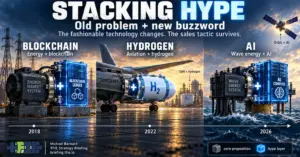
For decades, the aviation industry’s approach to decarbonization has been dominated by spectacle. Billions of venture capital dollars and corporate balance-sheet funds have chased the alluring promises of science fiction: vertical-takeoff-and-landing (eVTOL) air taxis buzzing over congested downtown cores, and hydrogen-powered jumbo jets traversing oceans on zero-emission vapor. Yet, as high-profile startups like Lilium and Volocopter face insolvency, and as hydrogen infrastructure proves to be a logistical labyrinth, a sobering reality has set in. The aviation sector does not necessarily need a complete reinvention of its transportation categories; it needs a hard, pragmatic look at how to electrify the markets that already exist.
Enter Heart Aerospace and its X1 demonstrator aircraft.
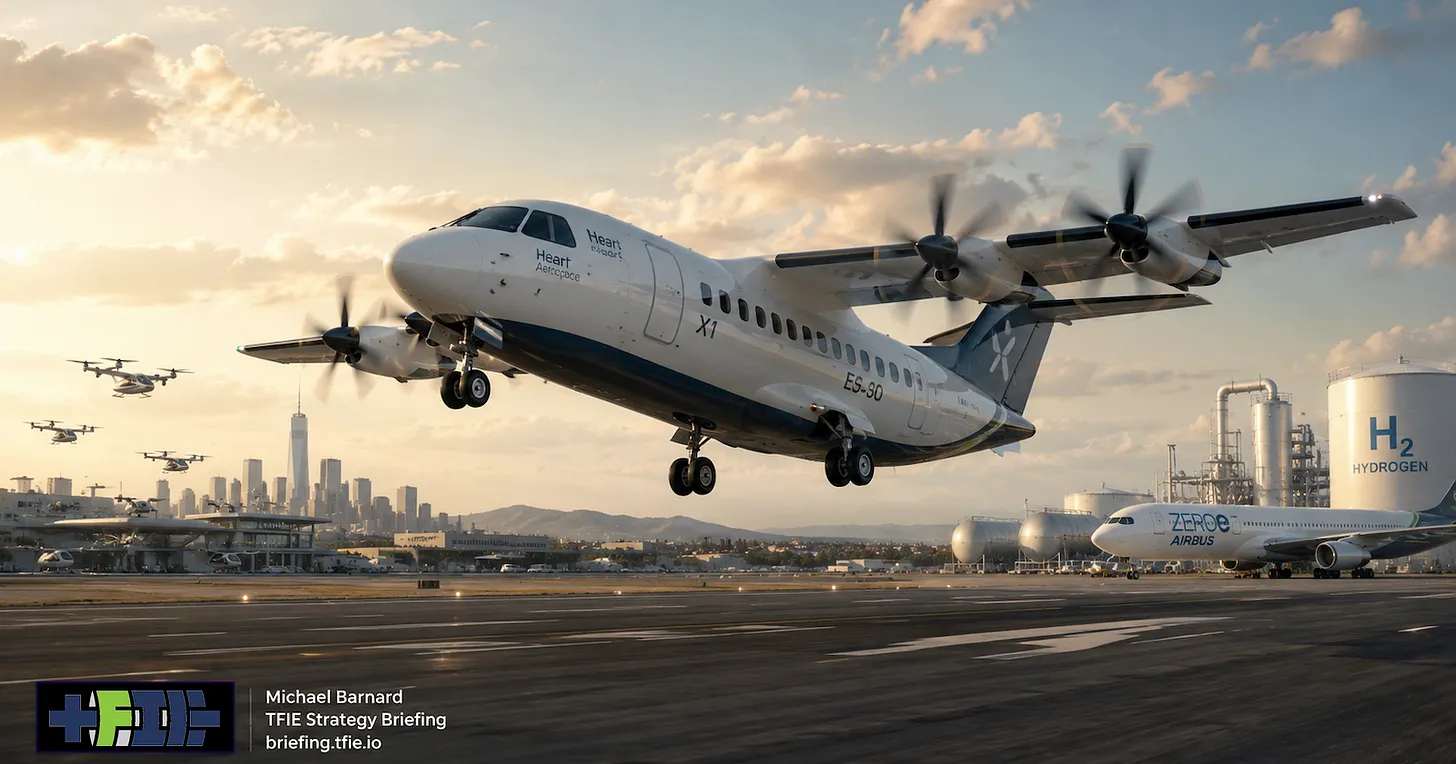
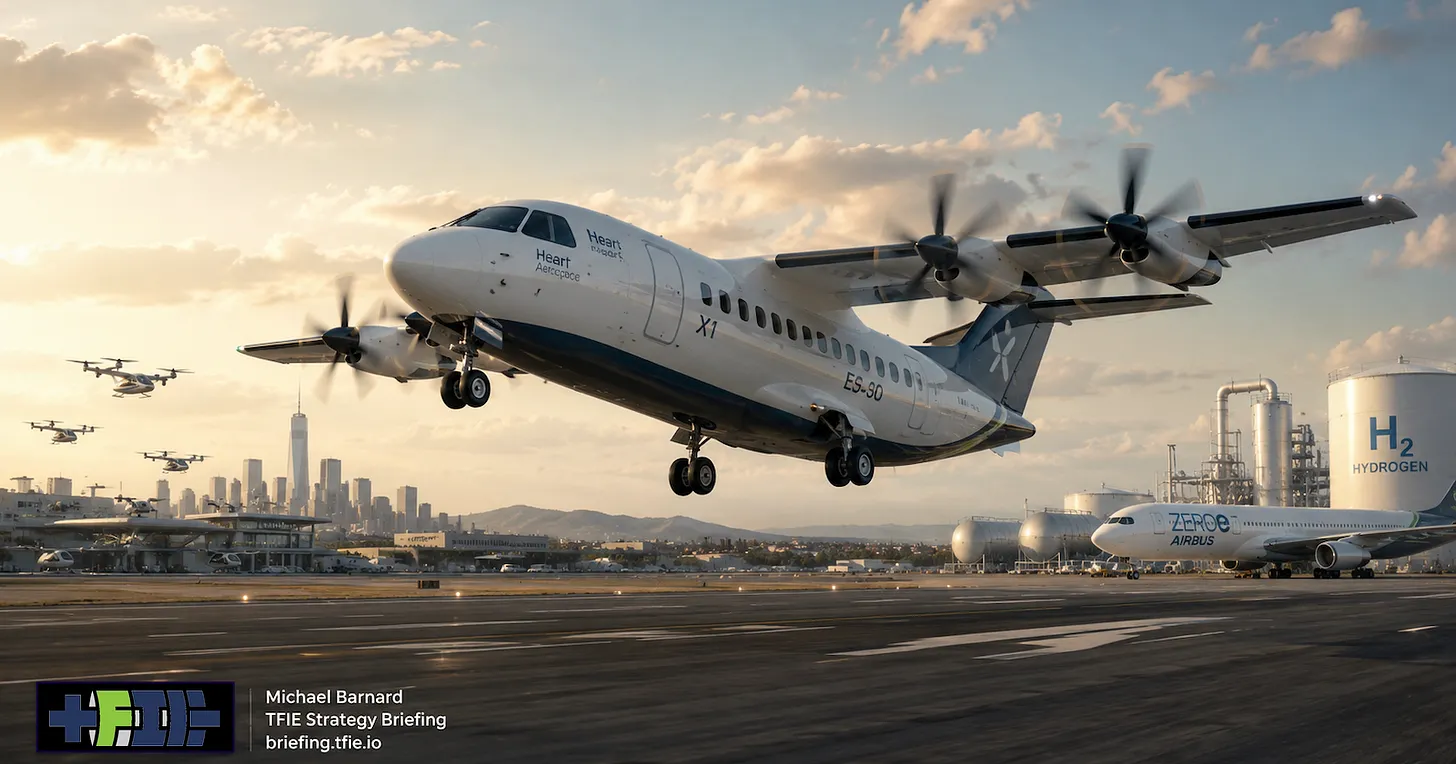
On August 12, from Plattsburgh International Airport, the X1 completed a successful 27-minute flight powered entirely by high-density batteries. With a sweeping 106-foot wingspan, a takeoff weight exceeding 25,000 pounds, and peak power draws surpassing one megawatt, the X1 quietly claimed a major milestone: it is the largest battery-electric aircraft to ever take to the skies.

However, industry experts note that the headline-grabbing record is far less important than the economic and structural denominator. Heart Aerospace is not attempting to invent a brand-new urban mobility ecosystem or a novel fuel distribution network from scratch. Instead, the company is systematically targeting the existing regional aviation market—leveraging conventional airports, established commercial routes, and current passenger demand.
While Heart is still years away from commercial viability—with certification, production industrialization, and a service entry target set for 2031—the X1 flight represents a crucial turning point. It demonstrates what happens when engineering prowess is aimed squarely at a real, functional market with a plausible energy pathway, providing a masterclass in how aviation capital should be deployed in the years ahead.
Detailed Chronology: The Milestone Flight of the X1
The path to the August 12 milestone at Plattsburgh International Airport was years in the making, defined by rigorous ground testing, structural assembly, and the painstaking integration of heavy-duty aerospace battery architectures.
The Lead-Up to Plattsburgh
Heart Aerospace first captured global attention with its conceptual design of the ES-30, a 30-passenger regional electric airplane. However, moving from concept art to physical reality requires rigorous, incremental testing. To mitigate regulatory and engineering risks, the Swedish aerospace innovator developed the X1—a full-scale functional demonstrator built specifically to validate the aerodynamics, propulsion integration, battery thermal management, and power-draw dynamics of a heavy electric aircraft.

In the weeks preceding the flight, the X1 underwent comprehensive taxi tests at Plattsburgh International, verifying low-speed steering, braking systems, and electrical bus stability. These trials were essential for ensuring that the massive battery packs could deliver consistent, reliable megawatt-scale power without triggering thermal anomalies or voltage sags.
The 27-Minute Flight
On August 12, under clear skies at Plattsburgh, the X1 achieved "first flight." Piloted and monitored by a specialized flight test crew, the aircraft detached from the runway, utilizing electric propulsion driven entirely by its onboard battery systems.
Key performance parameters recorded during the 27-minute flight included:
- Duration: 27 minutes of continuous, uninterrupted battery-electric flight.
- Physical Scale: A 106-foot wingspan, placing the aircraft firmly in the dimensional class of traditional regional turboprops.
- Mass: A takeoff weight exceeding 25,000 pounds, making it a true heavy-class testbed rather than a lightweight hobbyist drone or ultra-light trainer.
- Power Draw: Peaking at over one megawatt of electrical power, proving that modern aerospace architectures can safely manage high-voltage, high-current demands in flight conditions.
While the flight was brief, it served as a vital empirical check. It proved that the computer models, aerodynamic simulations, and thermal management systems designed by Heart were accurate in real-world, dynamic airflows.
Supporting Context & Metrics: Where Aviation Capital Went Wrong
To truly understand the significance of Heart Aerospace’s methodical approach, one must examine the graveyard of speculative capital that has characterized the green aviation movement over the last decade.
The eVTOL Mirage
According to estimates by Jefferies financial analysts, approximately $12 billion has been poured into the eVTOL (electric vertical takeoff and landing) sector. Major automotive and aerospace players have written massive checks: Boeing injected $450 million into Wisk in 2022, while Hyundai backed Supernal with at least $1 billion.
Yet, these investments frequently ran aground on a fundamental business truth: the engineering challenge of making an aircraft hover and transition to forward flight was often easier than the commercial challenge. Even if sophisticated powered-lift vehicles could be certified and manufactured at scale, industry analysts began asking hard questions:
- Will enough passengers pay premium fares, frequently enough, to support dense fleets of urban air taxis?
- Do cities possess the space and zoning permissions required to build extensive networks of downtown vertiports?
- Can the operating systems scale to handle high-frequency urban commuting without pricing out the average traveler?
For companies like Lilium and Volocopter, which experienced severe financial insolvency and restructuring, the answers to these questions came too late. They built magnificent engineering marvels, but they targeted markets with unproven economic foundations.
The Hydrogen Hurdle
Simultaneously, hydrogen aviation positioned itself as the savior for medium- to long-haul flight. However, hydrogen suffered from a completely different set of denominator problems.
The obstacle was never merely getting a hydrogen-powered combustion or fuel-cell aircraft off the ground. Rather, it was the catastrophic complexity of the entire energy supply chain:
- Production and Liquefaction: Generating genuinely low-carbon "green" hydrogen and cooling it to cryogenic liquid states requires immense energy inputs and sophisticated facility management.
- Infrastructure: Airports possess zero capacity to store, handle, or pump liquid hydrogen at scale. Rebuilding airport fueling infrastructure globally represents a multi-trillion-dollar capital expenditure.
- Storage and Aerodynamics: Hydrogen requires roughly four times the volume of jet fuel. Designing aircraft with bulky, pressurized, or cryogenic tanks fundamentally alters fuselage aerodynamics and passenger payload capacities.
- Energy Conversion Losses: Converting hydrogen back into useful thrust via fuel cells or combustion turbines incurs substantial thermodynamic energy losses before the propeller even spins.
When these systemic hurdles are stacked on top of the already brutal economics of commercial aircraft development, the pathway to profitability becomes nearly invisible.
Official Statements and Industry Perspectives
The aerospace industry’s reaction to the X1’s flight underscores a growing shift toward realism. Stakeholders are increasingly valuing tangible, incremental progress over grand, sci-fi visions.
While Heart Aerospace acknowledges that the X1 is not the final commercial ES-30 configuration, company executives emphasize that the demonstrator is designed to buy down risk where it matters most.

"The X1 is an engineering milestone, but more importantly, it is a risk-reduction instrument," industry strategy briefs note. "Aviation capital should be deployed to resolve concrete uncertainties: battery mass fractions, hybrid range limitations, high-cycle durability, megawatt-level charging speeds, airport grid connections, and hard regulatory certification frameworks."
Financial analysts tracking the decarbonization space have similarly praised Heart’s focus on the regional tier. By plugging directly into the operational DNA of existing regional airlines, Heart bypasses the need to invent new customer behaviors or construct greenfield transportation hubs. Regional carriers already manage ticket counters, baggage handling, maintenance schedules, safety protocols, and gate slots at thousands of regional airports worldwide.
Future Outlook: The Credible Shape of Aviation Decarbonization
Heart Aerospace is under no illusion that its path is easy. Commercial aircraft development is famously unforgiving—often referred to in the industry as a "billion-dollar bonfire." The X1 does not automatically guarantee that the production ES-30 will achieve full certification, optimal reliability, or commercial profitability by its 2031 service target.
However, the X1 establishes a credible blueprint for how aviation can actually decarbonize over the remainder of the 21st century.
The Multi-Tiered Transition Pathway
The future of sustainable flight will not rely on a silver bullet technology that serves every mission profile. Instead, it will be segmented by range and payload:
- Short-to-Medium Regional Routes (Under 300–400 miles): Dominated by battery-electric and hybrid-electric aircraft. Because electricity is inherently more efficient and boasts significantly lower operating energy costs than fossil fuels or synthetic alternatives, this market segment will likely transition first. Aircraft like the ES-30 fit seamlessly into this niche.
- Long-Haul Intercontinental Routes: Physics dictates that heavy batteries cannot store enough energy to propel a 300-seat widebody aircraft across the Atlantic Ocean. Therefore, long-haul routes will continue to require energy-dense liquid fuels for the foreseeable future, placing an absolute premium on scaling genuinely sustainable aviation biofuels and power-to-liquid synthetic e-fuels.
A New Standard for Venture and Institutional Capital
As the aviation sector enters its next major investment cycle, institutional capital must mature. Investors should be far less impressed by glossy promotional videos and theoretical spectacle.
Instead, the litmus test for any green aviation venture must be: Is this capital directly resolving the physical, regulatory, and economic uncertainties that stand between today’s fossil-fueled aviation system and a viable, lower-carbon iteration?
Heart Aerospace’s X1 flight proves that progress does not require reinventing the wheel—or the airport. By focusing engineering brilliance on a real, functioning market with a plausible energy pathway, Heart has charted a sensible, pragmatic course through the turbulent skies of sustainable aviation.