









By Megan Bennett, Senior Manager, Digital Outreach
Executive Overview
To the casual observer standing on a shoreline or looking at a globe, the global ocean appears as a singular, harmonious expanse of blue. Yet beneath the surface lies a mosaic of staggering thermal extremes. Ocean temperatures fluctuate wildly, ranging from the sub-zero, crystal-forming deep waters of Antarctica to superheated hydrothermal vents exceeding 600°F on the pitch-black ocean floor.
Unlike terrestrial mammals and human beings, who can alter their immediate environments with air conditioning, heavy winter coats, or central heating, marine organisms are bound by the fluid dynamics of their surroundings. They cannot simply escape a warming current or a sudden freeze at will. Instead, millions of years of evolutionary pressure have equipped ocean wildlife with an astonishing array of thermoregulatory tools.
Thermoregulation—the biological process by which living organisms maintain internal body temperatures within survivable limits—is often the definitive boundary between life and death in the marine realm. As anthropogenic climate change accelerates ocean warming, driving historic marine heatwaves, intensifying hurricanes, and triggering catastrophic coral bleaching, understanding how marine species regulate their body heat has never been more vital. This investigation explores the remarkable, specialized adaptations that allow sea turtles, apex fish, and abyssal invertebrates to defy thermal limits, and examines what these survival strategies reveal about the future of ocean life in a rapidly warming world.
Detailed Chronology: Milestones in Marine Thermal Adaptation & Discovery
The scientific understanding of how marine animals conquer extreme temperatures has evolved dramatically over the last century, shifting from basic physiological observations to deep genetic analyses.
- 1928 – The Discovery of the Pale Abyssal: Researchers first documented Antarctic icefish (Channichthyidae), revealing a baffling biological anomaly: vertebrates operating entirely without red blood cells or hemoglobin, relying solely on specialized plasma diffusion in near-freezing waters.
- Mid-to-Late 20th Century – Unveiling the "Wonderful Net": Marine biologists mapped the rete mirabile in regionally endothermic fish like the bluefin tuna, explaining how complex countercurrent vascular networks allow cold-blooded predators to hunt in icy depths while maintaining explosive muscular power.
- 1977 – The Abyssal Oasis: The discovery of hydrothermal vents along the Galápagos Rift by a team of geologists and marine biologists shattered the dogma that all life on Earth requires solar energy. This discovery introduced science to Riftia pachyptila (giant tubeworms) and chemosynthetic communities thriving at temperatures once thought incompatible with protein stability.
- Late 20th to Early 21st Century – Antifreeze Protein Breakthroughs: Biochemists isolated Antifreeze Glycoproteins (AFGPs) in polar species such as Antarctic toothfish and northern cod, mapping how specialized molecules disrupt ice crystal lattice formation in sub-zero cellular environments.
- 2025–2026 – Genetic Losses in Extreme Teleosts: Cutting-edge genomic sequencing revealed that specialized species like Asian noodlefishes have entirely discarded myoglobin and hemoglobin genes, prompting a reevaluation of vertebrate respiratory evolution under severe environmental pressures.
Supporting Context & Metrics: The Physics of Ocean Thermoregulation
Marine animals operate under distinct physiological constraints determined by whether they are ectothermic ("cold-blooded") or endothermic ("warm-blooded"). While ectotherms rely on environmental heat sources, certain pelagic hunters have evolved regional endothermy to master diverse thermal layers.
| Adaptation Type | Biological Mechanism | Representative Species | Operating Temperature Range |
|---|---|---|---|
| Countercurrent Heat Exchange | Arterial warmth transfers directly to incoming venous blood, preventing core cooling. | Leatherback Sea Turtles (Dermochelys coriacea) | 40°F to 85°F+ |
| Regional Endothermy | Rete mirabile vascular networks preserve heat in targeted muscles, eyes, and brain. | Atlantic and Pacific Bluefin Tuna | 35°F to 75°F |
| Antifreeze Glycoproteins (AFGPs) | Specialized proteins bind to nascent ice crystal faces, halting structural propagation. | Antarctic Toothfish, Northern Cod | Below 28.5°F (seawater freezing point) |
| Hemoglobin-Free Plasma | High cardiac output and widened blood vessels maximize oxygen absorption via skin and gills. | Antarctic Icefish (Channichthyidae) | 28°F to 32°F |
| Chemosymbiotic Heat-Tolerance | Symbiotic bacteria metabolize sulfur/minerals; plumes manage extreme thermal gradients. | Giant Tubeworms (Riftia pachyptila) | 35°F to over 400°F |
The Leatherback Strategy: Gigantothermy and Countercurrent Flow
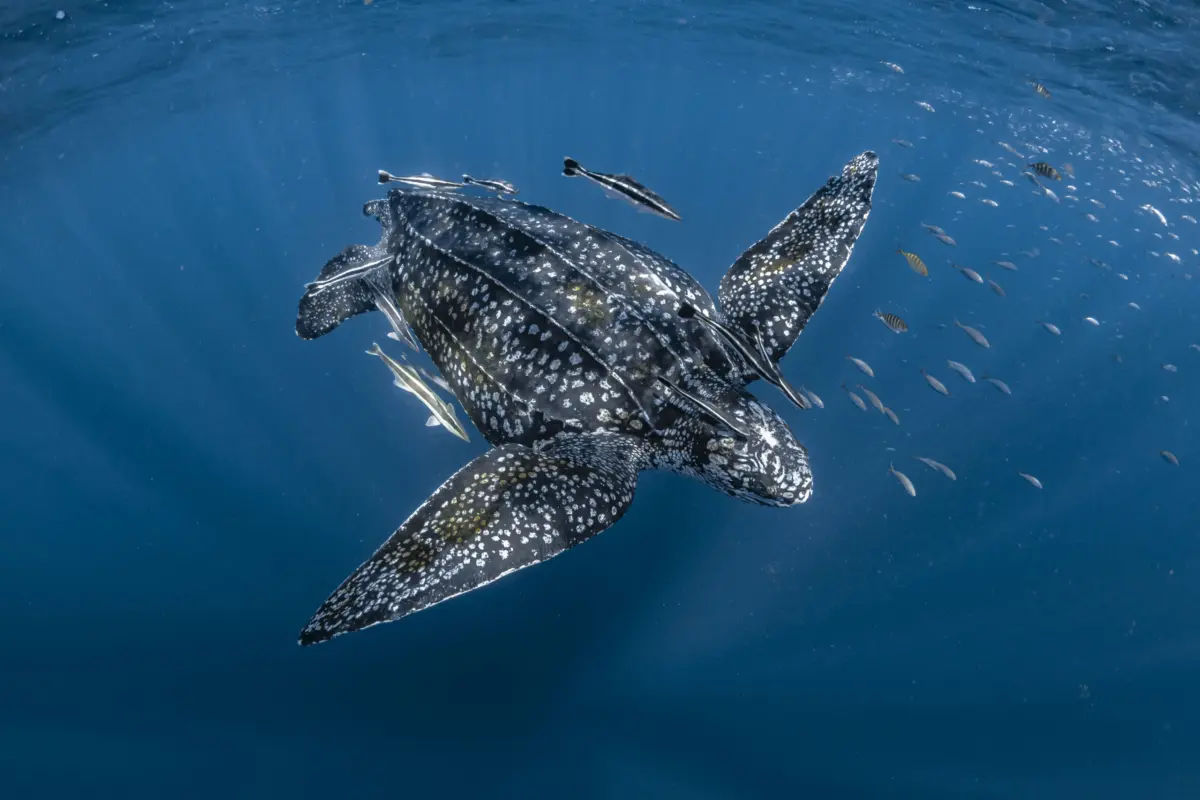
Sea turtles are ectothermic reptiles, typically requiring solar basking or warm tropical shallows to elevate their metabolic rates. However, the leatherback sea turtle (Dermochelys coriacea) regularly ventures into near-freezing sub-polar waters to feed on gelatinous zooplankton and sea jellies.
Leatherbacks accomplish this through two primary adaptations: countercurrent heat exchange and gigantothermy. The animal’s vascular system features intertwined arteries and veins in its flippers. Warm blood traveling outward from the core surrenders its heat directly to the cool blood returning from the extremities, warming it before it reaches vital organs. Furthermore, as the largest species of sea turtle on Earth, their massive body volume-to-surface-area ratio—combined with a thick layer of oily, insulating subcutaneous fat and a flexible, leathery carapace—acts as a thermal battery, trapping metabolic heat and dramatically slowing thermal loss.
The Bluefin Tuna’s Engine
While the vast majority of bony fish are ectotherms, the bluefin tuna stands out as a marvel of regional endothermy. To maintain the rapid swimming speeds and high-frequency muscle contractions required to pursue agile prey in cold, deep oceanic layers, bluefin tuna utilize the rete mirabile—literally translating to "wonderful net."
This dense, tightly packed mesh of microscopic arteries and veins acts as a biological heat exchanger. By recycling metabolic heat generated by red swimming muscles, the tuna keeps its core, brain, and eyes significantly warmer than the surrounding water. Interestingly, their hearts remain cool, receiving blood directly from the gills to prevent thermal shock to cardiac tissue, showcasing an elite partitioning of biological energy.
Official Statements and Expert Perspectives
As marine heatwaves increase in frequency and intensity, marine conservation scientists emphasize that while these evolutionary traits are awe-inspiring, they have finite limits.
Dr. Elena Vance, a senior marine ecologist focusing on polar ecosystems, notes:
"For millions of years, Antarctic notothenioids and icefish have fine-tuned their biochemistry to a knife-edge of survival. Antifreeze proteins and hemoglobin-free plasma represent the zenith of evolutionary optimization for sub-zero stability. However, these creatures are hyper-specialized. When you rapidly alter the baseline temperature of their environment, you strip away their evolutionary margin for error. They cannot simply migrate toward the poles when they are already living at the literal bottom of the world."
Policy advocates at organizations like Ocean Conservancy underline the urgency of translating biological resilience into legislative action. Conservation leaders stress that while nature has spent eons developing thermal defenses, anthropogenic climate change is moving faster than natural selection can adapt.
“The climate crisis in our oceans is no longer a distant theoretical threat; it is an active, destabilizing reality,” noted a recent Ocean Conservancy briefing. “Historic marine heatwaves, intensifying hurricanes fueled by thermal energy in the upper ocean, and widespread coral bleaching events demonstrate that marine life is trapped in a pressure cooker. These extraordinary adaptations remind us of what is at stake—and compel us to demand immediate policy intervention to curb carbon emissions before these ecosystems reach their absolute thermal tipping points.”
Future Outlook: Navigating a Warming Ocean
The study of marine thermoregulation bridges basic physiological science with urgent conservation imperatives. As global carbon emissions continue to trap excess heat within the world’s oceans—absorbing over 90% of excess anthropogenic heat—the thermal architecture of the sea is shifting beneath its inhabitants.
- Range Shifts and Thermal Squeezes: As temperate and tropical waters warm, many pelagic species are forced to migrate toward higher latitudes or deeper waters. However, geographic barriers, continental shelf boundaries, and oxygen-minimum zones create "thermal squeezes," trapping species in environments that quickly exceed their physiological thresholds.
- Genomic Resilience Research: Conservation geneticists are increasingly analyzing the genomes of extremophiles—such as hydrothermal vent worms and Antarctic icefish—to identify the molecular markers responsible for thermal and cellular stability. These insights may illuminate how other, less-adapted species might cope with rapid environmental transformation.
- The Imperative for Climate Mitigation: Ultimately, scientific consensus confirms that no amount of evolutionary ingenuity can indefinitely outpace unchecked planetary warming. Protecting marine biodiversity requires an immediate, coordinated global shift toward renewable energy, the expansion of highly protected marine reserves to build ecological resilience, and aggressive policies to mitigate greenhouse gas emissions.
Thermoregulation remains one of the most stunning chapters in the story of life on Earth. Yet, preserving these evolutionary marvels requires humanity to recognize that the ocean’s thermal limits are also our own.
To support ongoing conservation efforts and join the call for immediate climate action to protect vulnerable marine ecosystems, visit the Ocean Conservancy Action Center.