








Executive Overview
When the conversation turns to microplastic pollution, the human imagination is rarely at a loss for vivid imagery. We picture brightly colored fragments of discarded water bottles, brittle pieces of weathered buckets, and decaying marine gear bobbing in coastal currents. Alternatively, we visualize thick piles of micro-fibers—the microscopic, spaghetti-like synthetic threads shed from fleece jackets and nylon athletic wear during a routine washing cycle.
Yet, there is an insidious, high-volume source of microplastic pollution hiding in plain sight. It does not float in the ocean initially, nor does it begin its journey in a washing machine. It is under our feet every single day, coating our highways, paving our urban centers, and quietly washing into our waterways. This hidden menace is tire wear particle pollution.
Every time a vehicle accelerates around a corner, brakes heavily to avoid a traffic hazard, or simply rolls down an asphalt highway, the friction generated between its rubber tires and the abrasive pavement creates billions of microscopic debris fragments. According to Dr. Britta Baechler, Director of Ocean Plastics Research at Ocean Conservancy, driving a car or riding in a bus is conceptually similar to "dragging an eraser across the planet, except the crumbs are microplastics. Toxic microplastics."
These particles—composed of synthetic and natural rubber matrices infused with complex chemical additives—are now recognized by environmental scientists as one of the single largest sources of microplastics entering our global ecosystems. Because they have historically evaded detection methods, their massive environmental footprint is only now coming fully into focus.
As researchers race to quantify the scale of the crisis, attention has turned away from immediate, sweeping overhauls of the global transportation network—which are decades away from realization—and toward a more pragmatic, near-term defense mechanism: green infrastructure. By engineering natural systems such as bioswales, rain gardens, and permeable pavements, urban planners and scientists hope to intercept these toxic fragments before they ever touch a stream, river, or ocean.
Detailed Chronology: From the Highway to the Ocean Floor
To understand how a tire on a commuter vehicle in downtown Portland or suburban London ends up threatening marine wildlife, one must trace the precise lifecycle of a tire wear particle from its explosive birth on the asphalt to its final resting place in aquatic sediment.
Phase 1: Generation and Mechanical Friction
Modern vehicle tires are engineering marvels designed to handle immense heat, weight, and friction. Composed of a complex blend of natural and synthetic polymers, fillers (such as carbon black and silica), and specialized chemical preservatives, they are built to endure tens of thousands of miles of driving. However, this durability comes at a cost.

As a vehicle moves, the constant shear stress between the tread blocks and the abrasive road surface shaves off microscopic fragments. Studies indicate that a single vehicle can emit upwards of two trillion particles per mile driven. Scaled across billions of vehicles worldwide, the aggregate output is staggering: the average person generates nearly two pounds of tire particles per year simply through routine travel.
Phase 2: Atmospheric Dispersion and Terrestrial Accumulation
Once shed from the moving tire, these particles do not all stay on the road. Due to their varied sizes and weights, they bifurcate into two distinct environmental pathways:
- Airborne Transport: The smallest, lightest particles become aerosolized. They drift into the air as dust, contributing significantly to urban particulate matter (PM) air pollution before settling onto soils, rooftops, and vegetation far from the original roadway.
- Roadway Accumulation: Heavier particles settle directly onto the pavement, accumulating in the interstitial spaces of the asphalt, highway shoulders, and urban gutters. There, they mix with heavy metals, oil residues, and exhaust soot, forming a toxic cocktail waiting for the next precipitation event.
Phase 3: The Stormwater Surge
When rain falls on impervious urban surfaces, it cannot soak into the ground. Instead, it becomes stormwater runoff, rushing across parking lots, highways, and city streets. Acting as a powerful conveyor belt, this rushing water scoops up accumulated tire wear particles and sweeps them directly into municipal storm drains.
Phase 4: Aquatic Migration and Ecological Impact
From storm drains, the runoff is typically channeled—often untreated or only partially treated—directly into local streams, rivers, and estuaries. Once introduced to these aquatic environments, tire wear particles begin releasing their chemical components into the water column.
Among these compounds is 6PPD, a chemical added to tires to prevent them from degrading and cracking. When exposed to ozone in the environment, 6PPD transforms into 6PPD-quinone (6PPD-Q). Even at astonishingly low concentrations, 6PPD-Q has been proven to be acutely lethal to coho salmon and other sensitive aquatic species, inducing rapid mortality syndromes before the fish can even spawn. For decades, biologists were baffled by "urban runoff mortality syndrome" in Pacific Northwest salmon populations; we now know that microscopic tire crumbs are the primary culprit.
Supporting Context & Metrics: The Hidden Scale of the Problem
The sheer magnitude of tire wear particle pollution demands rigorous scientific inquiry. For many years, these particles remained largely invisible to researchers due to methodological limitations in microplastic analysis. Traditional sampling techniques often struggled to differentiate fragmented tire rubber from natural organic matter or other industrial polymers. As analytical chemistry has advanced, however, the numbers revealed by researchers have upended conventional wisdom regarding plastic pollution.
| Metric / Indicator | Data Point / Finding | Implication |
|---|---|---|
| Emission Rate per Vehicle | ~2 trillion particles per mile driven | High volume of microscopic shedding from every active vehicle fleet globally. |
| Individual Annual Footprint | ~2 pounds of tire particles per person/year | Widespread, ubiquitous contribution by everyday citizens through modern transportation. |
| Environmental Ranking | Top source of microplastics in terrestrial & aquatic ecosystems | Surpasses many traditional consumer plastics in total mass and particle count in urban runoff. |
| Toxicity Benchmark | Extremely low concentrations of 6PPD-Q cause mortality in coho salmon | Highlights that chemical toxicity matches physical ingestion hazards for wildlife. |
The intersection of physical microplastic pollution and chemical toxicity makes tire wear particles uniquely dangerous. Unlike larger macroplastics that primarily threaten wildlife via physical entanglement or starvation through gut blockage, tire particles act as chemical Trojan horses. They deliver concentrated doses of heavy metals, plasticizers, and degradation byproducts directly into the tissues of filter-feeding bivalves, benthic invertebrates, and predatory fish, bioaccumulating upward through the marine food web.
Official Statements and Expert Perspectives
As the scientific community races to address this hidden crisis, leading researchers and policy experts at organizations like Ocean Conservancy are sounding the alarm while charting a clear path forward.
"Driving a car or even riding in a bus is a bit like dragging an eraser across the planet, except the crumbs are microplastics. Toxic microplastics."
— Dr. Britta Baechler, Director, Ocean Plastics Research, Ocean Conservancy
Dr. Baechler’s vivid metaphor underscores the inescapable nature of the problem. Modern mobility is fundamentally tethered to material attrition; as long as rubber meets asphalt, particulate shedding will occur.
Complementing this scientific perspective, Dr. Anja Brandon, Director of Plastics Policy at Ocean Conservancy, emphasizes the necessity of structural interventions. While acknowledging that long-term solutions must involve reforming tire manufacturing processes—such as developing novel compounds that resist shedding or eliminating toxic chemical additives like 6PPD—Dr. Brandon points out that the global vehicle fleet cannot be transformed overnight.
"We cannot simply stop driving tomorrow," policy experts note. "We need near-term, scalable defenses that intercept these particles before they devastate our local watersheds. That is why bridging the gap between rigorous field science and civil engineering is our most urgent priority today."
Future Outlook: Engineering Nature to Defend Our Waters
Faced with the reality that vehicle-dependent societies will continue generating tire wear particles for decades to come, scientists and urban planners are focusing heavily on green infrastructure as the most promising near-term remediation strategy.
What is Green Infrastructure?
Unlike traditional "gray infrastructure"—which relies on concrete pipes, rapid drainage channels, and centralized treatment plants designed to rush water away from cities as fast as possible—green infrastructure mimics natural hydrological cycles. It integrates living systems and permeable materials into the urban landscape. Key components include:
- Bioswales and Rain Gardens: Engineered depressions planted with native vegetation and layered with specialized soil media designed to capture, slow down, and biologically filter stormwater runoff.
- Roadside Buffers: Vegetated strips placed between roadways and waterways that trap airborne and surface-level particulate drift.
- Permeable Pavements: Porous asphalt or concrete surfaces that allow rainwater to percolate directly into subsurface stone reservoirs rather than washing across topsoils.
The Portland Study: Science on the Ground
To transition green infrastructure from an experimental concept to a proven, quantifiable urban standard, Ocean Conservancy—with funding from the Tire Industry Project and in partnership with the University of Toronto—has launched a groundbreaking research initiative.
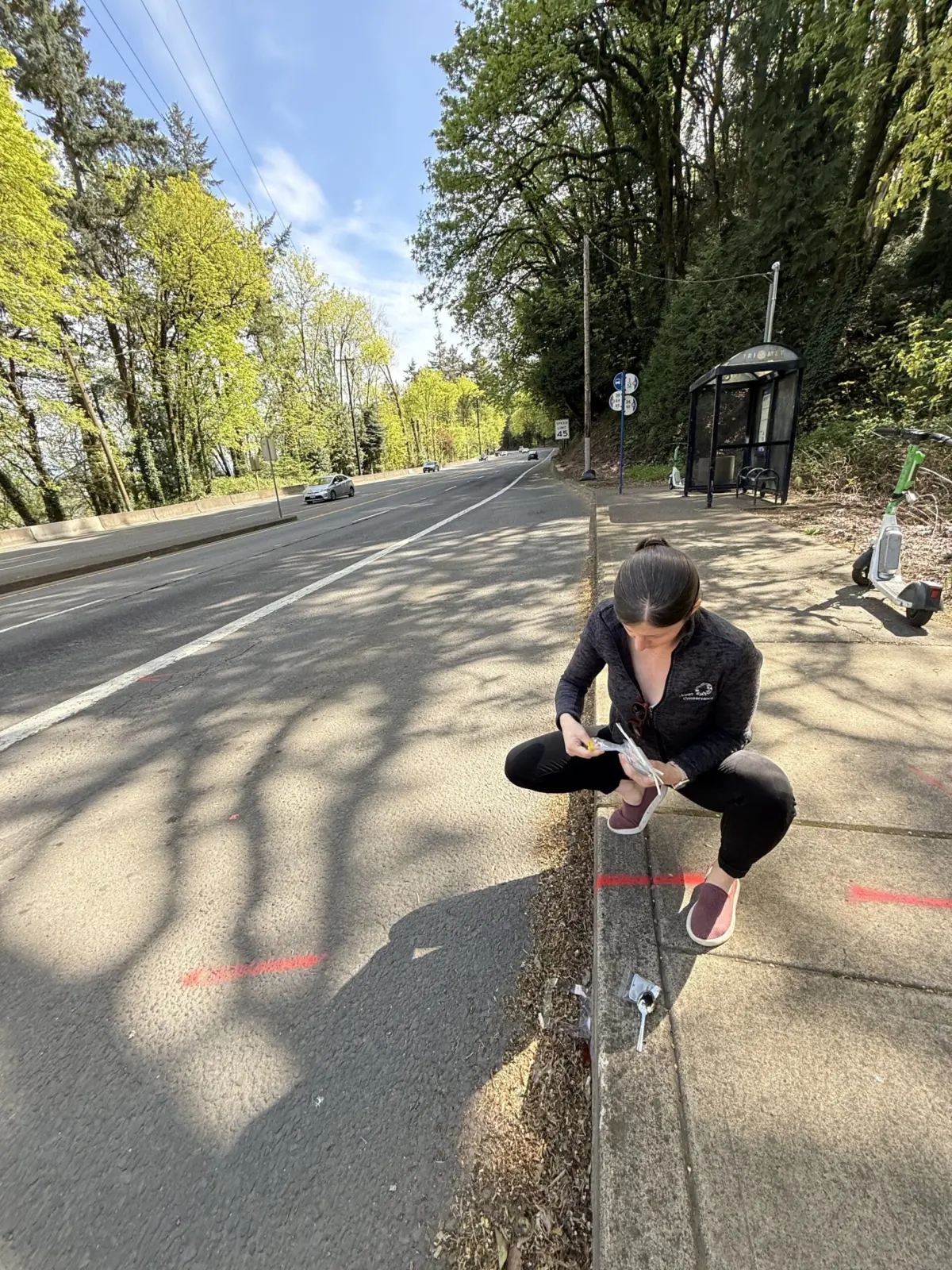
If you happen to walk or drive through the neighborhoods of Portland, Oregon, you might spot specialized research teams crouching by the roadside, meticulously scooping soil and sediment samples from urban bioswales and runoff channels. This on-the-ground fieldwork is designed to measure precisely how efficiently existing green infrastructure installations capture tire wear particles, how deep the particles penetrate the soil columns, and what saturation limits these natural filters possess.
By pairing rigorous empirical science with practical urban planning guidance, Ocean Conservancy’s plastics science and policy teams are helping municipal governments answer a critical question: How do we scale these systems cost-effectively across an entire city?
A Path Forward for Citizens and Policymakers
The challenge of tire wear particle pollution can easily induce a sense of helplessness. Because transportation is foundational to modern economic and social life, individual consumers cannot simply opt out of the system. However, this realization highlights the profound value of targeted, systemic research.
By investing in green infrastructure, supporting evidence-based advocacy, and pushing for regulatory changes in tire manufacturing standards, society can build an effective multi-layered defense. We do not need to wait for the entire global transportation network to be electrified or redesigned to start making a tangible difference. Through smarter urban design, strategic natural filtration, and unwavering dedication to ocean protection, we can intercept the invisible tide of microplastics—one roadway, one bioswale, and one city at a time—ensuring a cleaner, safer future for our waterways and wildlife.