









Executive Overview
The global maritime industry stands at a multi-billion-dollar crossroads, forced to decarbonize amidst tightening international environmental regulations, mounting pressure from port communities, and an urgent mandate to eliminate heavy bunker fuel emissions. Within this high-stakes arena, a stark dichotomy has emerged between public perception and industrial reality. Hydrogen fuel cell technology routinely captures the spotlight, generating breathless headlines, photogenic demonstrations, and political fanfare. Yet, the actual, scalable mechanics of maritime electrification rely on a much quieter, less glamorous foundation: local electrical grids, stationary battery energy storage systems (BESS), and routine, automated charging infrastructure.
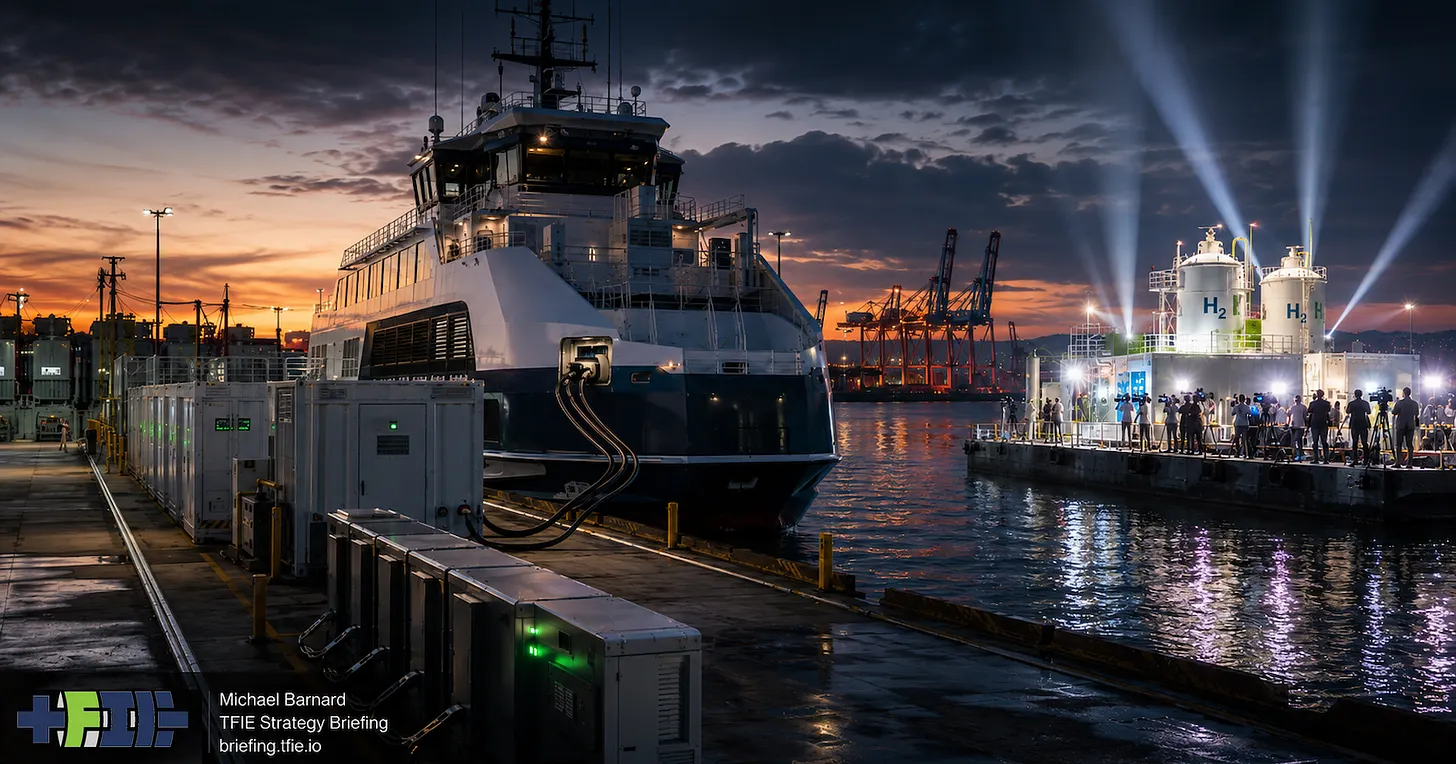
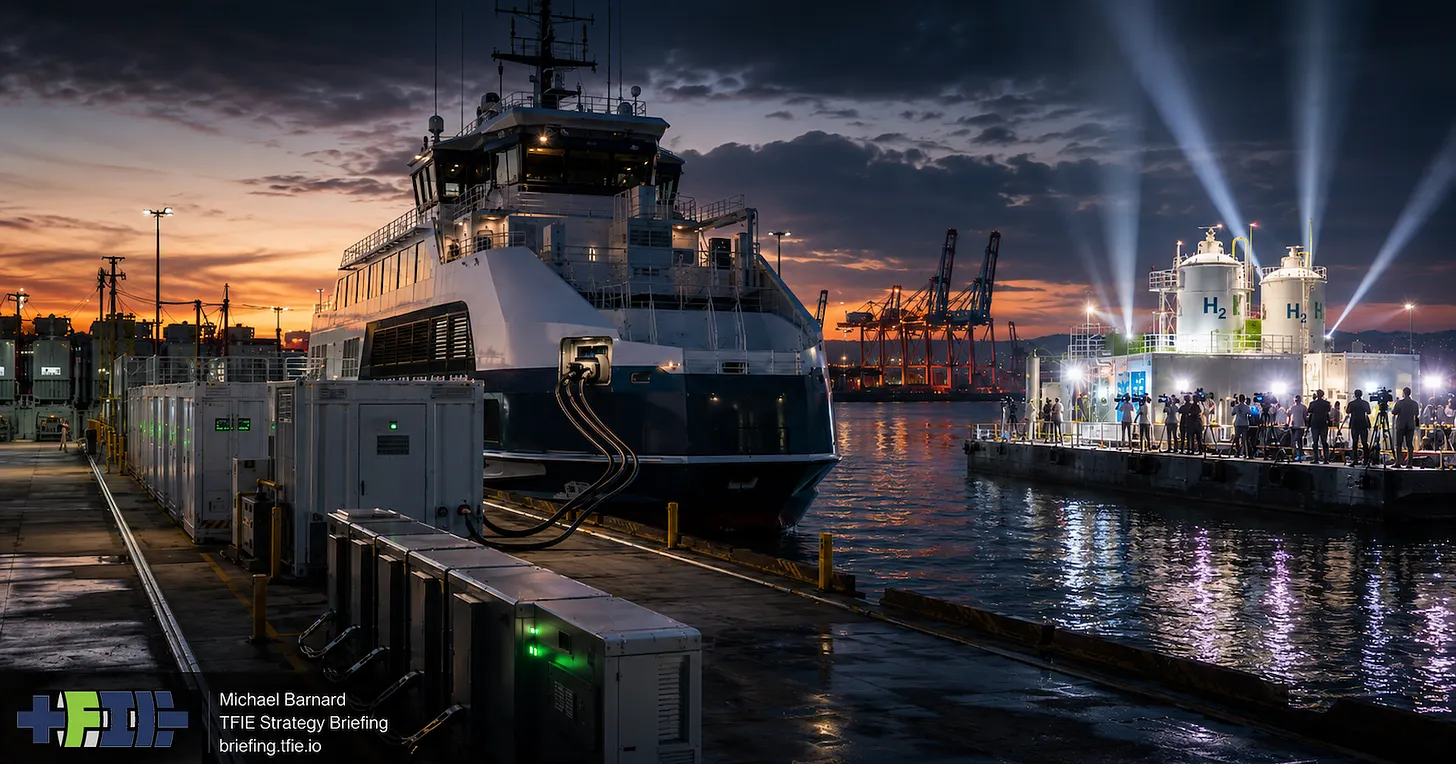
A recent high-profile demonstration at the Port of Tilbury on the River Thames serves as a textbook case study of this phenomenon. GeoPura, a prominent clean energy firm, mounted one of its hydrogen power units (HPUs)—equipped with five Ballard fuel cells—onto a floating barge to charge a commercial electric vessel. Visually, the setup was irresistible: a working ship, a floating platform, specialized hydrogen equipment, and an innovative architecture that practically guaranteed front-page coverage and social media engagement.
However, beneath the polished veneer of the demonstration lies a more complicated engineering truth. The vessel being charged was not powered by hydrogen; it was a fully battery-electric ship. GeoPura’s system did not propel the vessel via hydrogen combustion or fuel-cell propulsion. Instead, it converted hydrogen back into electricity, fed that electricity through a specialized charger, and stored it inside the ship’s onboard batteries.

While technically successful, the demonstration forces an unavoidable, rigorous question for maritime strategists and port operators: Why introduce the added complexity, cost, and efficiency penalties of a hydrogen loop when the destination vehicle is already electric?
As the shipping sector transitions away from fossil fuels, distinguishing between clever marketing spectacles and scalable infrastructure systems is vital. While hydrogen undeniably plays a crucial role in remote off-grid environments, construction sites, and emergency backup scenarios, scaling port electrification requires an unglamorous reliance on grids, substations, and battery buffering. The future of shipping will not be written in a succession of dazzling technological firsts, but in the quiet, predictable rhythm of vessels arriving, plugging into robust local grids, charging efficiently, and departing on schedule.
Detailed Chronology: The Tilbury Port Demonstration and the Hydrogen Loop
To understand the friction between hydrogen hype and battery reality, one must examine the sequence of events that brought clean energy technology to the historic Port of Tilbury.
Setting the Scene on the Thames
The Port of Tilbury, one of the United Kingdom’s major enclosed ports handling vast quantities of containerized and bulk cargo, faces an acute version of a modern port dilemma: accommodating high-power electrical demands without overloading fragile local distribution networks. Into this operational bottleneck stepped GeoPura, deploying its mobile hydrogen power unit onto a floating pontoon.
Using five integrated Ballard fuel cells, the floating HPU delivered a steady 300 kW of power to a commercial electric vessel berthed alongside the quay. The arrangement was deliberately engineered to showcase versatility. Ports are notoriously constrained by water boundaries, making mobile, deck-mounted or barge-mounted generators an attractive theoretical solution for vessels requiring supplementary shore power (cold ironing) or rapid top-up charging.
Unpacking the Energy Pathway
Despite the visual triumph of the Tilbury project, a step-by-step audit of the energy pathway reveals the thermodynamic hurdles inherent in using hydrogen as an intermediary for battery charging:
- Renewable Generation & Electrolysis: Clean electricity (typically sourced from wind or solar) is used to split water molecules through electrolysis, creating hydrogen gas.
- Compression, Storage, and Transport: The resulting hydrogen must be compressed, stored in pressurized tanks or tube trailers, and physically transported to the port site.
- Fuel Cell Conversion: At the quayside, the hydrogen power unit feeds the gas into fuel cells (in this case, Ballard units), which recombine hydrogen with ambient oxygen to generate electricity.
- Power Conditioning & Charging: The electricity is stepped, conditioned, and routed through a charger interface.
- Onboard Storage: Finally, the electricity enters the lithium-ion or alternative chemical battery packs housed within the hull of the commercial vessel.
Every single step in this chain incurs an energy loss. According to industry metrics and GeoPura’s own technical efficiency data, producing hydrogen via electrolysis and subsequently converting it back into usable electricity through a fuel cell yields an aggregate round-trip efficiency of roughly 31%. In plain terms, for every 3.1 megawatt-hours (MWh) of renewable electricity put into the front end of the hydrogen lifecycle, only about 1 MWh of usable energy ultimately reaches the vessel’s battery.
The remaining ~69% of the energy is lost as waste heat during electrolysis, compression, transport, and fuel-cell conversion. When the ultimate goal is simply to charge an electric ship, routing power through a low-efficiency hydrogen loop defies basic thermodynamic optimization.
Supporting Context & Metrics: The Port Power Crisis and the Battery Alternative
To evaluate why hydrogen is an awkward fit for routine quayside charging, one must first analyze the genuine electrical engineering challenges facing modern ports.
The Quayside Power Paradox
Ports are essentially miniature cities operating under heavy industrial constraints. When a modern electric or hybrid vessel docks, its energy demands spike dramatically. A single vessel berth may require several hundred kilowatts—or multiple megawatts—of instantaneous power over a relatively brief turnaround window.
However, local electrical grid connections are rarely designed to accommodate these massive, intermittent load spikes. Upgrading regional transmission lines, installing high-capacity substations, and trenching heavy-duty cabling through congested, active industrial port zones are notoriously slow, disruptive, and astronomically expensive endeavors. Furthermore, a ship may demand enormous amounts of power for an hour during hotel load operations or rapid battery charging, while the berth requires very little power for the remainder of the day.
Why Stationary Batteries Win the Infrastructure Race
This operational profile—high peak demand coupled with low average utilization—is a textbook application for stationary battery energy storage systems (BESS).
Instead of demanding an immediate, ultra-heavy-duty grid upgrade, a port can install a containerized stationary battery at the berth. This battery can draw electricity from the local grid slowly and continuously over many hours, safely operating within the existing capacity limits of the local distribution network.
When a commercial electric vessel arrives at the quay, the stationary battery discharges stored energy at an ultra-high rate, satisfying the ship’s rapid-charging needs instantly. From the perspective of the electrical grid, the load appears smooth, predictable, and manageable. From the perspective of the ship operator, the vessel receives a fast, high-power charge without delay.
Where vessel schedules and port logistics permit, containerized battery swapping offers an even faster alternative. By physically swapping depleted battery modules for fully charged ones on the dock, ports can decouple battery charging time entirely from vessel turnaround schedules, maximizing operational efficiency.
Where Hydrogen Actually Shines
Acknowledging the limitations of hydrogen in quayside battery charging does not render the technology obsolete. Hydrogen power units occupy a vital, irreplaceable niche in scenarios where grid electricity is genuinely unavailable, impossible to provision, or physically out of reach.
- Remote Construction Sites: Large-scale civil engineering projects located far from transmission infrastructure benefit immensely from zero-emission, quiet hydrogen generators that replace noisy, polluting diesel gensets.
- Temporary Events & Festivals: Public gatherings requiring temporary, heavy-duty power can utilize HPUs to eliminate local particulate emissions and noise pollution.
- Emergency Disaster Relief: In situations where regional electrical grids have collapsed due to severe weather or natural disasters, mobile hydrogen units can provide reliable, localized emergency power.
In these contexts, avoiding the efficiency penalty of hydrogen is secondary to the absolute necessity of off-grid power generation. GeoPura has built a successful, legitimate business model addressing these exact use cases. The strategic error occurs not in deploying hydrogen for off-grid power, but in attempting to force hydrogen into a stationary port environment where grid-tied battery infrastructure is cheaper, simpler, and nearly three times as efficient.
Official Statements & Industry Perspectives
Industry analysts, maritime economists, and clean technology strategists are increasingly vocal about the need for rigorous, metrics-driven deployment rather than symbolic technological stunts.
Recent analysis from specialized maritime intelligence briefings, such as the TFIE Strategy Briefing, highlights a growing divergence between companies building scalable, boring infrastructure and those chasing headline-grabbing media moments.

"The maritime transition will look less like a succession of technological firsts and more like something far less exciting: ships arriving, charging and leaving on schedule," notes maritime infrastructure analyst reports.
Experts emphasize that the accumulation of isolated, one-off "firsts"—such as the first time a hydrogen unit charges a ship on a specific river—can quickly transition from a sign of innovation to a symptom of commercialization weakness. If a technology cannot be cleanly repeated, scaled, and integrated into standard commercial tariffs without heavy reliance on demonstration subsidies, it remains an expensive prototype rather than a market solution.
Furthermore, ports operating under strict net-zero mandates are looking closely at total cost of ownership (TCO). Port authorities are questioning the long-term economics of maintaining complex fuel storage, specialized safety perimeters, and low-efficiency energy chains when direct electrification via grid and stationary storage offers a streamlined, unified capital expenditure model.
Grids, substations, high-power DC fast chargers, power electronics, and buffering batteries possess a distinct commercial advantage: they are multi-use assets. A robust quayside microgrid and battery storage system can simultaneously serve electric container handling equipment, shore-powered vessels, electric harbor trucks, port administration buildings, and local grid stabilization services. Hydrogen infrastructure, by contrast, often remains siloed within a specific fuel delivery and conversion paradigm.
Future Outlook: The Unglamorous Reality of Decarbonized Shipping
As the 2030s approach, the global maritime sector faces tightening decarbonization targets set by the International Maritime Organization (IMO) and regional bodies like the European Union. Meeting these targets will require trillions of dollars in capital expenditure directed toward port modernization and vessel retrofitting.
The trajectory of this transition points toward a future defined by infrastructure integration rather than technological novelty.
The Death of the Demonstration Trap
The era of celebrating proof-of-concept demonstrations simply for proving that physics works is drawing to a close. Investors, port directors, and fleet operators are no longer asking whether hydrogen can generate electricity, or whether a fuel cell can interface with a battery charger. Those questions have been answered.
The metrics that matter moving forward are uncompromisingly commercial:
- How many commercial vessels utilize the system on a daily or weekly basis?
- What is the total volume of megawatt-hours safely delivered to active fleets?
- What is the exact delivered cost of electricity per kilowatt-hour to the end operator?
- Will independent port authorities purchase duplicate systems after reviewing real-world operational spreadsheets?
Building the Quiet Foundation
In the coming years, the most successful ports will be those that invest heavily in unphotogenic, highly functional electrical infrastructure. Upgraded regional substations, subterranean high-voltage cabling, smart-charging software management systems, and large-scale lithium-ion or alternative-chemistry battery buffers will form the invisible backbone of green shipping corridors.
These assets will not generate viral photographs or trending social media posts. A transformer sitting quietly behind a concrete quay lacks the cinematic drama of a hydrogen barge billowing water vapor on the Thames. Yet, it is precisely this ordinary, scalable hardware that will enable the global shipping fleet to shed its heavy fossil-fuel addiction.
Ultimately, the true measure of success for maritime decarbonization will not be found in the noise of announcements, ribbon-cuttings, and press releases. It will be found in the silence of zero-emission ports operating with seamless efficiency—where ships dock, plug into robust local grids, replenish their energy reserves, and quietly slip back out to sea on schedule.