









Executive Overview
In the upper tier of modern luxury motor yacht manufacturing, the pursuit of volume, efficiency, and open-air connectivity often results in compromises. Builders frequently sacrifice sea-keeping capability for sprawling interior volume, or conversely, prioritize mechanical performance at the expense of relaxed, livable layouts. Enter the Absolute 70 Fly—the new flagship of the Italian builder’s acclaimed Fly series. Stepping boldly into a highly competitive market segment, this vessel represents a masterclass in spatial architecture and engineering refinement.
Built in Piacenza, Italy, by a yard renowned for pushing the boundaries of spatial optimization across its Navetta, Fly, and Coupe lines, the Absolute 70 Fly is engineered to challenge conventional expectations of what a 70-foot flybridge yacht can achieve. Powered by twin 1,000-horsepower Volvo Penta D13 engines paired with IPS1350 pod drives, the yacht couples spirited, responsive handling with a 285-nautical-mile range at high cruising speeds. More than just a collection of impressive specifications, however, the 70 Fly is the culmination of more than two decades of institutional knowledge, representing everything Absolute Yachts has learned since its founding in 2002. This review provides an exhaustive look into the vessel’s design philosophy, performance metrics, luxury appointments, and broader significance within the luxury marine sector.
Detailed Chronology: From Concept to Sea Trial
The journey of the Absolute 70 Fly from a preliminary drawing board concept to a fully realized flagship vessel reflects a meticulous development cycle anchored in iterative testing and owner feedback.
Phase I: Conceptualization and Spatial Engineering
The conceptual genesis of the 70 Fly began years prior to its spring debut, driven by a clear mandate from Absolute’s executive and design teams: create a flagship for the Fly series that outclasses its peers in raw volume while maintaining the sleek, clean exterior lines that define the brand. Unlike traditional yacht designs where mechanical spaces dictate living arrangements, Absolute’s engineers utilized advanced CAD spatial planning to maximize the 17-foot, 8-inch beam from the outset. By integrating the compact footprint of the Volvo Penta IPS pods directly into the hull design, engineers reclaimed critical square footage traditionally lost to conventional shaft-drive engine rooms.
Phase II: Construction and Yard Integration
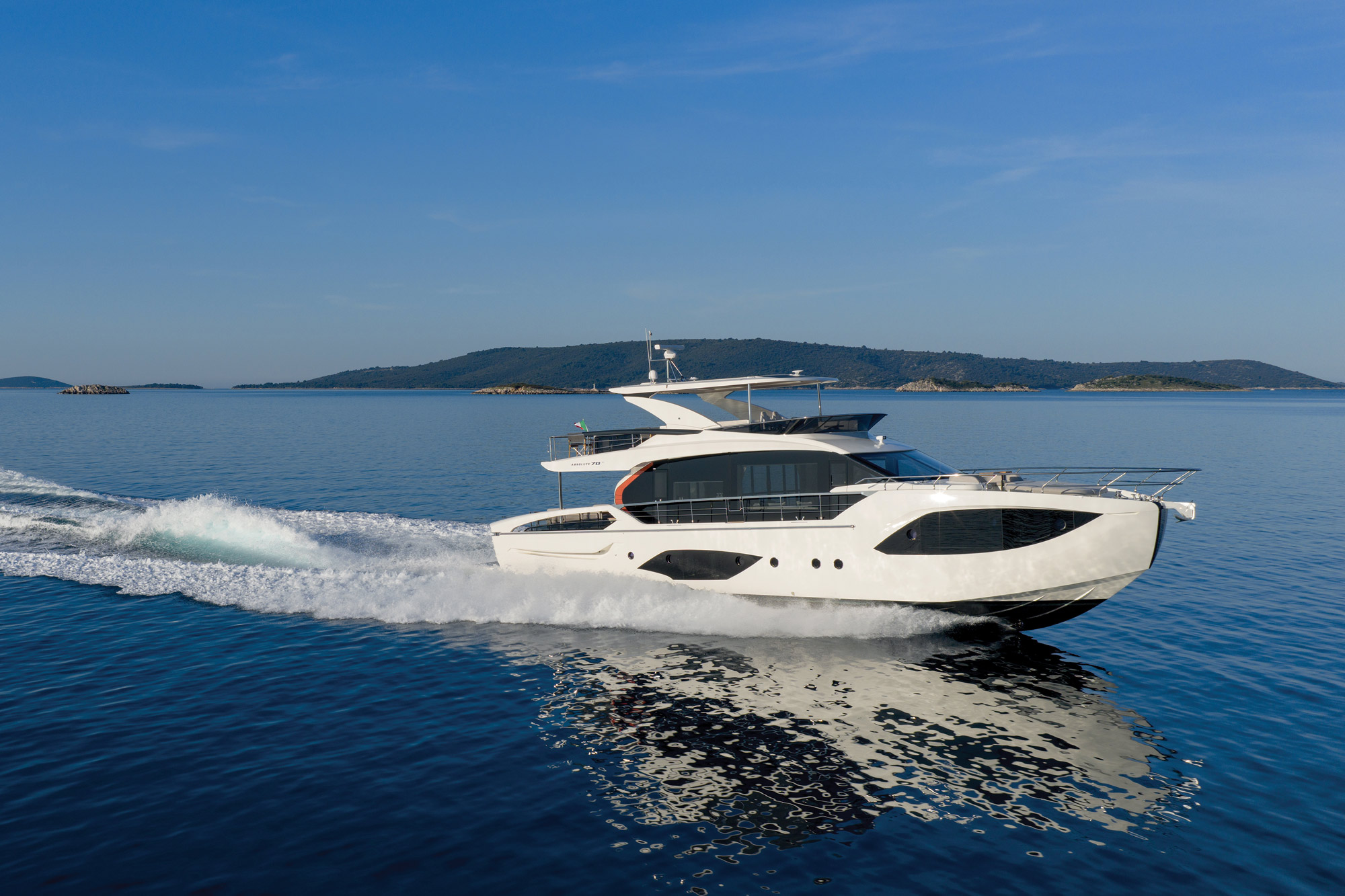
Fabrication takes place at Absolute’s state-of-the-art production facility in Piacenza, Italy. Here, the 116,000-pound fiberglass semi-displacement hull is meticulously laid up, cured, and outfitted. The yard’s vertically integrated manufacturing process allows for precise quality control over structural integrity and custom outfitting. During this phase, the modular interior components—ranging from reeded partitions to high-gloss lacquered cabinetry—are custom-fitted to ensure seamless transitions between open-plan social zones and private staterooms.
Phase III: Sea Trials and Refinement
The culmination of the development cycle occurred in the spring, when marine journalists and technical experts boarded the Absolute 70 Fly for comprehensive sea trials. Tested across various sea states, the vessel was subjected to rigorous performance evaluations, testing everything from wide-open-throttle acceleration to low-speed joystick maneuverability in tight Mediterranean harbors. The trials confirmed that the vessel’s semi-displacement hull form, coupled with its advanced propulsion system, successfully delivered on its dual promises of long-range cruising capability and sublime onboard comfort.
Supporting Context & Metrics
To truly understand the engineering achievement of the Absolute 70 Fly, one must analyze the hard metrics and contextual design choices that govern its performance and layout.

Architectural Layout and Main Deck Dynamics
The Absolute 70 Fly welcomes guests aboard via a vertically retractable swim platform that serves double duty as a submerged water-access point and an expansive teak terrace capable of hosting loose loungers and loose furniture. The transom features a distinct cutoff tail design, flanked by a glass guardrail that preserves unobstructed sightlines astern from the aft deck seating.
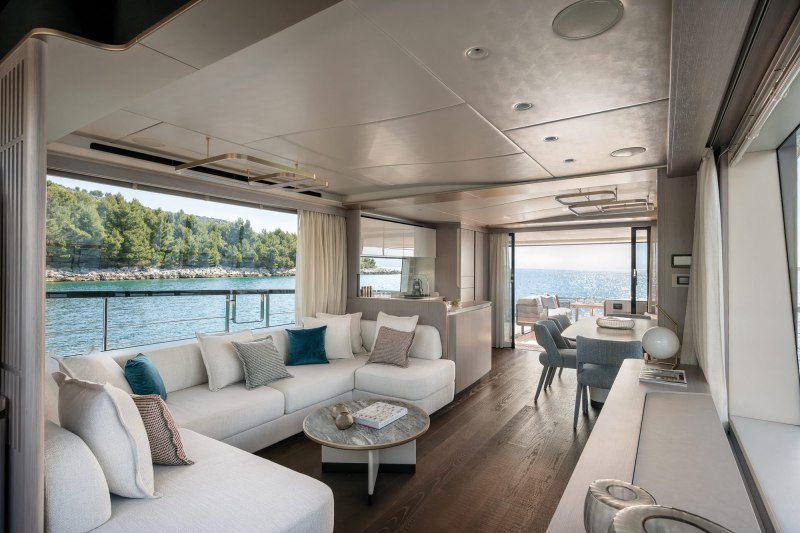
The aft cockpit is arranged around three modular sofas and a teak foldout table, complemented by a dedicated wet bar to port and stairs leading to the flybridge to starboard. Stepping through the wide sliding glass doors reveals a salon characterized by a remarkable 6 feet, 10 inches of headroom. Because the layout avoids obtrusive structural pillars and heavy bulkheads, the 17-foot-8-inch beam feels even more expansive.
For formal dining, a six-seat table is positioned to port, served directly by a starboard galley equipped with a four-burner induction cooktop, microwave/conventional oven, full-height refrigerator/freezer, dishwasher, and deep sink. Forward of the salon is a secondary gathering space featuring a U-shaped sofa, a coffee table, and a fixed 54-inch television housed in an electronic pop-up cabinet.
Accommodations and Below-Deck Luxury
Below deck, the Absolute 70 Fly provides a four-stateroom configuration designed to rival yachts of a much larger class:
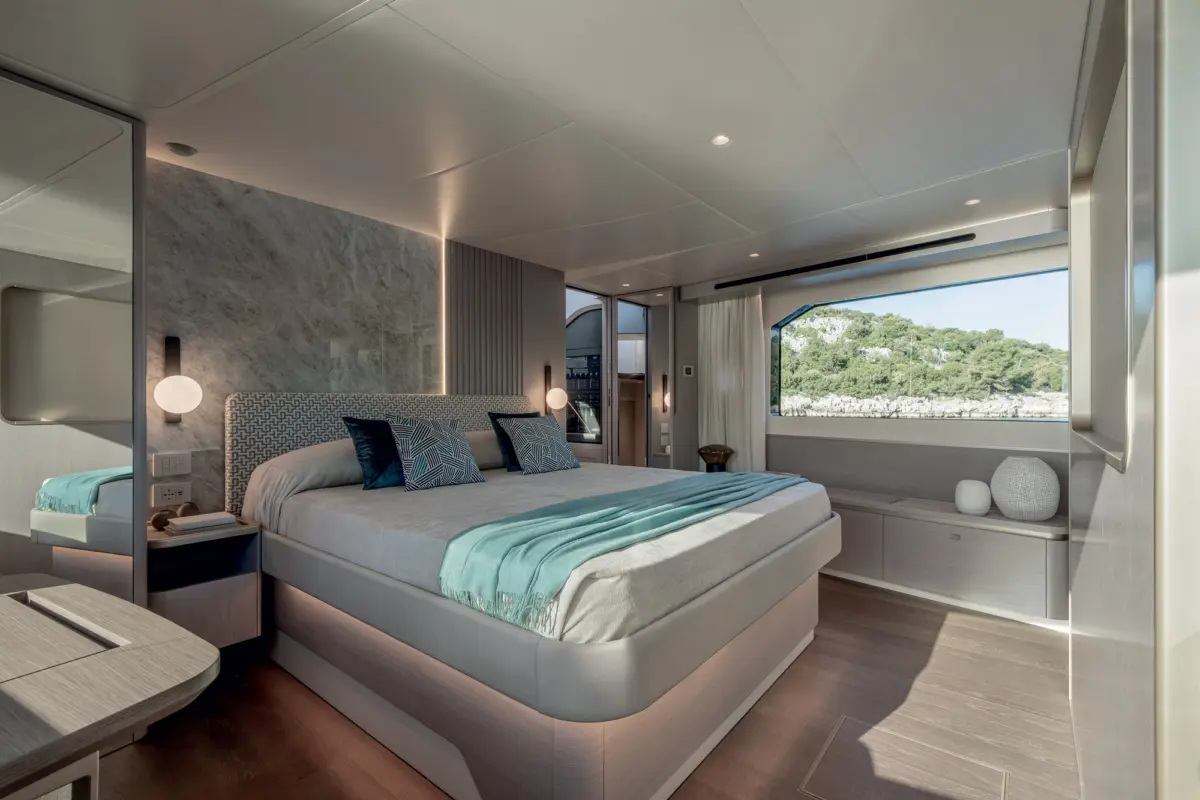
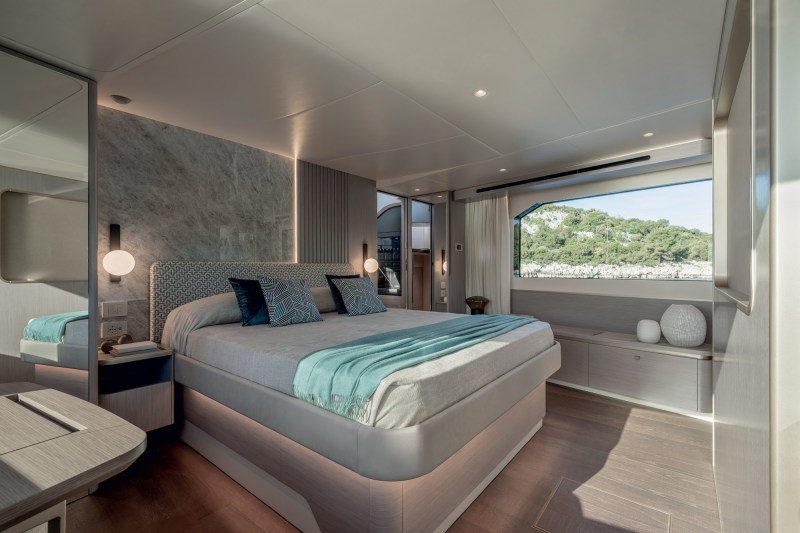
- Master Stateroom: Located forward, the master cabin features a forward-facing king berth. By positioning the en suite head in the forepeak, Absolute maximized the usable cabin floor space, allowing for a dedicated sitting sofa, a vanity, expansive hullside windows, and a full 72 inches of headroom.
- VIP Stateroom: Situated amidships across the full beam of the vessel, the VIP suite features a centerline queen berth and its own en suite facilities, easily rivaling master staterooms found on competing models.
- Guest Staterooms: Two additional guest cabins occupy the central lower deck—one equipped with twin fixed berths, and the other featuring sliding berths that easily convert from twins into a double bed.
Technical Specifications & Performance Data
Performance data collected during official sea trials highlights the efficiency and capability of the Absolute 70 Fly:
| Metric | Measurement / Specification |
|---|---|
| Builder / Series | Absolute Yachts / Fly Series |
| Hull Material | Fiberglass Semi-Displacement |
| Length Overall (LOA) | Flagship scale (Fly series spans 47’ to 70’+) |
| Beam | 17 feet, 8 inches |
| Headroom (Salon) | 6 feet, 10 inches |
| Dry / Loaded Weight | Approx. 116,000 lbs |
| Propulsion | Twin Volvo Penta D13 (1,000 hp each) with IPS1350 drives |
| Slow-Cruise Speed | ~15 knots (Fuel burn: 57 gph) |
| Fast-Cruise Speed | 21.9 knots at 2100 RPM (Fuel burn: 73 gph) |
| Cruising Range | 285 nautical miles at fast cruise |
| Top Speed | 28.5 knots at Wide-Open Throttle (WOT) |
Official Statements and Design Philosophy
The underlying ethos of the Absolute 70 Fly is rooted in a philosophy of architectural transparency and lifestyle-centric design. In statements released regarding the vessel’s market introduction, representatives for Absolute Yachts emphasized the company’s commitment to eliminating traditional interior barriers.
"The Absolute 70 is designed to dissolve the boundary between the interior living spaces and the surrounding marine environment," noted a senior brand representative during the vessel’s launch. "Every glass panel, every sliding partition, and every sightline has been engineered not just for aesthetic appeal, but to ensure that the owner and their guests remain visually and physically connected to the sea at all times."
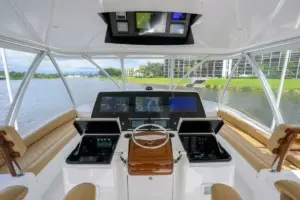
Designers focused heavily on customizability, offering owners an array of tactile finishes. From leather dining seat colorways and stain-resistant sofa fabrics to Corian countertops, stone-effect laminates, teak tables, marble tabletops, and high-gloss lacquered cabinetry, the yacht is built to reflect individual tastes. A prime example of this thoughtful engineering is the light-tone reeded partition located directly abaft the main deck helm. This clever architectural element allows the captain to maintain situational awareness of the main salon while preserving the open, airy aesthetic demanded by modern yacht owners.
Future Outlook and Market Impact
As the luxury yacht market continues to evolve, consumer demands have shifted heavily toward vessels that offer independent long-range cruising capabilities without sacrificing the amenities of a luxury seaside villa. The Absolute 70 Fly positions itself at the bleeding edge of this trend.
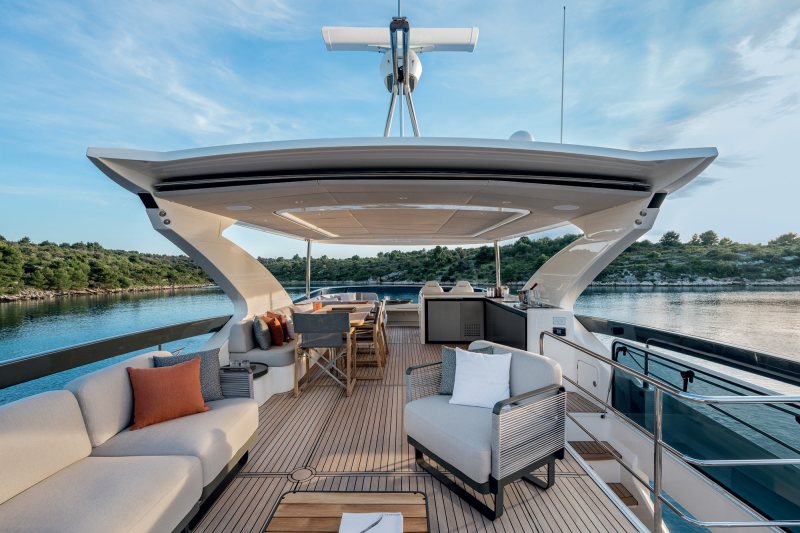
By pairing the intuitive docking and handling capabilities of Volvo Penta IPS drives with a robust 285-nautical-mile cruising range, Absolute has ensured that the 70 Fly is not merely a coastal dock-hopper, but a capable voyager. Its expansive flybridge—complete with open-air dining, an outdoor grill station, and customizable modular seating protected by a sturdy hardtop—caters directly to the modern desire for flexible outdoor entertainment spaces.
Looking ahead, the success of the 70 Fly is likely to influence the broader design language of European flybridge construction. As builders strive to pack superyacht-level amenities into sub-80-foot hulls, Absolute Yachts has set a formidable benchmark. For families, entertainers, and adventurous owners alike, the Absolute 70 Fly demonstrates that uncompromising luxury, operational efficiency, and spatial ingenuity can indeed coexist within a single, beautifully sculpted hull.