









Executive Overview
As artificial intelligence rapidly transforms from a novelty into the primary "front door" for travel planning, hospitality giants are scrambling to adapt. When a traveler asks an advanced AI assistant to curate the ideal hotel for a bespoke vacation or a high-stakes business trip, the properties that appear in the recommendations are not necessarily the best ones—they are the ones whose underlying data structures and content models the algorithms can actually read.
Recognizing this seismic shift, InterContinental Hotels Group (IHG) is executing a comprehensive, multi-million-dollar overhaul of its digital infrastructure. At the vanguard of this transformation is Heather Balsley, IHG’s Chief Commercial & Marketing Officer. Balsley is steering the global hospitality network through a dual-pronged strategy: making IHG’s vast portfolio "legible" to machine learning algorithms while fiercely maintaining that automated discovery tools will never usurp the direct, human-centric brand loyalty required to retain long-term guests.
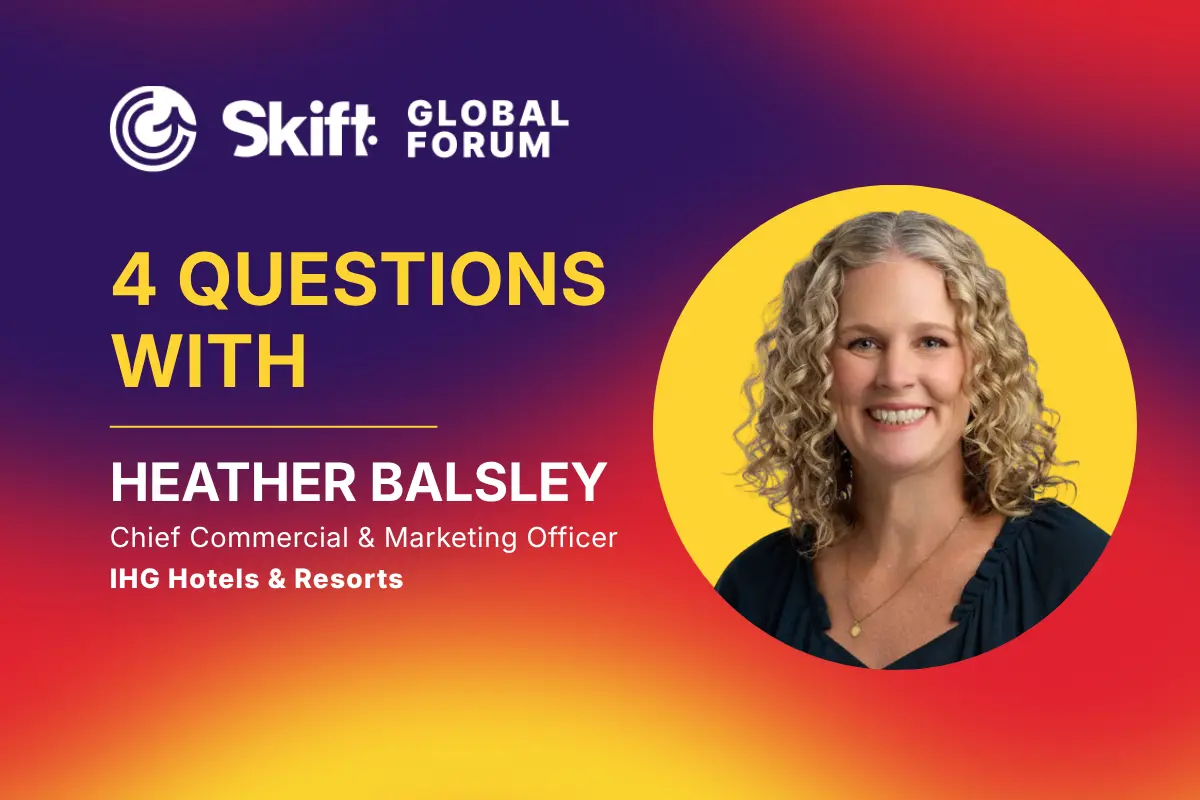
Ahead of her keynote appearance at the upcoming Skift Global Forum in New York, Balsley sat down to discuss the impending content revolution, the changing paradigms of the customer journey, and why the channel used for discovery will never dictate the ultimate winner in hospitality. This report explores IHG’s strategic roadmap, examining how legacy hotel brands are future-proofing their operations for an AI-first economy.

Detailed Chronology: The Evolution of Hotel Discovery
To understand why IHG is radically overhauling its content systems today, one must examine the chronological evolution of how consumers discover, evaluate, and book accommodations.
Phase 1: The Direct-to-Desk and Directory Era (Pre-2000s)
For decades, the hospitality industry relied on physical directories, travel agents, and direct phone calls. Brand reputation was communicated through physical touchpoints, printed collateral, and global reservation networks (GDS). The customer journey was linear, highly reliant on human intermediaries, and constrained by geographic information barriers.
Phase 2: The Rise of Online Travel Agencies (2000s–2010s)
The dawn of the internet birthed Online Travel Agencies (OTAs) like Expedia and Booking.com. For the first time, consumers could compare hundreds of hotels side-by-side on a single screen. This era forced hotel groups to standardize descriptions, room types, and pricing structures into rigid database fields to ensure compatibility with OTA aggregators. However, it also initiated a decades-long battle for customer ownership between independent brands and third-party platforms.
Phase 3: The Mobile and Super-App Proliferation (2010s–Early 2020s)
Mobile applications shifted the friction point from desktop comparisons to handheld convenience. In markets like China, super-apps integrated messaging, payments, and booking ecosystems, altering how users engaged with travel brands. Despite these shifts, hotel groups maintained control over their proprietary digital properties, driving traffic to brand.com sites through aggressive loyalty programs and performance marketing.

Phase 4: The Generative AI Front Door (Present–Future)
Today, the industry has entered the era of generative AI and conversational commerce. Modern travelers increasingly bypass search engines and OTAs entirely, posing complex, conversational prompts to AI assistants: "Find me a boutique hotel in downtown Chicago with a quiet workspace, pet-friendly amenities, and proximity to great coffee shops for under $300 a night."
This behavioral shift has rendered traditional, keyword-stuffed hotel descriptions obsolete. If a hotel’s backend content architecture cannot parse and answer these nuanced parameters, the AI assistant will simply omit the property from its curated shortlist. IHG’s current strategic pivot is a direct response to this existential challenge.
Supporting Context & Metrics: The Mechanics of AI Readability
Making a global hotel portfolio legible to artificial intelligence is no small feat. IHG manages thousands of properties across a diverse family of brands—ranging from luxury icons like InterContinental and Six Senses to mainstream favorites like Holiday Inn and Express. Each property possesses unique attributes, regional nuances, and localized amenities that must be translated into structured, machine-readable formats.
The Content Overhaul: A New Technological Backbone
Later this year, IHG is slated to roll out a proprietary content management platform designed to completely reimagine how property data is structured, stored, and distributed.
- Granular Metadata: Traditional hotel listings rely on basic tags (e.g., "pool," "free Wi-Fi," "gym"). AI-readiness demands contextual depth—details about the specific depth of the pool, the speed of the Wi-Fi network, the acoustic quality of the workspaces, and the exact operating hours of the fitness center.
- Dynamic Content Delivery: The new platform will allow individual properties to update their digital profiles in real time, pushing synchronized updates instantly across brand websites, mobile apps, third-party distribution channels, and AI partner integrations.
- Semantic Search Optimization: By restructuring descriptions into semantic data models, IHG ensures that large language models (LLMs) can accurately interpret the experiential value of a stay, rather than merely matching superficial keywords.
The Fragmented Yet Streamlined Customer Journey
While the number of discovery channels has exploded, consumer behavior is simultaneously consolidating around mobile ecosystems. According to industry observations, travelers are increasingly handling research, itinerary generation, and booking within unified mobile environments.
However, the psychological hurdle remains unchanged: risk aversion. The more choices available, the higher the cognitive load on the consumer. IHG’s strategy relies on mitigating this friction by leveraging its expansive brand portfolio and robust loyalty ecosystem (IHG One Rewards) to instill immediate confidence. When an AI assistant suggests an IHG property, the brand’s established reputation acts as an instant trust anchor for the hesitating traveler.
Official Statements: Insights from Heather Balsley
During her preparations for the Skift Global Forum, Heather Balsley elaborated on the strategic imperatives driving IHG’s technological investments and her philosophy on customer relationships.
On Earning the AI Recommendation
Addressing the mechanics of algorithmic curation, Balsley emphasized that AI models are fundamentally constrained by the quality of their inputs:
"AI tools can only be as helpful as the content they’re drawing from, so content has become increasingly important. Travelers are asking AI more nuanced questions about where they should stay based on their specific needs, preferences, and purpose of trip. That means hotel content needs to go beyond basic descriptions and amenities. It needs to be rich, accurate, and relevant so AI can understand what makes a property unique and connect it with the right guest."
Balsley noted that the upcoming platform rollout is designed to future-proof this discoverability:
"The goal is to ensure the right hotel information is showing up on the right channels at the right time, all while strengthening the digital signals that help our hotels to be surfaced and recommended by AI tools… Ultimately, we need to clearly communicate the value and experience each hotel offers and make it easy for travelers to find the stay that’s right for them."
On the Rule of Decision-Making
Amid a hyper-accelerated technology landscape, executive decision-making can easily become bogged down by shiny object syndrome. Balsley shared the simple operational test she applies to all new initiatives:
"My test is simple: does this create a better experience for guests while also delivering value for owners? Technology will continue to evolve, but those fundamentals don’t change. If something helps travelers make more confident decisions, reduces friction, strengthens loyalty, or improves hotel performance, it’s worth pursuing. If it doesn’t, it’s probably a distraction."
On Channel Supremacy vs. Customer Relationships
Perhaps the most critical thesis of Balsley’s strategy is her dismissal of the idea that whoever controls the discovery channel ultimately owns the customer. Drawing parallels to past industry disruptions, she argued that aggregators and tools cannot replace authentic brand equity:
"There’s a lot of focus right now on how AI and new platforms are changing the way travelers find and evaluate their travel options… But I think it’s equally important to recognize that new discovery channels don’t replace direct relationships with travelers. We’ve seen a similar pattern in the past—the rise of online travel agencies, mobile booking, and super apps in markets like China all changed how travelers discovered and engaged with brands. Those shifts created new opportunities and new challenges, but they didn’t diminish the importance of strong brands or direct customer relationships."
Balsley concluded with a definitive stance on the limits of artificial intelligence in hospitality:
"AI may transform how guests find us, but brands that consistently deliver meaningful experiences and strong relationships will continue to earn their business in the long run."
Future Outlook: The Road Ahead for IHG and the Hospitality Industry
As the travel sector convenes in New York for the Skift Global Forum—featuring industry titans such as Booking Holdings CEO Glenn Fogel and Expedia Group CEO Ariane Gorin—the conversations on stage will inevitably center on the friction between algorithmic gatekeepers and direct-to-consumer brand loyalty.
For IHG, the path forward requires a delicate balancing act. On one hand, the group must aggressively court the machine. By investing heavily in structured data, semantic content platforms, and AI-optimized digital signals, IHG is ensuring its properties remain visible in an increasingly automated search landscape.
On the other hand, Balsley’s conviction serves as a necessary anchor for the industry: technology dictates where a traveler looks, but emotional resonance, personalized recognition, and consistent service quality dictate who they book with. As AI assistants become ubiquitous travel planners, the ultimate winners will not be the platforms that write the itineraries, but the hotel brands that deliver the memories.
Hear more from Heather Balsley and other global travel leaders live at the Skift Global Forum, taking place September 22–24 in New York City.