









Executive Overview
Long gone are the days when staying in touch on the water meant shouting across a rapid or relying on plastic 1980s “walkie-talkies” modeled after military toys. For modern kayakers, canoeists, and paddleboarders, efficient communication is a core element of on-water safety, expedition logistics, and group coordination. Whether you are scouting a remote desert canyon rapid, scouring a winding shoreline for an ideal campsite, portaging heavy gear around a blocked channel, or attempting to steer your fishing buddies toward a schooling fish, a reliable two-way communication device is as vital as a personal flotation device (PFD) and a paddle.
Over a rigorous two-month testing period across desert rivers, foothill lakes, and roaring mountain rapids, gear analyst and veteran paddler Jory Brass put a diverse suite of contemporary communication devices through their paces. Ranging from high-powered GMRS (General Mobile Radio Service) handhelds with multi-day battery reserves to compact FRS (Family Radio Service) units and cutting-edge simultaneous mesh-network communicators, these devices were evaluated for weight, durability, weather resistance, and true-to-life on-water range.
This comprehensive review explores the top communication tools available for paddlers, details the critical differences between radio standards and mesh networks, and offers essential guidance on how to choose the right gear for your next aquatic expedition.

Detailed Chronology: The Evolution of Paddling Communication
To understand how modern on-water communication devices have evolved, it helps to examine the timeline of how outdoor adventurers have historically stayed connected.
The Era of Toys and Line-of-Sight Limitations (1980s–1990s)
Decades ago, recreational communication on rivers and lakes was largely non-existent for the average paddler. Children’s plastic walkie-talkies provided neighborhood entertainment for games of capture the flag, but they completely lacked the environmental sealing, transmission power, and durability required to survive the moisture, impacts, and temperature fluctuations of a marine environment. Paddlers relied almost exclusively on visual signals, whistle blasts, or staying tightly grouped—strategies that frequently failed when unexpected weather or swift currents separated a group.
The Rise of Consumer FRS and Marine VHF (2000s)
As consumer electronics miniaturized, Family Radio Service (FRS) walkie-talkies flooded the market, offering license-free communication over short distances. While these radios found a place in campgrounds, their low power (typically 2 watts) and poor water resistance meant they struggled in canyon environments or wet kayaking conditions. Meanwhile, marine-specific VHF radios became the gold standard for coastal sailors and large-lake boaters, but their bulk and complex maritime protocols made them less appealing to recreational whitewater and touring paddlers.
The Modern Multi-Sport Revolution (Present Day)
Today’s market bridges the gap between rugged backcountry survival gear and consumer-friendly electronics. Manufacturers now design compact, submersible, and high-wattage radios specifically tailored to the physical demands of paddle sports. With the introduction of voice-activated transmission (VOX), lightweight PFD attachment systems, and localized mesh networks like the Milo Action Communicator, paddlers can now maintain hands-free, crystal-clear dialogue without compromising control of their craft.

Supporting Context & Metrics: The Top Tested Devices
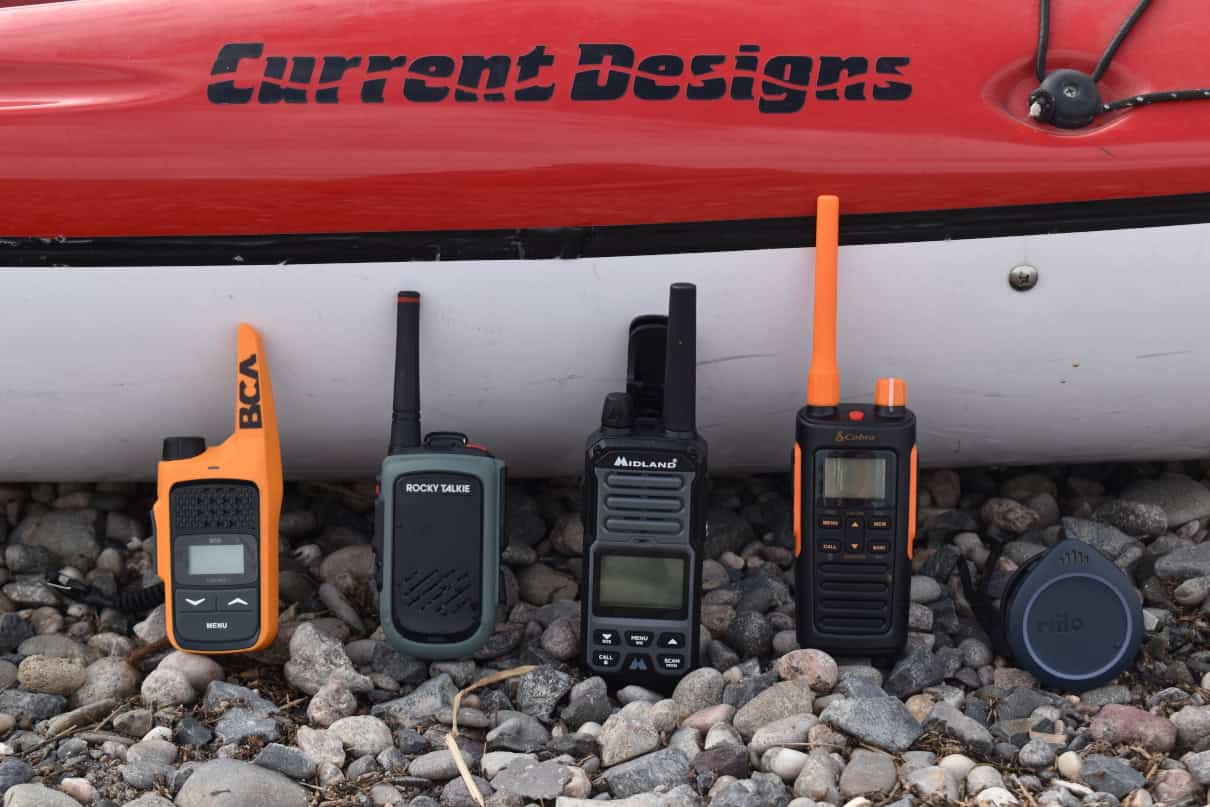
Choosing the right communication device depends entirely on your paddling environment, group size, and technical requirements. Here is a detailed breakdown of the top-performing units evaluated during field testing.
1. Best Overall Walkie-Talkie: Rocky Talkie Expedition Radio
- Price: $180 USD
- Power Output: 5 Watts
- Waterproofing: IP67 (Submersible to 3 feet for 30 minutes)
Why We Love It:
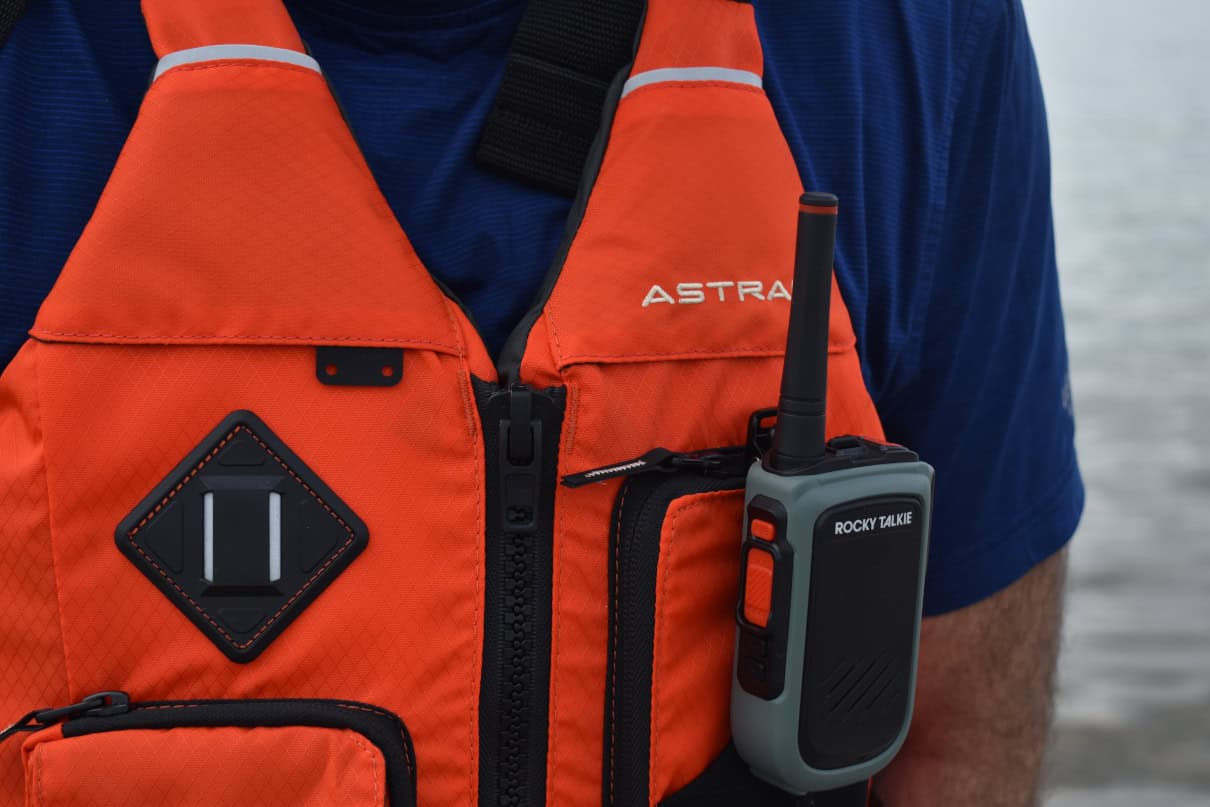
The Rocky Talkie Expedition Radio represents the gold standard for remote and whitewater paddling. Engineered specifically for harsh outdoor environments, it features a shatterproof LED screen, rugged housing, and an astonishing 4 to 6 days of battery life under normal operating conditions. With 5 watts of transmission power, its range adapts impressively to the terrain: yielding 0.5 to 3 miles in deep river canyons, 2 to 8 miles in mountainous terrain, and up to 35 miles under optimal line-of-sight conditions.
Furthermore, the inclusion of 8 GMRS repeater channels, a standard 17mm antenna, and support for an optional whip antenna allows users to significantly boost their transmission footprint. Integrated NOAA weather channels provide crucial early warnings for approaching squalls, high winds, and lightning storms.
- Trade-offs: The unit is relatively heavy, does not float on its own, requires an inexpensive and straightforward FCC GMRS license, and lacks voice-activated (VOX) transmission, meaning you must briefly take a hand off your paddle to transmit.
2. Most Compact Walkie-Talkie: Backcountry Access BC Link Mini
- Price: $119.95 USD
- Power Output: FRS Standard
- Waterproofing: IP55 (Splash and spray resistant)
Why We Love It:
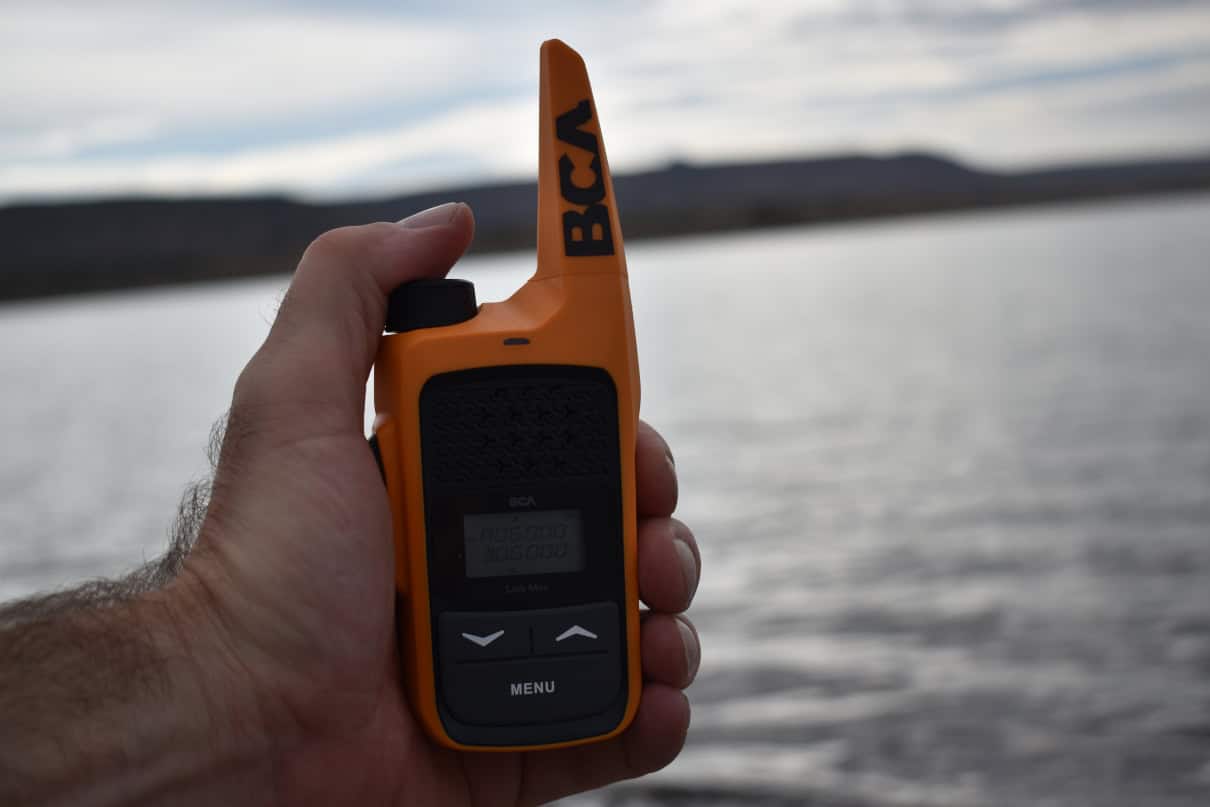
If weight and minimalist design are your top priorities, the BC Link Mini is the standout choice. Weighing in at a mere 6 ounces, this ultra-compact FRS radio feels completely natural in the hand and disappears comfortably on a PFD. Backcountry Access includes three versatile mounting options and a secure leash to ensure the radio stays anchored during a swim. Because it operates on the FRS band, no FCC license is required, and its intuitive interface makes it ready to use straight out of the box.
- Trade-offs: Primarily designed for backcountry skiing and snowboarding, the BC Link Mini features an IP55 water-resistance rating. While it easily shrugs off rain, spray, and light splashes, it is not built for submersion or heavy surf. Paddlers running technical whitewater or big-water rapids will need to store it safely inside a dry bag.
3. Best Voice-Activated (VOX) Radio: Midland GXT67 PRO
- Price: $219.99 USD
- Power Output: 5 Watts
- Waterproofing: IP67 Submersible
Why We Love It:
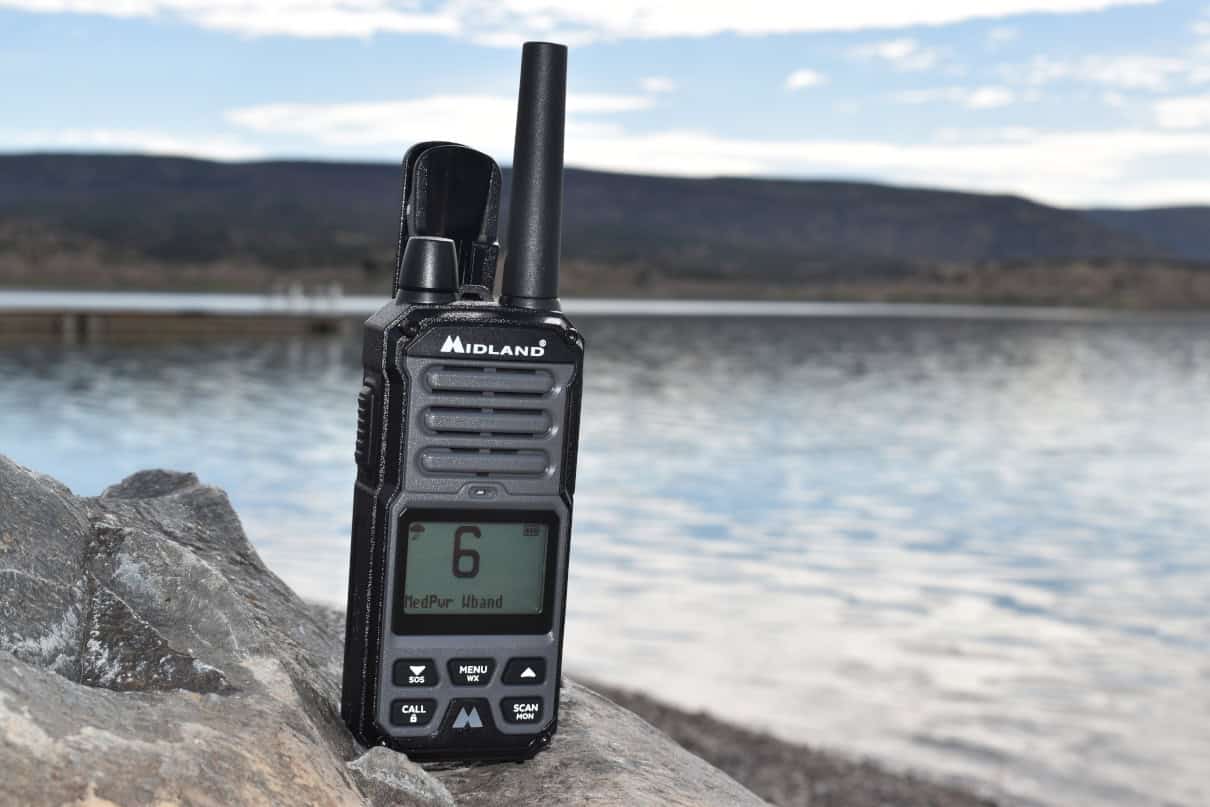
The Midland GXT67 PRO matches many of the premium specifications of the Rocky Talkie Expedition, but introduces a crucial upgrade for paddlers: hands-free VOX (Voice Operated eXchange) transmission. This feature automatically triggers the microphone the moment you speak, freeing up both hands to manage your paddle and boat through complex maneuvers—a major safety advantage over traditional push-to-talk models.
Additional features include an IP67 submersible rating, built-in NOAA weather alerts, and an automatic noise-cancelling microphone that cuts through environmental wind and rushing water noise. Operating at 5 watts on the GMRS band, it delivers a reliable 5-mile range in most conditions, with repeater capabilities for extended reach.
- Trade-offs: Like other heavy-duty GMRS units, it is somewhat bulky and requires an FCC license.
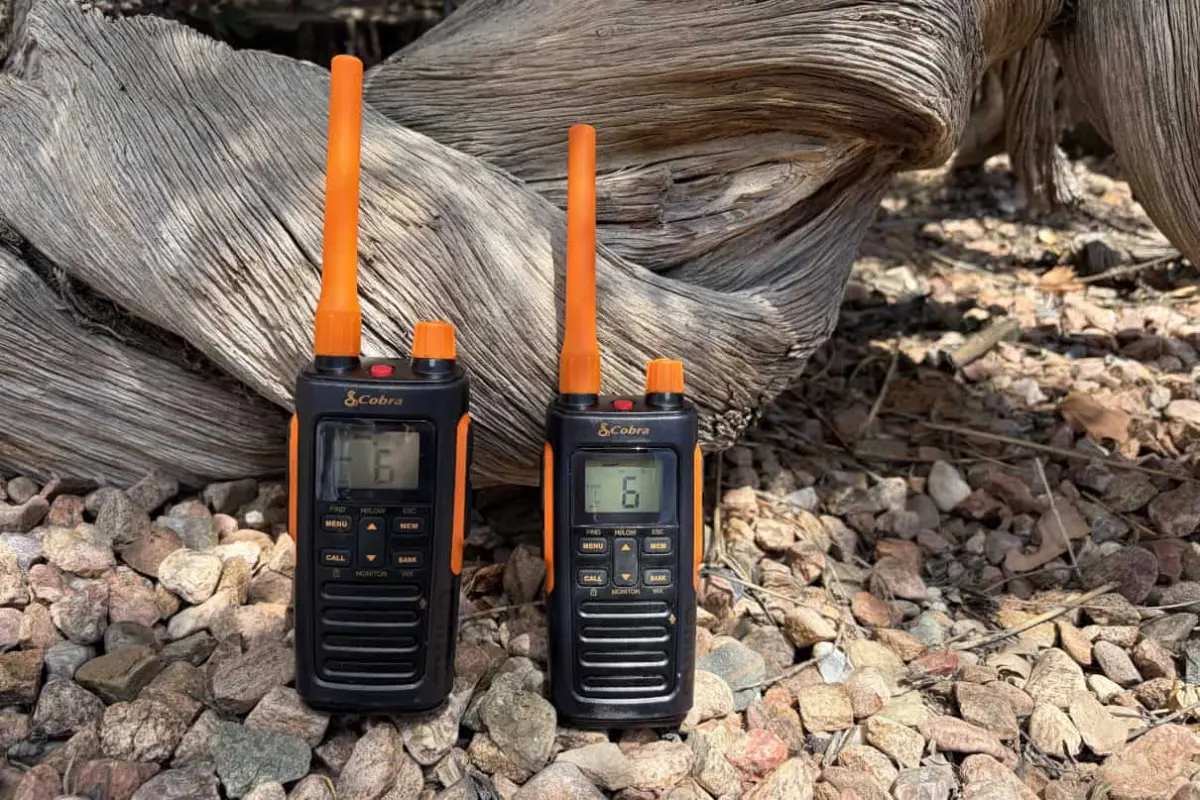
4. Best Budget GMRS Radio: Cobra Trailblazer 450
- Price: $129.95 USD (Pair)
- Power Output: 2.5 Watts
- Waterproofing: IP54 (Splash-resistant)
Why We Love It:
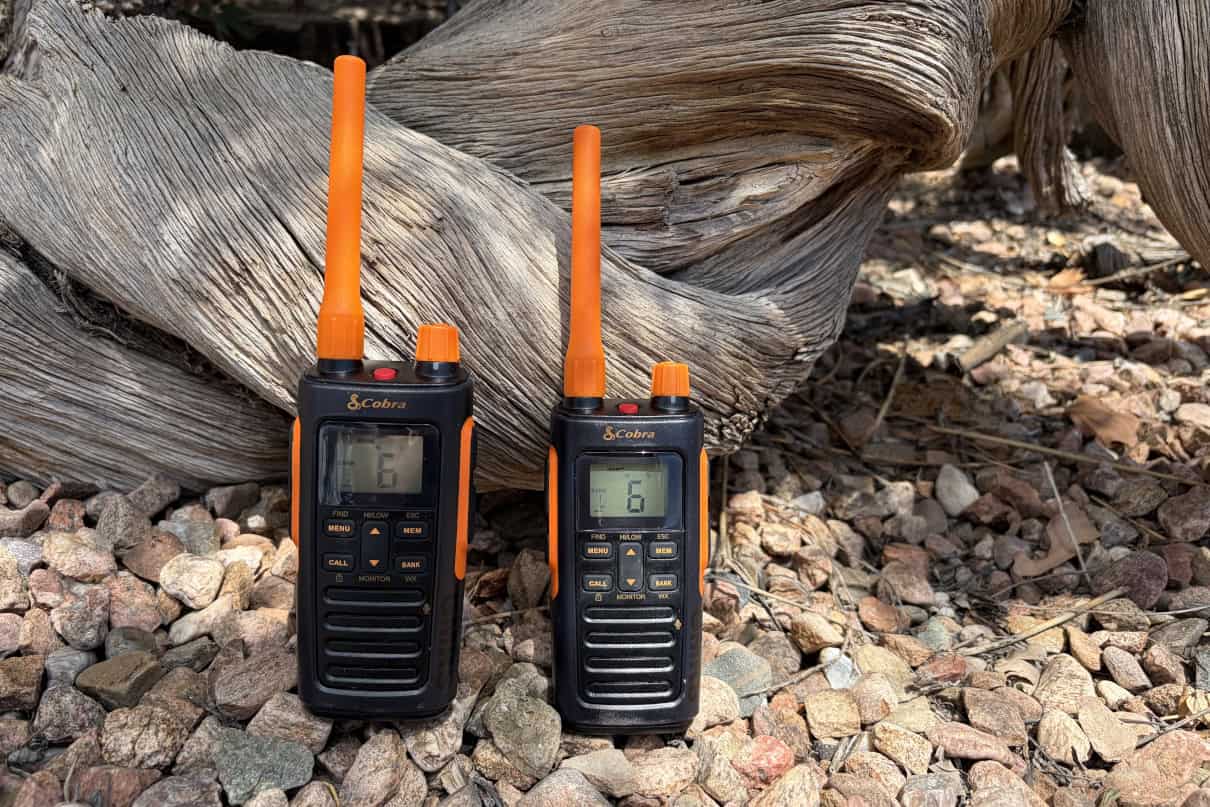
The standout attribute of the Cobra Trailblazer 450 is unbeatable value. Retailing at less than half the cost of competing GMRS systems, this radio lets you purchase a fully functional pair for less than the price of a single high-end unit. It features a removable antenna for repeater access, VOX hands-free capability, weather alert monitoring, and a lightweight chassis.
- Trade-offs: Operating at 2.5 watts of transmission power, it sits halfway between typical FRS radios and high-end 5-watt GMRS units. Its IP54 rating makes it splash-resistant rather than submersible, and its 16-hour battery life is sufficient for day trips but requires nightly recharging on multi-day expeditions.
5. Best Group Communicator: Milo Action Communicator
- Price: $249 USD
- Waterproofing: IP67 Submersible (with USB-C port sealed)
Why We Love It:
The Milo Action Communicator completely redefines on-water chatter. Rather than operating like a traditional walkie-talkie where users must take turns speaking and pushing buttons, the Milo creates a localized wireless mesh network. This allows an entire crew to speak and listen simultaneously—much like an open conference call on the water. Easily mounted to a PFD strap, paddle shaft, or collar, it is fully hands-free.
- Trade-offs: The primary limitation is range, which maxes out at approximately 600 meters. Because water surface reflections and low-slung kayak seating positions can attenuate radio signals, the Milo is best suited for groups that stay relatively clustered together.
Official Statements & Expert Guidance: Choosing the Right Standard
When navigating the complex world of two-way communication, industry experts and regulatory bodies emphasize several key distinctions that every paddler should understand.
FRS vs. GMRS: Demystifying the FCC License
Understanding the difference between FRS (Family Radio Service) and GMRS (General Mobile Radio Service) is essential before purchasing:
- FRS Radios: Operate at lower power limits (typically 2 watts or less), feature fixed antennas, and require no license. They are plug-and-play and ideal for casual, close-range group coordination.
- GMRS Radios: Offer higher power outputs (up to 5 watts or more), removable antennas, and access to repeater stations that dramatically extend communication range.
Many consumers are intimidated by the requirement for an FCC GMRS License. However, industry experts point out that the process is remarkably straightforward. As Jory Brass notes from personal experience, the online application takes roughly 20 minutes, costs a modest fee ($35 for a 10-year term), and covers your entire immediate family without requiring a technical exam.
Walkie-Talkies vs. Marine VHF Radios
A critical safety warning for all on-water explorers: Consumer walkie-talkies (FRS/GMRS) do not communicate with marine VHF channels.
While GMRS and FRS units are phenomenal for talking to your paddling partners within a river valley or lake basin, they cannot reach the VHF frequencies actively monitored by the U.S. Coast Guard, commercial vessels, and local harbor authorities. Therefore, consumer two-way radios should always be viewed as intra-group communication tools, not replacements for a dedicated handheld marine VHF radio in coastal or large-body maritime environments.
The Importance of VOX (Voice-Operated Exchange)
When your hands are locked onto a double-bladed paddle or a canoe sweep stroke, taking a hand off the shaft to press a push-to-talk (PTT) button can compromise your stability in moving water. Radios equipped with adjustable VOX technology solve this by transmitting audio automatically upon voice activation. While high winds can occasionally trigger sensitive microphones, modern noise-cancelling processors on units like the Midland GXT67 PRO filter out ambient environmental noise effectively.
Future Outlook: The Convergence of Mesh Networking and Outdoor Safety
As outdoor recreation technology continues to advance, the boundary between traditional radio transmission and digital mesh networking is blurring. Devices like the Milo Action Communicator point toward a future where group separation alerts, real-time spatial audio, and automated emergency beacon integration occur seamlessly without cellular coverage.
Simultaneously, traditional radio manufacturers are pushing the envelope of battery efficiency and durability, ensuring that solar charging, USB-C rapid charging, and shatterproof displays become standard across all price points.
Whether you are navigating the intricate maze of a coastal archipelago, tackling roaring Class IV whitewater in the desert Southwest, or simply keeping tabs on your family during a tranquil lake paddle, investing in a rugged, reliable communication tool is an indispensable upgrade to your safety kit. Choose the device that matches your group’s dynamic, respect the licensing requirements, and enjoy the peace of mind that comes with staying securely connected on the water.