









Executive Overview
For decades, the humble two-way radio has served as an essential tool for wilderness communication. From 1980s plastic G.I. Joe toys used to coordinate neighborhood games of capture the flag to modern, ruggedized, high-frequency devices, walkie-talkies have long bridged distances in the great outdoors. However, transitioning these devices from dry land to the unpredictable aquatic environment introduces an entirely new set of engineering challenges. Whitewater rapids, shifting shorelines, deep river canyons, and wide-open lakes demand gear that is not only durable and reliable, but purpose-built for the unique demands of kayaking, canoeing, and stand-up paddleboarding.
Over a rigorous two-month testing period across the rugged desert rivers and canyon reservoirs of the American Southwest, outdoor gear analyst Jory Brass put a curated selection of contemporary two-way radios and communication devices to the test. This evaluation explores gear engineered to withstand complete submersion, deliver multi-mile clarity in rugged topography, and provide reliable links when cell service is entirely absent.
While cell phones remain a valuable secondary tool, modern waterproof two-way radios are indispensable primary communication instruments for paddling partners scouting rapids, securing campsites, or managing group safety. This report examines the top-performing communication devices on the market, breaks down essential technical specs like IP ratings and FRS versus GMRS frequencies, and offers a definitive buying guide for paddlers seeking reliable on-water connectivity.

Detailed Chronology of the Field Test
To accurately judge how these communication systems perform under stress, the testing methodology moved far beyond standard bench checks. The evaluation took place across diverse real-world environments, spanning the foothills and high-altitude mountain ranges outside Albuquerque, New Mexico, as well as extended trips on desert waterways in New Mexico, Arizona, and Southern Utah.
Phase 1: Ergonomics and PFD Integration
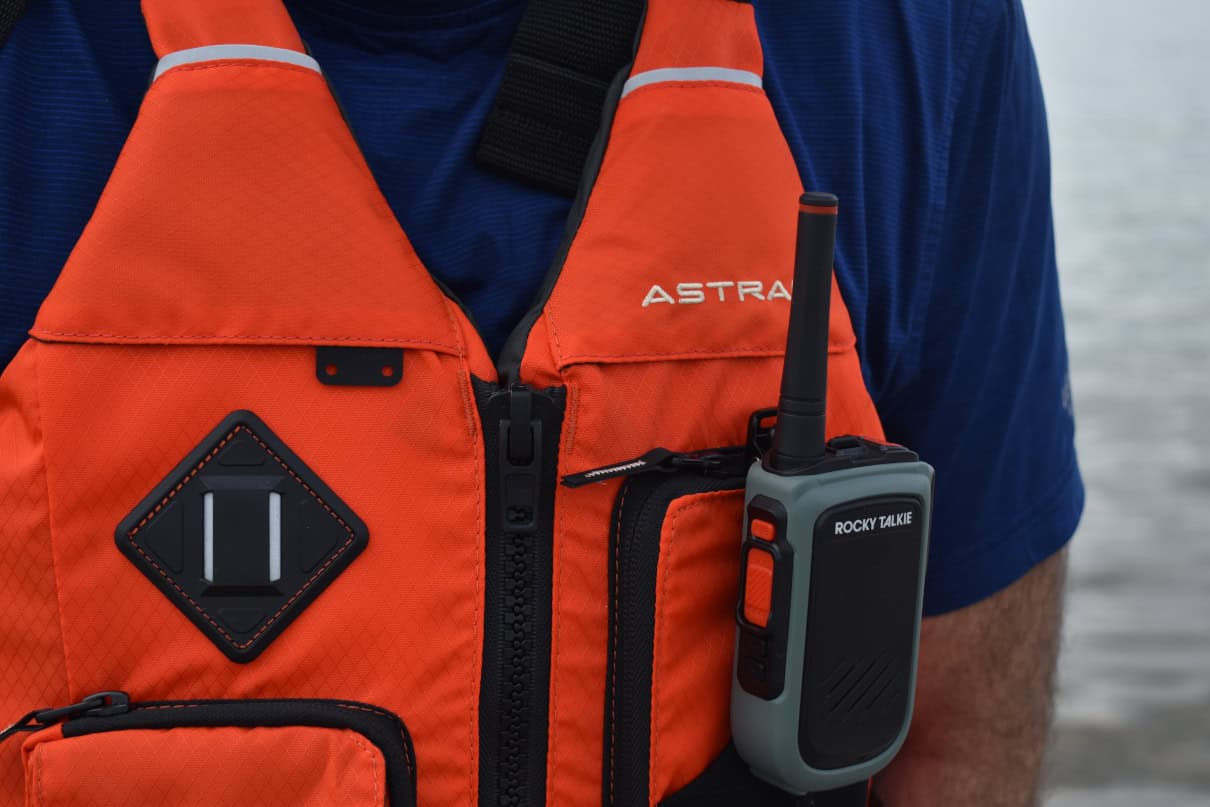
Initial bench and shoreline tests focused on form factor, weight, and mounting versatility. Testers evaluated how easily each device integrated with personal flotation devices (PFDs)—the central command hub for any paddler. Units were rated on how securely they attached, whether they included reliable lanyards or multi-way mounting hardware, and whether their buttons and screens could be manipulated easily with cold, wet fingers.
Phase 2: Range and Audio Clarity Trials
Next, the radios were subjected to varying line-of-sight and obstructed conditions. Testers paired units to gauge transmission reliability in dense canyons, across winding river bends, and against heavy background noise, such as rushing whitewater and persistent desert winds. Audio processing features, including automatic noise-cancelling microphones and voice-activated transmission (VOX) modes, were evaluated to see if they genuinely freed up a paddler’s hands or simply triggered false transmissions from wind gusts.
Phase 3: Water Resistance and Durability Stress-Tests
Because a wet paddler is an inevitability, water resistance was tested aggressively. Radios with official IP ratings were exposed to heavy deck spray, driving rain, and, where applicable, accidental or intentional submersions to simulate rolls in a kayak or swims in a rapid. Battery longevity was monitored over multi-day itineraries to establish real-world power retention against manufacturer claims.

Supporting Context & Metrics: The Contenders Reviewed
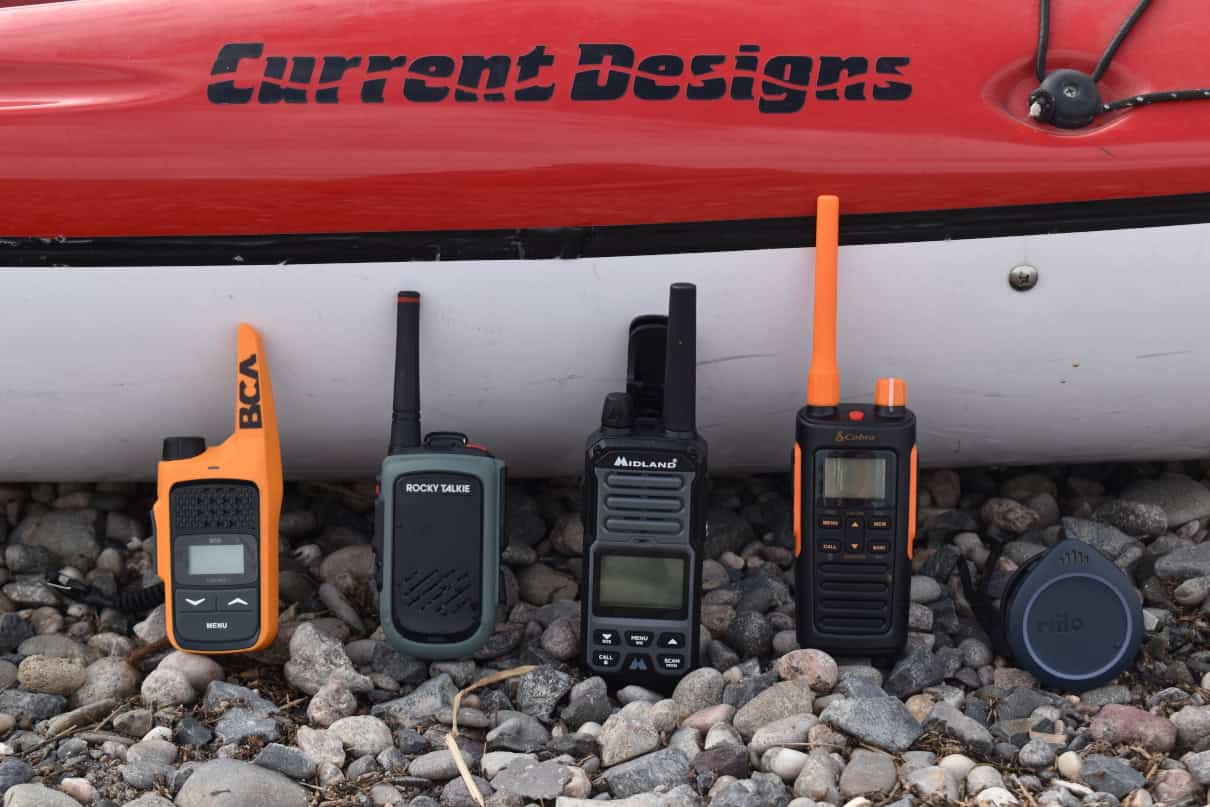
Following extensive field evaluations, several standout devices emerged as top recommendations for specific paddling disciplines.
Best Overall Walkie-Talkie: Rocky Talkie Expedition Radio
- Price: $180 USD
- Power Output: 5 Watts
- Waterproofing: IP67 (submersible to 3 feet for 30 minutes)
- Why it stands out: Combining rugged durability with exceptional battery life (4 to 6 days), the Rocky Talkie Expedition Radio is arguably the premier choice for expedition and whitewater paddlers venturing deep into remote country like the desert Southwest. It features a shatterproof LED screen, 5 watts of power, and access to 8 GMRS repeater channels. Range spans 0.5 to 3 miles in deep canyons and rivers, 2 to 8 miles in mountainous terrain, and up to 35 miles with perfect line-of-sight. It also integrates NOAA weather channels for real-time storm tracking.
- Trade-offs: It is relatively heavy, does not float, lacks hands-free VOX transmission (requiring manual push-to-talk operation), and requires an accessible, inexpensive FCC license.
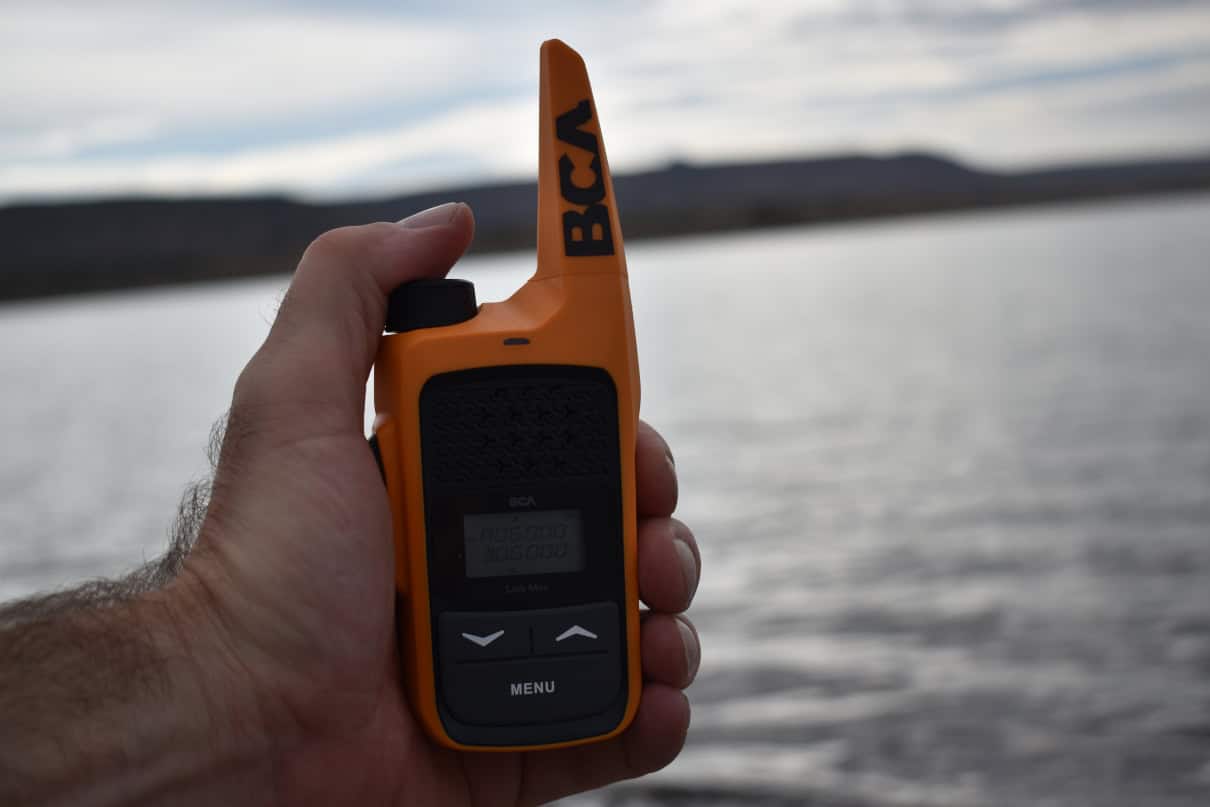
Most Compact Walkie-Talkie: Backcountry Access BC Link Mini
- Price: $119.95 USD
- Power Output: FRS standard (lower than GMRS)
- Waterproofing: IP55 (splash and spray-resistant)
- Why it stands out: Tipping the scales at a mere 6 ounces, the BC Link Mini is exceptionally light and compact, making it feel entirely natural in hand or mounted to a PFD via the three included attachment options and leash. Operating on the FRS frequency spectrum, it requires no FCC license, and its intuitive, out-of-the-box interface offers straightforward communication for recreational lake paddlers and flatwater canoeists.
- Trade-offs: With an IP55 rating, it can handle light rain and deck spray, but it cannot survive submersion or regular heavy waves. It must be stowed in a dry bag during technical whitewater.
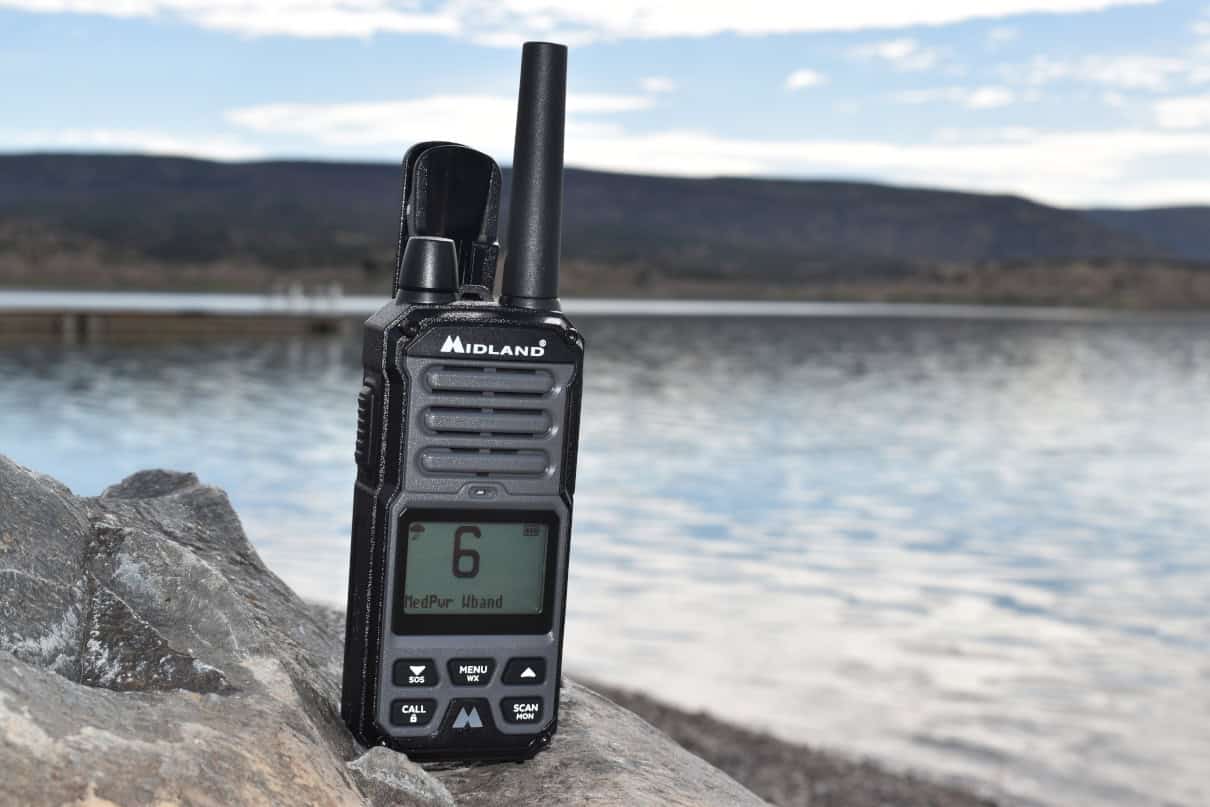
Best Voice-Activated Walkie-Talkie: Midland GXT67 PRO
- Price: $219.99 USD
- Power Output: 5 Watts
- Waterproofing: IP67 (submersible)
- Why it stands out: Mirroring the high-end durability and 5-watt power of premier adventure radios, the Midland GXT67 PRO adds hands-free VOX transmission. This allows paddlers to communicate without taking their hands off their paddle strokes—a major safety and convenience upgrade over traditional push-to-talk models. It also features an automatic noise-cancelling microphone and NOAA Weather Alert capabilities.
- Trade-offs: Like other heavy-duty GMRS units, it is bulkier than ultralight alternatives and requires an FCC license.
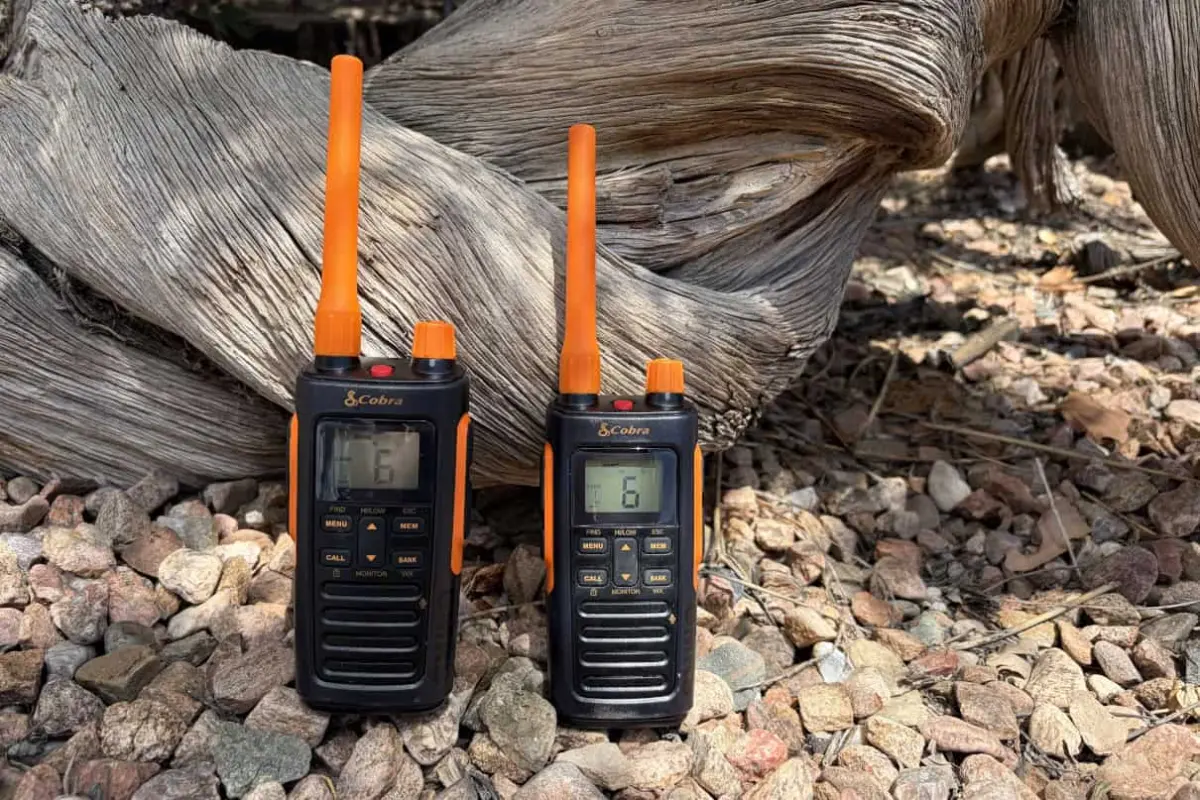
Best Budget GMRS Walkie-Talkie: Cobra Trailblazer 450
- Price: $129.95 USD
- Power Output: 2.5 Watts
- Waterproofing: IP54 (splash-resistant)
- Why it stands out: The Trailblazer 450 delivers GMRS functionality—including repeater access and a removable antenna—at a fraction of the cost of competing high-end radios. It includes hands-free VOX capabilities, weather alerts, and a lightweight frame that performed well in field testing.
- Trade-offs: It features a lower IP54 rating (splash-resistant, not submersible), a shorter 16-hour battery life, and a lower output (2.5 watts) than premium 5-watt GMRS units.
Beyond the Traditional Walkie-Talkie: Milo Action Communicator
- Price: $249 USD
- Power Output: Mesh network technology
- Waterproofing: IP67 (submersible with sealed USB-C port)
- Why it stands out: The Milo is not a traditional walkie-talkie; it is a wearable action communicator that creates a private mesh network, allowing an entire group of paddling partners to talk simultaneously. There are no buttons to push or channels to toggle—just sync the devices, mount them to your PFD or paddle, and converse naturally in a group chat. They are IP67 waterproof when ports are sealed and excel at close-range group coordination.
- Trade-offs: The operational range is capped at approximately 600 meters, which can be further shortened by sitting low to the water surface in a kayak. It is best suited for tight-knit groups that stay within sight of one another.
Technical Analysis: What to Consider When Buying
Selecting the right communication device requires understanding several core industry standards and regulatory frameworks.
1. Waterproof Ratings (IP Codes)
On the water, electronics face constant moisture threats. Always examine the Ingress Protection (IP) rating before purchasing:
- IP54 / IP55: Protected against dust and limited water splashes or spray. Suitable for flatwater touring and calm lake paddling, but vulnerable to heavy waves and immersion.
- IP67: Dust-tight and capable of surviving temporary immersion in water up to 1 meter (3 feet) deep for 30 minutes. The gold standard for whitewater and expedition kayaking.
- IP68: Rated for continuous immersion under pressure. (Note: None of the standard consumer walkie-talkies tested carry an IP68 rating).
2. FRS versus GMRS Frequencies
- FRS (Family Radio Service): Lower power output, shorter range, but license-free. Excellent for casual users who want simplicity out of the box.
- GMRS (General Mobile Radio Service): Higher power output (typically 5 watts), longer range, and the ability to utilize repeaters to bounce signals across long distances. An FCC license is required, though the application process is inexpensive, covers the entire family, and takes only minutes online.
3. Consumer Walkie-Talkies vs. Handheld VHF Marine Radios
A vital distinction must be made regarding who can be reached in an emergency. Consumer FRS and GMRS radios are designed strictly for peer-to-peer communication within a paddling party. They do not communicate on VHF (Very High Frequency) marine channels monitored by the U.S. Coast Guard, port authorities, or commercial vessels.
For coastal environments, massive lakes, or major commercial shipping rivers, a dedicated handheld VHF marine radio remains an essential safety device, while consumer walkie-talkies serve primarily as group coordination tools.
4. VOX Mode (Voice-Operated Exchange)
For paddlers, keeping both hands on the paddle is critical for boat control. Walkie-talkies equipped with VOX technology automatically broadcast when the user speaks, eliminating the need to reach for a push-to-talk button. However, users should be mindful that high winds and splashing water can occasionally trigger false transmissions.
Future Outlook: The Evolution of On-Water Safety Tech
As outdoor recreation continues to surge in popularity, the market for backcountry and on-water communication is evolving rapidly. Traditional boundaries between consumer radios, satellite messengers, and mesh-network communicators are beginning to blur.
Looking forward, manufacturers are placing increased emphasis on hybrid connectivity—devices that combine local mesh group chatter with satellite SOS capabilities, longer-lasting lithium-ion power banks, and even more resilient waterproofing standards. For paddlers navigating increasingly remote waters, investing in robust, water-safe communication gear is no longer an afterthought; it is a foundational element of responsible wilderness stewardship and group safety.