








September 8, 2026
Executive Overview
In the rapidly evolving landscape of marine electronics, digital switching and integrated control systems have shifted from high-end luxuries to baseline expectations for modern vessel owners. Leading this charge is Lumitec, a prominent designer and manufacturer of extreme-environment LED lighting solutions. The company has announced a significant technological leap for its flagship Poco Digital Lighting Control system: the introduction of the Channel Expander Feature.
This new firmware-driven enhancement fundamentally alters how marine lighting systems are architected. By enabling Poco modules to communicate dynamically over a standard NMEA 2000 (N2K) marine network, Lumitec has effectively bypassed the physical limitations of standalone hardware. Historically restricted by a maximum current capacity of 40 amps and four physical output channels per module, boat builders, marine electronics integrators, and yacht owners can now network multiple Poco units together.

The resulting architecture behaves as a single, highly scalable, and unified lighting ecosystem. For larger center consoles, multi-deck catamarans, and superyachts, this release solves a long-standing engineering bottleneck: how to deliver complex, high-amperage, multi-zone LED control without resorting to overly complex wiring harnesses or expensive, proprietary third-party digital switching matrices.
Detailed Chronology: The Evolution of Marine Lighting Control
To understand the significance of the Channel Expander release, it is necessary to examine the trajectory of marine lighting technology over the past two decades.
+---------------------------+     +---------------------------+     +---------------------------+
|    Legacy Analog Era      |     |   The Digital Transition  |     |   The Networked Future    |
|  - Heavy copper wire runs | --> |  - Poco System introduced | --> |  - Channel Expander (2026)|
|  - Mechanical switches    |     |  - Digital switching/MFDs |     |  - NMEA 2000 networking   |
|  - Limited zoning/colors  |     |  - 40A / 4-channel limits |     |  - Infinite scalability   |
+---------------------------+     +---------------------------+     +---------------------------+
The Analog Era (Pre-2010)
For decades, marine lighting was defined by simple, binary systems. High-draw incandescent and halogen fixtures required thick, heavy copper wiring run directly from the main DC distribution panel to physical toggle switches on the helm. Dimming was achieved through inefficient, heat-generating rheostats. Configuring custom "scenes" or zoning (e.g., dimming the cockpit while keeping the underwater lights at full brightness) required intricate, manual daisy-chaining of physical circuits.
The Rise of Smart LED and the Original Poco System (2010–2020)
The introduction of marine-grade LED fixtures revolutionized energy efficiency and durability, but it also introduced color-changing (RGB/RGBW) capabilities. To manage these multi-color, dimmable lights, marine manufacturers initially relied on proprietary remote controls or basic analog controllers.
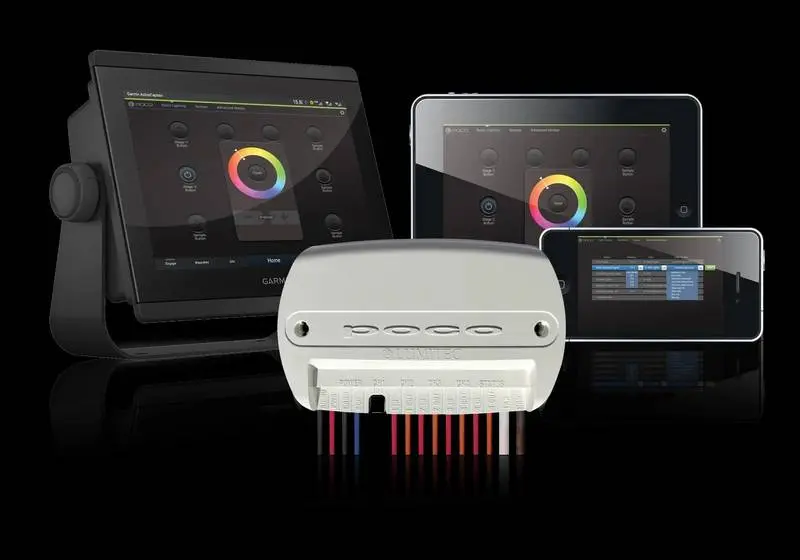
Lumitec disrupted this space with the launch of the Poco Digital Lighting Control system. By using digital power-line instructions (PLI), Lumitec enabled complex color-mixing and dimming commands to be sent directly over standard two-wire power lines. Users could control their entire lighting array via multi-function displays (MFDs) from industry giants like Garmin, Simrad, Lowrance, Raymarine, and Furuno. However, each Poco module was still a localized hub, limited to four independent channels and a maximum continuous current draw of 40 amps.
The Scalability Bottleneck (2021–2025)
As recreational vessels grew in size and complexity—exemplified by the rise of quad-engine mega-center consoles and luxury cruising catamarans—the demand for elaborate lighting arrays skyrocketed. A single modern vessel might feature:
- Multiple underwater lights
- Indirect deck and gunwale accent lighting
- T-top and hardtop downlights
- Cabin and companionway lighting
- Specialized baitwell and engine room utility lights
Powering and controlling these distinct zones pushed single-module systems to their physical limits. Integrators were forced to install multiple independent Poco modules, which operated as isolated islands. Users had to toggle between different control interfaces on their MFDs, disrupting the seamless luxury experience.
The 2026 Breakthrough: The Channel Expander Feature
Recognizing this integration friction, Lumitec’s engineering team developed the Channel Expander feature. By leveraging the existing NMEA 2000 network backbone already present on virtually all modern vessels, Lumitec transformed the Poco hardware from isolated control hubs into a collaborative, networked grid.
Technical Deep Dive: Supporting Context & Metrics
The core innovation of the Channel Expander feature lies in its communication protocol and system topology. Rather than requiring proprietary data cables, the system utilizes the standardized NMEA 2000 CAN bus protocol to share telemetry and command structures between modules.
Primary vs. Expansion Architecture
Under the new update, the system operates on a master-slave configuration, termed Primary and Expansion units:

- The Primary Module: Acts as the central brain of the lighting network. It hosts the user interface, stores the configuration profiles, connects directly to the vessel’s MFD or mobile app via Wi-Fi/Bluetooth, and processes all user inputs.
- The Expansion Module(s): Act as distributed power-distribution nodes. They receive synchronized commands from the Primary module via the NMEA 2000 bus and execute them across their local physical channels.
                      +-----------------------------+
                      |   Multi-Function Display    |
                      |   (Garmin, Simrad, etc.)    |
                      +--------------+--------------+
                                     |
                                     v
                      +-----------------------------+
                      |    Primary Poco Module      |
                      | (System Brain & UI Host)    |
                      +--------------+--------------+
                                     |
                             [ NMEA 2000 Bus ]
                                     |
            +------------------------+------------------------+
            |                                                 |
            v                                                 v
+-----------------------------+                 +-----------------------------+
|   Expansion Poco Module A   |                 |   Expansion Poco Module B   |
|   (4 Channels / 40A Max)    |                 |   (4 Channels / 40A Max)    |
+-----------------------------+                 +-----------------------------+
Mitigating Voltage Drop and Simplifying Wiring
One of the most significant engineering advantages of this networked approach is the reduction of voltage drop and overall wire weight.
In a traditional centralized wiring scheme, all lighting wires must run from the lights back to a central electrical panel, often located in the console or cabin. For lights located at the extreme bow or stern (such as underwater lights or anchor lights), these long wire runs require heavy-gauge wire to prevent voltage drop over distance.
With the Channel Expander feature, builders can mount an Expansion Poco module close to the physical load (e.g., one in the transom for underwater and cockpit lights, and another in the bow for forward deck lights). These modules only require a short, localized run to a nearby high-amperage DC bus bar and a connection to the local NMEA 2000 backbone. This distributed power architecture significantly reduces the physical weight of copper wire onboard, lowers installation labor times, and improves overall electrical efficiency.
Key System Metrics Comparison
| Feature/Specification | Legacy Poco System (Single Module) | Networked Poco System (With Channel Expander) |
|---|---|---|
| Max Control Channels | 4 physical channels | Scalable (4 channels per added module) |
| Max System Amperage | 40 Amps continuous | Scalable (40 Amps per added module) |
| Network Protocol | Standalone / Direct MFD connection | NMEA 2000 (CAN bus) integrated |
| Wiring Topology | Centralized (Long wire runs) | Distributed (Localized power nodes) |
| Control Interface | Single UI per module | Unified single-screen UI for all modules |
| Installation Profile | Ideal for vessels under 30 feet | Ideal for vessels 30 to 100+ feet |
Industry Impact: Official Statements & Market Reception
The release of the Channel Expander feature has drawn praise from marine electronics integrators and boat builders (OEMs), who are constantly seeking ways to simplify manufacturing processes while delivering premium consumer experiences.
The Builder’s Perspective
A lead electrical engineer at a premier center-console manufacturing facility noted the manufacturing efficiencies gained by the update:
"In the past, when designing the electrical layout for our 45-foot offshore models, we had to carefully budget our lighting loads. If a customer opted for high-output underwater lights alongside extensive indirect cabin and deck lighting, we would quickly exceed the 40-amp limit of a single digital controller. This forced us to split the system into two distinct interfaces, which was confusing for the end-user.
With Lumitec’s new Channel Expander, we can place one module in the console, one in the bilge, and one in the hardtop. The customer sees one seamless control screen on their Garmin display, while our rigging team saves dozens of hours in wire-pulling and cabin-routing."
The Integration and Service Sector
Marine electronics installers also benefit from the ease of retrofitting existing vessels. A certified National Marine Electronics Association (NMEA) installer commented on the diagnostic advantages:
"NMEA 2000 integration is the holy grail for marine service technicians. By putting the lighting control system on the N2K bus, diagnosing issues becomes significantly easier. We can quickly verify if a module is communicating with the network, check voltage levels, and isolate faults without tearing apart wire bundles behind the helm. Lumitec has made digital switching highly accessible to mid-tier vessels, not just custom superyachts."
Future Outlook: The Next Phase of Marine Digital Switching
The introduction of network-enabled channel expansion signals a broader trend in the marine industry: the convergence of lighting, power management, and the Internet of Things (IoT).
As vessels become smarter, the demand for contextual automation will increase. Industry analysts predict that the next logical step for networked systems like Poco will involve integration with onboard sensor arrays. For example:
- Geofencing & Time-of-Day Automation: A vessel returning to its slip at dusk could automatically trigger a "docking scene," illuminating underwater lights, boarding steps, and cleat areas as soon as the GPS coordinates match the home marina.
- Safety & Security Integration: Integrating the Poco system with onboard security systems (such as Siren Marine or Yacht Sentinel) could allow the lighting system to flash strobe patterns or red warning lights if an bilge high-water alarm or unauthorized entry sensor is triggered.
- Advanced Power Management: In low-battery or "silent-running" generator modes, the primary Poco module could automatically communicate with the vessel’s power management system to shed non-essential lighting loads, preserving battery life for critical navigation electronics.
By building on the robust, open-standard foundation of NMEA 2000, Lumitec has positioned the Poco platform to easily adapt to these future software-defined capabilities. The Channel Expander feature is not merely an incremental update; it is a foundational architectural shift that ensures Lumitec remains at the forefront of marine lighting control for years to come.