









Executive Overview
In the rapidly evolving landscape of global hospitality, luxury is undergoing a fundamental recalibration. For decades, premium and upscale hotel brands have largely adhered to a standardized Western formula—imposing uniform markers of opulence, sprawling open-plan atriums, and heavy-handed decorative motifs across continents. Today, however, a new paradigm is taking shape. Modern travelers, particularly in Asia, are seeking depth over excess, emotional restoration over visual spectacle, and authentic cultural resonance over homogenized grandeur.
Enter the Grand Ji Hotel, the premier upscale hotel brand launched by H World Group, one of the world’s largest and most prolific hospitality powerhouses. Operating a global portfolio that exceeds 13,000 hotels—including massive household names like JI Hotel and Hanting—H World is bringing a distinctly Chinese design philosophy and aesthetic to the forefront of premium hospitality.
Rather than treating local culture as an afterthought or a superficial design accessory, Grand Ji Hotel is built around a contemporary interpretation of traditional Chinese aesthetics, spatial psychology, and refined hospitality. Grounded in five natural anchors—water, clouds, tea, pine, and stone—the brand focuses intensely on elements that modern urbanites crave most: privacy, uncompromising quiet, sensory grounding, and frictionless, background technology.

With two flagship properties totaling 441 rooms already operational and an additional 18 properties rapidly advancing through its pipeline, Grand Ji Hotel represents more than just a new commercial offering. It is a calculated blueprint for how a homegrown Chinese hotel conglomerate can leverage its colossal operational scale, cutting-edge supply chain infrastructure, and modular design capabilities to scale a culturally nuanced concept without diluting its intimate soul. This is the story of how H World Group is setting new benchmarks in premium hospitality and scripting a new chapter in the global hotel industry.
Detailed Chronology: The Genesis and Evolution of Grand Ji Hotel
The conceptualization of Grand Ji Hotel did not happen in a vacuum; it is the culmination of years of market maturation, shifting consumer expectations, and H World’s strategic ambition to capture the upper tiers of the hospitality market.
Phase 1: Identifying the Shift in Consumer Desires
As China’s domestic travel market matured following decades of rapid urbanization, H World Group recognized a critical psychological shift among its consumer base. Premium travelers were no longer impressed by ostentatious displays of wealth or oversized public spaces. Instead, post-pandemic fatigue, information overload, and dense urban living created a desperate market demand for mental respite, personal space, and emotional calm.
H World enlisted Kuang Ming (Ray) Chou, founder and creative director of Vermilion Zhou Design Group and chief designer at H World Group, to spearhead the aesthetic and structural philosophy of the new brand. Chou and his team began dissecting the core elements of modern hospitality, asking a radical question: What does true luxury feel like when stripped of unnecessary noise?

Phase 2: Translating Philosophy into Physical Form
The conceptual phase moved rapidly from abstract ideas to tangible spatial strategies. The design team anchored the brand identity in five fundamental natural elements: water, clouds, tea, pine, and stone. Crucially, these elements were not treated merely as decorative themes, but as functional guidelines for spatial planning, material selection, and guest interaction.
By mid-2024, the structural framework was finalized, paving the way for the opening of the first pilot properties. The focus shifted to engineering a hospitality model that could merge boutique-level design nuance with industrial-scale execution.
Phase 3: Commercial Debut and Expansion (2025–2026)
By the end of June 2026, H World successfully opened its first two Grand Ji Hotels, yielding a combined inventory of 441 rooms. These initial properties served as living laboratories, proving that the brand’s design ethos—characterized by low boundary walls, compressed tea-leaf transition bricks, and subtle spatial partitions—resonated powerfully with discerning travelers.
Simultaneously, the brand’s robust development pipeline kicked into gear. With 18 additional properties currently under development, H World is actively transitioning Grand Ji Hotel from an innovative design concept into a scalable, highly repeatable commercial hotel model.
Supporting Context & Metrics: Scale, Supply Chain, and Market Position
Translating an intricate, culturally sophisticated boutique concept into a scalable chain is a challenge that has tripped up many major hotel groups. However, Grand Ji Hotel derives its competitive advantage from the colossal industrial machinery and operational muscle of its parent company, H World Group.
Unmatched Global Scale
To understand the viability of Grand Ji Hotel, one must look at the sheer magnitude of H World’s network. As of June 30, 2026, the company commanded an astonishing operational footprint:
- Global Portfolio: 13,539 hotels in operation worldwide.
- Room Count: Over 1.3 million rooms managed globally.
- Pipeline: An additional 3,089 hotels currently in development.
- Upper-Midscale Dominance in China: In the second quarter of 2026 alone, H World boasted 1,738 upper-midscale hotels either open or in the pipeline—representing a robust year-over-year growth of more than 13%.
Furthermore, H World’s dominance is internationally recognized. In the prestigious Hotels Magazine annual ranking for 2026, H World’s flagship economy and midscale brands, JI Hotel and Hanting, claimed the first and second spots globally by room count, respectively.
Modular Construction and Supply Chain Integration
Scaling a brand defined by fine craftsmanship requires more than artistic vision; it requires industrial precision. H World achieves this through sophisticated supply chain integration and modular design methodologies.
By manufacturing complex architectural and interior elements in controlled factory environments before delivering them to construction sites, H World ensures rigorous quality control and simplifies on-site assembly. This approach drastically reduces maintenance friction and guarantees that a Grand Ji Hotel in a bustling northern metropolis like Harbin retains the exact same sensory atmosphere, spatial proportions, and material integrity as a property in the tropical resort city of Sanya.
Official Statements & Design Philosophy: Inside the Mind of Ray Chou
To fully grasp the ethos of Grand Ji Hotel, one must examine the guiding principles articulated by its chief architect, Ray Chou. In extensive discussions with Skift Studio, Chou elaborated on the psychological dimensions of modern luxury and the cultural foundation driving the brand.
Redefining Premium: Quality Over Quantity
"Premium guests today don’t necessarily want more," Chou stated flatly. "They want better."
This philosophy directly challenges the traditional American or European luxury models that often equate value with sprawling rooms, heavy marble surfaces, and an abundance of service touchpoints that can sometimes feel intrusive. At Grand Ji Hotel, luxury is measured by absence—the absence of noise, visual clutter, and unnecessary friction.

Spatial Psychology and the Architecture of Privacy
In an unfamiliar environment, modern travelers experience subtle forms of anxiety. Chou noted that Chinese travelers, in particular, are increasingly sensitive to interpersonal distances:
"Chinese travelers today care much more about the distance between people, especially in an unfamiliar environment."
To counteract this, Grand Ji Hotel abandons the sprawling, fully open-plan lobbies common in contemporary hotels. Instead, the design utilizes delicate light partitions in high-traffic zones such as the lobby, breakfast areas, and fitness centers. These partitions create psychological and physical boundaries, allowing guests to navigate shared spaces without feeling exposed to strangers.
Sensory Cultural Immersion
The brand’s reliance on nature is deeply rooted in traditional Chinese epistemology.
"We are not trying to put Chinese symbols everywhere and say, ‘Look, this is Chinese,’" Chou explained. "We are trying to go back to nature, and to the Chinese way of understanding nature."
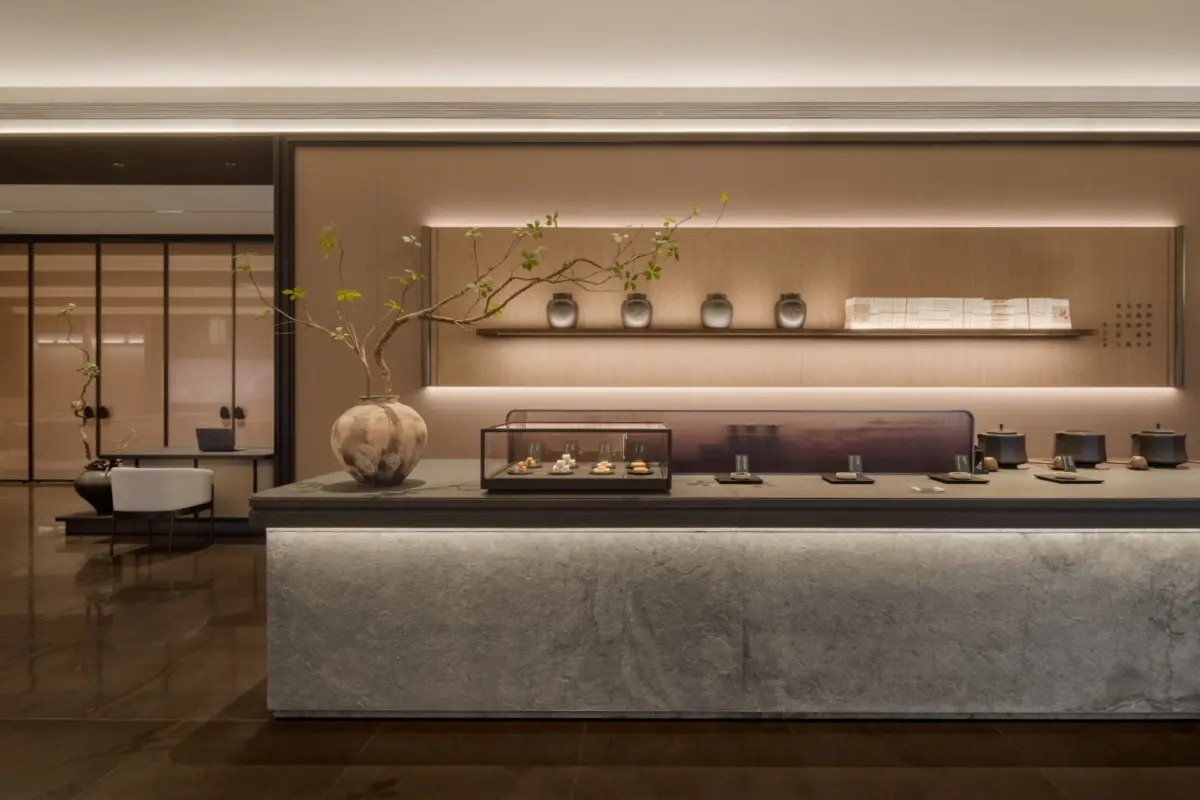
This commitment manifests immediately upon arrival. Guests bypass sterile, transactional front desks and are instead greeted by a long, communal tea table where freshly brewed tea is prepared and offered. For domestic guests, this invokes a comforting sense of home; for international visitors, it serves as a gentle, non-verbal introduction to Chinese hospitality.
This sensory integration extends to the dining experience. Grand Ji’s breakfast offerings deliberately pair international hotel staples with authentic Chinese comfort foods, featuring hot, steaming soups and traditional dishes.
"For me, culture should not just be something hanging on the wall," Chou emphasized. "You should be able to eat it, smell it, sit inside it, live inside it."
The Sanctuary of Quiet
Perhaps the most radical departure from standard hotel design is Grand Ji’s obsession with acoustic and mental tranquility. Acknowledging that contemporary urbanites suffer from digital fatigue and chronic stress, Chou asserts that the fundamental purpose of a hotel has been lost in modern commercialization:
"I think we are living in an age of too much information. When you are not quiet inside, when you are anxious or afraid, you cannot really rest… For me, the first principle of a hotel is actually sleep."
The journey to tranquility begins outside the building. A low exterior stone wall blocks direct lines of sight from the street, compelling arriving guests to slow their pace and walk alongside a welcoming pine installation. Transitional entryways incorporate architectural bricks compressed from spent tea leaves, releasing a subtle, earthy aroma before the lobby even opens up.
Inside, the palette relies on negative space, subdued earth tones, and restrained proportions. The psychological impact is immediate and behavioral: without a single staff member requesting silence, guests instinctively lower their voices upon entering a Grand Ji Hotel.
Invisible Technology
In an era where hotels race to install flashy, gimmick-heavy smart rooms, Grand Ji takes a refreshingly minimalist approach to technology. While guests can seamlessly unlock doors via mobile devices, control room ambiances through voice commands, and receive amenity deliveries via autonomous robots, the technology is strictly kept behind the scenes.
"I don’t want technology to become the main character," Chou noted. When an autonomous delivery robot brings a bottle of water to a guest room, it achieves operational efficiency while safeguarding guest privacy—eliminating the need for a staff member to knock. Technology, in Chou’s vision, should "disappear beside you," leaving the spotlight firmly on human comfort, natural materials, and sensory well-being.
Future Outlook: Setting New Standards in a Changing World
As Grand Ji Hotel looks toward the horizon, it occupies a fascinating crossroads in the global hospitality market. The brand represents a broader cultural phenomenon that industry analysts are increasingly referring to as the "Chinese Renaissance"—a profound, self-assured re-evaluation of indigenous aesthetics, philosophies, and ways of living, adapted meticulously for the contemporary global citizen.
+-------------------------------------------------------------------+
                   GRAND JI HOTEL STRATEGIC PILLARS
+-----------------------+-------------------------------------------+
| Spatial Philosophy    | Privacy, light partitions, negative space |
| Cultural Anchors      | Water, clouds, tea, pine, and stone       |
| Operational Backbone  | H World scale, modular design, supply chain|
| Technological Approach| Invisible, friction-reducing automation   |
| Core Objective        | Rest, restoration, and acoustic calm      |
+-----------------------+-------------------------------------------+
A hotel, as Chou aptly observes, is a microcosm of a culture: "It is how you live. How you eat. How you welcome people. How you sit together. How you keep distance. How you use color. How you understand space."
The ultimate test for Grand Ji Hotel over the coming years will not be whether it can design one stunning flagship property, but whether H World Group can relentlessly preserve these intimate, meticulous details as the portfolio scales from 20 properties to hundreds across the globe.
If H World can successfully maintain this delicate balance between hyper-scaled industrial efficiency and deeply boutique cultural nuance, Grand Ji Hotel will do far more than just expand the company’s footprint. It will fundamentally redefine how the world perceives upscale hospitality, proving that a Chinese hotel brand can establish global standards of luxury entirely on its own terms.
To learn more about H World Group’s expanding global portfolio and innovative hospitality strategies, visit ir.hworld.com.