








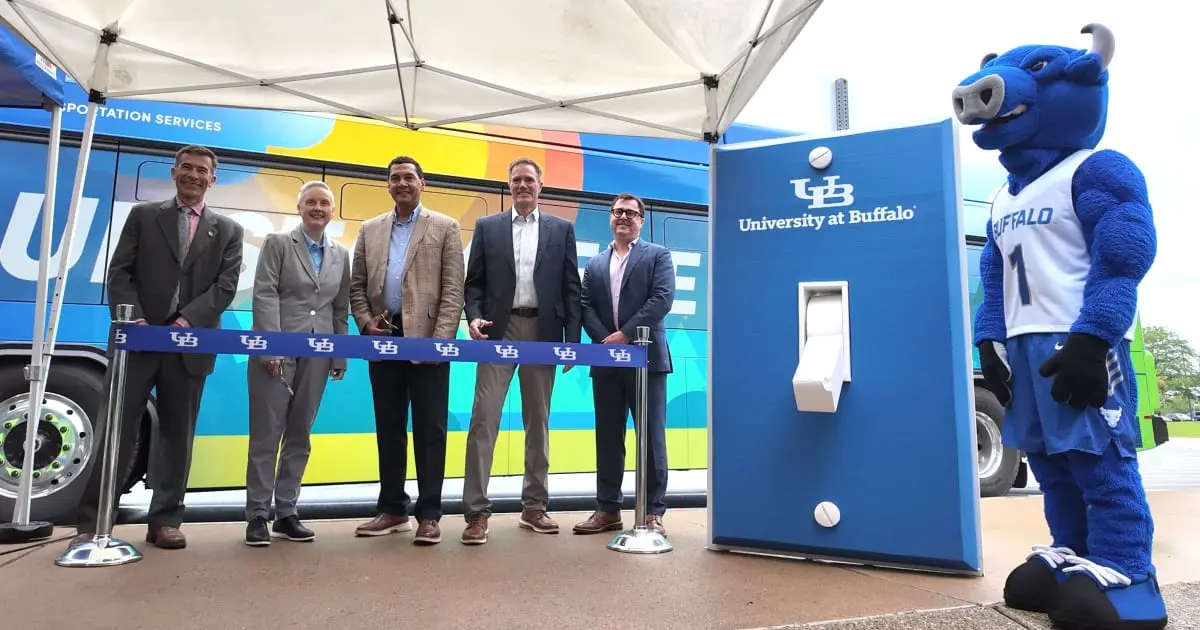
BUFFALO, N.Y. — In a landmark development for higher education transit and municipal sustainability, the University at Buffalo (UB) has officially deployed its first cohort of 40-foot battery-electric buses into active daily service. Marked by an official unveiling attended by students, university leadership, and local municipal officials, this rollout represents a pivotal moment in UB’s aggressive roadmap to eliminate fossil fuels from its campus transit operations.
The introduction of these zero-emission vehicles marks the very first phase in phasing out the university’s legacy diesel fleet. Delivered through a high-stakes, collaborative partnership with transportation solutions provider WeDriveU and fleet electrification specialist Zenobē, the deployment turns years of strategic environmental planning into a tangible, daily reality for the university community.
As higher education institutions nationwide face mounting pressure to decarbonize their infrastructure while maintaining high-volume commuter services, UB’s execution of this project offers a masterclass in modern fleet electrification. By fusing academic vision, operational transit expertise, and advanced charging infrastructure, the university is actively rewriting the standard for sustainable campus mobility.
Executive Overview
The scale of the University at Buffalo’s transportation network is massive. The UB Stampede, the university’s primary campus shuttle service, carries an estimated 16,000 passengers daily, acting as the vital connective tissue between sprawling campus zones, residential housing, and academic buildings.
For decades, this critical artery relied entirely on internal combustion engines. However, under the banner of its ambitious “10 in 10” roadmap—a strategic climate initiative designed to achieve a completely zero-emissions campus by 2030—UB has committed to systematically replacing every diesel bus in the Stampede fleet over the next four years.
The arrival of the first eight battery-electric buses is not merely a symbolic green gesture; it is an engineered infrastructure overhaul. Supported by ten dedicated high-powered charging stations at WeDriveU’s Buffalo customer service facility, the project is projected to slash Stampede greenhouse gas emissions by 55.6%. In concrete terms, this transition will avoid 5,984 metric tons of carbon dioxide equivalent ($textCO_2texte$) emissions, an environmental impact roughly equivalent to removing 1,395 passenger cars from public roads permanently.
For Christopher Austin, Director of Parking and Transportation Services at UB, the launch bridges the gap between long-term theoretical planning and immediate operational execution.

"As part of our Climate Action Plan, this is an important milestone because it moves our sustainability goals from planning into daily operation," Austin stated during the deployment ceremony. "Students and staff can now see and experience that transition every day as they move around campus."
Detailed Chronology: From Strategy to Maiden Voyage
The successful launch of UB’s electric fleet is the culmination of a meticulously managed timeline that required deep cross-sector collaboration, logistical foresight, and uncompromising operational standards.
June 2024: Cementing the Partnership
The structural foundation of today’s success was laid in June 2024, when the University at Buffalo officially announced its selection of WeDriveU to manage and operate its comprehensive campus transportation network. Recognizing that transitioning a high-frequency transit system from diesel to electric requires specialized competencies far beyond standard bus procurement, UB formed a tripartite alliance.
The partnership capitalized on three distinct pillars of expertise:
- The University at Buffalo: Provided institutional vision, campus community insights, and alignment with overarching institutional sustainability targets.
- WeDriveU: Contributed day-to-day operational knowledge, route logistics, workforce management, and transit execution capabilities.
- Zenobē: Brought specialized fleet electrification engineering, charging architecture design, and intelligent power-management technologies.
The Engineering of the Depot
Transitioning to electric mobility is rarely as straightforward as swapping a diesel tank for a battery pack. Long before the first 40-foot bus touched campus asphalt, project engineers had to solve complex grid, spatial, and logistical equations.
The project team focused heavily on the ecosystem surrounding the vehicle. This included calculating precise charging windows, evaluating the regional electrical grid capacity, and provisioning the local bus yard with scalable power capabilities. Ten state-of-the-art chargers were installed at WeDriveU’s Buffalo depot, thoughtfully positioned to accommodate immediate charging protocols while engineered to scale seamlessly as more diesel buses are retired over the next four years.
"Electrification isn’t simply a matter of replacing a diesel bus with an electric one," Austin explained. "You have to think about the entire operating system around the vehicle: where and when buses charge, how charging fits around daily service, the power available at the yard, and how the infrastructure will support additional electric buses as the fleet grows."
Critically, the project was intentionally designed around the immutable realities of the existing Stampede operating schedule. Rather than forcing the transit operations to bend to the limitations of nascent battery technology, engineers reverse-engineered the charging workflows to match peak commuter hours, route lengths, and turnaround frequencies.
Deployment and Inauguration
Following rigorous testing, driver training, and depot integration, the eight battery-electric buses officially entered rotation on the UB Stampede network. Surrounded by students, faculty, and local dignitaries, the maiden voyage marked a cultural and operational turning point for Western New York higher education transit.
Supporting Context & Metrics: The Math Behind the Mission
The imperative to electrify heavy-duty transit fleets is heavily underlined by quantifiable environmental and operational metrics. In the case of the University at Buffalo, the numbers paint a compelling picture of immediate impact and long-term viability.
Environmental Impact Analysis
Transportation remains one of the largest contributors to global carbon emissions. By tackling the high-mileage, stop-and-start routes characteristic of university shuttles, UB is targeting some of the most emissions-heavy transit cycles in the region.
- Emissions Reduction: The initial deployment and subsequent four-year rollout will eliminate 5,984 metric tons of $textCO_2texte$.
- Percentage Drop: Greenhouse gas emissions tied directly to the Stampede service will plummet by 55.6% compared to baseline diesel operations.
- Equivalency: The carbon savings match the annual emissions output of taking nearly 1,400 traditional internal-combustion passenger vehicles off the highway.
Intelligent Fleet Management via Zenobē
Maintaining vehicle reliability across a fleet handling 16,000 daily passenger trips requires sophisticated software and hardware integration. To prevent range anxiety and unexpected vehicle downtime, Zenobē integrated an advanced operational management suite into the Buffalo depot.
The system features:
- Real-Time Monitoring: Constant telemetry tracking charger performance, electrical draw, and equipment health 24 hours a day, 7 days a week.
- Optimized Charging Schedules: Automated algorithms that dictate when buses plug in, ensuring vehicles are charged during optimal utility-rate windows without interfering with morning and evening peak commuter rushes.
- Dynamic Load Management: Smart software designed to balance the physical power available at the depot against the massive electrical demands of multiple 40-foot buses charging simultaneously, preventing local grid strain and minimizing utility demand charges.
This technological backbone provides the operational transparency required to run a zero-emission network with the exact same reliability as traditional fossil-fuel vehicles.
Official Statements and Leadership Perspectives
The success of the UB-WeDriveU-Zenobē partnership has drawn praise from key stakeholders across the private and public sectors, highlighting the collaborative spirit required to drive modern clean-energy transformations.
Christopher Austin (Director of Parking and Transportation Services, UB):
"At the same time, we need to continue providing the safe, reliable transportation our campus community depends on while reducing our environmental impact. These first eight buses show that those goals can go hand in hand… For riders, our goal is for that transition to feel seamless: they’ll see more electric buses entering the Stampede fleet, but the expectation for safe and reliable service doesn’t change."
Matt Curwood (VP of Business Development for Transit, Zenobē North America):
"Fleet operators and institutions need confidence that their electric buses will be ready to perform every day. Zenobē’s giving that certainty through thoughtful planning, reliable charging infrastructure, and long-term operational support."
Tim Wayland (Chief Commercial Officer, WeDriveU):
"We’re proud to provide the University at Buffalo community with safe, dependable, and innovative transportation solutions and congratulate UB on this incredible achievement. Together with UB, Zenobē, and WeDriveU’s local operations team, we’re showing the impact on campuses and communities by transitioning to zero-emission fleets."
Wayland also made a point to highlight the human element of the transit system—the frontline workers who ensure the daily success of the Stampede.
"WeDriveU’s bus drivers, maintenance team, and other operations staff do a fantastic job and enjoy getting Stampede riders everywhere they need to go. They have a lot of pride knowing they’re impacting the campus, community, and environment in positive ways."
Future Outlook: The Road to 2030
While the debut of the first eight electric buses is a historic triumph, university officials view this deployment as the opening chapter of a much larger blueprint.
Data-Driven Scaling
Over the coming months, UB’s transportation department will treat this initial fleet as a living laboratory. Engineers and planners will collect and analyze granular, real-world operating data across various metrics:
- Route Efficiency: How battery performance holds up over distinct campus topography and varying distances.
- Seasonal Resilience: How Western New York’s notorious winter weather, freezing temperatures, and heavy snow loads impact battery range and cabin heating demands.
- Charging Synchronization: How depot charging patterns gel with driver shift changes and unexpected surge demands in student passenger volume.
These empirical insights will directly inform the subsequent phases of the fleet conversion, ensuring that future infrastructure investments are optimized to the highest degree.
The 2030 Horizon
With the "10 in 10" roadmap serving as its north star, the University at Buffalo is firmly on track to achieve a 100% zero-emission campus transit footprint before the decade is out. As additional funding, vehicle deliveries, and grid expansions come online over the next four years, the lessons learned from this foundational deployment will serve as a national blueprint for universities and municipalities seeking to electrify mass transit without sacrificing reliability, safety, or fiscal responsibility.
For the students boarding the UB Stampede today, the ride is quieter, cleaner, and entirely smoke-free—a daily, moving reminder of a university actively engineering a sustainable tomorrow.