











Executive Overview
Northwest Florida’s identity has long been forged by its relationship with the water. From the historic waters of Pensacola Bay to the deep expanses of the Gulf of Mexico, the region serves as a vital corridor for national defense, maritime commerce, and marine science. Home to Naval Air Station (NAS) Pensacola, the Port of Pensacola, and a rapidly expanding ecosystem of defense contractors, advanced marine manufacturers, and marine technology firms, this coastal corridor has quietly transformed into a premier epicenter of maritime innovation.
To sustain this momentum, however, the region required a dedicated engine for research and workforce development—a bridge to connect academic theory with the rigorous demands of industrial maritime engineering.
Enter the University of West Florida (UWF) and its pioneering Watercraft and Vessel Engineering (WAVE) Program.

Launched in 2025 through a transformative $3.3 million grant from Triumph Gulf Coast, the WAVE Program represents a paradigm shift in how public universities interface with regional industries. Housed within UWF’s Department of Mechanical Engineering and operating directly out of the Port of Pensacola, the WAVE Program is designed to accelerate the commercialization of marine technologies, cultivate a highly skilled workforce, and solidify Northwest Florida’s status as a global leader in the high-stakes "blue economy."
Rather than confining students to traditional landlocked classrooms, WAVE places them at the water’s edge, utilizing active working ports, advanced digital design tools, and open-water testing grounds to solve real-world engineering challenges.
Detailed Chronology: From Blueprint to Blue Economy Leader
The trajectory of the WAVE Program illustrates a deliberate, highly strategic effort to align higher education with regional economic development.
[Pre-2025] -------------------> [2025] ------------------------> [May 2026] ------------------> [Present & Beyond]
Economic Assessment             $3.3M Triumph Grant Approved    First WAVE Cohort Graduates   Regional Hub Scaling
& Industry Demand Identified    WAVE Program Launched at Port   Keanu Peoples Joins           AI Integration &
                                of Pensacola                    American Magic Full-Time      Expanded Littoral Testing
Pre-2025: The Catalyst for Economic Diversification
Following the economic shocks of the early 21st century, including environmental and economic challenges along the Gulf Coast, regional leaders sought sustainable, high-growth industries to diversify Northwest Florida’s economy. The "blue economy"—comprising marine biotechnology, renewable ocean energy, maritime transportation, and advanced shipbuilding—emerged as a primary target.

Local economic development agencies and UWF administrators identified a critical vulnerability: a shortage of specialized maritime engineers capable of working with advanced composites, autonomous marine robotics, and next-generation vessel designs.
2025: The Genesis and Funding of WAVE
In early 2025, this gap was decisively addressed when Triumph Gulf Coast—a nonprofit corporation taskforce responsible for administering economic recovery funds—awarded UWF a $3.3 million grant. This funding was earmarked specifically to establish the WAVE Program under the umbrella of the Department of Mechanical Engineering.
Unlike traditional academic departments, WAVE was designed from its inception to operate externally. The university secured space at the Port of Pensacola, embedding researchers, students, and advanced fabrication machinery directly inside an active maritime commerce hub.
2025–2026: Operational Integration and Strategic Alliances
Throughout its inaugural year, the WAVE Program established key infrastructure. Labs were equipped with state-of-the-art computational fluid dynamics (CFD) software, additive manufacturing capabilities, and composite fabrication tools.
Crucially, the program established a strategic proximity to the New York Yacht Club American Magic sail racing team, which had established its primary training and development base at the Port of Pensacola. This proximity allowed UWF students to observe and assist with some of the most aerodynamically and hydrodynamically advanced vessels in the world.
May 2026: The First Proof of Concept
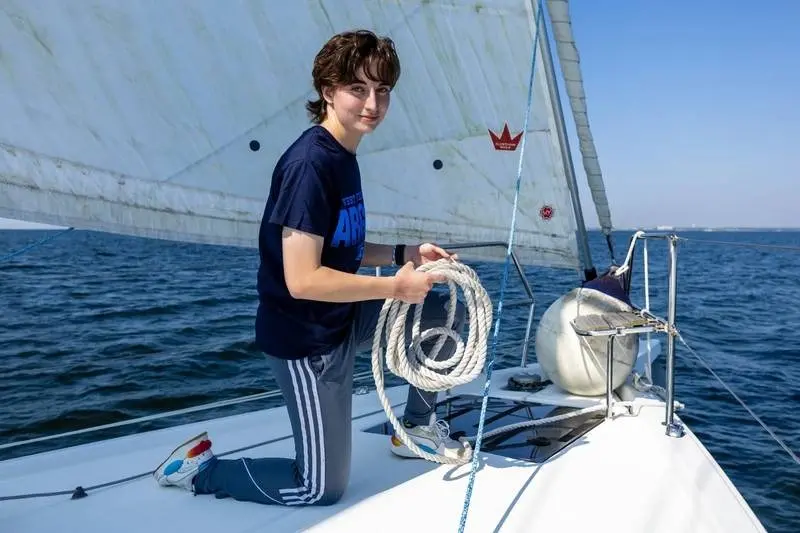
By the spring of 2026, the program’s workforce pipeline bore its first major fruits. Students who had entered the program during its initial rollout began graduating. Among them was Keanu Peoples, who earned his Bachelor of Science in Mechanical Engineering in May 2026.
Having spent his senior year interning with American Magic through the WAVE pipeline, Peoples immediately transitioned into a full-time engineering role with the world-class sailing organization—proving that the program’s applied-learning model could successfully place graduates directly into elite engineering positions.
Supporting Context & Metrics: The Pillars of Maritime Innovation
The success of the WAVE Program relies on its structural integration of three core pillars: advancing research, supporting economic development, and preparing a specialized future workforce.
                  ┌─────────────────────────────────────────┐
                  │          UWF WAVE Program               │
                  │   $3.3M Triumph Gulf Coast Funding      │
                  └────────────────────┬────────────────────┘
                                       │
         ┌─────────────────────────────┼─────────────────────────────┐
         ▼                             ▼                             ▼
┌──────────────────┐          ┌──────────────────┐          ┌──────────────────┐
│ Applied Research │          │ Economic Growth  │          │ Workforce Prep   │
│ • Marine Robotics│          │ • Port Colocated │          │ • Industry Certs │
│ • Renewable Wave │          │ • Startup Incub. │          │ • AI Integration │
│ • Adv. Composites│          │ • Local Business │          │ • Direct Pipeline│
└──────────────────┘          └──────────────────┘          └──────────────────┘
1. Advancing Research in Real-World Environments
Traditional academic research often suffers from the "valley of death"—the gap between laboratory discovery and commercial viability. WAVE bypasses this hurdle by utilizing a multi-stage R&D pipeline that leverages the unique geography of Northwest Florida:
- The Campus Laboratory: Initial conceptual designs, mathematical modeling, and computational simulations are conducted on the main UWF campus.
- The Port of Pensacola Facility: Virtual designs are converted into physical prototypes using advanced materials, 3D printing, and composite layups. Here, students and faculty work alongside industrial technicians to refine structural integrity.
- Pensacola Bay and the Gulf of Mexico: The final, critical phase of research occurs on the water. WAVE’s direct access to deep-water ports and diverse marine environments allows for real-time testing of hull designs, autonomous navigation algorithms, and marine propulsion systems under variable maritime conditions.
2. Supporting Economic Development and the Startup Ecosystem
The WAVE Program serves as a technical resource for established defense contractors, marine manufacturers, and early-stage startups. By offering access to specialized university equipment and faculty expertise, WAVE lowers the barrier to entry for blue-economy entrepreneurs.
Key areas of industrial collaboration include:
| Focus Area | Key Technical Applications | Regional Impact |
|---|---|---|
| Vessel & Maritime Systems | Hydrodynamic optimization, hull design, and propulsion efficiency. | Lowers fuel costs and carbon footprints for commercial and military vessels. |
| Autonomy & Marine Robotics | Unmanned surface vehicles (USVs) and underwater drones. | Supports naval defense operations and offshore environmental monitoring. |
| Marine Renewable Energy | Wave, tidal, and offshore wind energy capture systems. | Diversifies the regional energy grid and fosters green-tech manufacturing. |
| Advanced Manufacturing | Carbon fiber composites, custom marine assemblies, and digital twins. | Attracts high-tech manufacturing firms to the Florida Panhandle. |
3. Preparing the Future Workforce
The modern maritime industry is no longer dominated solely by traditional welding and diesel mechanics; it is increasingly defined by automation, data science, and advanced material engineering. WAVE addresses this evolution by offering specialized training that yields professional certifications, including:
- Composite Materials Certifications: Essential for both modern yacht building and aerospace manufacturing.
- Advanced Digital Tools Certifications: Training in industry-standard CAD, CFD, and product lifecycle management (PLM) software.
- AI-Enabled Systems Training: Preparing engineers to design, operate, and troubleshoot autonomous marine vessels governed by machine learning algorithms.
Official Statements and Case Studies
The real-world impact of the WAVE Program is best understood through the experiences of those operating at its intersection of academia and industry.
The Student Perspective: Keanu Peoples
For Keanu Peoples, a May 2026 graduate with a B.S. in Mechanical Engineering, the WAVE Program was a direct pathway to a dream career. Reflecting on his transition from a student intern to a full-time engineer with the New York Yacht Club American Magic team, Peoples noted the competitive edge the program provided:
"The hands-on experience I gained through the WAVE Program is something you simply cannot replicate in a standard lecture hall. Working alongside elite professionals who are pushing the absolute limits of hydrodynamics and carbon fiber technology showed me what is expected at the highest levels of engineering. WAVE didn’t just teach me the theory of engineering; it taught me how to think, adapt, and build under pressure."
The Academic Vision: Integrating Rigor and Practice
UWF engineering faculty emphasize that the program’s location at the Port of Pensacola is its greatest asset. According to program coordinators, embedding students in a working port forces them to confront the realities of maritime operations—such as salt-water corrosion, biofouling, and unpredictable weather—early in their academic careers.
This exposure ensures that when graduates enter the workforce, they possess the practical judgment required to solve immediate problems for employers, reducing the onboarding time typically required for new hires.
Future Outlook: Charting the Next Course
As the WAVE Program matures, its leadership is looking well beyond individual research grants and student internships. The long-term objective is to transform WAVE into the definitive regional hub for maritime technology across the entire Gulf Coast.
               ┌────────────────────────────────────────┐
               │    WAVE Regional Hub Vision (2027+)    │
               └───────────────────┬────────────────────┘
                                   │
         ┌─────────────────────────┼─────────────────────────┐
         ▼                         ▼                         ▼
┌──────────────────┐      ┌──────────────────┐      ┌──────────────────┐
│  Multi-State     │      │   AI-Powered     │      │   Defense and    │
│  Academic Net    │      │  Autonomy Labs   │      │ Commercial Tech  │
│  Collaborations  │      │  At-Sea Testing  │      │  Transfer Hub    │
└──────────────────┘      └──────────────────┘      └──────────────────┘
Expanding Academic and Industrial Networks
Plans are already underway to expand collaborative research agreements with other universities along the Gulf Coast, as well as federal agencies such as the Office of Naval Research (ONR) and the National Oceanic and Atmospheric Administration (NOAA). By serving as a neutral, high-tech testing ground, WAVE aims to attract international maritime tech firms seeking to test their products in the warm, predictable waters of the Gulf.
Embracing the AI Revolution in Shipbuilding
The next frontier for WAVE lies in the integration of artificial intelligence and machine learning into vessel design and operations. Future research initiatives will focus on:
- Predictive Maintenance Models: Utilizing sensor data and machine learning to predict when a vessel’s mechanical systems will fail before they leave the dock.
- Swarm Robotics: Developing coordinated networks of autonomous underwater vehicles (AUVs) for search-and-rescue, defense, and oceanographic mapping missions.
- Sustainable Propulsion: Designing hybrid and hydrogen-fuel-cell propulsion systems to meet tightening international maritime emission standards.
An Open Invitation to Innovators
The University of West Florida’s WAVE Program is actively seeking new partnerships. Whether it is an early-stage startup looking for a space to prototype a novel hull design, a government agency requiring specialized testing, or an established manufacturer looking to upskill its workforce, WAVE offers the infrastructure, talent, and geographic advantages to bring those concepts to reality.
By systematically linking academic rigor with industrial utility, the WAVE Program is doing more than training the next generation of mechanical engineers—it is actively drafting the blueprint for the future of the global maritime economy, right from the shores of Northwest Florida.


