By Amanda Dickinson, Senior Manager, Digital Marketing Estimated Reading Time: 8 minutes
Executive Overview
Far beneath the sunlit surface of our blue planet lies a realm where sunlight vanishes entirely, hydrostatic pressure skyrockets to crushing extremes, and temperatures plunge to near-freezing levels. In this pitch-black, frigid expanse—known to oceanographers as the deep sea—evolution has forged some of the most bizarre and awe-inspiring organisms on Earth.
With transparent heads, bioluminescent bodies, needle-like teeth, and anatomical structures that defy conventional biology, these deep-sea dwellers look as though they belong in a science-fiction epic rather than our own terrestrial oceans. Yet, these extraordinary creatures are entirely real.
Marine scientists estimate that upwards of one million deep-sea species remain undiscovered. Because the abyss covers the vast majority of our globe and presents immense technological hurdles to exploration, many of these organisms have only been witnessed a handful of times in human history. This article explores seven remarkable ocean creatures that prove Earth’s deep sea can be just as strange, mysterious, and alien as outer space.
Detailed Chronology & Scientific Discovery
The history of deep-sea exploration is a relatively brief chapter in human scientific endeavor. For centuries, the abyssal plains and bathypelagic zones were believed to be azoic—devoid of all life due to the absence of light and the presence of immense pressure.
The Mid-19th Century Paradigm Shift: Pioneering expeditions, most notably the Challenger Expedition (1872–1876), shattered the azoic theory by dredging up living creatures from depths previously thought uninhabitable. This discovery sparked a global fascination with benthic and pelagic life.
The 20th Century Submersible Revolution: The invention of deep-diving submersibles, such as the bathyscaphe Trieste and later modern remotely operated vehicles (ROVs) operated by institutions like the Monterey Bay Aquarium Research Institute (MBARI) and the National Oceanic and Atmospheric Administration (NOAA), allowed marine biologists to observe deep-sea animals in their native habitats rather than as mangled, decompressed specimens pulled to the surface.
Modern Oceanography (21st Century): Today, advanced high-definition cameras, environmental DNA (eDNA) sampling, and autonomous underwater vehicles (AUVs) continue to rewrite textbooks, uncovering rare species like the barreleye fish and live specimens of the vampire squid in unprecedented detail.
The Seven Wonders of the Deep Abyss
1. The Vampire Squid (Vampyroteuthis infernalis)
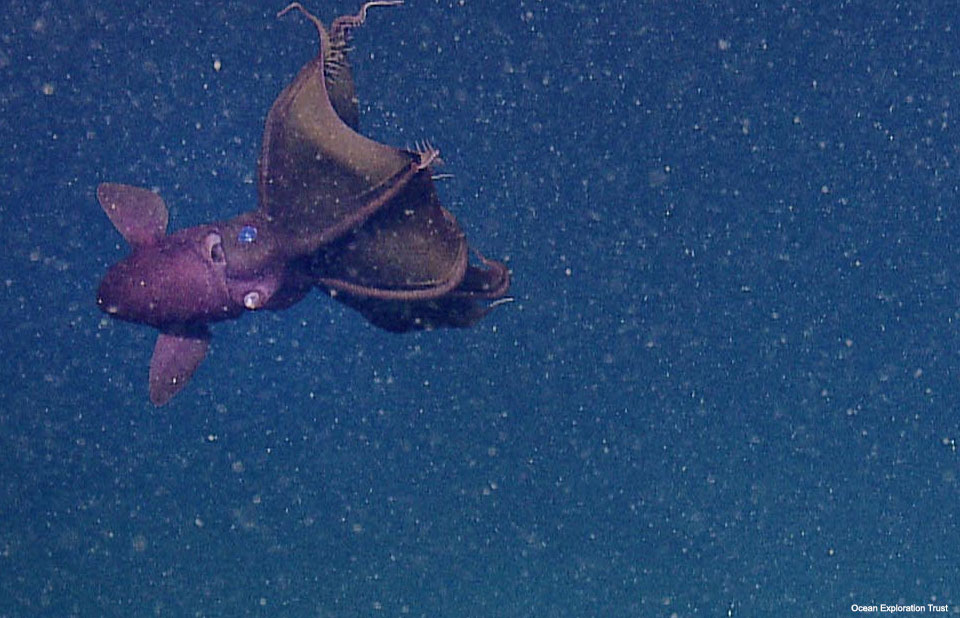
Despite its dramatic, spine-chilling scientific name—which translates loosely to "vampire squid from hell"—the vampire squid does not consume blood. This compact, deep-sea cephalopod earned its infamous moniker from its dark, reddish-brown coloration, haunting blue eyes, and the cloak-like webbing of skin stretched tightly between its arms.
Unlike many of its shallower-dwelling relatives, the vampire squid does not actively hunt or chase down prey. Instead, it possesses the remarkable ability to match the density of surrounding seawater, allowing it to remain neutrally buoyant and drift effortlessly without expending excess energy. It feeds primarily on "marine snow"—the continuous shower of organic detritus, fecal matter, and dead plankton drifting down from the upper ocean layers—utilizing two long, thread-like filaments to capture particles.
When cornered by predators in the perpetual night of the deep ocean, the vampire squid relies on sophisticated bioluminescence. Specialized light-producing organs called photophores, located at the tips of its arms, can emit brilliant, disorienting flashes of light to confuse attackers while the animal executes a swift escape.
2. The Barreleye Fish (Macropinna microstoma)
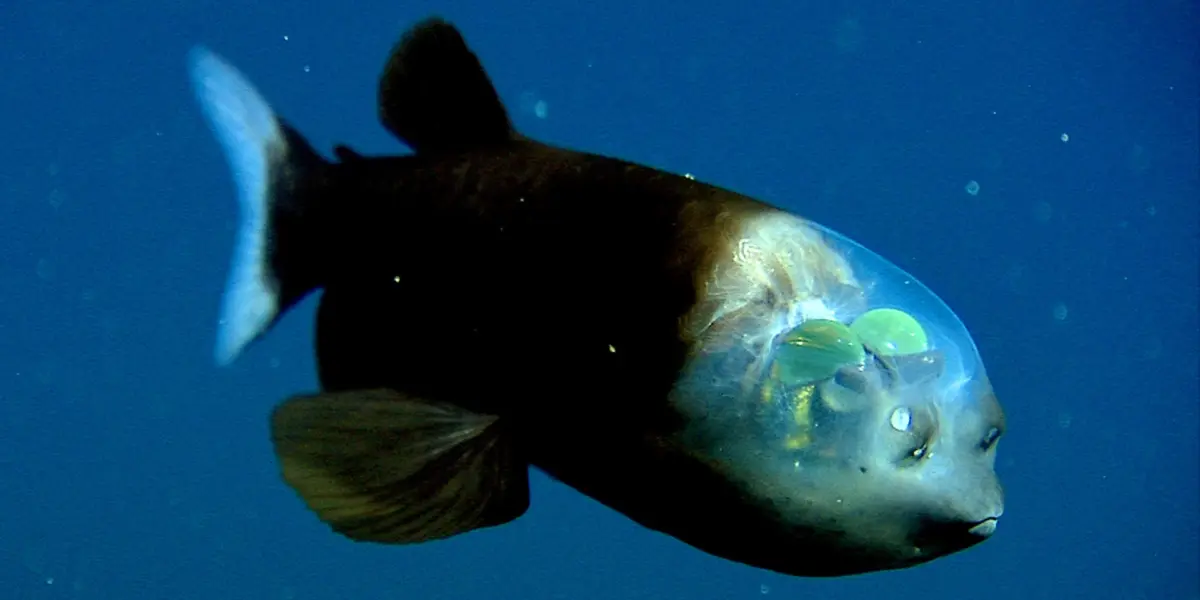
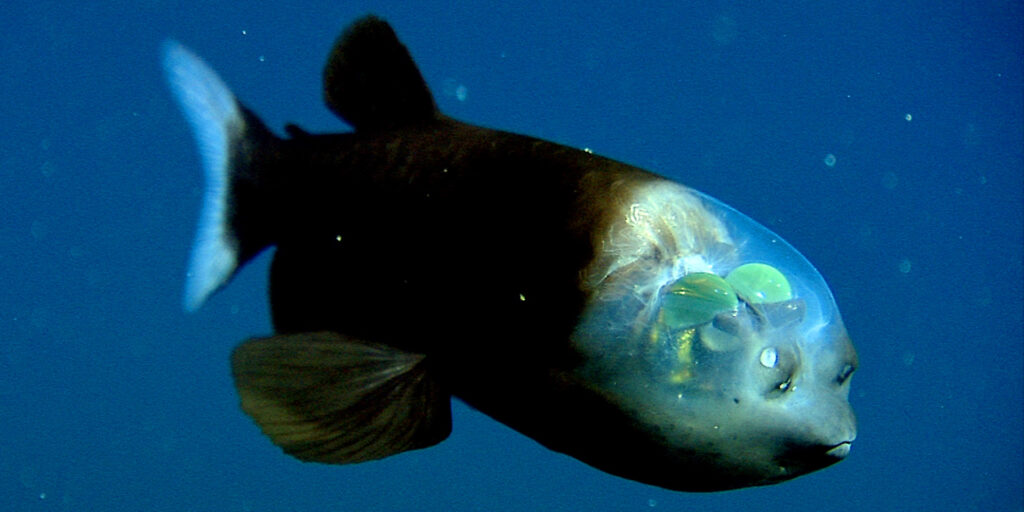
If extraterrestrials designed a fish with a built-in observation dome, it would likely resemble the barreleye fish. This remarkable creature features a completely transparent, fluid-filled shield over its head, allowing scientists to clearly view its glowing, tubular green eyes rotating freely inside its skull.
For decades, marine biologists were perplexed by the anatomy of the barreleye. Early specimens hauled to the surface were invariably damaged, the delicate transparent dome rupturing during the violent pressure and temperature changes of the ascent. It was not until researchers at the Monterey Bay Aquarium Research Institute captured high-definition footage of a living barreleye in its natural habitat that the mystery was finally solved.
The fish’s barrel-shaped eyes typically point upward to scan the gloom for the silhouettes of unsuspecting prey against the faint, filtered light penetrating from above. When it detects a food source, the eyes can rotate forward to align with its small mouth during feeding.
3. The Giant Isopod (Bathynomus giganteus)
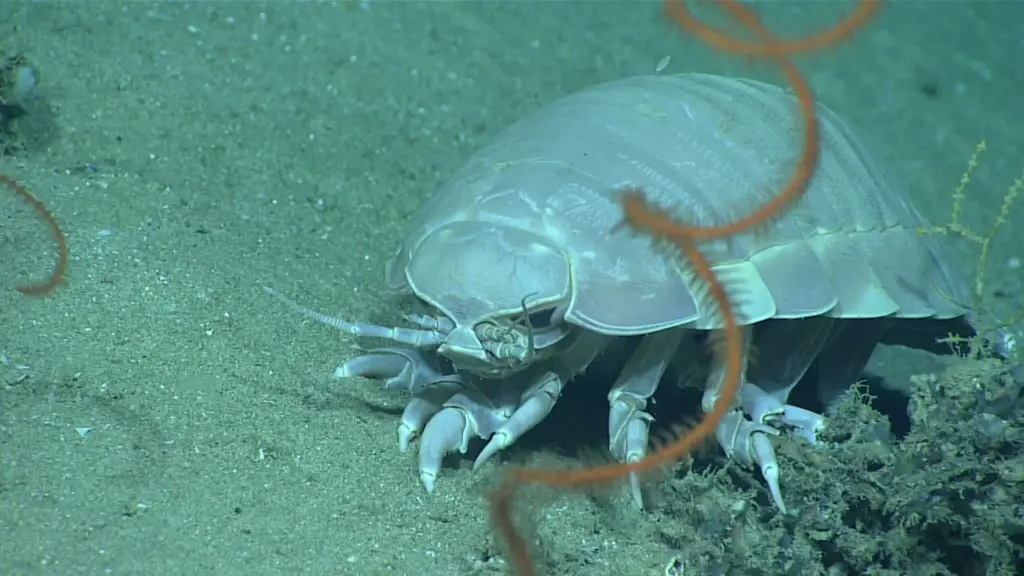
Imagine a terrestrial roly-poly (woodlouse) scaled up to the size of a domestic housecat, and you have the giant isopod. Cruising the ocean floor at depths reaching up to 7,000 feet, these armored crustaceans can exceed a foot in length.
With segmented exoskeletons, multiple pairs of synchronized legs, and compound eyes, giant isopods bear a striking resemblance to prehistoric trilobites. In fact, isopod fossils date back over 300 million years, making them living relics of ancient seas.
Because food is notoriously scarce in the abyssal zone, giant isopods have evolved an extraordinary metabolic adaptation: the ability to endure extended periods of starvation. Laboratory observations have shown that some adult isopods can survive for years without a substantial meal, conserving energy by remaining largely motionless until a fresh carcass drifts down from above.
4. The Anglerfish (Order Lophiiformes)
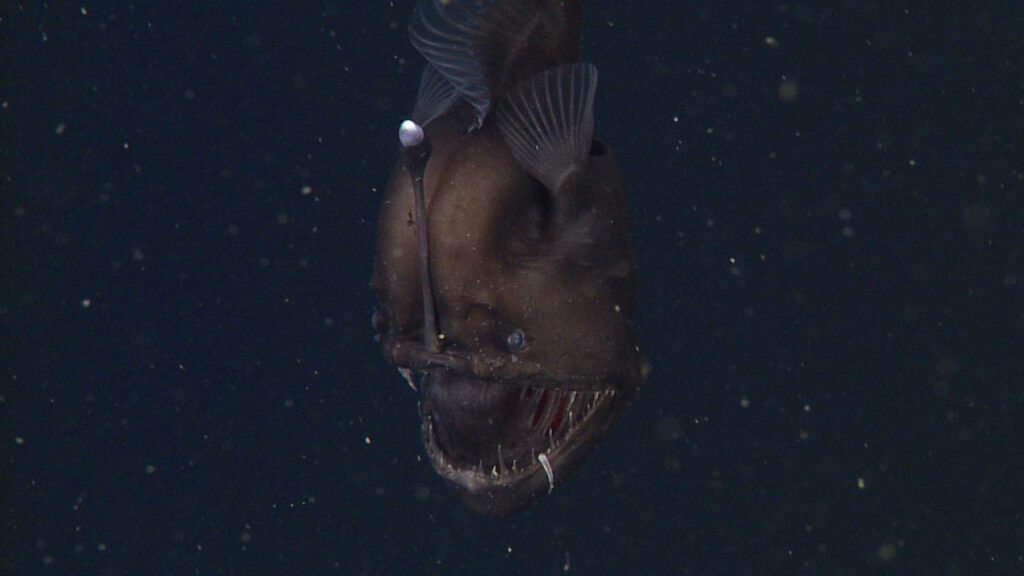
Few creatures embody the popular imagination of a deep-sea monster quite like the anglerfish. Characterized by jet-black skin, disproportionately massive jaws lined with translucent, needle-like teeth, and expandable stomachs capable of swallowing prey larger than themselves, these fish are apex ambush predators of the bathypelagic zone.
The defining feature of the female anglerfish is the ilicium—a modified dorsal spine that dangles over its mouth like a fishing rod, tipped with a glowing bulb of bioluminescent bacteria. By twitching this luminous lure in the absolute darkness, the anglerfish entices curious fish and crustaceans close enough to be snapped up in a fraction of a second.
Interestingly, sexual dimorphism in anglerfish is extreme. Dwarf males, lacking the ability to hunt independently, must find a female in the vastness of the deep ocean, bite onto her body, and permanently fuse with her tissues, effectively becoming a parasitic appendage that supplies sperm in exchange for nutrients.
5. The Dumbo Octopus (Genus Grimpoteuthis)
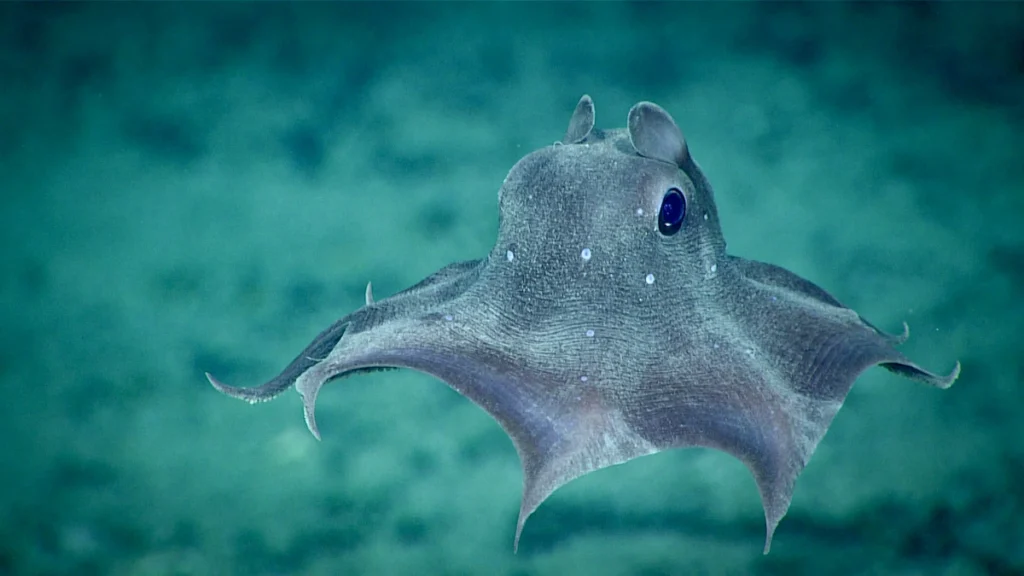
Soft, delicate, and undeniably charming, the dumbo octopus gets its common name from the prominent, ear-like fins protruding from the top of its mantle, which resemble the flapping ears of Walt Disney’s animated elephant.
Averaging a modest 8 to 12 inches in length, dumbo octopuses inhabit the most extreme depths of the global ocean, ranging from 1,000 to over 13,000 feet below the surface. This makes them one of the deepest-living octopus genera known to science. Unlike many shallow-water cephalopods, dumbo octopuses lack an ink sac; living in perpetual darkness where visual predators are sparse renders defensive ink clouds largely obsolete. Instead, they glide gracefully across the benthic ooze, using their webbed arms and wing-like fins to navigate currents.
6. The Goblin Shark (Mitsukurina owstoni)
Often hailed as a "living fossil," the goblin shark is an elusive, deeply unsettling elasmobranch that looks entirely distinct from any other shark species inhabiting modern seas.
Goblin sharks possess semi-translucent skin, allowing their intricate network of blood vessels to show through, which gives living specimens a soft pinkish-grey hue. Their most striking feature is an elongated, flattened snout packed with electroreceptive ampullae of Lorenzini, paired with a specialized jaw mechanism. When prey comes within range, the shark’s jaws can rapidly slingshot forward to snap up the target before retracting back beneath the skull. Due to their preference for deep submarine canyons and outer continental shelves, verified human encounters are exceptionally rare.
7. Gelatinous Deep-Sea Fauna (Jellies, Siphonophores, and Ctenophores)
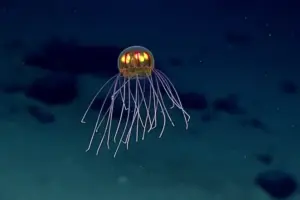
Some of the ocean’s most surreal inhabitants are not even solid. Gelatinous organisms—including deep-sea medusae, comb jellies, and colonial siphonophores—drift through the water column like organic holograms.
Many of these soft-bodied creatures pulse with mesmerizing neon bioluminescence or trail impossibly long, stinging tentacles through the abyss. Evolutionary lineages of sea jellies stretch back at least 500 million years. Composed of upwards of 95% water, they operate without a brain, heart, or centralized nervous system, yet remain exceptionally effective predators in their specialized niches.
Supporting Context & Metrics
Creature
Typical Depth Range
Primary Survival Adaptation
Notable Unique Trait
Vampire Squid
2,000 – 3,000 meters
Neutral buoyancy; detritivory
Photophores & arm webbing
Barreleye Fish
600 – 800 meters
Tubular rotating eyes
Transparent fluid-filled head shield
Giant Isopod
170 – 2,140 meters
Slow metabolism / starvation tolerance
Prehistoric segmented armor (300+ MYO)
Anglerfish
200 – 3,000+ meters
Bioluminescent lure (ilicium)
Extreme sexual dimorphism & parasitic males
Dumbo Octopus
400 – 4,000 meters
Wing-like fins for gliding
Absence of defensive ink sacs
Goblin Shark
270 – 1,300+ meters
Protrusible jaw mechanism
Semi-translucent pinkish skin
Gelatinous Fauna
Variable (Surface to Abyss)
95%+ water composition
Ancient lineage lacking complex organs
Official Statements & Conservation Significance
While these organisms may seem detached from human existence, marine scientists emphasize that the deep sea is deeply interconnected with planetary health.
"It is easy to think of deep-sea creatures as isolated mysteries, but these animals are fundamental cogs in our global ocean ecosystem," notes conservation literature from the Ocean Conservancy. "The deep ocean regulates our global climate, sequesters vast amounts of carbon, and supports biodiversity on a scale we are only just beginning to comprehend."
Despite its critical ecological functions, the deep sea remains heavily underexplored and increasingly vulnerable to emerging anthropogenic threats, including deep-sea mining, bottom trawling, plastic pollution, and climate-induced ocean acidification.
Conservation organizations continue to advocate for international marine protections, marine protected areas (MPAs), and robust scientific funding to safeguard these fragile habitats before human activity permanently alters environments that took millions of years to evolve.
Future Outlook
The next frontier of marine biology holds unprecedented promise. As robotic engineering advances, submersible technology becomes more cost-effective, and environmental monitoring systems grow more sophisticated, humanity stands on the precipice of major breakthroughs.
Researchers anticipate discovering countless new species in the coming decades, particularly within unexplored abyssal trenches and hydrothermal vent fields. Far from being a barren wasteland, the deep ocean is a vibrant, dynamic, and profoundly strange frontier. As science continues to pierce the veil of the dark depths, one truth remains abundantly clear: the most incredible discoveries on our planet are still waiting in the dark below—proving that reality is far stranger than any science fiction.