










Executive Overview
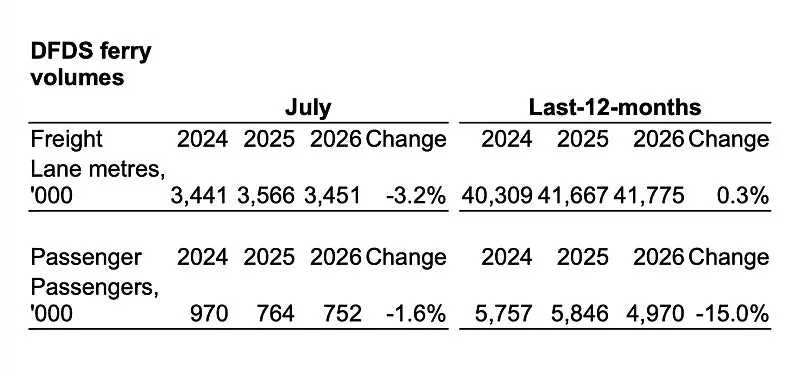
Danish shipping and logistics powerhouse DFDS A/S has published its volume performance metrics for July 2026, revealing a nuanced picture of European maritime trade and passenger transit. Total freight volumes for the month settled at 3.5 million lane metres, reflecting a 3.2% decrease compared to July 2025. This contraction underscores broader macroeconomic headwinds, shifting supply chain routes across Northern Europe, and intentional capacity realignments across key Mediterranean corridors.
Despite the year-over-year monthly dip, the carrier’s trailing twelve-month freight footprint demonstrated underlying structural stability. Over the past year, total freight volumes edged up by 0.3% to reach 41.8 million lane metres. However, when adjusted for structural route changes and network reallocations, the twelve-month baseline experienced a minor organic contraction of 0.5%, highlighting the fine balance DFDS must strike between organic demand and strategic network recalibration.
| Metric | July 2026 | July 2025 Comparison | Last 12 Months (LTM) | LTM Organic (Adjusted) |
|---|---|---|---|---|
| Freight Volume | 3.5m Lane Metres | -3.2% | 41.8m Lane Metres (+0.3%) | -0.5% |
| Passenger Volume | 752,000 Passengers | -1.6% | N/A | -15.0% (-5.1% adjusted) |
On the passenger front, overall summer travel figures saw a modest contraction. DFDS carried 752,000 passengers in July 2026, representing a 1.6% decline from the same period in 2025. This decrease was predominantly driven by reduced passenger activity across the Strait of Gibraltar. On a rolling twelve-month basis, passenger figures showed a headline decline of 15.0%, though this figure narrows to a 5.1% reduction when adjusted for network route modifications.
The monthly update illustrates a period of operational transition for DFDS. As industrial output in traditional Northern European strongholds experiences localized demand shifts, emerging cross-border trade arteries—particularly connecting Southern Europe and North Africa—are assuming an increasingly strategic role in the group’s overarching route ecosystem.
Detailed Chronology of Regional Performance
                           JULY 2026 FREIGHT VOLUME TRENDS BY CORRIDOR

  Continent–UK Routes       [=========================> Growth ]
  Scandinavian Routes       [<======================== Decline ]
  English Channel           [<======================== Softness ]
  Mediterranean Routes      [<======================== Capacity Cuts ]
  Baltic Sea Network        [========================= Stable ]
  Strait of Gibraltar       [=========================> Rebound ]
  Egypt Expansion Corridor  [=========================> Expansion ]
An analysis of DFDS’s operating regions in July 2026 reveals divergent economic indicators, route-specific capacity adjustments, and changing trade corridor dynamics across Europe and its adjacent waters.
North Sea and Channel Operations
The North Sea corridor, historically the backbone of DFDS’s roll-on/roll-off (Ro-Ro) network, delivered mixed results. Overall freight volumes in the North Sea ended slightly below the levels recorded in July 2025. This was characterized by a distinct geographical split:
- Continent–UK Routes: Strong freight demand between mainland European ports and the United Kingdom provided a positive buffer, sustained by resilient cross-border manufacturing supply chains and retail distribution.
- Scandinavian Outflows: Growth on Continent–UK routes was offset by weaker outbound volumes from Scandinavia. Softening export volumes from Sweden and Norway, particularly in industrial manufacturing and forestry product categories, pulled regional aggregate totals down.
- English Channel: Performance on the short-sea Channel routes remained constrained. Channel freight volumes landed below 2025 levels, reflecting ongoing competitive pressures, tighter port operating environments, and elevated price sensitivity among cross-Channel hauliers.
Mediterranean and Southern Corridor Rebalancing
The Mediterranean market faced a challenging operational climate during July, influenced by both external market conditions and internal capacity management strategies:
- Main Mediterranean Routes: Freight volumes across core Mediterranean lanes registered a notable year-over-year decline. DFDS cited a combination of a softer regional economic environment and deliberate reductions in vessel capacity on specific routes as primary drivers for the slowdown.
- Strait of Gibraltar: Contrastingly, the Strait of Gibraltar corridor delivered robust freight results. Commercial transport across this short-sea crossing expanded, driven by growing integration between Iberian manufacturing hubs and Moroccan industrial parks.
- Egypt Expansion Corridor: DFDS’s strategic expansion into North Africa maintained its upward trajectory. The direct freight service linking Mediterranean Europe with Egypt continued its growth trend, validating the carrier’s focus on nearshoring opportunities along North-South trade lanes.
Baltic Sea Resilience
In the Baltic Sea, freight volumes demonstrated notable stability. Despite lingering geopolitical complexities and fluctuating economic recovery rates across the Baltic states and Central Europe, DFDS maintained consistent lane-metre throughput. The region benefited from stable industrial output and steady demand for standardized Ro-Ro logistics solutions across regional transit corridors.
Supporting Context & Metrics
To fully understand DFDS’s July 2026 operational reporting, the monthly performance must be evaluated within the context of long-term strategic route optimization and vessel utilization.
                  12-MONTH FREIGHT VOLUME ADJUSTMENT (LTM)

  Raw Headline Growth       [ 41.8M Lane Metres  | +0.3% ]  ====> (Includes route expansions)
  Route-Adjusted Growth     [ Baseline Volume    | -0.5% ]  ====> (Organic volume shift)
Unpacking Freight Lane-Metre Dynamics
The 3.2% decline in monthly freight volume to 3.5 million lane metres reflects both market cooling and active capacity management by DFDS fleet planners. Over the rolling twelve-month period, total freight volume stood at 41.8 million lane metres—a raw increase of 0.3%. However, the 0.5% drop on a route-adjusted basis reveals critical insights into the fleet’s structural shifts:
- Impact of Route Restructuring: Network changes, including vessel redeployments, route cancellations, and new route acquisitions (such as the expansion of North African corridors), distorted the raw headline figure.
- Organic Yield Prioritization: The underlying 0.5% organic contraction highlights that management prioritized yield management and load factor efficiency over raw volume growth, withdrawing excess tonnage from softer routes like the Mediterranean and Channel.
- Capacity Utilization: By curbing capacity on lower-margin routes, DFDS maintained overall vessel fill rates, protecting operational margins against rising maritime fuel costs and inflationary pressures on port handling tariffs.
Passenger Volume Analysis and Route Realignments
The passenger division reported 752,000 customers for July 2026, representing a 1.6% drop year-over-year. July typically represents the peak season for passenger travel across DFDS’s combined freight and passenger (Ro-Pax) routes.
                12-MONTH PASSENGER VOLUME TREND (LTM)

  Headline Passenger Shift  [=======================> -15.0% ]
  Route-Adjusted Baseline   [======> -5.1% ]
The year-over-year contraction was primarily caused by lower passenger volumes on the Strait of Gibraltar routes, where tourist and transit traffic experienced localized drops compared to the elevated surge seen in summer 2025.
On a rolling twelve-month basis, the passenger division registered a 15.0% drop in raw volume. However, the organic, route-adjusted decline was significantly lower at 5.1%. This 9.9 percentage point gap highlights how strategic structural changes—such as rationalizing targeted seasonal passenger services and reallocating Ro-Pax vessels toward freight-dominated corridors—have deliberately reshaped DFDS’s passenger exposure over the past year.
Official Statements and Strategic Interpretations
While DFDS continually recalibrates its footprint to align with trade flows, corporate updates and executive commentary emphasize long-term operational resilience, fleet flexibility, and network optimization.
Adapting Network Capacity to Market Realities
Industry analysts highlight that DFDS’s proactive reduction of Mediterranean capacity reflects a disciplined operational stance. In maritime market briefings following similar volume updates, executive leadership has consistently emphasized agile fleet management:
"Our primary objective remains the optimization of our core logistics and ferry network. By adjusting vessel capacity in response to softer regional demand and redeploying resources into high-performing corridors—such as our expanding North African routes—we ensure that our infrastructure remains resilient, flexible, and yield-focused regardless of macroeconomic volatility."
Re-balancing Freight Corridors
Commenting on the divergence across Northern European corridors, maritime logistics analysts note that the dynamic between Scandinavian outbound softening and Continent–UK resilience illustrates the value of DFDS’s diversified short-sea footprint:
"The short-sea freight ecosystem in Northern Europe is undergoing structural realignments. DFDS’s ability to capture expanding trade between Continental Europe and the UK effectively mitigates localized dips in Scandinavian heavy export goods. The long-term investment in direct North Africa-to-Europe routes further insulates the company from regional economic slowdowns in Central Europe."
Future Outlook and Strategic Implications
As DFDS moves through the remainder of 2026, several critical factors will dictate its volume trajectory, route profitability, and operational strategy.
                        DFDS STRATEGIC PRIORITIES (H2 2026 & BEYOND)

  [ North African Expansion ]   ---> Further integration of Morocco & Egypt supply chains
  [ Capacity Optimization ]   ---> Continuous fine-tuning of Channel & Med route allocations
  [ Fleet Decarbonization ]   ---> Deployment of green technology & energy-efficient vessels
  [ Yield Management ]        ---> Prioritizing operational profitability over raw volume
1. Capitalizing on Mediterranean and North African Nearshoring
The continued growth along the Egypt route and the solid freight performance across the Strait of Gibraltar highlight a fundamental shift in European supply chain architecture. European manufacturers are increasingly looking to nearshoring strategies in North Africa to build supply chain resilience. DFDS is well-positioned to expand its footprint in these regions, deploying additional Ro-Ro tonnage to capture growing industrial trade between Southern Europe, Morocco, and Eastern Mediterranean ports.
2. Fleet Efficiency and Decarbonization Pressures
With maritime regulations tightening across the European Union—including the ongoing integration of the EU Emissions Trading System (ETS) and FuelEU Maritime standards—DFDS’s strategy of trimming underperforming capacity serves a dual purpose. By pulling inefficient vessel capacity off soft routes, the group reduces carbon intensity per lane metre carried, optimizing fleet efficiency while lowering regulatory compliance costs.
3. Freight Recovery in Core Markets
The medium-term outlook for the North Sea and Channel routes hinges on broader European macroeconomic recovery. Should inflation ease further and consumer purchasing power rebound, retail inventory replenishment is expected to lift Continent-UK and Scandinavian outbound trade volumes back into positive territory. In the interim, DFDS is expected to maintain strict discipline over sailing schedules and capacity deployment.
4. Passenger Segment Realignment
Following the significant route-adjusted normalizations over the last 12 months, the passenger division is entering a period of baseline stabilization. DFDS is expected to focus on maximizing onboard yield per passenger, enhancing digital booking experiences, and refining seasonal Ro-Pax schedules to ensure tourism traffic efficiently complements core year-round freight revenue.
Summary Strategy
DFDS’s July 2026 volume figures illustrate a company making calculated, strategic adjustments in a complex global market. While short-term regional drops present operational challenges, the company’s network adjustments, growing focus on North African corridors, and disciplined capacity management ensure it remains well-positioned to navigate shifting global trade patterns.