






Published by the Sea Tow Editorial Team | Updated August 2026
Executive Overview
For mariners navigating coastal waters, inland lakes, and the open ocean, the margin between a manageable mechanical hiccup and a life-threatening maritime disaster often hinges on rapid, effective communication. When a vessel takes on water, suffers an onboard fire, loses propulsion near a lee shore, or has a passenger go overboard, every second counts. While modern communications have evolved to include marine VHF radios, cellular phones, and satellite rescue beacons, Visual Distress Signals (VDS) remain a foundational, legally mandated pillar of maritime safety.
Federal and state regulations require most vessels operating on federally controlled waters, the Great High Seas, and connecting territorial waters to carry approved visual distress equipment. Yet, simply stowing a box of expired flares in a damp locker is not enough. True maritime safety demands an intimate understanding of the distinct differences between daytime and nighttime signals, the mechanical limits of pyrotechnics versus electronic devices, and the precise legal thresholds that separate an absolute maritime emergency from a routine non-emergency tow request.

This comprehensive guide examines the regulatory landscape, operational mechanics, and strategic deployment of marine visual distress signals. Drawing on decades of on-water rescue data and current U.S. Coast Guard guidelines, we analyze how boaters can build a robust, redundancy-rich distress signaling plan to ensure they are never left in the dark when help is needed most.
Detailed Chronology: The Evolution and Regulatory Timeline of Marine VDS
The requirement to carry distress signals is not a arbitrary bureaucratic hurdle; it is the product of over a century of maritime tragedy, technological innovation, and regulatory refinement designed to standardize how vessels cry out for help.
The Early Era of Maritime Signaling
Before electronic navigation and radio telephony, mariners relied on rudimentary visual cues: raising inverted flags, firing black powder cannons, setting bonfires on coastal bluffs, or burning oil-soaked rags. These methods were largely subjective, prone to environmental interference, and dependent on a shore-based observer or a passing ship looking in the exact right direction at the right time.
The Advent of Pyrotechnics and SOLAS
By the mid-20th century, the Safety of Life at Sea (SOLAS) international conventions began standardizing pyrotechnic devices—introducing standardized red hand flares, rocket parachute flares, and buoyant smoke signals. These chemical devices utilized energetic materials to produce high-intensity light and dense smoke, drastically increasing the visual horizon of a distressed vessel.
Modern Federal Mandates and Electronic Integration
In the late 20th and early 21st centuries, the U.S. Coast Guard codified strict carriage requirements under Title 33 of the Code of Federal Regulations (CFR). These rules established clear distinctions based on vessel length, operating waters, and time of day.
More recently, the maritime safety sector underwent a significant technological shift with the authorization of electronic visual distress signal devices (eVDSDs). Recognizing the safety hazards, storage constraints, and environmental limitations of pyrotechnics—as well as their strict 42-month expiration dates—regulatory bodies began approving high-intensity, repeating LED-based electronic lights. Today, mariners navigate a sophisticated framework that balances traditional pyrotechnic reliability with modern, maintenance-friendly electronic innovations.
Supporting Context & Metrics: Understanding VDS Requirements
Navigating the legal framework of visual distress signals requires understanding when, where, and what equipment must be on board. The requirements are rarely one-size-fits-all.
Who Needs Visual Distress Signals?
Generally, federal regulations require VDS equipment for:
- Vessels operating on the Great Lakes.
- Vessels on the high seas and territorial seas.
- Coastal waters and connecting waters up to a point where the waterway is less than two miles wide.
Exemptions: Certain vessels are exempt from carrying daytime signals, nighttime signals, or both, based on specific criteria:
- Recreational boats less than 16 feet in length (they must still carry nighttime signals if operated between sunset and sunrise).
- Boats competing in an organized marine parade, regatta, or race.
- Manually propelled boats (such as canoes, kayaks, and rowboats).
Even when legally exempt, safety experts strongly advise all mariners—especially paddlers and operators of small personal watercraft—to carry at least a basic signaling device, such as an electronic light, a signal mirror, or a waterproof whistle.
Day versus Night: The Dual-Condition Reality
The environment of the open water shifts dramatically between daylight and darkness. Consequently, VDS equipment is strictly categorized by operational lighting conditions:
- Daytime Signals: Must be clearly visible against bright sunlight and a complex horizon. Examples include orange smoke signals, orange distress flags, and daytime-approved pyrotechnics.
- Nighttime Signals: Must be visible after dark from a significant distance. Examples include red handheld flares, aerial meteor flares, and approved electronic distress lights.
- Combination Signals: Many pyrotechnic devices are approved for both day and night use, satisfying round-the-clock legal requirements. However, carrying only a daytime flag leaves a vessel completely non-compliant and invisible after sunset.
Official Guidelines: Breakdown of Approved Distress Equipment
To ensure compliance and maximize survivability, mariners must understand the specific characteristics, strengths, and limitations of each approved distress signal type.
1. Pyrotechnic Marine Flares
Pyrotechnic devices remain the gold standard for high-visibility urgency because their brilliant light, intense heat, and smoke cut through adverse weather conditions. However, they carry inherent risks: they burn at extremely high temperatures, contain hazardous chemical compositions, possess a strict federal expiration date (typically 42 months from the date of manufacture), and require meticulous storage.
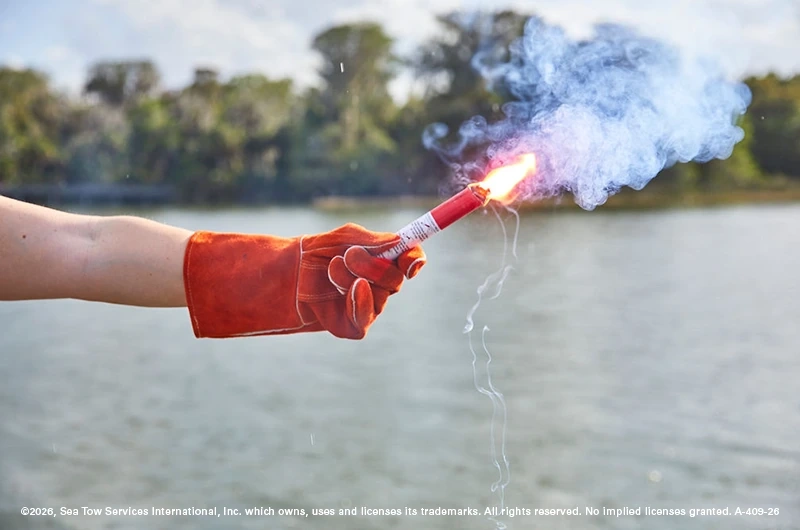
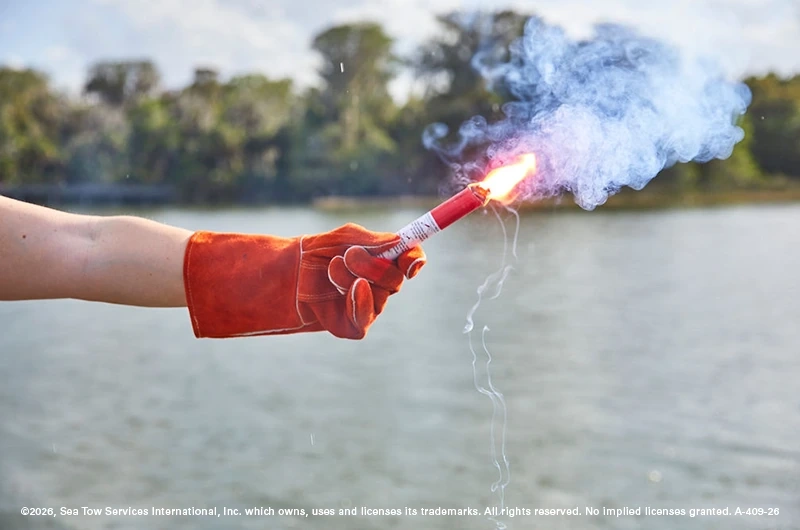
- Handheld Red Flares: Designed primarily for nighttime use, these produce an intensely bright red flame. Best Practice: Always hold the flare downwind and over the outboard gunwale. This ensures that hot slag, chemical residue, and toxic smoke are blown away from passengers, the boat’s hull, fuel tanks, and rigging.
- Aerial Flares and Meteor Signals: Launched from a pistol or pen-like launcher, these devices propel a bright projectile high above the horizon, dramatically increasing the viewing radius. They must be aimed and fired strictly according to manufacturer instructions—always away from people, sails, superstructure, passing aircraft, and flammable materials.
- Orange Smoke Signals: Designed exclusively for daytime use, smoke signals produce dense orange plumes that assist aircraft and surface vessels in spotting a position and gauging local wind direction. Crucial Note: Smoke is never a substitute for a nighttime signal.
2. Electronic Visual Distress Signal Devices (eVDSDs)
Approved electronic LED devices offer a modern alternative to traditional pyrotechnics. They project a repeating, high-intensity light pattern (often signaling SOS in Morse code) without open flames, hot slag, or expiration dates.
- Compliance: To meet nighttime requirements, the electronic device must explicitly state on its approval label that it complies with U.S. Coast Guard requirements for night use, and it must be paired with an approved daytime signal (such as an orange distress flag).
- Maintenance: Unlike sealed pyrotechnics, electronic devices require active maintenance. Operators must regularly inspect the housing, O-ring seals, switches, and battery compartments. Fresh batteries should be installed annually, or rechargeable units maintained precisely per manufacturer specifications. Ordinary flashlights, smartphones, or standard work strobes do not legally substitute for an approved eVDSD.
3. Orange Distress Flags
The standard daytime distress flag features a black square and black ball on a vivid international orange background.
- Deployment: The flag should be displayed from a mast, boathook, paddle, or the highest elevated point possible to maximize line-of-sight visibility.
- Durability: Unlike flares, flags do not expire and cannot burn out, but their effectiveness is entirely dependent on daylight, ambient wind conditions, and line-of-sight obstacles. They should always be used in tandem with secondary communication tools.
4. Non-Mandatory Supplemental Tools
While not officially satisfying primary carriage requirements on their own, several secondary tools can dramatically improve rescue outcomes:
- Signal Mirrors: Can direct concentrated beams of sunlight toward aircraft or distant vessels, even over long distances.
- Flashlights and Spotlights: Excellent for illuminating decks, signaling in Morse code, or catching the eye of a passing boat at night.
- High-Visibility Apparel & Whistling Devices: Bright clothing, life jackets with reflective tape, and marine whistles draw immediate attention during man-overboard scenarios.
5. Emergency Beacons: EPIRBs and PLBs
It is vital to distinguish between visual distress signals and electronic locating beacons.
- EPIRBs (Emergency Position-Indicating Radiobeacons) and PLBs (Personal Locator Beacons) do not emit light or smoke for visual spotting; rather, they transmit coded distress signals via satellite to search-and-rescue authorities.
- The Synergy: Beacons start and direct the rescue response across vast ocean expanses, while visual signals (flares, lights, and flags) guide rescuers directly to the final pinprick location in the final stages of the search.
Future Outlook: Emerging Trends in Maritime Safety and Signaling
As marine technology continues to evolve, the future of boating safety is moving toward integrated, smart-ecosystem solutions.
- Smart Integration and AIS SARTs: Search and Rescue Transmitters (SARTs) and AIS-enabled personal beacons are becoming increasingly compact and affordable. These devices transmit distress alerts directly to the electronic chartplotters and radar screens of all nearby commercial and recreational vessels equipped with Automatic Identification Systems.
- Eco-Friendly Pyrotechnics: With environmental concerns growing regarding chemical residue and ocean pollution from traditional pyrotechnic flares, manufacturers are researching biodegradable casings and non-toxic chemical formulations.
- Advanced LED Optics: Next-generation electronic distress lights are becoming smaller, brighter, and smarter, incorporating automated GPS reporting and multi-spectral lighting to penetrate heavy fog, rain, and spray more effectively than first-generation eVDSDs.
- Digital Dispatch Apps: Platforms like the Sea Tow app and integrated VHF-DSC radio systems are shifting the initial call for help from frantic visual signaling to precise digital coordinates. However, industry experts emphasize that technology can fail—batteries die, electronics short out in saltwater environments, and screens wash out in glaring sunlight. Consequently, analog redundancy (holding a waterproof handheld flare or raising an orange flag) will remain a vital fail-safe for generations to come.
Expert Summary & Best Practices
Building an uncompromised safety plan on the water requires discipline, situational awareness, and adherence to several golden rules:
- Audit Your Inventory Before Departure: Never assume your safety gear is operational. Check expiration dates on pyrotechnics, inspect electronic device batteries, and ensure your orange flag is free of rips and easily accessible.
- Know the Difference Between Distress and Assistance: Never fire a pyrotechnic flare for a routine, non-emergency towing request. Flares signal grave and imminent danger (sinking, fire, life-threatening injury). For a breakdown or minor mechanical failure, utilize your VHF radio, phone, or the Sea Tow app.
- Train Your Crew: Safety equipment is useless if passengers do not know where it is stored or how to deploy it under pressure. Conduct a brief safety orientation before leaving the dock, pointing out the exact location of all VDS equipment.
- Match Gear to Your Route: Ensure your equipment inventory covers both day and night operations, complies with local state and federal laws, and is scaled appropriately for the bodies of water you intend to navigate.
By combining modern electronic readiness with traditional visual signaling tools, mariners can protect their vessels, their passengers, and themselves—ensuring that when unexpected emergencies strike on the water, help is never truly out of sight.