








Executive Overview
In the persistent battle between vital maritime infrastructure and the raw, unyielding forces of the Great Lakes, a critical turning point has arrived in western New York. Repair work has officially resumed on the west breakwater of Dunkirk Harbor, a multi-phased engineering initiative designed to safeguard one of Lake Erie’s most vital recreational and commercial havens. Managed by the U.S. Army Corps of Engineers (USACE) Buffalo District, the project addresses decades of structural degradation caused by relentless wave action, severe winter ice sheets, and cyclical lake level fluctuations.
The breakwater acts as an indispensable shield, blunting the force of violent Lake Erie storms before they can breach the inner harbor. Without this massive stone and concrete barrier, local commercial vessels, recreational boaters, and charter fishing fleets would be left entirely exposed to the lake’s notoriously treacherous conditions. With the second and final phase of the rehabilitation project now in full swing—slated for completion in November 2026—federal and local stakeholders are inching closer to securing the long-term viability of the harbor.
Beyond its basic engineering scope, this project serves as a textbook example of the hidden, high-stakes maintenance required to sustain America’s freshwater navigation networks. This comprehensive report details the chronological evolution of the Dunkirk Harbor project, the engineering challenges of Great Lakes coastal protection, the broader economic metrics at stake, and the strategic outlook for the region’s maritime future.
Detailed Chronology: From Early Degradation to the 2026 Conclusion
To fully understand the significance of the ongoing work at Dunkirk Harbor, one must trace the timeline of the structure’s deterioration and the protracted engineering campaigns required to arrest it.
The Lifespan of a Lake Erie Shield
Built decades ago to tame the open waters of Lake Erie, the Dunkirk Harbor west breakwater was engineered to withstand punishing environmental conditions. However, the physical reality of the Great Lakes means that even the sturdiest stone structures face a slow, inevitable erosion. Over successive decades, the freeze-thaw cycles of harsh northern winters, combined with the battering ram effect of massive ice packs driven by prevailing winds, began to systematically dismantle the breakwater’s armor stone core.
As voids formed within the structure and sections of the cap stone shifted or dislodged, the breakwater’s capacity to absorb wave energy diminished. Port authorities and federal inspectors flagged accelerated damage following severe multi-year storm seasons, which brought unprecedented high water levels and subsequent wave surges to the southern shore of Lake Erie.
Phase One: Stabilizing the Bulk of the Structure
Recognizing the imminent threat to navigation safety and local property, the USACE Buffalo District mobilized a major federal intervention. Phase One of the rehabilitation effort targeted the lion’s share of the distressed infrastructure. During this initial mobilization, heavy marine construction contractors focused on stabilizing and reconstructing approximately 1,850 linear feet of the west breakwater.
This phase involved:
- Sourcing and placing thousands of tons of heavy, high-density armor stone capable of withstanding extreme wave shear stress.
- Repositioning displaced core materials to restore the structural cross-section of the barrier.
- Filling internal voids that had compromised the integrity of the breakwater’s crest.
Phase One successfully secured the primary length of the barrier, drastically reducing wave transmission into the inner harbor basins. However, a significant vulnerability remained at the remaining unrepaired sections, necessitating the current follow-up campaign.
Phase Two: The Push to the Finish Line (August – November 2026)
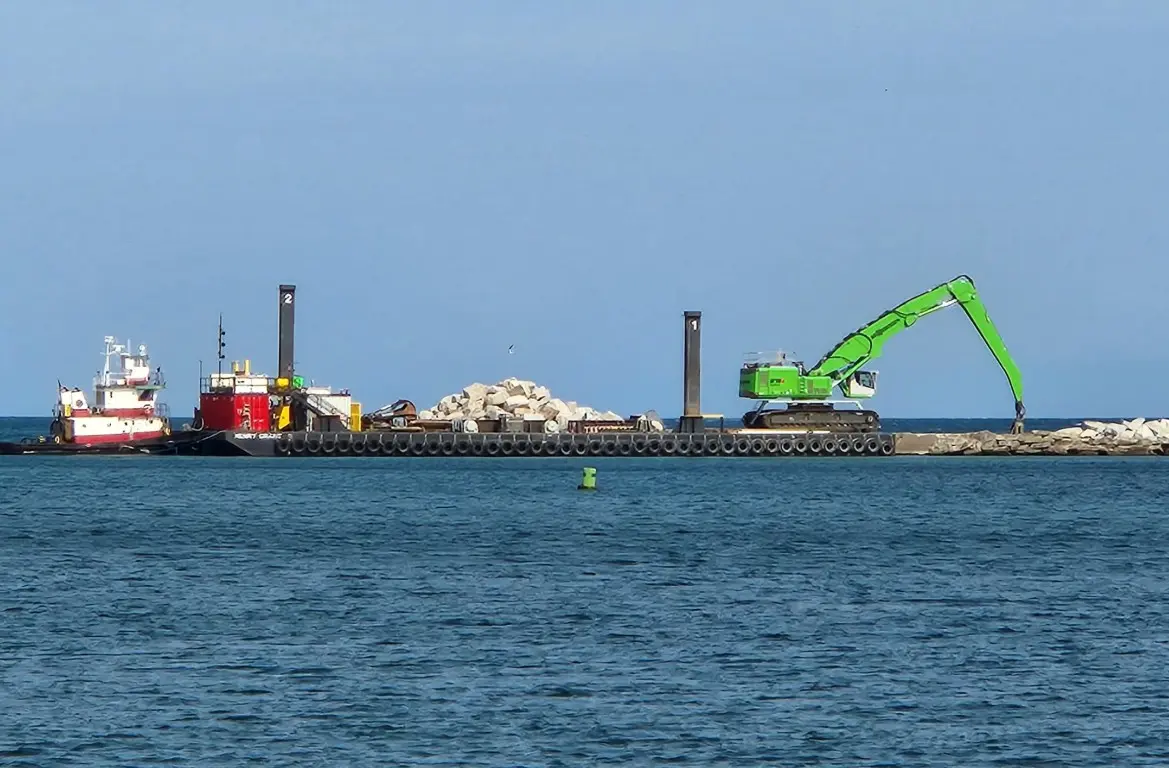
With the bulk of the breakwater secured, work has now entered its final, highly specialized phase. Active construction resumed in August 2026, targeting the remaining 450 feet of the west breakwater that still suffered from legacy storm damage and age-related wear.
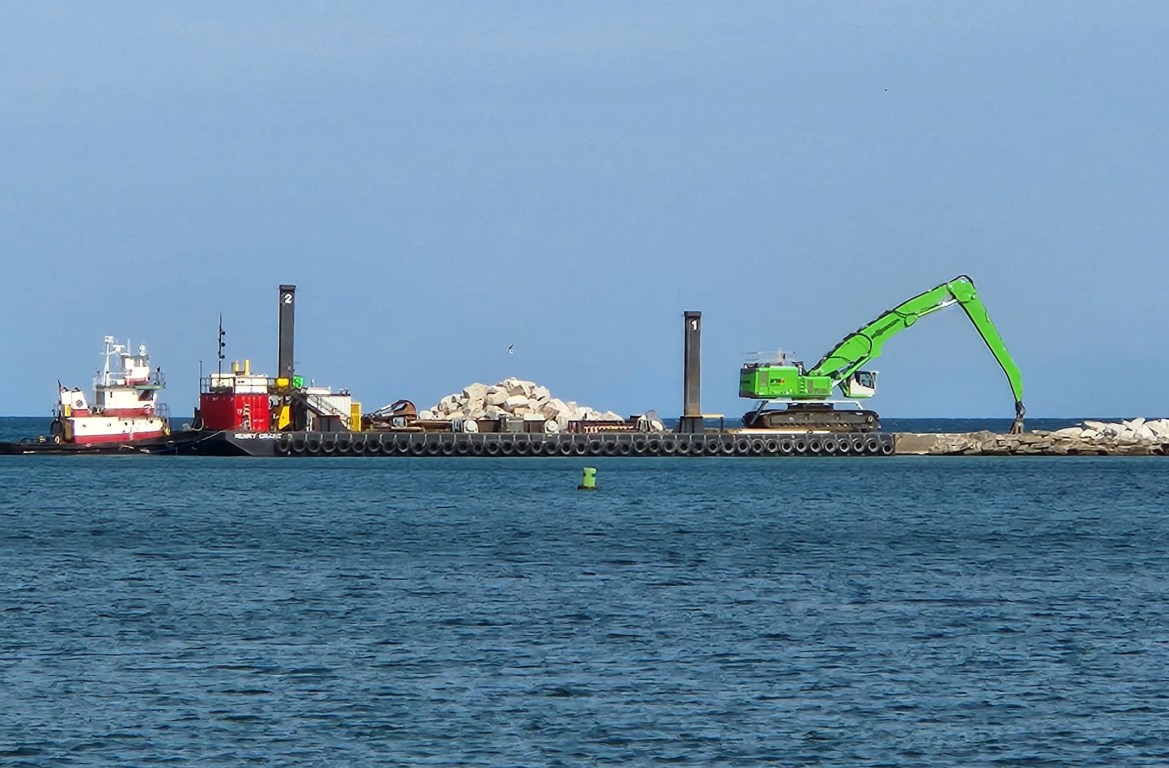
Marine contractors are utilizing specialized barge-mounted cranes and heavy excavators to place precision-engineered stone packages along the lake-facing slope. Working against the clock to complete operations before the onset of the punishing late-autumn gales on Lake Erie, project engineers have set a hard deadline of November 2026 for total project completion. Once these final 450 feet are reinforced, the entire length of the west breakwater will operate at peak structural efficiency, fully insulated from the catastrophic breaches that once threatened the harbor’s interior.
Supporting Context & Metrics: The Engineering and Economics of Coastal Defense
The rehabilitation of the Dunkirk Harbor breakwater is not merely an isolated masonry project; it is part of a massive, nationwide federal commitment to maintaining the economic corridors of the Great Lakes navigation system.
The Engineering Feat: Fighting Lake Erie’s Physics
Lake Erie is the shallowest of the Great Lakes, a geographic quirk that makes it uniquely volatile. When high winds sweep across the lake from the west or southwest, they rapidly pile water up at the eastern end—a phenomenon known as a seiche—while generating steep, short-period waves that pack an immense amount of destructive hydraulic energy.
When these waves encounter a breakwater, they exert dynamic pressures measured in thousands of pounds per square foot. To counter this, the USACE specifies armor stone designed to interlock tightly, dissipating wave energy through friction and void spaces rather than trying to meet the water with rigid, unyielding resistance. The stones utilized in the Dunkirk project must meet stringent geological specifications regarding specific gravity, shape, and durability to ensure they do not fracture under impact or weather away over decades of submersions.
Economic Impact and Local Metrics
While large commercial ports on the Great Lakes often capture headlines, smaller harbors like Dunkirk are the absolute lifeblood of regional tourism, commercial fishing, and local municipal economies.
- Recreational Boating and Tourism: Dunkirk Harbor serves as a premier launching point for recreational boaters exploring the southern shore of Lake Erie. Local marinas, fuel docks, and boat-launch facilities rely on calm harbor waters to attract regional visitors.
- The Sportfishing Industry: Lake Erie is world-renowned for world-class walleye, perch, and bass fishing. Dunkirk is a central hub for charter captains and angling tournaments, generating substantial seasonal revenue for local hotels, restaurants, and bait-and-tackle retailers.
- Commercial Fisheries: Commercial operators depend on a safe, predictable harbor entrance to navigate their vessels out to open water and return safely with their catches, regardless of sudden shifts in weather.
By securing the west breakwater, the USACE Buffalo District is directly protecting millions of dollars in marine-related economic activity and safeguarding the municipal assets—such as seawalls, docks, and public parks—that line the Dunkirk waterfront.
Official Statements: Perspectives from the Front Lines
The collaborative nature of federal, state, and local partnerships is a recurring theme in major civil works projects across the Great Lakes. The ongoing efforts at Dunkirk have drawn praise from regional leaders who recognize the direct link between civil infrastructure and community vitality.
In a statement released to highlight the resumption of construction, the USACE Buffalo District emphasized the human element behind the heavy engineering:
"For Dunkirk, that means more than infrastructure. It means supporting the boaters, anglers and visitors who head out on the lake and enjoy the harbor each season."
This sentiment underscores a broader shift in how federal agencies communicate public works projects—moving away from dry engineering metrics toward a clear acknowledgment of how structural resilience translates into community well-being, public safety, and economic security.
Local municipal leaders in Chautauqua County have similarly lauded the federal investment, noting that local tax bases and small businesses simply do not have the capital reserves required to independently execute multi-million-dollar breakwater restorations. The federal partnership ensures that Dunkirk remains an open, safe, and thriving port of call for generations to come.
Future Outlook: Long-Term Resilience and Maintenance
As the November 2026 deadline for the final 450 feet of repairs approaches, attention is already turning toward the post-construction lifecycle of the Dunkirk Harbor breakwater. Civil infrastructure on the Great Lakes can never be viewed as a "one-and-done" endeavor; rather, it demands a continuous cycle of inspection, adaptive management, and preventative maintenance.
Proactive Monitoring and Climate Adaptability
Climate patterns across the Great Lakes basin are experiencing increased volatility, characterized by extreme swings between record-high water levels—which submerge lower structural tiers and increase wave attack zones—and rapid drops that expose foundations to frost damage.
Moving forward, the USACE Buffalo District utilizes advanced hydrographic surveying, drone imaging, and underwater sonar mapping to monitor the post-repair condition of the breakwater. These technological tools allow engineers to identify minor stone displacement or settlement before it snowballs into a major structural failure.
A Model for Regional Coastal Defense
The successful execution of the Dunkirk Harbor project provides a valuable blueprint for other small-boat harbors and regional ports scattered along the New York and Pennsylvania shores of Lake Erie. As federal funding priorities continue to emphasize the maintenance of existing marine infrastructure over new construction, projects like Dunkirk demonstrate that targeted, phased investments can successfully extend the operational life of historic breakwaters by decades.
Ultimately, the completion of the west breakwater repairs in late 2026 will mark a major milestone for Dunkirk. It ensures that as Lake Erie continues to unleash its formidable power against the Chautauqua County coastline, the harbor will remain a safe, sheltered sanctuary for all who make their living—or find their recreation—on the water.