






Executive Overview
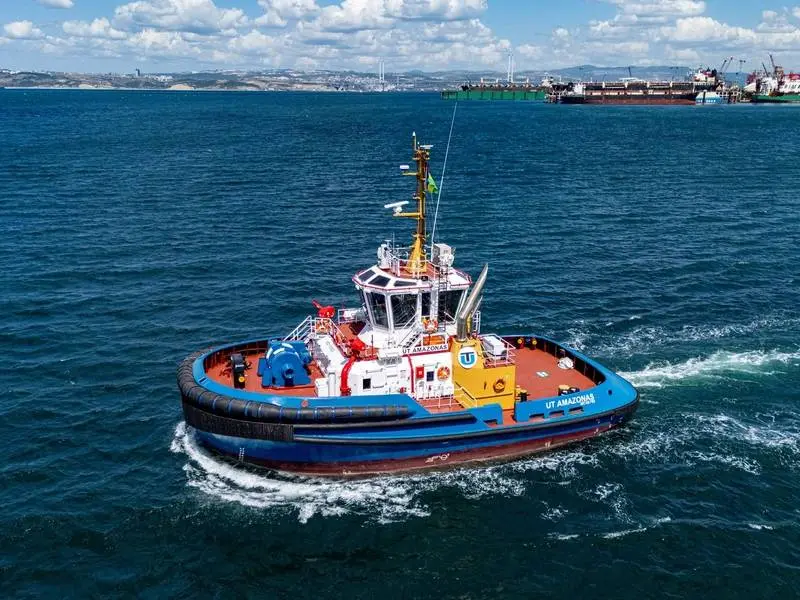
On August 11, 2026, the global maritime industry witnessed another milestone in the transition toward sustainable port operations. Sanmar Shipyards, a world-renowned Turkish tugbuilder, officially delivered UT AMAZONAS, a state-of-the-art, environmentally friendly tugboat, to Ultratug, one of the premier towage and marine services operators in the Americas. The handover ceremony, held at Sanmar’s cutting-edge Altinova Shipyard in Yalova, Turkey, marks a critical phase in Ultratug’s fleet modernization program.
UT AMAZONAS is destined for operations in Colombia, where it will provide essential harbor towing, escort, and terminal support services. The vessel is the direct sister ship to UT PATZCUARO, the first tugboat Sanmar constructed for Ultratug, which was delivered only a few months prior and is currently active in Mexican waters. Both vessels represent a major technological leap for Latin American port operations, introducing advanced emission-reduction technologies to a region experiencing rapid port expansion and increasingly stringent environmental standards.
Built to the proprietary RAmparts 2400SX-MKII design by the prestigious Canadian naval architects Robert Allan Ltd., UT AMAZONAS combines high-performance towing capabilities with a remarkably low environmental footprint. Equipped with Selective Catalytic Reduction (SCR) technology, the vessel fully complies with International Maritime Organization (IMO) Tier III emissions standards, significantly reducing nitrogen oxide ($textNO_x$) emissions. With a robust bollard pull of at least 75 tons and excellent maneuverability, this vessel is uniquely positioned to handle the larger container ships and liquid bulk carriers now frequenting Colombia’s major maritime hubs, such as Cartagena, Barranquilla, and Buenaventura.
Detailed Chronology
The delivery of UT AMAZONAS is the culmination of a structured, multi-year strategic partnership between Sanmar Shipyards and Ultratug, aimed at deploying highly efficient, low-emission vessels across key Latin American trade lanes.
[Late 2024 / Early 2025] Contract Signing & Design Selection (RAmparts 2400SX-MKII)
       │
       ▼
[Mid-2025] Keel Laying & Construction Commencement at Altinova Shipyard
       │
       ▼
[Early 2026] Delivery & Deployment of Sister Ship 'UT PATZCUARO' (Mexico)
       │
       ▼
[Mid-2026] Sea Trials & IMO Tier III Certification of 'UT AMAZONAS'
       │
       ▼
[August 11, 2026] Official Handover Ceremony at Altinova Shipyard
Phase 1: Design Selection and Contractual Agreements
The genesis of the project dates back to Ultratug’s strategic review of its regional operations. Facing demands from port authorities and international shipping lines for greener and more powerful escort tugs, Ultratug selected Sanmar Shipyards to build a new generation of versatile tugboats. The design chosen was the RAmparts 2400SX-MKII, developed exclusively for Sanmar by Robert Allan Ltd. This hull form was selected for its optimal balance of compact dimensions, high stability, and superior transit efficiency.
Phase 2: The Debut of the Sister Ship
The operational viability of this class was proven earlier in 2026 with the delivery of the sister vessel, UT PATZCUARO. Designed for Mexican port operations, UT PATZCUARO underwent rigorous sea trials before entering active service. Its successful deployment established a performance baseline that validated Ultratug’s investment in the Boğaçay Class platform, paving the way for the completion of the Colombian sister vessel.
Phase 3: Construction, Sea Trials, and Handover
Throughout late 2025 and the first half of 2026, UT AMAZONAS underwent construction at Sanmar’s Altinova Shipyard. This facility utilizes advanced robotic welding, modular assembly techniques, and strict quality control protocols to ensure structural integrity.

By mid-2026, the vessel commenced comprehensive sea trials in the Sea of Marmara. These trials evaluated its bollard pull, free-running speed, crash-stop distances, and the performance of its Selective Catalytic Reduction (SCR) units under varying load conditions.
The culmination of this process occurred on August 11, 2026, during an official delivery ceremony. The event was attended by senior leadership from both companies. The delegation from Ultratug Colombia featured:
- Silvia Herrera, Country Manager of Ultratug Colombia
- Cristian Franco, Fleet and Operations Manager, Colombia
- José Morales, Maintenance Engineer, Colombia
The delegation was received by Sanmar’s executive team, including:
- Ali Gürün, Vice Chairman & CEO of Sanmar Shipyards
- Ipek Gürün, Director of Corporate Strategy
- Selin Seven, Governance Processes Manager
- Ruchan Civgin, Commercial Director
Following the signing of the transfer documents and the traditional blessing of the vessel, UT AMAZONAS was prepared for its trans-Atlantic mobilization voyage to its new homeport in Colombia.
Supporting Context & Metrics
The Boğaçay Class tugboats built by Sanmar are widely regarded as a benchmark in modern tug design. Below is an in-depth analysis of the technical specifications, performance metrics, and environmental systems that distinguish UT AMAZONAS.
Technical Specifications & Dimensions
| Parameter | Specification |
|---|---|
| Class / Design | Boğaçay Class / RAmparts 2400SX-MKII |
| Designer | Robert Allan Ltd. (Canada) |
| Builder | Sanmar Shipyards (Turkey) |
| Overall Length (LOA) | 24.4 meters |
| Moulded Beam | 12.0 meters |
| Least Moulded Depth | 4.5 meters |
| Navigational Draft | Approximately 5.45 meters |
| Gross Tonnage | < 300 GT |
The compact length of 24.4 meters combined with a wide 12.0-meter beam provides high stability and a large working deck area, while allowing the vessel to operate effectively in tight slips and locks typical of Latin American ports.
Propulsion and Environmental Engineering
At the heart of UT AMAZONAS are its twin Caterpillar (CAT) 3516E marine diesel engines. Each engine is rated to produce a minimum of 2,200 kW of power at 1,600 rpm.
[CAT 3516E Engine] ──> [Exhaust Gas] ──> [Urea Injection (SCR)] ──> [Catalyst Chamber] ──> [IMO Tier III Compliant Emissions]
                                                                                              (Low NOx, Reduced Particulates)
To meet the stringent IMO Tier III emissions standards, the propulsion system is integrated with Caterpillar’s advanced Selective Catalytic Reduction (SCR) system.
- The SCR Process: The system works by injecting an aqueous urea solution (commonly known as DEF or AdBlue) into the exhaust stream upstream of a catalyst. This triggers a chemical reaction that converts harmful nitrogen oxides ($textNO_x$) into harmless nitrogen ($N_2$) and water vapor ($H_2O$).
- Environmental Impact: This technology reduces $textNO_x$ emissions by up to 80% compared to Tier II vessels. It enables UT AMAZONAS to operate in environmentally sensitive areas and comply with international green port initiatives.
- Automation and Efficiency: The vessel features high-level automation systems that monitor engine load, exhaust temperature, and urea dosing in real time, optimizing fuel consumption and minimizing chemical waste.
Performance and Maneuverability
UT AMAZONAS is designed to deliver exceptional power both ahead and astern, combined with omnidirectional maneuverability:
- Bollard Pull: Achieves a certified bollard pull of at least 75 tons over the stern, providing the necessary force to control and assist ultra-large container vessels (ULCVs) and LNG tankers.
- Free-Running Speed: Reaches a maximum free-running speed of 12.5 knots, allowing for rapid transit times between port stations.
- Thrusters: The vessel is equipped with twin Kongsberg US 255S P30 FP azimuth thrusters. Featuring fixed-pitch propellers rotating through 360 degrees, these thrusters provide exceptional vector thrust, enabling lateral movement and precise positioning in high-current environments.
Deck Machinery and Auxiliary Systems
The deck layout of UT AMAZONAS is optimized for safe, high-load towing operations:
- Forward Towing Winch: A heavy-duty TW-E 250 kN electrically driven forward towing winch is installed on the bow, designed for rapid line retrieval and precise tension control.
- Aft Towing Hook: A DTH 90-135P quick-release disc towing hook is fitted aft, providing backup towing capability over the stern.
- Firefighting (FiFi 1): The vessel features full FiFi 1 capability, powered by a dedicated pump system capable of delivering water and foam through dual monitors to combat shipboard or terminal fires.
Accommodation and Crew Comfort
Recognizing that crew fatigue is a critical factor in maritime safety, Sanmar and Robert Allan Ltd. integrated extensive soundproofing and vibration-dampening measures throughout the vessel.
- Layout: Accommodations are provided for up to eight crew members.
- Officer Cabins: Two high-grade, single-berth cabins on the main deck are designated for the Captain and Chief Engineer.
- Crew Cabins: Three spacious double-berth cabins are located on the lower deck.
- Amenities: The vessel includes a modern galley, a spacious mess/lounge area, and fully ducted air conditioning/heating systems designed for tropical Colombian climates.
Official Statements
The delivery ceremony at the Altinova Shipyard provided an opportunity for leadership from both Sanmar and Ultratug to emphasize the strategic significance of this project.
Ali Gürün, Vice Chairman & CEO of Sanmar Shipyards, highlighted the shipyard’s commitment to sustainable maritime engineering:
"The delivery of UT AMAZONAS is a proud moment for Sanmar. It represents not only our continued engineering excellence but also our commitment to helping our partners meet their environmental goals. The Boğaçay Class, particularly when equipped with IMO Tier III-compliant CAT engines and SCR technology, represents the pinnacle of modern, compact tug design. We are delighted to strengthen our relationship with Ultratug, a forward-looking operator that shares our vision for a cleaner, safer, and more efficient maritime sector."
Silvia Herrera, Country Manager of Ultratug Colombia, emphasized the operational and strategic impact of the new vessel on Colombian maritime infrastructure:
"The arrival of UT AMAZONAS in Colombia is a major step forward for our national operations. As Colombian ports continue to expand and welcome larger vessels, the demand for powerful, reliable, and environmentally responsible towage services has never been higher. This tugboat, with its 75-ton bollard pull and advanced green technology, will allow us to offer our clients unmatched operational safety and efficiency while actively reducing our carbon and emissions footprint in the local communities we serve. Sanmar has delivered a vessel of exceptional build quality."
Ruchan Civgin, Commercial Director of Sanmar Shipyards, focused on the collaborative nature of the shipbuilding process:
"Working alongside Ultratug’s technical and operational teams has been an outstanding experience. Designing and delivering a vessel that meets the specific demands of South American port infrastructures requires deep collaboration. UT AMAZONAS is tailored to perform in demanding environments, and its state-of-the-art propulsion and deck systems ensure it will remain an industry leader for decades to come."
Future Outlook: The Green Transition in Latin American Ports
The delivery of UT AMAZONAS occurs at a time when Latin American maritime infrastructure is undergoing rapid modernization. The expansion of the Panama Canal has permanently altered shipping routes, bringing larger Neo-Panamax vessels to the East and West coasts of South America. Ports in Colombia, such as the Port of Cartagena and the Port of Buenaventura, have invested heavily in dredging and terminal expansions to accommodate these giants.
                  ┌────────────────────────────────────────┐
                  │ Neo-Panamax Vessels in Colombian Ports │
                  └───────────────────┬────────────────────┘
                                      │ (Demands)
                                      ▼
                  ┌────────────────────────────────────────┐
                  │ Higher Bollard Pull & Escort Standards │
                  └───────────────────┬────────────────────┘
                                      │ (Meets)
                                      ▼
                  ┌────────────────────────────────────────┐
                  │      Deployments like UT AMAZONAS      │
                  │      (75t BP, IMO Tier III, FiFi 1)     │
                  └────────────────────────────────────────┘
Navigating New Operational Realities
Large container ships, often exceeding 14,000 TEU, require highly specialized harbor tugs to safely guide them through narrow access channels and assist in berthing operations, especially under challenging wind and current conditions. Tugs with less than 60 tons of bollard pull are increasingly insufficient for these tasks. By deploying UT AMAZONAS with its 75-ton bollard pull, Ultratug is positioning itself to secure lucrative long-term contracts with major global container lines that demand high safety margins.
The Rise of Environmental Mandates
Environmental sustainability is no longer optional in international shipping. Global shipping alliances (such as 2M, Ocean Alliance, and THE Alliance) are under intense pressure to decarbonize their supply chains. Consequently, they prefer port service providers that utilize low-emission vessels.
- NOx Regulations: While Latin America is not yet classified as a formal Emission Control Area (ECA) like the North Sea or the Baltic Sea, individual port authorities are increasingly introducing local incentives and green tariffs for environmentally friendly vessels.
- The Pioneer Advantage: By proactively introducing IMO Tier III-compliant tugs like UT AMAZONAS and UT PATZCUARO to Colombia and Mexico, Ultratug establishes a competitive advantage, setting a new benchmark for regional emissions standards.
Sanmar’s Role in Global Shipbuilding
For Sanmar Shipyards, this delivery solidifies its position as a global leader in the construction of low-emission and alternative-fuel tugboats. The shipyard’s portfolio has expanded to include not only IMO Tier III diesel vessels but also fully electric (ElectRA series) and dual-fuel LNG tugs.
As the maritime industry moves closer to the IMO’s 2030 and 2050 decarbonization targets, the partnership between innovative builders like Sanmar and progressive operators like Ultratug will serve as a model for regional fleets worldwide. UT AMAZONAS stands as a clear example of how modern engineering can balance the immediate demand for high-bollard-pull performance with the long-term necessity of environmental stewardship.