






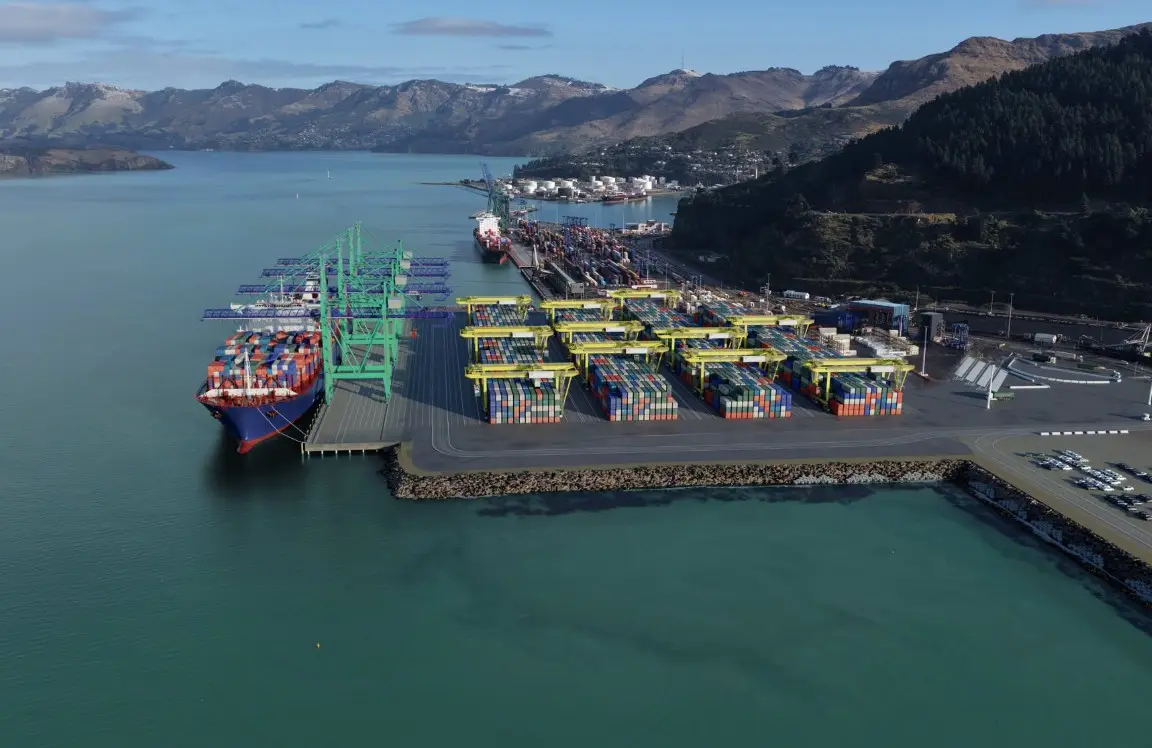
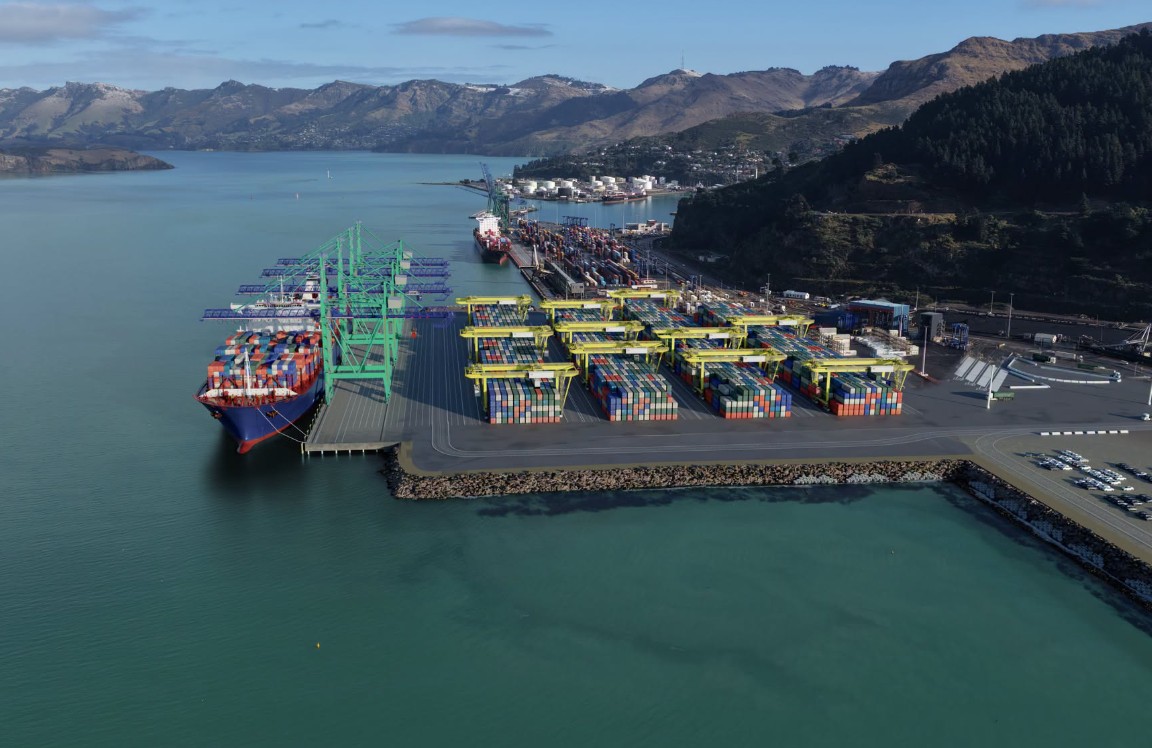
CHRISTCHURCH, NEW ZEALAND — In one of the most substantial maritime infrastructure investments in the modern history of the South Island, the Lyttelton Port Company (LPC) has officially unveiled an $821 million capital development program. Centered on the Te Awaparahi Bay Expansion and Resilience Project, this ambitious multi-year undertaking is designed to fundamentally upgrade New Zealand’s supply chain architecture, future-proof regional trade against seismic and climatic disruptions, and dramatically expand the operational capacity of the country’s South Island gateway.
Announced by LPC Board Chair Barry Bragg, the transformative initiative bridges a decade of post-earthquake reconstruction with a forward-looking strategy aimed at accommodating the next generation of global container shipping. By combining state-of-the-art capital dredging, coastal protection engineering, and advanced automated cargo-handling technologies, the project seeks to position Lyttelton Port as a premier, high-efficiency maritime hub in the Asia-Pacific region. Completion of the sweeping development is slated for 2031.
Executive Overview: Securing the Future of South Island Commerce
The $821 million injection into Te Awaparahi Bay is not merely an expansion of physical dock space; it represents a strategic pivot toward structural longevity, technological modernization, and enhanced international competitiveness. For decades, Lyttelton Port has served as the vital economic lifeline for Christchurch, Canterbury, and the wider South Island, facilitating the import of critical goods and the export of New Zealand’s world-renowned agricultural, manufacturing, and forestry products.
However, shifting paradigms in global shipping—characterized by the deployment of increasingly massive ultra-large container vessels (ULCVs)—have placed mounting pressure on regional ports worldwide. Shipping lines are rapidly consolidating routes around mega-vessels to achieve economies of scale, leaving ports with insufficient draft, berth length, or yard capacity at risk of being bypassed.
The Te Awaparahi Bay project directly addresses these structural challenges. At its core, the initiative will deliver:
- A brand-new, purpose-built 388-meter deepwater wharf capable of hosting some of the largest commercial vessels operating in Southern Hemisphere trade lanes.
- A 5-hectare reclaimed container terminal engineered to maximize yard density and operational efficiency.
- The integration of next-generation port equipment, including four massive ship-to-shore (STS) cranes and semi-automated gantry yard cranes.
- A quantum leap in throughput capacity, enabling the facility to support an annual berth capacity of approximately 850,000 TEU (Twenty-Foot Equivalent Units) and service vessels up to 15,000 TEU.
Detailed Chronology: From Post-Crisis Recovery to Mega-Expansion
To fully appreciate the magnitude of the $821 million investment, one must examine the evolutionary arc of Lyttelton Port over the past fifteen years. The port’s trajectory has been defined by an unyielding cycle of disaster recovery, structural adaptation, and strategic vision.
The Crucible of Recovery (2011–2020)
The foundation for today’s expansion was forged in the aftermath of the devastating Canterbury earthquakes of 2010 and 2011. The seismic events caused widespread liquefaction, lateral spreading, and severe structural damage to wharves, cargo handling equipment, and inland logistics corridors across Lyttelton.
For the better part of a decade, LPC’s operational focus was strictly internal: repairing fractured infrastructure, stabilizing damaged landmasses, and restoring baseline operational continuity. Billions of dollars were funneled into civil engineering works to ensure the port could safely continue servicing exporters and importers without catastrophic supply chain failures. During this period, marine engineers and terminal operators gained critical insights into geotechnical resilience, soil stabilization, and seismic design standards—expertise that would directly inform the blueprint for Te Awaparahi Bay.
Transition to Growth and Resilience (2020–2025)
By the early 2020s, having largely completed the essential phase of earthquake repairs, LPC leadership shifted its institutional posture from reactive recovery to proactive development. The port management recognized that simply maintaining pre-quake capabilities would be insufficient to meet the projected trade demands of the 2030s and beyond.
Planning for the Te Awaparahi Bay reclamation and expansion began taking concrete shape during this window. Environmental assessments, coastal modeling, community consultations, and engineering feasibility studies were systematically conducted. The overarching goal was to design an expansion footprint that could harmonize high-intensity industrial port operations with environmental stewardship within the sensitive marine ecosystem of Lyttelton Harbour (Whakaraupō).
The 2026 Investment Decision and Path to 2031
The formal announcement by Chair Barry Bragg in August 2026 marks the definitive transition from planning to execution. With the financial framework secured and strategic parameters defined, the project enters its primary development phase.
Over the next five years, the initiative will progress through several critical milestones:
- Marine Civil Works & Coastal Protection (2026–2028): Execution of extensive dredging campaigns, shoreline reinforcement, and marine foundation engineering to prepare Te Awaparahi Bay for heavy industrial loads.
- Wharf Construction & Land Reclamation (2028–2030): Building out the 388-meter deepwater wharf structure and finalizing the 5-hectare container terminal platform.
- Crane Installation & Automation Integration (2030–2031): Erection of the four ship-to-shore cranes, deployment of semi-automated gantry yard systems, and rigorous testing of terminal operating software.
- Full Commissioning (2031): Commercial handover and integration of the new terminal into the active shipping schedule.
Supporting Context & Operational Metrics
The engineering and logistical scope of the Te Awaparahi Bay project is immense. Modernizing a container terminal to handle vessels up to 15,000 TEU requires meticulous coordination across civil engineering, marine dredging, structural steel fabrication, and digital automation.
Infrastructure Specifications
To accommodate 15,000 TEU vessels safely, the marine environment must be engineered to withstand immense hydrodynamic forces. The new 388-meter wharf will feature deep-piled foundations designed to absorb the kinetic energy of massive container ships docking under varying wind and tidal conditions.
Simultaneously, the capital dredging component of the project will ensure that navigational channels and berth pockets maintain the necessary nautical depth (draft) to float fully laden mega-vessels. Dredging operations must be executed with precision to manage sediment displacement while adhering to stringent environmental monitoring protocols set by regional regulatory bodies.
Yard Optimization and Automation
Physical berth space alone does not guarantee port efficiency; the speed at which cargo is moved off ships, through the terminal gates, and onto rail or road networks is paramount. The inclusion of semi-automated gantry yard cranes and four advanced ship-to-shore cranes will dramatically reduce vessel turnaround times.
- Ship-to-Shore Cranes: These towering waterfront assets provide the outreach and lifting capacity required to clear containers from the wide, multi-layered decks of 15,000 TEU ships.
- Semi-Automated Gantry Cranes: Operating within the stack yards, these systems optimize container stacking density, reduce truck turnaround times, and enhance workplace safety by minimizing manual intervention in high-risk zones.
With an anticipated annual berth capacity of 850,000 TEU upon completion, Lyttelton Port will possess the headroom necessary to absorb future trade surges without introducing the crippling bottlenecks that have periodically plagued global maritime supply chains over the past decade.
Official Statements & Industry Perspectives
The announcement of the $821 million investment has drawn widespread attention from government officials, industry stakeholders, and economic analysts, who view the project as a critical endorsement of New Zealand’s export-driven economy.
Unveiling the financial commitment, LPC Chair Barry Bragg emphasized the generational nature of the endeavor:
“We’ve spent the last decade rebuilding and strengthening the port. Today’s announcement is about creating the capacity, resilience, and capability needed for the next generation of South Island trade.”
Bragg’s comments underscore the dual philosophy guiding LPC’s leadership: resilience against natural hazards and scalable capability for commercial growth. For a nation heavily reliant on maritime trade—where over 99% of international freight moves by sea—investments of this scale are foundational to national economic sovereignty.
Industry bodies and supply chain analysts have similarly lauded the decision. Exporters across the South Island—spanning dairy, horticulture, meat, wine, and forestry sectors—have long advocated for port infrastructure capable of attracting direct international shipping services. By enabling the handling of 15,000 TEU vessels, Lyttelton Port reduces the South Island’s reliance on transshipment hubs (such as ports in the North Island or Australia), thereby lowering freight costs, reducing transit times, and shrinking the carbon footprint of regional supply chains.
Future Outlook: A New Benchmark for New Zealand Logistics
As Lyttelton Port Company looks toward the 2031 completion date, the Te Awaparahi Bay Expansion and Resilience Project stands as a defining monument to modern engineering and strategic foresight.
In an era defined by geopolitical shifts, climate vulnerabilities, and rapid technological transformation, ports can no longer function merely as passive interfaces between land and sea. They must operate as intelligent, highly resilient nodes within an interconnected global logistics web. By integrating robust coastal defenses, seismic engineering, and advanced automation into the Te Awaparahi Bay development, LPC is setting a new benchmark for maritime infrastructure in the Southern Hemisphere.
When the first ultra-large container vessel berths at the new 388-meter wharf in 2031, it will not just symbolize the culmination of an $821 million construction effort. It will mark the dawn of a more connected, competitive, and secure trading future for the South Island—ensuring that New Zealand businesses remain powerfully linked to the pulse of global commerce for generations to come.