










Executive Overview
In an aggressive maneuver to rewrite its financial trajectory and capture a lucrative, high-yielding segment of the aviation market, JetBlue Airways has officially unveiled its long-awaited domestic first-class product, branded as BlueFirst. Rolled out on Tuesday, the new offering represents a monumental strategic pivot for an airline historically celebrated for its single-class, low-cost model and its later disruption of the transcontinental market with its acclaimed "Mint" business class.
For six consecutive years, JetBlue has reeled from a string of financial losses, battered by macroeconomic headwinds, soaring labor and operational costs, the post-pandemic normalization of travel demand, and the regulatory collapse of its proposed merger with Spirit Airlines. In response, airline leadership is betting the house—or, more accurately, the cabin—on BlueFirst. The carrier is banking on these premium domestic seats to transform its balance sheet, attract high-spending corporate and leisure travelers, and serve as a primary catalyst in its return to profitability.
The BlueFirst initiative is not merely a cosmetic refresh; it is a holistic overhaul of the passenger experience on key domestic routes. Featuring cutting-edge ergonomics, customized culinary programming, craft cocktails, and a suite of elevated ground and in-flight perks, BlueFirst is engineered to compete directly with the legacy Big Three—Delta Air Lines, United Airlines, and American Airlines—on their own turf.
As JetBlue prepares to open bookings this autumn and debut the first retrofitted aircraft later this year, the aviation industry is watching closely. This report provides an in-depth analysis of the BlueFirst rollout, examining the physical specifications of the product, the financial imperatives driving the decision, the operational integration across the fleet, and the long-term outlook for a carrier fighting to secure its place in the modern skies.
Detailed Chronology: From Single-Class Disrupter to Premium Competitor
To understand the magnitude of the BlueFirst announcement, one must trace the evolutionary arc of JetBlue’s cabin philosophy since its inception.
The Low-Cost Genesis
Founded in 1999 by David Neeleman, JetBlue entered the U.S. aviation market with a radical proposition: bring humanity back to air travel by offering low fares coupled with a superior customer experience. Crucially, this meant an all-coach, single-class configuration across its fleet, outfitted with leather seats, personal live-television screens, and generous legroom. For over a decade, this democratic approach resonated deeply with consumers and fueled rapid growth.
The Mint Revolution (2014)
The first major crack in JetBlue’s single-class armor occurred in 2014 with the introduction of Mint, its transcontinental and later transatlantic business-class product. Mint featured fully lie-flat seats, private suites with sliding doors, curated dining, and high-end amenities. It was an unmitigated success, instantly capturing market share from legacy carriers on lucrative routes like New York (JFK) to Los Angeles (LAX) and San Francisco (SFO). Mint proved that JetBlue could successfully upsell passengers, but the product was strictly limited to long-haul and select international flights. The vast majority of its domestic network remained strictly single-class.

The Post-Merger Realignment and Financial Pressures (2020–2024)
The intervening years brought unprecedented turbulence. The COVID-19 pandemic devastated global aviation, and JetBlue’s subsequent efforts to scale rapidly—most notably through its "Northeast Alliance" with American Airlines and its ambitious acquisition bid for Spirit Airlines—drained corporate resources. When federal antitrust rulings blocked both the NEA and the Spirit merger in quick succession, JetBlue found itself isolated, financially bruised, and carrying a heavy debt load.
For six straight years, the airline posted net losses. Leadership realized that organic growth via its traditional network was insufficient to offset rising operational expenses. The airline needed structural margin expansion. The decision to introduce a dedicated domestic first-class product—a staple of legacy profitability—transitioned from a distant consideration to an urgent operational imperative.
The Unveiling (Tuesday)
On Tuesday, after months of industry speculation and internal development, JetBlue formally pulled back the curtain on BlueFirst. The unveiling marks the official birth of JetBlue’s domestic premium era, signaling to Wall Street and competitors alike that the carrier is willing to evolve its core product identity to survive and thrive.
Supporting Context & Metrics: Engineering the BlueFirst Experience
BlueFirst is designed to impress both tactilely and technologically. JetBlue’s product development teams spent months analyzing passenger pain points in domestic short- and medium-haul travel to engineer a cabin that balances luxury, comfort, and operational efficiency.
Ergonomics and Seating Innovations
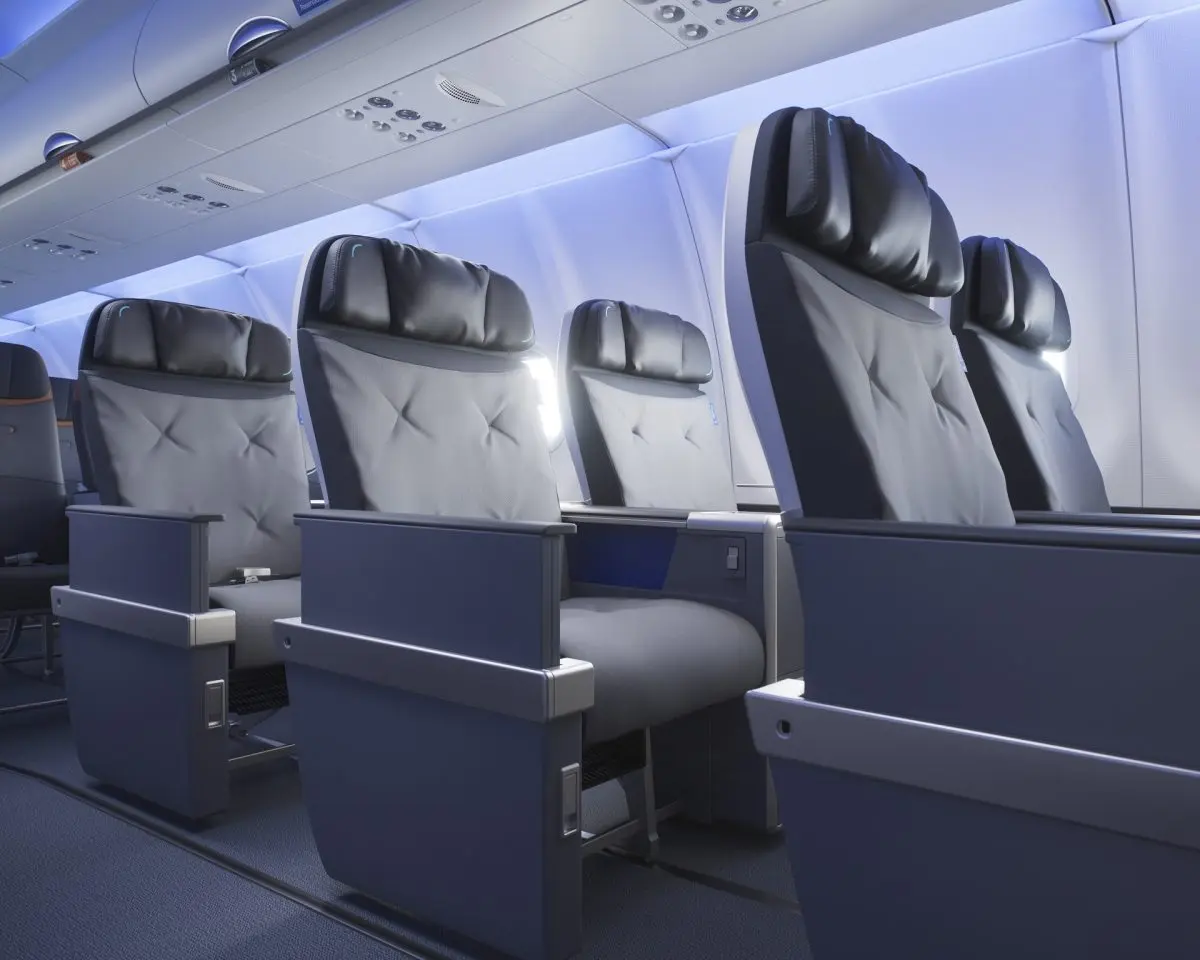
At the heart of the BlueFirst experience is the seat itself. Abandoning standard industry molds, JetBlue partnered with manufacturers to design a proprietary seat utilizing advanced foam technology typically reserved for high-end mattresses. This pressure-relieving foam is intended to mitigate fatigue on cross-country and multi-hour regional flights.
- Legroom and Recline: BlueFirst passengers will enjoy seven additional inches of legroom compared to standard domestic configuration, alongside up to five inches of recline.
- Cabin Configuration: The seats will be arranged in a comfortable 2×2 layout.
- Fleet Integration: The rollout will vary by aircraft type. Airbus A220s and A320s will feature 12 BlueFirst seats, while the larger Airbus A321 aircraft will accommodate 16 seats.
Technological Integration and Amenities
Recognizing that modern travelers measure comfort through connectivity as much as physical space, JetBlue has outfitted the BlueFirst cabin with state-of-the-art amenities:
- In-Flight Entertainment (IFE): Each seat features a sprawling 13.3-inch high-definition seatback screen, paired with robust streaming capabilities and live television.
- Power and Storage: Dedicated AC and USB power outlets ensure devices remain charged, while passengers benefit from reserved overhead bin space, eliminating the stressful scramble for luggage real estate during boarding.
- Soft Product Extras: Customers will receive premium blankets and curated amenity kits designed to rival long-haul international offerings.
Ground Experience and Priority Services
True premium travel extends far beyond the aircraft door. BlueFirst passengers will receive a comprehensive suite of priority services designed to streamline the airport journey:
- Priority Boarding and Check-in: Dedicated airport lanes will allow premium flyers to bypass standard queues.
- Accelerated Security: BlueFirst customers will enjoy access to expedited security lanes at more than 30 major airports across JetBlue’s network.
Culinary Program: Customized Cocktails and Seatback Ordering
Food and beverage service is often a primary differentiator in premium travel. BlueFirst introduces a refreshed culinary program featuring regionally inspired, hot and cold meals tailored to flight duration and time of day.
Furthermore, JetBlue is leveraging its robust digital infrastructure to introduce seatback ordering for food and drinks. Passengers can browse, select, and customize their culinary and cocktail options directly through their 13.3-inch entertainment screens. The beverage menu has similarly been elevated, featuring customized, craft-forward cocktails designed exclusively for the BlueFirst experience.
Official Statements and Industry Analysis
The announcement of BlueFirst has generated widespread commentary from travel analysts, aviation experts, and JetBlue’s executive leadership team.
Industry observers note that the launch represents a defensive and offensive masterstroke. For years, corporate travel buyers and high-net-worth leisure travelers booked away from JetBlue because the carrier lacked a domestic first-class cabin to match Delta, United, or American. By plugging this glaring gap in its product portfolio, JetBlue immediately unlocks access to lucrative corporate contracts that mandate first-class booking options for executive travel.
Financial analysts point out that premium seating disproportionately drives airline profitability. While economy seats often cover baseline operating costs, premium cabins yield significantly higher margins per square foot of aircraft real estate.
While JetBlue’s executive suite has emphasized that BlueFirst is a direct response to evolving consumer demands, the underlying narrative is clear: margin recovery is the ultimate goal. In investor briefings following the reveal, leadership underscored that the capital expenditure required to retrofit the A220, A320, and A321 fleets is a calculated investment designed to yield immediate returns once bookings open this fall.
Future Outlook: Can BlueFirst Rescue JetBlue’s Bottom Line?
As JetBlue looks toward the horizon, the successful execution of the BlueFirst rollout will serve as the ultimate litmus test for the carrier’s current turnaround strategy.
Implementation Timeline
The timeline is tight and ambitious. Following Tuesday’s unveiling, marketing campaigns and corporate outreach will ramp up throughout the summer. Bookings for BlueFirst will officially open in the fall, with the first retrofitted aircraft scheduled to enter commercial service later this year. Fleet-wide retrofits will continue progressively, scaling up through 2025 and beyond.
Competitive Realities
Entering the domestic first-class arena pits JetBlue against formidable incumbents. Delta Air Lines, United Airlines, and American Airlines have spent decades refining their domestic premium offerings, complete with expansive domestic lounge networks (such as Delta Sky Clubs and United Clubs) and deeply entrenched frequent-flyer loyalty ecosystems.
To win over discerning flyers, JetBlue will need to lean heavily on its historic strengths: superior hospitality, faster free Wi-Fi, larger baseline screen sizes, and the cult-like loyalty of its core customer base. Furthermore, the integration of BlueFirst with its existing Mint product creates a seamless "premium ladder" for travelers moving from domestic hops to transcontinental or transatlantic journeys.
The Path to Profitability
Ultimately, BlueFirst must do more than just win design awards—it must generate hard cash. After six consecutive years in the red, JetBlue’s stakeholders have little patience for prolonged transition periods. If BlueFirst successfully captures high-yield business travelers and lucrative corporate accounts, it could decisively swing the airline back into profitability, validating leadership’s bold gamble.
Should execution falter or consumer adoption lag, however, the financial burden of fleet retrofits could deepen the airline’s woes. For now, all eyes are on the tarmac as JetBlue prepares to launch its most ambitious cabin transformation in a decade, hoping that mattress-foam seats and craft cocktails can pave the way to a secure and profitable future.