









Executive Overview
For the past two years, artificial intelligence has dominated boardrooms, investor calls, and strategy decks across the global travel sector. Early narratives were characterized by boundless optimism, breathless press releases, and speculative implementations of generative AI wrappers. Every major hospitality brand, airline, online travel agency (OTA), and global distribution system (GDS) scrambled to prove they were at the bleeding edge of the technological revolution.
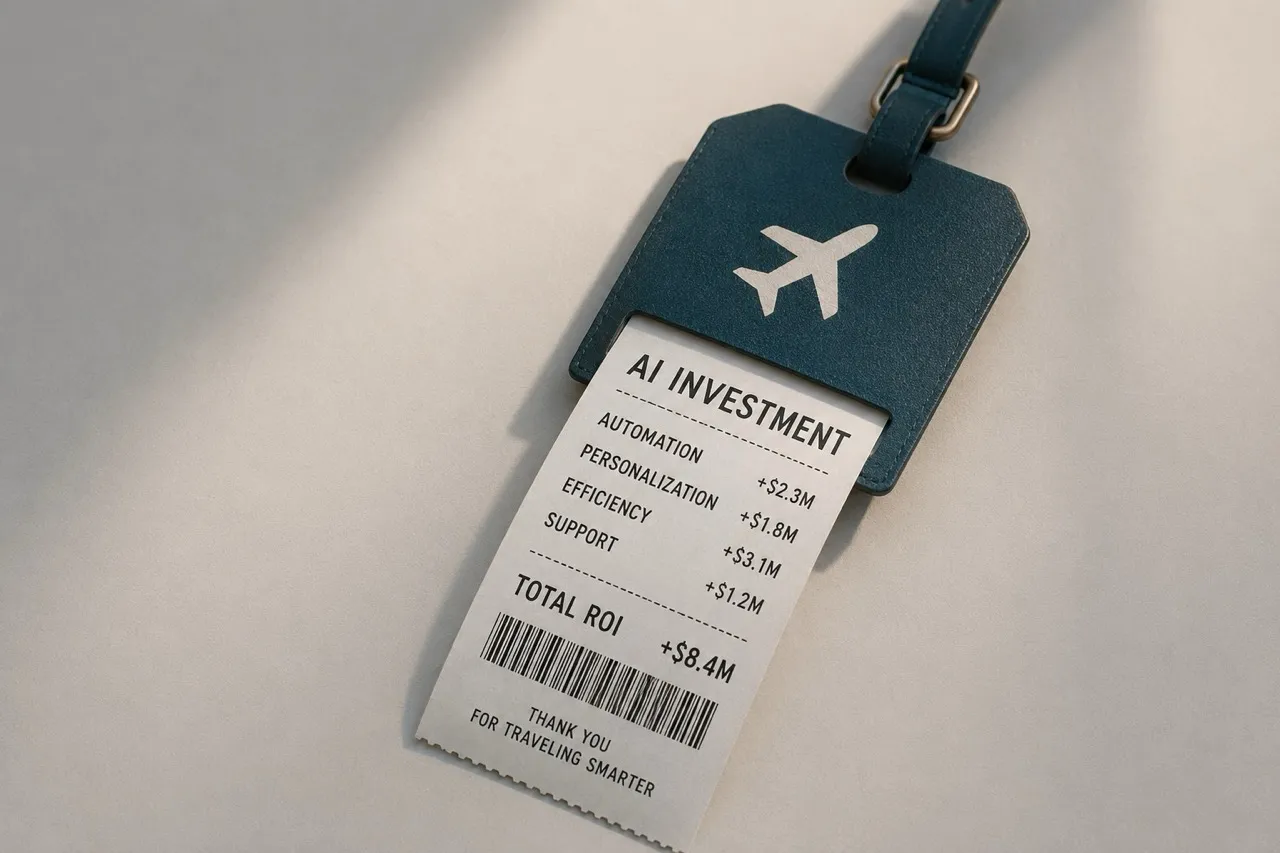
However, as the industry navigates the latest sweep of corporate earnings, SEC filings, shareholder presentations, and executive commentary, a profound maturation is taking place. The travel sector’s AI race has officially entered a disciplined, execution-focused phase. The era of loose experimentation and amorphous promises has given way to a rigorous demand for quantifiable value, operational efficiency, and clear-cut return on investment (ROI).
Rather than treating AI as a magical panacea, industry leaders are increasingly explicit about what the technology actually delivers, where it falls short, and how it directly impacts the bottom line. Distinctions are rapidly emerging across the travel ecosystem. Consumer-facing giants like Airbnb and Booking Holdings are demonstrating tangible economic benefits, validating their AI strategies with concrete financial gains and market performance. Others, such as Expedia, are taking a more nuanced view—acknowledging that while certain AI-driven consumer features are successfully boosting conversion rates, the true long-term value may lie in predictive analytics that decode shifting traveler intent. Meanwhile, foundational infrastructure providers like Sabre and Amadeus are positioning themselves to cement their roles as the technological backbone of travel AI, patiently laying the groundwork even as transaction volumes remain modest.

This article provides an in-depth analysis of this transitional epoch. By examining how different sectors of the travel industry are measuring the payoff of artificial intelligence, we will explore the shifting metrics of success, the strategic divergence between OTAs and infrastructure players, and the long-term outlook for a sector fundamentally reshaped by algorithmic intelligence.
Detailed Chronology: From Generative Hype to Pragmatic Deployment
To understand where the travel industry stands today, it is essential to trace the rapid evolution of artificial intelligence deployment over recent operational cycles. The trajectory has not been linear; it has been defined by rapid pivoting from consumer-facing novelty to back-end optimization and economic accountability.
Phase One: The Generative Surge (Late 2022 – Mid 2023)
Following the public debut of OpenAI’s ChatGPT in late 2022, the travel industry experienced an immediate reflexive response. Companies across the spectrum rushed to launch conversational trip planners, AI-powered chatbots, and personalized recommendation engines. These early rollouts were largely defensive and promotional, designed to signal technological agility to Wall Street and capture early-adopter consumer attention. Little empirical data existed regarding whether these tools actually drove bookings; the primary metric of success was deployment speed.
Phase Two: The Friction and Realization (Late 2023 – Early 2024)
As initial implementations scaled, travel executives encountered the structural limitations of early generative AI models—specifically high inference costs, hallucinations, and a failure to seamlessly convert exploratory chat sessions into completed transactions. Consumers enjoyed playing with AI travel itineraries, but conversion rates lagged behind traditional search-and-filter interfaces. Companies were forced to confront a hard truth: novelty does not automatically translate to net revenue. This realization triggered a quiet internal pivot toward efficiency, data governance, and high-margin use cases.

Phase Three: The Discipline and ROI Era (Mid 2024 – Present)
The current phase is defined by strict economic discipline. Travel corporations are no longer evaluated simply on whether they use AI, but how AI contributes to specific Key Performance Indicators (KPIs)—ranging from customer acquisition costs and average order value to customer lifetime value and call center containment rates. The latest earnings season marked a watershed moment: companies that could clearly articulate AI’s economic contribution were rewarded by the markets, while those relying on vague technological aspirations faced mounting skepticism from institutional investors.
Supporting Context & Metrics: Measuring the Payoff
The financial reality of AI in travel is deeply nuanced. Different segments of the industry are experiencing vastly different economic payoffs based on their business models, customer touchpoints, and technological integration depths.
Online Travel Agencies (OTAs) and the Economics of Engagement
For online travel agencies, the economic test of artificial intelligence depends entirely on use-case execution. OTAs sit at a unique vantage point: they command massive volumes of transactional data, search queries, and behavioral histories.
- Booking Holdings: As a dominant global force, Booking Holdings has systematically integrated machine learning and generative AI into its property-matching algorithms, customer service workflows, and trip-planning interfaces. Rather than deploying standalone, gimmicky chatbots, Booking has woven AI into the fabric of the core booking journey. The economic payoff is visible in optimized inventory matching, reduced customer friction, and streamlined internal operations.
- Airbnb: The ultimate validation of modern travel tech execution came when Airbnb released its second-quarter earnings. The company’s financial results, underpinned by smarter algorithmic matching, host optimization tools, and localized search enhancements, propelled Airbnb shares to a notable 17% jump. Investors signaled clear approval of a platform strategy where AI enhances supply-demand equilibrium without inflating structural overhead.
- Expedia Group: Expedia’s approach represents the pragmatic middle ground of the OTA landscape. During recent earnings calls, executives noted that select consumer-facing AI products have officially crossed the threshold into driving actual conversions. However, Expedia has also displayed refreshing candor: not all consumer-facing AI features have yielded immediate transactional lifts. Crucially, the company believes the technology’s most potent long-term value proposition lies in its ability to shed light on granular traveler intent. By analyzing complex, unstructured search behavior through advanced language models, Expedia can better anticipate what users want before they even articulate it, transforming search intent into targeted marketing and personalized inventory presentation.
GDS and Infrastructure Providers: Laying the Foundation
While OTAs fight for the consumer click, Global Distribution Systems and travel tech giants like Sabre and Amadeus are playing a longer, foundational game.
For infrastructure providers, the excitement around "agentic AI"—autonomous software agents capable of executing complex multi-step travel bookings on behalf of humans—does not yet match the current transaction volume. Agentic volumes remain small, boutique, and experimental. However, both Sabre and Amadeus understand that when agentic AI scales, the underlying plumbing of the travel industry must be ready to support it.
These companies are actively re-architecting their APIs, modernizing their legacy systems, and embedding AI into enterprise-grade B2B tools. Their objective is clear: they are positioning themselves to cement their infrastructure roles in travel AI. Whether a consumer books via an OTA, a hotel app, or an autonomous AI agent, Sabre and Amadeus intend to process the transaction, ensuring their B2B moats remain unassailable regardless of how the front-end user interface evolves.
Official Statements and Industry Commentary
The shift from hype to discipline is perhaps best captured through the direct commentary of travel tech leaders who are navigating this economic transition in real-time.
Industry analysts note a distinct evolution in executive language during recent earnings calls. Where CEOs once peppered their remarks with buzzwords like "transformative disruption" and "revolutionary ecosystems," they now speak the language of unit economics, margin protection, and operational leverage.
"Travel’s AI race is entering a more disciplined phase: companies are getting more explicit about AI’s value and what it actually delivers."
This sentiment echoes across boardrooms. Executives are increasingly pressured to justify heavy capital expenditures dedicated to cloud computing, large language model licensing, and specialized engineering talent.
An executive briefing from a leading travel technology consultancy emphasized this cultural shift: "The honeymoon period for AI is over. Wall Street no longer rewards companies simply for putting the letters ‘A-I’ in a presentation deck. The market demands proof of unit economics. If a generative feature costs more in API inference fees than the incremental booking margin it generates, it is a failed product. Companies are waking up to this reality."
Conversely, companies demonstrating clear correlation between AI deployment and top-line growth are commanding investor confidence. The dramatic market reaction to Airbnb’s earnings report underscores that when AI capabilities directly improve user retention, conversion efficiency, and host satisfaction, the financial rewards are swift and substantial.
Future Outlook: Where Travel AI Goes From Here
As the travel industry looks toward the horizon, the trajectory of artificial intelligence will be defined by several critical vectors: consolidation, hyper-personalization, operational automation, and regulatory scrutiny.
1. From Conversational Interfaces to Autonomous Agents
The next frontier beyond basic chatbots is the maturation of agentic workflows. Over the next three to five years, consumers will increasingly delegate entire trip lifecycles—from flight disruptions and hotel re-booking to dynamic itinerary adjustments—to autonomous AI agents. Infrastructure players like Amadeus and Sabre are building the secure, high-speed API corridors required to handle machine-to-machine transactions safely.
2. Back-Office and Operational ROI
While consumer-facing AI garners the most media attention, the most profound economic payoffs will likely continue to occur behind the scenes. Revenue management systems, dynamic pricing engines, automated baggage handling algorithms, and predictive maintenance for aviation will drive billions in structural savings. Travel companies that master back-office AI integration will enjoy superior margin profiles, insulating them against macroeconomic volatility and labor cost inflation.
3. The Data Moat Advantage
As foundational large language models become increasingly commoditized, the true competitive advantage in travel AI will not lie in the model itself, but in proprietary data moats. Companies that possess deep, proprietary behavioral data—such as historical booking patterns, loyalty preferences, and real-time operational feedback—will train superior localized models that generalized third-party tools simply cannot replicate.
4. Regulatory and Ethical Pressures
Finally, as AI takes on a more decisive role in pricing, availability, and consumer profiling, travel companies will face heightened regulatory scrutiny regarding algorithmic bias, transparency, and data privacy. Navigating these compliance challenges will become a core competency for sustainable AI adoption.
Conclusion
The travel industry’s encounter with artificial intelligence has matured past its adolescent phase. The reckless enthusiasm of the early generative AI boom has been tempered by financial reality, rigorous market testing, and investor demands for empirical proof.
Today, the industry recognizes that AI is neither a miraculous cure-all nor a passing fad; it is a powerful, highly specialized suite of tools that requires strategic discipline to yield results. Whether through Airbnb and Booking’s proven conversion engines, Expedia’s deep dives into traveler intent, or Sabre and Amadeus’s patient fortification of backend infrastructure, the travel sector is building a more resilient, efficient, and economically accountable future. In this new era of AI realism, success belongs not to the loudest prognosticators, but to the most disciplined executors.