





Executive Overview
To the casual observer standing on the banks of Idaho’s Salmon River, the churning confluence of water, foam, and rock looks like a place to avoid at all costs. Thousands of cubic feet per second of raw, glacial momentum slam into a massive boulder, collapsing into frothing whitewater before tearing into a deep, unsettled eddyline. It is a chaotic, violent hydraulic feature—the kind of rapid that strikes fear into the hearts of traditional rafters and seasoned kayakers alike.
Yet, for a tight-knit, fiercely dedicated subculture of extreme paddlers, this exact spot represents holy ground.
Back in November, South Carolina paddler and veteran squirt boater Andy Grizzell posted a video of this very Salmon River seam on Facebook. The clip sent shockwaves through the niche community of squirt boaters, instantly sparking debates, memes, and the hashtag #sinkandgetdestroyed. Grizzell was pitching it as the official sink spot for the upcoming 17th annual Mystery Worlds, scheduled for July 4, 2026.
Mystery Worlds is not your standard whitewater competition. There are no gates to navigate, no corporate sponsors handing out energy drinks, and no massive cash prizes. Instead, it is an underground, highly specialized gathering of paddling’s most eccentric daredevils. Between 10 and 40 elite athletes converge on a single, hyper-specific underwater hazard—a "sink spot"—to compete in the sport’s ultimate test: the mystery move.
In this realm, victory is measured not in seconds above the water, but in seconds below it. As competitors dive their ultra-low-volume watercraft into descending currents, they vanish completely from sight, swallowed by the river for up to a minute or more while water pressure squeezes their chests and pops their ears. Part extreme sport, part fluid-dynamics experiment, and part summer camp for water-obsessed renegades, the Mystery Worlds competition stands as one of the most unique subcultures in the outdoor world.
Detailed Chronology: From Social Media Buzz to the Quest for the 2026 Title
The path to the 17th annual Mystery Worlds began quietly in the digital ether before building toward the high-altitude wilderness of Idaho.
The Spark: November Social Media Revelation
When Andy Grizzell uploaded his now-famous Facebook video in late autumn, he wasn’t just sharing a cool piece of river footage. As the reigning 2025 Mystery Worlds champion, Grizzell held the traditional privilege of selecting the venue for the following year’s event.

The video captured a thunderous stretch of the Salmon River near Riggins, Idaho. Water wraps furiously around a mid-river boulder, creating a complex, subterranean-pulling seam. Comments piled up fast, alternating between awed declarations of destruction and tongue-in-cheek jokes labeling the spot "a perfect place to do less." But beneath the banter, the community recognized the gravity of Grizzell’s choice.
The Evolution of Venues: From East Tennessee to the Wild West
The location of Mystery Worlds changes every year, dictated entirely by who won the previous championship. The reigning titleholder wields absolute authority, choosing whether to host the event on a classic, reliable run or a wild, unexplored mission that requires deep reconnaissance.
For the 2025 competition, four-time Mystery Worlds champion Taft Sibley took the crown and chose the Leslie on the Hiawassee River in east Tennessee. Sibley’s strategy was inclusive: he wanted a well-known spot with easy access, situated right in the heartland of America’s highest concentration of squirt boaters. His stated mission was simple: get as many people into a squirt boat as possible.
The gambit paid off brilliantly. Locals walking the riverside trail were greeted by a surreal sight: a massive rubber flotilla the size of a pickleball court, packed with nearly 100 competitors and spectators, all staring fixedly at a single, unassuming patch of swirling water. When Grizzell emerged victorious after nailing a breathtaking 39.10-second alternate-charc ride, the flotilla erupted.
Now, moving from the accessible, spectator-friendly waters of Tennessee to the rugged backcountry of Idaho’s Salmon River marks a dramatic tonal shift. It is a return to a "mission-style" event—a place that demands travel, rigorous on-site study, and a willingness to gamble on an unfamiliar seam.
As Grizzell himself put it when asked about the risks of choosing such a remote and volatile location: "Could it flop on me? Yeah, it could flop. But who cares? It’ll still be squirt boating."
Supporting Context & Metrics: The Anatomy of the Mystery Move
To understand why the Mystery Worlds community is so captivated by these specific hydraulic features, one must first understand the equipment and the physics of the "mystery move."
The Watercraft: Swimming in Fiberglass
Squirt boats bear little resemblance to modern whitewater kayaks. They are custom-molded, ultra-low-volume craft that taper down to knife-edge points at both the bow and stern, functioning more like aerodynamic wings than traditional displacement hulls. There is virtually no excess space inside; the boat molds tightly around the paddler’s legs, hips, and feet.
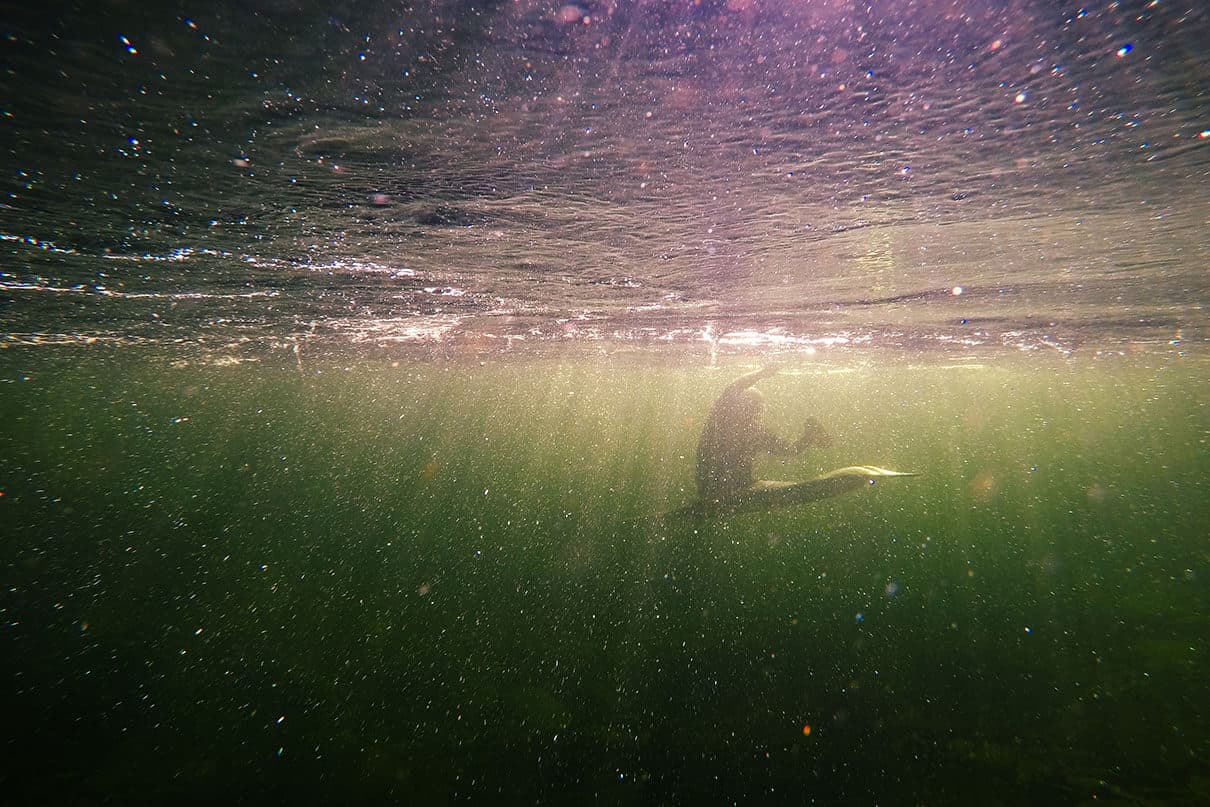
As multi-Mystery Worlds winner and downtime record-holder Jeremy Pou famously observed: "You can’t get more in the water. It’s essentially swimming in a piece of fiberglass."
Because of this minimal volume, squirt boats are intensely sensitive to weight distribution and hydrodynamic forces. Competitors frequently experiment with ballast, stuffing up to eight pounds of lead shot into their boats to help punch through the surface tension and plunge deeper into the river’s throat.
The Physics of the Sub-Surface Fishbowl
A mystery move is initiated when a paddler executes a charc—the charging arc used to build momentum—and dives their boat directly into an eddyline or seam where the river’s current forces immense volumes of water downward.
Once caught in the downward vector, the boat and rider are sucked completely beneath the surface. Staying down for 20, 30, 40 seconds, or longer is entirely a test of the boater’s core strength, breath control, and ability to micro-adjust their position inside a violently shifting hydraulic trap before the boat’s inherent buoyancy eventually forces them back to the light.
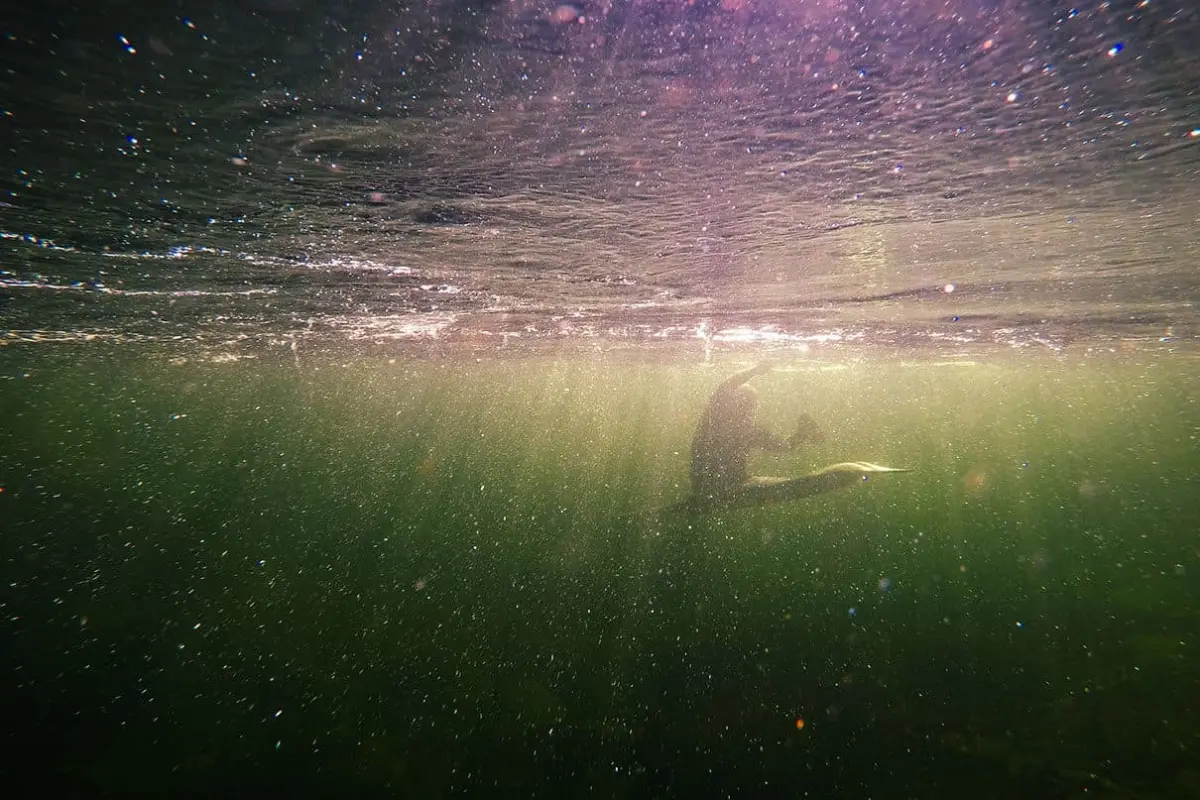
Below the surface, the experience is entirely divorced from the chaotic roar of the whitewater above. From the riverbank, sunlight refracting through churning water bursts into metallic flakes of gold, green, red, and blue, making the brightly colored boats look like rainbow sturgeon darting through a current. But from the inside, the reality is starkly physical.
"Sixteen feet hurts," Pou recalls, reflecting on the 2018 Worlds held on Oregon’s Santiam River. At that depth, the sheer weight of the river applies crushing hydrostatic pressure. Ears pop, chests compress, and the tight fiberglass hulls squeeze painfully against knees, shins, and sensitive anatomy. Yet, past the threshold of the surface whirlpools, the rushing water suddenly muffles into an eerie silence, transforming the hidden depths into a surreal aquatic fishbowl.
Official Statements & Community Philosophy
Despite the intense physiological strain and the competitive stakes, the Mystery Worlds maintain a remarkably laid-back, anti-establishment ethos. There are no rigid, overly litigated rulebooks governing hull designs or equipment specs. One competitor might arrive in a state-of-the-art carbon-fiber prototype loaded with lead weights, while another might show up in a vintage craft that barely sinks below navel-deep.
For the athletes who dedicate their summers to chasing these elusive river seams, the equipment is secondary to raw human capability.
"At the end of the day, skill matters more than the boat," notes four-time champion Taft Sibley.
This philosophy anchors the community in a spirit of camaraderie rather than corporate rivalry. Andy Grizzell captures the prevailing mindset by likening the annual gathering to a seasonal ritual:
"Taft and I call it Beach Week. Everyone else goes to the beach for a week in the summer. We go to a mystery spot and milk it for everything it’s got, sun up to sundown, and try to get the biggest rides we can out of the place."
This "Beach Week" attitude ensures that the competition never takes itself too seriously. People return year after year not merely to add another line to their resume or lift the traveling trophy, but for the rare, shared privilege of pushing a strange little craft a bit deeper into the unknown alongside kindred spirits who truly understand the call of the abyss.
Future Outlook: Looking Ahead to July 4, 2026
As the paddling community looks toward the horizon, all eyes are fixed on Riggins, Idaho. The 17th annual Mystery Worlds on the Salmon River promises to be a watershed moment for the sport.
Moving the competition to a high-consequence, remote western river raises the stakes significantly. Unlike accessible southeastern runs where spectators can line the banks in comfort, the Salmon River demands respect, rigorous safety protocols, and a high degree of technical mastery from every participant. The hydraulics of the chosen Idaho boulder-seam are less forgiving, more powerful, and entirely less predictable than the urban-adjacent drops of previous years.
Will Grizzell’s bold gamble pay off with record-shattering sub-surface times, or will the Salmon River prove too unruly, forcing the community to adapt on the fly? Whatever transpires on July 4, 2026, one thing is certain: the squirt-boating faithful will be there, huddled around the eddyline, watching for the flash of a brightly colored hull, ready to celebrate whoever manages to sink and get destroyed.