











Executive Overview
The transition of the United States power grid toward renewable energy sources has often been characterized as a patchwork journey, marked by rapid deployment in regions like the wind-rich plains of the Midwest and the vast solar installations of the Southwest. However, a seismic shift is underway in one of the country’s traditionally more constrained energy markets: New England.
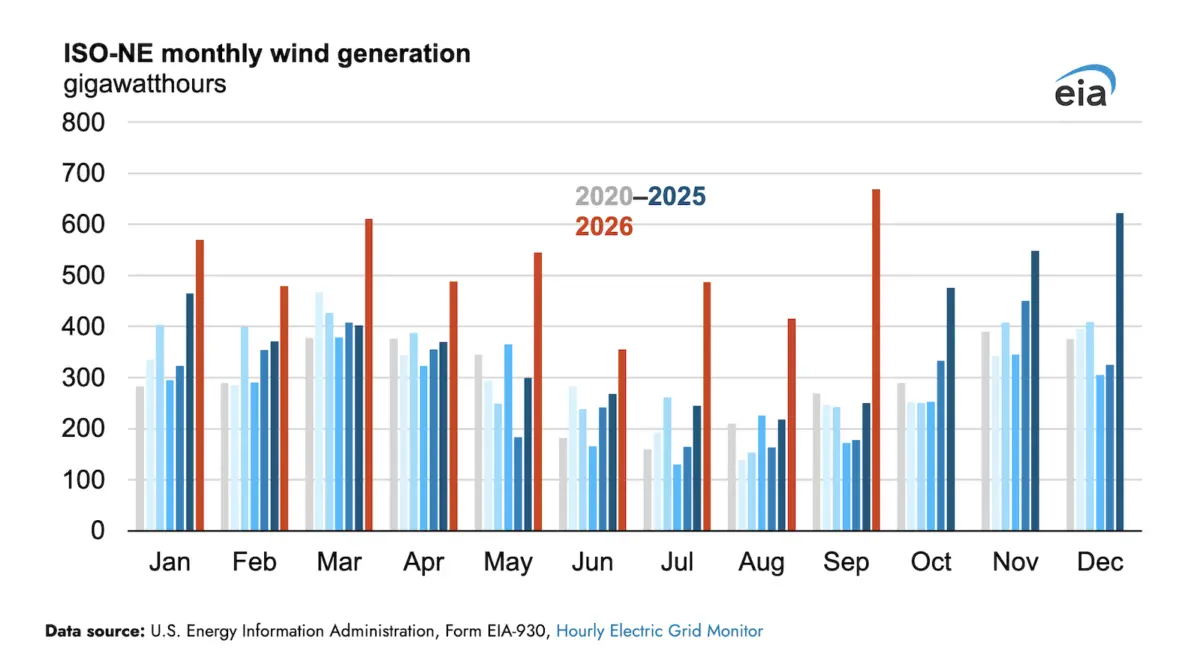
Recent data compiled by the U.S. Energy Information Administration (EIA) and highlighted by regional system operators reveals an extraordinary milestone for clean energy development. During the first nine months of 2026, monthly wind generation within the ISO New England (ISO-NE) grid footprint skyrocketed by an average of 68% compared to the exact same period in 2025.
This remarkable growth is far more than a statistical anomaly; it represents the tangible maturation of long-gestating onshore and offshore wind projects coming online, enhanced transmission interconnectivity, and a regional regulatory framework increasingly aligned with aggressive carbon-reduction mandates. For ISO-NE—a grid operator historically dependent on imported natural gas and constrained by dense populations and limited real estate for large-scale infrastructure—this surge signals a new era. It demonstrates that wind power can rapidly scale to meet regional demand, diversify the energy mix, and provide a formidable bulwark against fossil fuel price volatility.
Detailed Chronology: How New England’s Wind Boom Accelerated
The dramatic 68% surge in wind generation observed through the first three quarters of 2026 did not happen overnight. It is the culmination of years of strategic planning, permitting battles, engineering triumphs, and capital allocation by both public and private entities. Understanding this trajectory requires examining the pivotal milestones that laid the groundwork for this monumental leap.
The Foundation Years (2020–2023): Overcoming Historical Hurdles
Historically, New England lagged behind other U.S. regions in harnessing wind energy. While the geography of northern New England (Maine, in particular) offered substantial onshore wind resources, transmission bottlenecks severely limited how much of that power could be delivered to population centers in southern New England (such as Boston, Providence, and Hartford). Meanwhile, offshore wind development faced a protracted gauntlet of federal environmental reviews, local opposition, supply chain bottlenecks, and shifting state-level procurement strategies.
Between 2020 and 2023, regional stakeholders focused heavily on laying the groundwork to clear these hurdles. State legislatures across Massachusetts, Connecticut, and Rhode Island enacted increasingly stringent net-zero carbon mandates, forcing utilities to issue larger and more frequent long-term solicitations for offshore and land-based wind. Concurrently, regional transmission organizations began prioritizing upgrades to the high-voltage grid to relieve chronic congestion points that had previously forced wind farm operators to curtail their output.
The Turning Point (2024–2025): Construction Peaks and Interconnections
By 2024, several large-scale projects that had been stalled by inflation, pandemic-era supply chain disruptions, and renegotiated power purchase agreements (PPAs) finally cleared financial closing and entered active construction phases.

During 2025, regional grid operators began integrating significant new megawatt capacities. In northern New England, several major onshore expansions came fully online, taking advantage of sophisticated forecasting tools that allowed ISO-NE to manage intermittent supply more dynamically. Simultaneously, early phases of offshore developments began making landfall, proving that the technical challenges of subsea cabling and heavy maritime construction in the choppy North Atlantic could be systematically overcome.
These installations, while still ramping up commercial operations throughout 2025, established a vastly expanded physical footprint compared to previous years.
The Breakout Year (2026): Reaping the Harvest
The compounding effects of these completed projects culminated in the dramatic metrics recorded throughout the first nine months of 2026. With a substantially larger nameplate capacity installed across both land and sea, and benefiting from favorable meteorological conditions during key seasonal windows, wind farms operating within the ISO-NE balancing authority shattered previous generation records month after month.
The 68% year-over-year average increase reflects not just the activation of new turbines, but also improved grid operational efficiency, modernized curtailment management, and a robust transmission backbone capable of moving green electrons from generation sites to load centers with minimal loss.
Supporting Context & Metrics: Analyzing the ISO-NE Data
To fully grasp the significance of the 68% generation increase, one must examine the operational realities of the ISO New England grid, the mechanics of wind resource variability, and the broader macroeconomic context of regional energy markets.
Understanding the ISO-NE Footprint
ISO New England operates the bulk electric power system and administers wholesale electricity markets for six states: Connecticut, Maine, Massachusetts, New Hampshire, Rhode Island, and Vermont. Serving a population of approximately 15 million people, the grid is characterized by several distinct challenges:
- High Reliance on Natural Gas: For years, natural gas has generated upwards of 50% of New England’s electricity. This leaves the region vulnerable to winter gas pipeline constraints and global fuel price spikes.
- Geographic Polarization: The best onshore wind resources are concentrated in the northern states (predominantly Maine), while the vast majority of electricity demand resides in the densely populated southern urban corridors.
- Aggressive Decarbonization Mandates: States like Massachusetts and Connecticut have legally binding requirements to achieve net-zero greenhouse gas emissions by 2050, requiring rapid displacement of fossil-fueled generation.
Deconstructing the 68% Metric
The EIA’s Today in Energy report, featuring analysis by principal contributor Alex Mey, highlights that monthly wind generation in the first three quarters of 2026 averaged nearly double the output levels of the corresponding months in 2025.
Several factors drove this quantitative leap:
- Nameplate Capacity Expansion: The total megawatt (MW) capacity of wind assets connected to the ISO-NE grid grew significantly. Every newly commissioned turbine adds cumulative baseline generation capability, especially during high-wind regimes.
- Capacity Factor Improvements: Modern wind turbine technology features larger rotors, taller towers, and advanced aerodynamics designed to capture lower-speed winds more efficiently. This has driven up the average capacity factors of newer installations.
- Reduced Curtailment: Enhanced transmission pathways reduced instances where grid operators had to order wind farms to shut down due to local transmission overloads, allowing more generated power to reach paying customers.
Macroeconomic and Policy Tailwinds
The regional wind boom is also supported by federal policy frameworks, most notably provisions within the Inflation Reduction Act (IRA), which provided long-term tax certainty, domestic content bonuses, and advanced manufacturing credits for renewable energy infrastructure. These financial mechanisms helped project developers weather the high-interest-rate environment of 2023 and 2024, ensuring that projects scheduled for 2025 and 2026 completions crossed the finish line.
Official Statements and Industry Perspectives
The milestone achievement has drawn reactions from across the energy sector, ranging from system operators and regulatory bodies to environmental advocates and utility executives.
Grid Operators and System Reliability
Representatives from ISO-NE have emphasized that integrating high levels of variable renewable energy requires sophisticated grid management techniques. In technical briefings throughout the year, system planners noted that while the rapid influx of wind generation provides critical zero-emission energy, it also underscores the growing need for flexible resources—such as grid-scale battery energy storage systems (BESS) and fast-ramping peaker plants—to maintain instantaneous supply-demand equilibrium.
"The steady and substantial growth of wind generation in our control area demonstrates the evolving nature of New England’s resource mix," noted a regional grid operations analyst familiar with the EIA data. "Managing this transition successfully requires continuous innovation in forecasting, automated grid controls, and strategic transmission enhancements to ensure reliability is never compromised."
Federal Insights: The EIA Perspective
Alex Mey, the principal contributor of the EIA report highlighting the 68% surge, pointed out that regional generation trends in ISO-NE reflect a broader national movement toward portfolio diversification. While wind development has historically dominated the central plains and parts of the West, the ability of densely populated, transmission-constrained Northeastern markets to accelerate wind deployment proves that geographic constraints can be systematically overcome with coordinated policy and engineering execution.
Clean Energy Advocates
Environmental and clean energy trade associations have lauded the figures as proof positive that regional decarbonization strategies are yielding measurable results.

"A 68% year-over-year increase in wind generation is not just a win for climate metrics; it is a major victory for New England consumers," said a spokesperson for a regional renewable energy coalition. "Every megawatt-hour of wind that hits the grid displaces expensive, volatile fossil fuels, stabilizes wholesale electricity prices, and cleans our air. This proves that when we commit to building clean infrastructure, the results exceed expectations."
Future Outlook: What’s Next for New England Wind?
While the 68% increase in wind generation through the first nine months of 2026 is an undeniable triumph, it represents a waypoint rather than a destination. The trajectory of New England’s power sector over the next decade will depend on how effectively regional stakeholders address the next wave of opportunities and challenges.
Overcoming Remaining Transmission Bottlenecks
The single greatest challenge facing New England’s wind ambitions remains transmission infrastructure. As additional onshore projects in Maine and massive offshore wind arrays off the coasts of Massachusetts, Rhode Island, and Connecticut move toward commercial operation, the existing high-voltage transmission grid will face unprecedented stress.
Future success hinges on the completion of major regional transmission initiatives designed to transport bulk renewable power from remote generation zones directly into major load centers. Without these upgrades, the risk of renewable energy curtailment will rise, potentially capping the economic and environmental benefits of new installations.
The Role of Offshore Wind Integration
While onshore wind has provided immediate gains in 2026, the long-term decarbonization of New England relies heavily on the maturation of the offshore wind sector. The Atlantic coastline adjacent to New England boasts some of the strongest and most consistent wind resources in the world. As multi-gigawatt offshore projects progress through their construction and interconnection phases over the late 2020s and early 2030s, they are expected to dwarf current generation figures, providing massive blocks of clean power precisely where regional population density is highest.
Balancing Intermittency with Storage
As wind and solar penetration climbs toward 50% and beyond on the ISO-NE grid, the management of resource intermittency will become increasingly paramount. The future grid will require massive expansions in energy storage capacity—particularly four-hour and multi-day lithium-ion and alternative storage technologies—to capture excess generation during peak wind events and discharge it during high-demand, low-wind periods.
Conclusion
The news that wind generation in ISO New England surged by an average of 68% during the first nine months of 2026 marks a watershed moment for the region. It validates years of policy persistence, financial investment, and engineering ingenuity. As New England continues to build out its onshore and offshore wind capabilities, modernize its transmission backbone, and integrate advanced storage solutions, the region is proving that a clean, secure, and resilient energy future is not merely an aspirational goal, but an unfolding reality.