








The global maritime sector’s transition toward zero-emission mobility reaches a major milestone this week as the 7th edition of the Venice Boat Show (Salone Nautica Venezia) opens its gates. Running from Wednesday, May 27th through Sunday, May 31st, 2026, the exhibition takes over the historic Arsenale complex—a sprawling architectural marvel where a workforce of 2,000 once churned out a warship a day during the height of Venice’s five-century reign as a maritime empire.

Today, the centuries-old stone docks of La Serenissima are serving as a high-tech stage for the cutting edge of electric propulsion. From ultra-dense solid-state batteries and high-voltage automotive-derived drivetrains to hydrofoiling passenger ferries and high-speed charging infrastructure, the 2026 show proves that electric boating has graduated from niche experimentation to mainstream commercial viability.

This comprehensive guide details the key highlights, foundational joint ventures, and technological breakthroughs on display across the Arsenale, mapping out how the old world of Venetian shipbuilding is anchoring the future of clean marine technology.

Detailed Chronology: Key Events of the 2026 Venice Boat Show
The five-day event follows a carefully structured schedule designed to balance industry networking, public engagement, and technological demonstrations:

- Wednesday, May 27th (Opening Day): The 7th edition of Salone Nautica Venezia officially opens to dignitaries, international press, and trade professionals. Exhibitors unveil their newest electric hulls, motors, and energy management systems along the historic docks.
- Friday, May 29th (The Green Parade): A central highlight of the exhibition calendar, the Green Parade takes center stage. A fleet of electric sailboats, powerboats, and commercial vessels cruises in a silent procession through the famous, delicate canals of Venice, demonstrating zero-emission, wave-free navigation in a sensitive urban ecosystem.
- Friday, May 29th – Sunday, May 31st: A dedicated three-day showcase highlights electric sailboats, powerboats, water toys, jet skis, and advanced powertrain components.
- Sunday, May 31st (Closing & Awards): The event concludes with the presentation of the annual Venice Boat Show awards, recognizing excellence in design, engineering, and sustainability across multiple marine sectors.
Infrastructure and Powering the Future: Aqua superPower
A technological transition of this scale requires robust, reliable infrastructure. Enter AQUA superPower, which is supplying two heavy-duty, high-speed chargers situated directly on the P2 Pontoon of the Arsenale complex.

AQUA superPower is recognized globally as the first fully marinized dockside network of fast-charging stations purpose-built for electric vessels. Powered by its proprietary cloud-based Neptune platform, the system combines heavy-duty charging hardware, intelligent network load management, and 24/7 customer support.

By establishing a reliable charging ecosystem for marinas, yacht clubs, ports, and commercial operators, AQUA superPower is systematically removing the "range anxiety" that has historically hindered the widespread adoption of electric marine mobility.

Electric Sailboats: The E-Lektra Revolution
One of the most consequential developments heading into the Venice Boat Show is the quiet, seismic shift occurring in the auxiliary propulsion market for sailboats.

The E-Lektra Joint Venture
Just last month (April 2026), two of the world’s largest sailboat builders—Groupe Beneteau and the Fountaine Pajot Group—announced the creation of E-Lektra Marine, a 50/50 joint venture dedicated to standardizing electric and hybrid propulsion systems for sailboat manufacturers.

The E-Lektra technology delivers fully electric or hybrid packages tailored for sailboats ranging from 9 to 24 meters (29 to 80 feet). The platform integrates motors, battery banks, generators, and comprehensive energy-management software to intelligently handle inputs and outputs from solar arrays, hydrogeneration, shore power, and onboard "hotel loads."

Crucially, E-Lektra’s initial customer base encompasses seven major brands exhibiting at Venice that collectively represent 60% of the global sailboat market: Beneteau, Fountaine Pajot Sailing Catamarans, Fountaine Pajot Yachts, Dufour, Excess, Jeanneau, and Lagoon.

Selected Sailboat Highlights at Venice
- Bavaria Yachts – C42e: Founded in Germany in 1978, Bavaria Yachts introduced its E-Line of electric sailboats under a partnership with Denmark’s EPTechnologies. The C38, C42, and C46 models are now available with advanced electric/hybrid drivetrains. The C42e features an efficient saildrive linked to a 25kW electric motor, powered by an 18.2 kWh battery bank (expandable) that yields over 50 nautical miles of pure electric range.
- Beneteau – Oceanis 34.1 (E-Lektra System): Designed by Marc Lombard and NAUTA Design, this sleek monohull combines a light displacement, optimized sail area, and an un-cluttered cockpit layout with Beneteau’s newest electric capabilities.
- Dufour – 37 & 44 (E-Lektra System): A luxury builder for over six decades, Dufour integrates hydro-generation and solar arrays into nearly its entire model lineup. Showcased locally via Eurosail Yacht, these vessels cater to everything from coastal family cruising to long-range blue-water voyaging.
- Excess Catamarans – Excess 11 (E-Lektra System): Known for merging racing responsiveness with cruising comfort, the VPLP-designed Excess 11 acts as a beacon for sustainable multihull performance at the Venice show.
- Lagoon – Lagoon 38 (E-Lektra System): Winner of multiple international accolades, including Multihull of the Year 2026 (Under 45ft), the Lagoon 38 optimizes space, modular layout, and energy efficiency.
- Nautor Swan – Swan 48: Representing the pinnacle of sailing luxury, Nautor Swan’s dual-energy systems (featuring Oceanvolt propulsion and hydro-generation) push the envelope of aerodynamic and hydrodynamic efficiency.
- Sunreef – Sunreef 70: Sunreef brings its groundbreaking Solar Skin 3.0 technology to Venice. Solar cells are seamlessly embedded directly into the composite hull material, featuring individual RFID chips that dynamically optimize energy harvesting in real-time, even when shaded by sails or superstructures.
Electric Powerboats and Commercial Vessels
While sailboats utilize wind for primary propulsion, the powerboat and commercial sectors rely entirely on high-capacity battery storage and high-output electric motors.

Axopar and the AX/E Line
Axopar, one of the fastest-growing adventure boat brands in the world, has doubled down on its AX/E electric line powered by Evoy motors. The AX/E 22 utilizes the Evoy Outboard Breeze (90 kW continuous, 137 kW peak), while the larger AX/E 25 mounts the Evoy Storm+ (225 kW continuous, 450 kW peak / ~610 hp), capable of thrilling top speeds of 50 knots (57 mph).

Belisama Yachts – Cybercat
A truly innovative concept originating in Italy, the Cybercat is a modular catamaran built from fully recyclable marine aluminum. Designed for both cargo logistics and passenger transport in fragile lagoon ecosystems, it utilizes eco-friendly interior materials, standard solar integration, and Yamaha Harmo electric motors.

Frauscher X Porsche – 790 Spectre
Following the award-winning success of the 850 Fantom Air, Frauscher and Porsche return with the debut of the 790 Spectre. Utilizing the high-voltage drive components of the Porsche Macan Electric SUV, this 7.93-meter runabout delivers 170 kW continuous power (400 kW peak), a comfortable cruising speed of 22 knots, and a blistering top speed of 51 knots (95 km/h).

Greenline – Greenline 42
A pioneer in hybrid boating since 2008, Greenline showcases the brand-new Greenline 42 in-water at Venice. Designed in collaboration with Micad and Marco Casali, it features an optimized hull capable of 30-knot top speeds and a solar roof equipped with 10 panels delivering 4kWp of clean generation capacity.

Helios – Omega 7.2
Fresh off a successful Initial Public Offering (raising nearly €2.5M and achieving a valuation of ~€21M on the Bulgarian Stock Exchange), Helios exhibits its award-winning Omega 7.2 day cruiser. Featuring vertically integrated LFP batteries, CCS1 fast-charging ports, and the proprietary Helios Marine Link IoT control module, the Omega represents the state-of-the-art in smart, connected electric day-cruising.

MobyFly – MBFY-S Premier
For commercial operators, MobyFly displays its 12-meter zero-emission hydrofoil passenger shuttle. Capable of carrying up to 12 passengers at speeds exceeding 60 km/h while consuming 70% less energy than a traditional diesel ferry—and generating zero wake—the MBFY-S provides a blueprint for sustainable public water transport.

Electric Water Toys, Jet Skis, and Components
The exhibition floors also highlight personal mobility and propulsion engineering:

- MoJet: A modular electric water toy system featuring a central 90cm jet unit capable of producing 100 kg of thrust and speeds up to 55 km/h, easily adaptable into a jetboard, tender, or diving scooter.
- Taiga – Orca: Adapting winter-proven snowmobile battery tech for marine environments, Taiga’s electric personal watercraft feature enhanced thermal management systems that boost continuous battery output by up to 65% in warm waters.
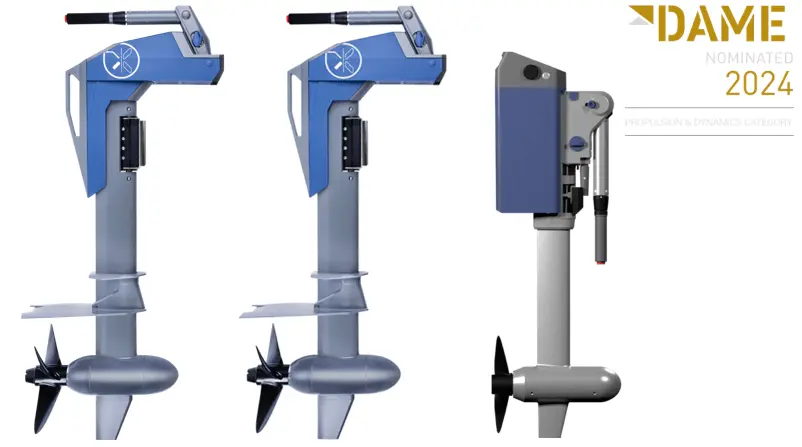
- Momentum: Founded by aerospace and naval engineers, Momentum highlights its compact electric outboard lineup (ranging from the U2 2.5kW up to the M-10 10kW motor), built explicitly to withstand punishing real-world marine conditions.
- Sealence – Solid-State Battery Tech: Sealence is turning heads with its proprietary DeepSpeed electric hydrojet powertrains and a revolutionary solid-state marine battery pack boasting an energy density of 245 Watt-hours per kilogram—matching individual cell densities while incorporating all structural and thermal coverings into a 75 kWh pack designed for larger vessels.
Future Outlook
As the 7th Venice Boat Show draws to a close on Sunday, May 31st, the overarching message from the Arsenale is clear: electric propulsion is no longer an alternative novelty; it is the dominant trajectory of the global marine industry.

Driven by massive OEM collaborations like the E-Lektra Marine joint venture, automotive cross-pollination (Porsche and Evoy), and leaps in battery chemistry (Sealence), the hurdles of range, infrastructure, and performance are rapidly dissolving. In a city built upon the water, Venice once again proves that honoring historical maritime mastery requires aggressively engineering a clean, silent, and sustainable future.